RTT Advantages for Expats: Fast, Targeted Relief


Rapid Transformational Therapy’s main advantage is speed: many clients report meaningful change within a few sessions for issues like anxiety, burnout, trauma, and sleep problems that traditional weekly therapy can take months to address. Developed by British therapist Marisa Peer, RTT combines hypnotherapy, CBT-style reframing, and NLP-informed techniques into a focused, time-limited model that works both in-person and online. Hesketherapy in Madrid offers RTT in English, Spanish, and Dutch, making it particularly accessible for expats navigating mental health care in a second language.
The core advantages of RTT, in brief:
Speed: Targeted results often within a few sessions rather than months of weekly appointments
Subconscious belief change: Sessions access and reframe the root beliefs driving anxiety, burnout, or insomnia
Bespoke audio consolidation: Every client receives a personalized recording to reinforce change daily for roughly three weeks
Flexible delivery: Sessions run in-person in Madrid or fully online, with no disruption to your schedule
RTT’s primary strength is that it works at the level where many problems actually live: the subconscious beliefs formed long before you had the language to question them. Changing those beliefs directly, rather than managing symptoms at the surface, is what makes rapid results possible.
One honest caveat: RTT is a promising but under-researched modality compared with therapies backed by large randomized controlled trials. The evidence base is growing, but it is not yet at the level of CBT or EMDR for most conditions.
Key Takeaways
RTT’s primary advantage is that it targets subconscious beliefs directly, often producing meaningful change within a few sessions, with a 21-day bespoke audio protocol consolidating results between appointments.
Point | Details |
Speed of results | Many clients report meaningful change within a few sessions, not months of weekly appointments. |
Belief-level focus | RTT targets subconscious root beliefs, not just surface symptoms, making it suited for anxiety, burnout, and insomnia. |
Evidence limitations | Practitioner reports are promising, but RTT lacks large-scale independent randomized controlled trials as a distinct package. |
Session structure | Each session runs 90–120 minutes; aftercare includes a personalized audio recording to listen to daily for 21 days. |
Hesketherapy | Offers licensed, English-language RTT in Madrid and online, integrated with EMDR and CBT as needed, at €600/month for a three-month plan. |
Table of Contents
How RTT works: a clinical overview
RTT is a hybrid therapeutic approach that Marisa Peer developed by drawing on hypnotherapy, cognitive behavioral techniques, and NLP-informed language patterns. The goal is to access subconscious beliefs formed in early life, reframe them during an intensive session, and then consolidate that reframing through daily audio practice.
A typical session runs 90–120 minutes and moves through four stages:
Induction: Guided relaxation brings the client into a focused, receptive state
Regression and exploration: The therapist guides the client to revisit memories or scenes connected to the presenting problem
Reframing: Beliefs identified during regression are actively challenged and replaced with more adaptive ones
Bespoke audio recording: The therapist creates a personalized recording the client listens to daily, usually for 21 days, to reinforce the session’s work
RTT targets what its model calls subconscious drivers: the internal rules and meanings attached to early experiences that continue to shape adult behavior. The intended mechanism is neuroplastic consolidation via repeated audio exposure after the session. Sessions are delivered by trained, licensed therapists and are available both in-person and online.
The core advantages of RTT, explained
1. Results often arrive in a few sessions
For many clients, RTT produces meaningful shifts within a few sessions rather than the months typical of weekly talk therapy. For an expat with a demanding job and limited time, that compression matters. A client dealing with performance anxiety before a high-stakes presentation, for example, may complete a single breakthrough session and notice a shift within days.

2. It targets belief-level change, not just symptom management
RTT works at the subconscious level where many anxiety, burnout, and sleep problems originate. Rather than teaching coping strategies for symptoms, the session aims to change the underlying belief producing them. Someone whose burnout is driven by an internal rule that rest equals failure, for instance, can address that rule directly rather than managing exhaustion indefinitely.
3. The bespoke audio recording extends the session’s reach
Every RTT client receives a personalized audio recording created during their session. Listening daily for roughly 21 days is central to the model’s consolidation protocol, according to proponents of the method. This means the therapeutic work continues between appointments without requiring weekly check-ins, which suits clients who travel frequently or work across time zones.
4. It integrates well with other clinical approaches
RTT is not a standalone system for every client. Its real strength for complex presentations is how cleanly it pairs with EMDR for trauma processing, CBT for behavioral change, or counseling for relational issues. A licensed clinician can sequence these approaches based on what you need, rather than committing you to a single-method protocol.
5. Online delivery is fully effective
Unlike some somatic therapies that require physical presence, RTT translates well to video sessions. For expats in Madrid who relocate mid-treatment, or for those living outside the city, online continuity means you do not lose momentum when life moves.
6. Cost efficiency compared with open-ended therapy
A 1–3 session model with aftercare audio is significantly more cost-contained than years of weekly appointments. For clients who need focused, time-limited care rather than ongoing support, RTT can deliver substantial value per session.
Pro Tip: Before your RTT session, spend ten minutes writing down the specific belief or feeling you want to address, not just the symptom. “I feel anxious” is a symptom; “I believe I am not safe unless I am in control” is a belief. Arriving with that clarity helps your therapist guide the regression more precisely.
A note on evidence: Many clients report change within a few sessions, and practitioner surveys consistently describe positive outcomes. However, RTT as a distinct package lacks large-scale independent randomized controlled trials. These reports are promising, not conclusive.
Evidence, limitations, and when to choose other care
The evidence picture for RTT is mixed in a specific way. A 2026 publication describes RTT as a hybrid of hypnotherapy, CBT, and NLP, notes rapid effects reported within one to three sessions, and explicitly flags a lack of high-quality independent trials. That is the honest summary: strong practitioner and client reports, limited controlled-trial validation.
The component techniques have a stronger evidence base. Hypnotic-augmented CBT has accumulating meta-analytic support for anxiety, phobias, and pain, which helps explain why RTT’s combination may produce clinical benefit even without direct RCTs of the full package. The same Neurolaunch overview notes that RTT may work partly by amplifying common therapeutic factors: a strong alliance, focused expectation of benefit, and intense emotional engagement.
RTT is not a replacement for evidence-based care in every situation. For active psychosis, unmanaged severe dissociation, or high suicide risk, RTT alone is not appropriate. A licensed clinician should always assess suitability before beginning.
Contraindications and cautions to know:
Active psychosis or severe dissociation: Regression-based work can destabilize these presentations
Medication review needed: Clients on psychiatric medication should inform their prescriber before starting
Complex PTSD: May benefit from RTT integrated with EMDR or trauma-focused CBT rather than RTT alone
High suicide risk: Requires a full clinical safety plan and likely a higher level of care first
The ResearchGate publication explicitly recommends that licensed therapists deliver RTT and calls for prospective randomized studies to establish long-term efficacy.
What a typical RTT session looks like
Knowing the structure before you book removes a lot of the uncertainty. Here is the usual sequence:
Intake and consent: Your therapist reviews your history, explains the process, and confirms suitability
Induction: Guided relaxation, usually 10–15 minutes, brings you into a focused state
Regression and exploration: You revisit scenes or memories connected to your issue, guided by the therapist
Reframing: The therapist works with you to reinterpret those scenes and replace limiting beliefs
Bespoke recording creation: The therapist records a personalized audio track for your daily use
Integration and close: Brief grounding, questions, and aftercare instructions
The full session runs 90–120 minutes. Most clients complete one to three sessions total, with the 21-day audio protocol running after each one.
Aftercare recommendations:
Listen to your bespoke recording daily for at least 21 days
Keep a short journal of shifts you notice in thoughts, feelings, or behaviors
Schedule a follow-up appointment at the 3–4 week mark to review progress
If emotional intensity feels high in the days after a session, contact your therapist rather than waiting
Sessions can be emotionally intense. A skilled therapist maintains containment throughout, offers breaks when needed, and provides integration support if difficult material surfaces.
Who RTT tends to help most
RTT is commonly used for a range of presenting issues. Responsiveness varies by condition:
Anxiety and panic: Often responds well, particularly when a specific triggering belief can be identified
Phobias: Single-session resolution is frequently reported for simple phobias
Low self-worth and confidence: A core RTT use-case; belief-level work is well-suited here
Burnout: RTT can access subconscious drivers of overwork and reframe the internal rules that make rest feel unsafe, though behavioral habit work helps cement lasting change
Insomnia: Sleep-related anxiety and hyperarousal often respond within a few sessions
Trauma-related beliefs: RTT can address specific trauma-linked meanings, though complex PTSD benefits from integrated care
Habit change (smoking, overeating): Habit-driven issues with a clear emotional root tend to respond quickly
Who may not be right for RTT alone: clients with severe personality disorders, active psychosis, or high suicide risk need integrated clinical pathways. RTT can be part of a broader plan, but it should not be the only intervention in those cases.
How to choose a qualified RTT therapist in Spain
Credentials matter more in RTT than in some modalities because the regression work is intensive. Ask these questions before booking:
Do you hold a clinical license or registration in Spain (or your country of practice)?
What is your RTT training and certification, and who provided it?
How many clients have you treated for my specific issue?
What languages do you offer sessions in?
What does your aftercare protocol look like, and how is the audio recording delivered?
Trust signals to look for: a documented clinical license, verified RTT practitioner training, a clear session structure, bespoke audio recordings as standard, written consent and a safety plan, and client testimonials that preserve confidentiality.
Red flags: guarantees of cure, no clinical license, pressure to purchase many sessions upfront without an assessment, no aftercare plan, or reluctance to discuss contraindications.
In Spain, psychologists are regulated under the Colegio Oficial de Psicólogos. Ask your therapist for their collegiate number and verify it if you want additional assurance. If you plan to seek insurance reimbursement, ask for a factura (official receipt) at booking.
Pro Tip: Ask for a short pre-session consultation, even 15–20 minutes by video. A therapist who is right for you will welcome that conversation and use it to assess fit, not just sell you a package.
Practicalities for expats in Madrid and online
For English-speaking expats, the logistics of finding qualified care in a second language are a real barrier. Here is what to know:
In-person in Madrid: English-language RTT sessions are available at practices like Hesketherapy, which also offers Spanish and Dutch. Sessions run 90–120 minutes; plan for travel time and some recovery space afterward
Online sessions: Fully effective for RTT and ideal for clients who travel, live outside Madrid, or want continuity during relocation. Scheduling across European time zones is generally straightforward
Cost shape: RTT breakthrough sessions are priced per session or in packages. Hesketherapy’s model involves a three-month engagement at €600/month, which covers integrated therapy including RTT, EMDR, and CBT as clinically indicated
Insurance: Private health insurance in Spain rarely covers psychotherapy directly; ask your insurer about reimbursement for psicología clínica and request official receipts from your therapist
Booking: Ask about a free discovery call before committing, confirm the audio recording delivery method (email or secure link), and clarify the cancellation policy
Why I offer RTT to English-speaking expats in Madrid
Expats face a specific set of pressures: relocation stress, cultural adjustment, professional performance in a second language, and often a support network that is still being rebuilt. What I see repeatedly is that these pressures do not just create surface-level stress. They activate older beliefs about safety, belonging, and self-worth that were already there.
RTT fits this population well because it is time-limited, works in English, and goes directly to the belief level rather than spending months building toward it. I integrate it with EMDR when trauma is present and with CBT when behavioral patterns need structured work. The bespoke audio recording means clients continue making progress between sessions, which matters when life is busy and appointments are hard to schedule. My practice is licensed, multilingual, and built specifically for the international community in Madrid and online.
RTT sessions with Hesketherapy in Madrid and online
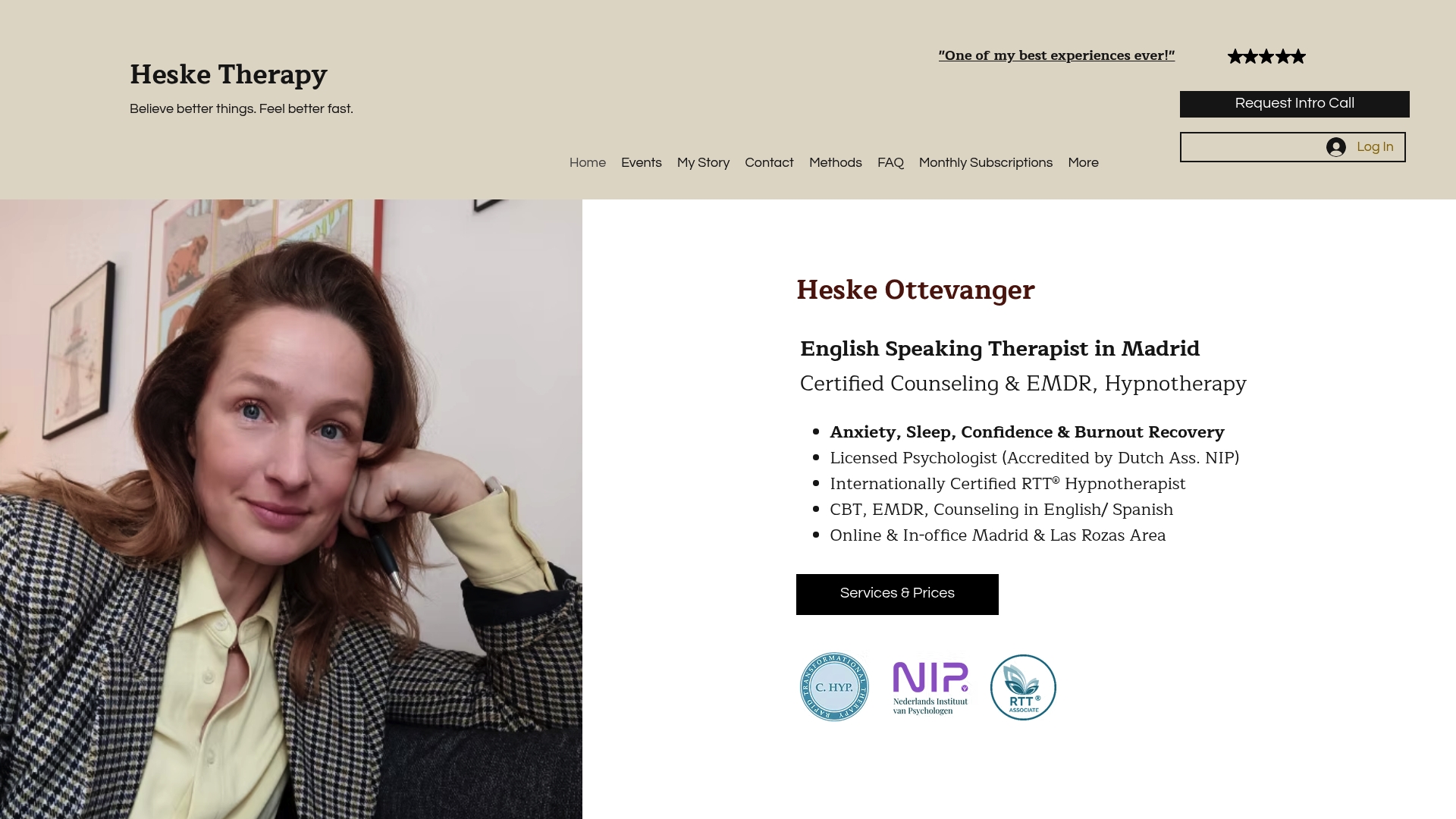
Hesketherapy offers English-language RTT sessions in Madrid and online, delivered by a licensed clinician with training across RTT, EMDR, and CBT. The model is built for expats who need focused, effective care without a year-long commitment: typically 1–3 RTT breakthrough sessions, each 90–120 minutes, with a bespoke audio recording and structured aftercare included.
Sessions are available in English, Spanish, and Dutch. The engagement fee covers a multi-month integrated therapy plan tailored to your presenting issue, whether that is anxiety, burnout, trauma, or sleep. A free discovery call is the first step: you describe what you are dealing with, and together you decide whether RTT, EMDR, CBT, or a combination is the right fit.
To book your discovery call or learn more about RTT and online therapy options, visit the Hesketherapy Madrid service page or reach out directly through the website.
Sources
This article is general information, not a substitute for advice from a qualified doctor. Consult a qualified healthcare professional about your own circumstances before acting on anything here.
Recommended
Comments