Overcoming Fear of Public Speaking in English: A Therapy Guide

Yes. Evidence-based psychotherapy can substantially reduce fear of public speaking in English, and you don’t need to white-knuckle your way through the next meeting to prove it. A meta-analysis of 30 randomized trials found that psychological interventions produce a large effect on this specific fear, with gains that keep growing after treatment ends.
If your heart races days before a presentation, if you’ve turned down speaking roles at work, or if rehearsing your English keeps you up at night, that’s not a personality quirk. That’s glossophobia, and it responds to treatment the way most anxiety disorders do.
Frequency check: if avoidance happens more than occasionally and shapes your career choices, therapy is appropriate now.
Interference check: if it disrupts sleep, work performance, or social life, waiting rarely helps on its own.
Quick fact: Treatment effects for fear of public speaking average a Hedges’ g of 0.74, a substantial reduction by clinical standards. Book a discovery session with an English-speaking therapist this week, whether online or in Madrid, and start there.
Key Takeaways
Evidence-based psychotherapy, particularly CBT with graded exposure, produces large and durable reductions in fear of public speaking, including in a second language.
Point | Details |
Treatment works | Psychological interventions produce a substantial average effect that grows stronger at follow-up. |
Delivery mode is flexible | VRET and in-person exposure both produce large reductions, so online therapy is a legitimate option for expats. |
Sessions are structured, not endless | Common frameworks run around eight sessions, though brief single-session formats exist for milder cases. |
Language triggers need direct attention | Accent scrutiny and self-monitoring in English are specific mechanisms generic anxiety treatment often misses. |
Heske Therapy treats this directly | Integrative RTT, EMDR, CBT, and hypnotherapy delivered in English, online or in Madrid, with plans built around real work scenarios. |
This article is general information, not a substitute for advice from a qualified doctor. Consult a qualified healthcare professional about your own circumstances before acting on anything here.
Table of Contents
Does Therapy Really Help You Speak in Public in English?
The short answer, backed by real numbers, is yes. The same meta-analysis tracked 62 interventions across 1,355 participants and found the overall effect held up at g = 0.74, with follow-up benefits climbing to g = 1.11. That second figure matters more than people realize.
Anxiety treatment for public speaking doesn’t just work in the room. It keeps improving for months afterward, a pattern researchers call the sleeper effect, where skills and confidence continue consolidating long after sessions stop.
Delivery mode matters less than most people assume. A separate meta-analysis of 11 studies covering 508 participants found virtual reality exposure therapy (VRET) produced a large effect size of −1.39, nearly matching traditional in-person exposure at −1.41. In-person exposure edges out VR slightly, but the gap is small enough that access and comfort often matter more than which format wins on paper.
There’s a nuance worth understanding before you pick a modality: therapy affects how you feel and how you perform, and those aren’t always the same measurement. Traditional cognitive behavioral therapy (tCBT) tends to reduce subjective anxiety, the racing heart and dread, more sharply. Acceptance-based approaches sometimes produce better observer-rated performance, meaning you may still feel nervous but come across as composed and clear to your audience. Neither is universally superior. The right choice depends on whether your primary goal is feeling calmer or performing better in the moment, and a skilled clinician will ask which matters more to you before building your plan.
Technology-assisted formats, whether internet-delivered sessions or VR headsets, perform comparably to face-to-face therapy for this specific fear, which is good news if you’re managing an expat schedule across time zones.
What Therapy Approaches Treat Fear of Public Speaking in English?
Most effective treatment for glossophobia centers on exposure, but the frameworks around that exposure vary.
CBT with graded exposure builds a hierarchy, starting with low-stakes tasks like reading aloud alone, moving toward mock presentations, then real meetings, each step reinforced with cognitive work that challenges catastrophic predictions.
Acceptance-based behavioral treatment (ABBT) skips the effort to eliminate anxious feelings and instead trains you to perform well alongside them, which research suggests can improve observer-rated performance even when subjective nerves persist.
EMDR is often introduced when a specific memory, like a humiliating mispronunciation in a meeting, keeps resurfacing and blocking progress.
RTT and hypnotherapy work well as integrative additions when anxiety is tangled with deeper self-esteem or identity issues tied to speaking a second language.
Pro Tip: Ask your therapist which delivery mode they’ll use for exposure work. VRET can substitute for real-world practice when travel, scheduling, or privacy make in vivo exposure impractical, and the evidence shows it holds up nearly as well.
How Many Sessions Does Public Speaking Therapy Take?
Treatment length depends on severity, but published frameworks give you real benchmarks to plan around.
Eight-session protocols are common in clinical trials. One open trial pairing CBT with VR exposure used four anxiety-management sessions followed by four exposure sessions, with self-reported anxiety reductions holding steady at three-month follow-up.
Brief single-session interventions have also been tested. Some exploratory trials used one 90-minute session comparing acceptance-based and traditional CBT formats, measuring both observer-rated performance and self-reported anxiety before and after.
Longer integrative plans are typical when public speaking fear sits alongside broader social anxiety, past trauma, or chronic stress, since the exposure work needs a foundation of trust and stabilization first.
Improvements rarely arrive all at once. Most people notice initial shifts within the first few sessions, but the biggest jump often shows up weeks after treatment wraps, the sleeper effect described earlier at work again. If your goal is simply feeling less shaky before a client call, expect a shorter, more targeted plan. If you’re dealing with a longstanding pattern of avoidance tied to how you’re perceived as a non-native speaker, a more layered plan tends to serve you better.
How Do You Choose the Right Therapist for This?
Not every therapist is equipped to treat language-specific speaking anxiety, so screen carefully before booking a package.
Confirm clinical licensure and a stated evidence-based approach, not just “confidence coaching.”
Verify fluent English, since nuance gets lost when you’re describing anxiety in a second language during your own sessions.
Ask about direct expat experience, since the triggers around accent scrutiny and workplace perception differ from general social anxiety.
Check whether they offer both online and in-office sessions and whether they provide documentation for insurance reimbursement.
On the discovery call itself, ask these directly:
Which modalities do you use for public speaking fear specifically, and why?
Have you worked with VR exposure tools, and would you recommend them for my situation?
What’s a realistic session count for someone at my level of severity?
What’s your cancellation and rescheduling policy?
A red flag worth noting: any provider who promises a permanent fix in one session without ever describing an actual method. Real treatment involves structure, even when it’s brief.
What Can You Do Right Now to Start Improving?
You don’t have to wait for your first appointment to begin building tolerance.
Practice paced breathing for two minutes before any speaking task, four seconds in, six seconds out.
Record a one-minute talk on your phone daily this week and watch it back once, without judgment.
Rehearse in front of one trusted person before scaling to a group.
Join a low-stakes practice setting, like a casual expat meetup, before tackling a high-pressure work presentation.
Keep a short log of triggers and specific incidents (what was said, what you feared, what actually happened) so you walk into your first session with material instead of vague dread. If sessions will be online, test your microphone, camera, and internet connection beforehand, and pick a private space where you won’t be interrupted.
Pro Tip: Practical steps like rehearsal and controlled breathing help in the short term, but clinical guidance is clear that professional CBT is the recommended path when fear is severe or interferes with daily functioning.
Why Speaking English in Public Feels Different for Expats
Public speaking anxiety compounds when the language itself isn’t your first one. It’s not just nerves about the message. It’s nerves about the mechanics, whether your accent will be judged, whether a wrong preposition will derail your point, whether the audience is quietly translating your grammar instead of listening to your content.
This creates a specific psychological loop. You rehearse the content, then rehearse the language, then monitor your own delivery in real time while speaking, a kind of triple cognitive load that native speakers rarely experience. That extra processing burden is often why expats report freezing mid-sentence even when they know the material cold.
There’s also a social dimension particular to expat life. Many international professionals speak fluent, functional English daily but still feel like impostors in front of a room, especially if their accent draws comment or if past experiences included correction or mockery. That history doesn’t fade on its own. It needs to be named and worked through, which is exactly why therapists treating this population should ask directly about language-related triggers, like fear of mispronunciation or accent scrutiny, and build exposure tasks around real situations you’ll actually face: team meetings, client calls, Q&A sessions.
How to Build Real Fluency and Confidence for Speaking
Confidence and fluency reinforce each other, and neither improves through avoidance. A few strategies consistently move the needle.
Slow down deliberately. Nervous speakers speed up, which increases mispronunciation and breathlessness. Practicing at 80% of your natural pace gives your brain room to retrieve words without panic.
Rehearse out loud, not silently. Reading a script in your head feels fluent. Saying it aloud exposes the actual friction points, the phrases that trip your tongue, the transitions that feel awkward.
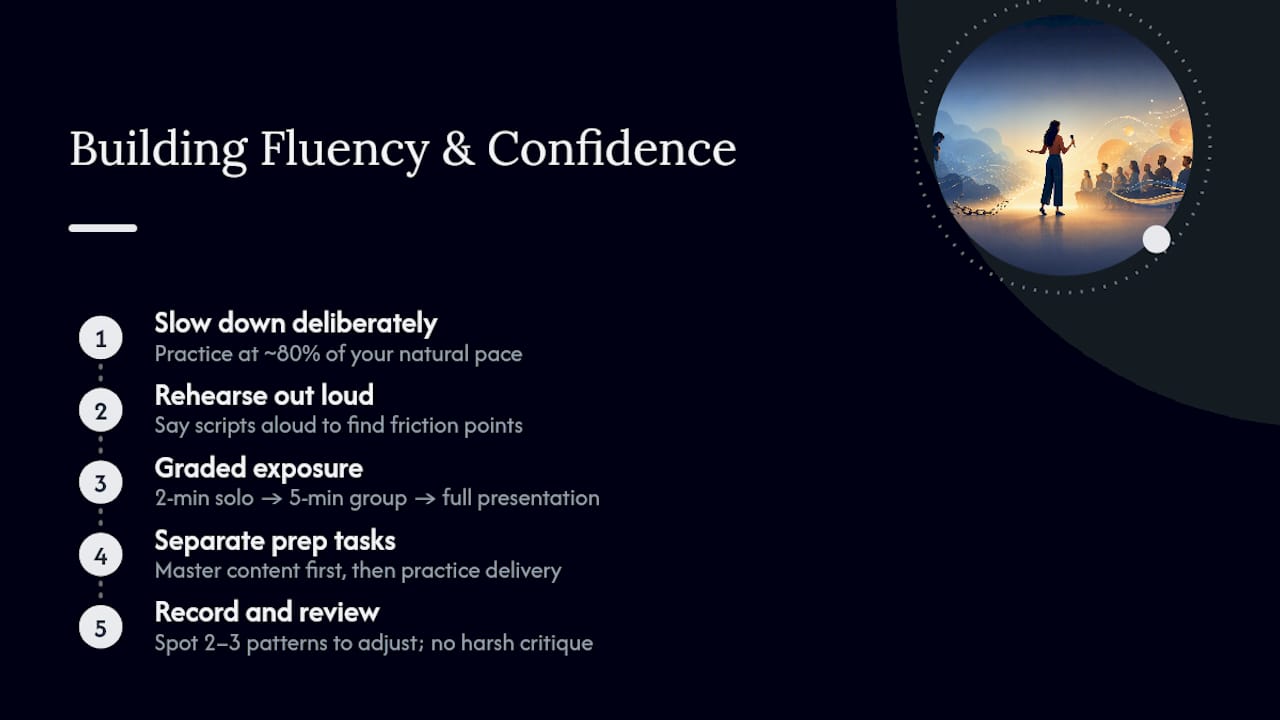
Use graded exposure instead of avoidance. Start with a two-minute update to one colleague, then a five-minute update to three colleagues, then a full team presentation. This mirrors the hierarchy structure used in CBT-based exposure treatment and builds tolerance incrementally rather than forcing a leap.
Separate content prep from delivery prep. Know your material so well you could explain it in your native language, then focus your English practice purely on delivery: pacing, pausing, emphasis. Splitting these tasks reduces the cognitive overload described earlier.

Record and review without self-criticism. The goal isn’t perfection. It’s identifying two or three specific patterns to adjust, not a full teardown of your speaking style.
What Pronunciation Errors Trip Up Public Speakers Most?
Certain pronunciation patterns cause outsized anxiety because they’re highly noticeable to English-speaking audiences, even when they don’t affect comprehension.
Word stress placement trips up speakers from syllable-timed languages (Spanish, French, Japanese) more than sound errors do, since English relies heavily on stress to convey meaning.
Final consonant dropping, common among speakers of languages with more open syllable structures, can make words sound clipped or unfinished to native ears.
The “th” sounds (as in “think” and “this”) are frequently substituted with /s/, /z/, /t/, or /d/, and while usually understandable, they’re often what nervous speakers fixate on.
Vowel length confusion, especially between short and long vowel pairs like “ship” and “sheep,” can occasionally shift meaning entirely.
None of these errors are character flaws, and none require eliminating your accent, which isn’t a realistic or necessary goal. The anxiety usually isn’t about being misunderstood. It’s about being judged, and that’s a therapeutic issue as much as a linguistic one. Working with a clinician who understands this distinction prevents sessions from turning into unwanted accent-reduction coaching when what you actually need is anxiety treatment.
Do English-Speaking Audiences Expect a Different Speaking Style?
Cultural expectations around public speaking vary more than most people realize, and mismatched expectations can quietly fuel anxiety.
Audiences in the US, UK, and other English-dominant business contexts often expect a more direct, conversational delivery style than what’s common in many other professional cultures. Humor, personal anecdotes, and audience interaction (rhetorical questions, brief pauses for reaction) are frequently expected rather than seen as unprofessional. Speakers from cultures that favor formality, hierarchy, or a strictly information-first structure sometimes misjudge this as a language problem, when it’s actually a style mismatch.
Directness expectations also differ. Meandering toward a point, common and even polite in some cultures, can read as evasive or underprepared to audiences accustomed to a clear thesis stated early. Q&A norms shift too. Open challenge and pushback during questions is standard in many English-speaking business and academic settings and isn’t a sign of hostility.
None of this means abandoning your natural style. It means recognizing that some of your discomfort may stem from a genuine cultural gap, not a personal failing, which is worth naming explicitly in therapy so the actual source of the anxiety gets addressed.
Where Can You Practice English Public Speaking?
Therapy builds the psychological foundation, but consistent low-stakes practice accelerates progress between sessions.
Public speaking clubs like Toastmasters International operate chapters in most major cities and many offer virtual meetings, giving you a structured, supportive environment to rehearse without professional stakes. Online platforms and expat community groups, often organized around shared nationality or industry, offer another low-pressure venue where English proficiency expectations feel less charged than in a workplace setting.
University extension programs and local community colleges frequently run public speaking workshops open to non-students. Even informal options count: leading a small team meeting, volunteering to give a toast, or recording short videos for personal review all function as graded exposure tasks. The goal isn’t finding the perfect venue. It’s building a rhythm of regular, low-stakes practice that keeps pace with whatever your therapist is building in session.
The Overlooked Piece Most Advice Misses
Most public speaking advice treats fear of speaking English as a confidence problem you can talk yourself out of. The research doesn’t support that framing. This is a treatable anxiety response, and treating it like a mindset issue instead of a clinical one is why so many capable professionals stay stuck for years.
What gets overlooked most often is the language-specific trigger itself. Generic anxiety treatment that never asks about accent scrutiny, translation lag, or the fear of grammatical mistakes in front of colleagues misses the actual mechanism driving the fear for many expats. The conventional advice, practice more, prepare more, breathe deeply, helps at the margins but doesn’t touch the underlying loop of self-monitoring in a second language.
What should come first is honest severity screening: how often does this interfere with your work or your life? From there, matching the modality to your actual goal, calmer feelings versus stronger performance, matters more than chasing a single “best” method. The evidence doesn’t crown one modality as universally superior. It rewards a good match between your situation and the approach.
— Heske
How Heske Therapy Treats Public Speaking Anxiety for Expats
Heske Therapy in Madrid builds treatment plans around exactly the gap described above: fear of speaking English isn’t just anxiety, it’s anxiety layered with language-specific triggers most generic therapy never addresses.
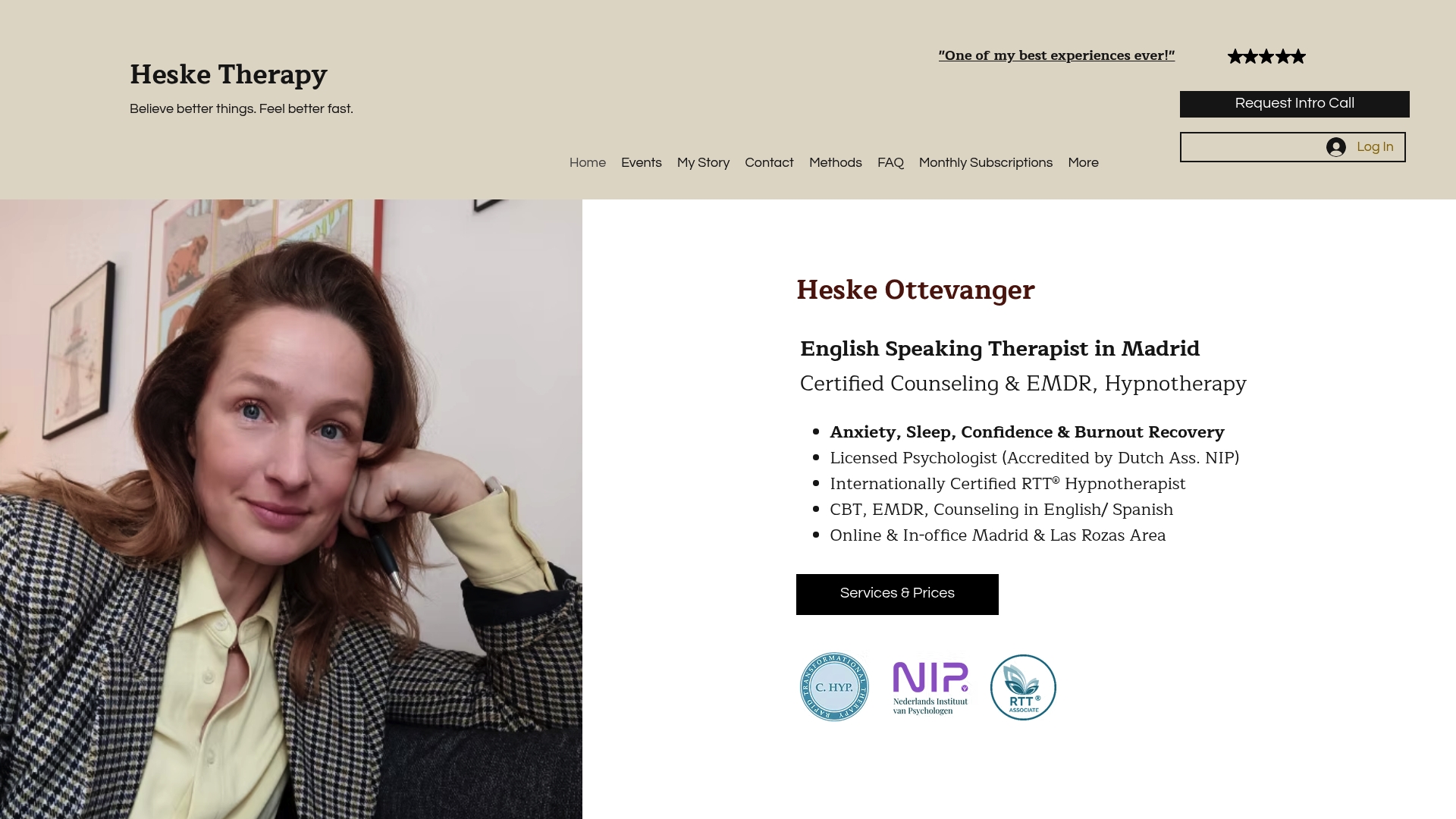
Sessions combine Rapid Transformational Therapy, EMDR, CBT, and clinical hypnotherapy, matched to whether your goal is reducing subjective dread or improving how you come across in the room. Treatment is available fully in English, alongside Spanish and Dutch, both online and in-office, so expats managing unpredictable schedules or living outside Madrid can still access the same multilingual counseling approach that tends to produce faster relief when therapy happens in a client’s most comfortable language.
A typical plan starts with an assessment of your specific triggers, whether that’s Q&A sessions, team presentations, or client calls, followed by a personalized exposure hierarchy built around your real work demands rather than generic scenarios. Most engagements run as a three-month commitment, giving enough structure for the sleeper effect to take hold rather than stalling after a handful of sessions.
If public speaking fear has been shaping your career choices, book a free discovery call and get a clear read on what a plan built for your situation would actually involve.
Sources
Recommended
Comments