Tonight: 10 Minute Sleep Autohypnosis and Clinician 4 Step Script


Hypnosis can help many people fall asleep faster, particularly when the suggestions are written specifically for sleep rather than generic relaxation, and when you practice consistently. Tonight, try this: three minutes of slow breathing followed by a 10-minute guided autohypnosis audio through headphones, done lying in bed with the lights off. If you want the evidence behind that recommendation, or a full script, keep reading.
TL;DR:
Hypnosis for sleep works best when suggestions are specifically designed to target sleep onset and maintenance, rather than general relaxation scripts.
The effectiveness of hypnosis varies due to individual differences, hypnosis design, and the quality of the audio, with sleep-specific suggestions showing stronger results.
Practice requires active participation, such as slow breathing, imagery, and permissive language, and benefits tend to accumulate over weeks of consistent use.
Binaural beats are optional and lack strong evidence for added benefit, while high-quality recordings should feature calm pacing and clear structure.
Hypnosis is most effective as part of a comprehensive approach, especially alongside cognitive behavioral therapy for insomnia, rather than as a standalone cure for chronic sleep issues.
Table of Contents
What Is Hypnosis for Sleep, and How Does It Feel?
Hypnosis is a focused, relaxed state of attention where your mind becomes more open to suggestion while you stay fully aware of what’s happening. Researchers describe it as a modified state of consciousness that increases suggestibility while preserving awareness and personal agency. You are not unconscious, and you are not under someone else’s control. You can open your eyes, get up, or stop the process at any point.
Autohypnosis, the self-guided version most people use for sleep, works the same way but without a practitioner in the room. You follow a recorded voice or your own internal script, guiding your attention inward and away from the mental noise that keeps you awake.
The mechanism behind it is fairly straightforward once you see it laid out. Hypnosis narrows your attention onto a single voice, image, or sensation, which naturally crowds out the analytical, worrying part of your mind. Clinical descriptions suggest this shift can reduce activity in the brain regions tied to rumination, making it easier to drift toward the slower mental states associated with sleep onset. That matters for insomnia specifically, because hyperarousal, the racing, alert feeling that keeps your brain “on,” is one of the central mechanisms keeping people awake at night.
A few sensations are common and worth normalizing before you try it:
A heavy, warm, or floating feeling in your limbs as your body relaxes.
A sense of time distortion, where 10 minutes can feel like two or twenty.
Drifting thoughts that wander from the script; this is normal and doesn’t mean you’ve “failed.”
A pleasant fogginess similar to the moment just before sleep, sometimes called the hypnagogic state.
People often confuse hypnosis with sleep itself, but they’re different states. Sleep involves specific brainwave stages and reduced consciousness; hypnosis is a wakeful, guided form of focus that can lead into sleep, not a substitute for it. It’s also distinct from being medicated or “knocked out.” You retain the ability to respond, move, or end the session whenever you choose.
What to expect in a guided session versus a self-guided audio: A live session with a hypnotherapist typically includes a conversation beforehand about your specific sleep pattern, followed by suggestions tailored to your situation, such as anxiety about work or a racing mind at 2 a.m. A self-guided audio uses generalized but sleep-specific language, works well for nightly repetition, and costs nothing to try, which makes it the more practical starting point for most people before considering one-on-one work.
Does Sleep Hypnosis Work? What the Research Shows
The evidence leans encouraging, with an important caveat: results depend heavily on how the suggestions are written. Reviews pulling together multiple studies on hypnosis and sleep report a consistent pattern. About half of the studies examined show measurable positive effects on sleep, and those effects strengthen when the hypnotic suggestions are built specifically around sleep onset and sleep maintenance rather than general relaxation or stress reduction, according to a summary of systematic reviews including Wofford et al.
By the Numbers: Many studies reviewed in recent systematic analyses report positive effects of hypnosis on sleep outcomes, with stronger results tied to sleep-specific suggestion design rather than generic relaxation scripts, per the same review synthesis.
That “half” figure isn’t a coin flip you should read pessimistically. Sleep research is notoriously hard to standardize. Study samples vary in size, some rely on self-reported sleep diaries rather than lab-measured sleep architecture, and hypnotic susceptibility differs from person to person, meaning some people respond strongly to suggestion and others barely notice a shift. A review that finds “half” of trials positive despite that noise is a genuinely useful signal, not a weak one.
The design detail matters more than most people realize. A hypnosis session that tells you to “relax and let go” produces a different result than one that specifically frames your bed as safe, disconnects the bedroom from daytime stress, and gives you permission to stop trying to control your sleep. The same body of research notes this design gap directly: when suggestions target sleep onset by name, outcome probabilities improve compared to broad relaxation scripts. If you’ve tried a generic meditation app for insomnia and felt underwhelmed, that may explain why.
Clinical overviews add a second, equally important point: hypnosis reduces anticipatory anxiety and rumination, the mental loop of “I need to sleep, why can’t I sleep,” but it isn’t positioned as a stand-alone cure for chronic insomnia. A clinical summary from Unobravo frames hypnosis as most effective when it’s paired with broader behavioral strategies rather than used in isolation for long-standing sleep disorders.
That framing lines up with how sleep medicine treats insomnia generally. Cognitive behavioral therapy for insomnia, known as CBT-I, is the front-line treatment recommended for chronic cases, and hypnosis fits naturally alongside it as an adjunct that lowers the emotional charge around bedtime while CBT-I retrains your sleep schedule and thought patterns. Regional clinical documentation reinforces this: hypnosis reduces hyperarousal, and clinical consensus recommends combining it with CBT-I when insomnia has become chronic or severe. Think of hypnosis as the tool that quiets the noise, and CBT-I as the tool that rebuilds the underlying habit. Used together, they tend to outperform either one alone.
How to Practice Autohypnosis Tonight: A Step-by-Step Script
Autohypnosis is a skill, not a passive listening experience. Practitioners who teach it note that people get more out of it when they actively participate in the process, following the pacing and engaging their imagination, rather than treating it like background noise, according to a Chilean clinical resource on autohypnosis for insomnia. Here’s a full routine you can run through tonight.
Before you start
Set up your environment for about five minutes before you begin:
Dim the lights or turn them off completely; hypnosis works better with your eyes closed and no visual stimulation competing for attention.
Put on headphones if you’re using a recorded audio; over-ear or soft in-ear models both work, as long as they’re comfortable enough to keep on while lying down.
Set your phone to airplane mode or do-not-disturb so a notification doesn’t interrupt you mid-session.
Get into bed as if you’re settling in for the night, not sitting up on the edge of the mattress.
The four-step routine
Step 1: Induction. Start with slow, deliberate breathing: inhale for four counts, hold for two, exhale for six. Repeat this four or five times. As you exhale, mentally say a phrase like, “With every breath out, my body settles a little more.” Then move into progressive relaxation, working from your feet upward: “My feet feel heavy and warm. My calves are loosening. My shoulders are dropping away from my ears.” Take your time; rushing this step undercuts the rest.

Step 2: Deepening. Once your body feels heavier, add an image that deepens the state. A common one is a staircase: picture yourself walking down ten steps, counting backward from ten to one, and imagine each step taking you further into calm. Alternatively, picture a familiar beach or quiet room, walking slowly through it as your attention narrows. The counting itself acts as a sensory anchor, giving your mind something simple to follow instead of drifting back to daytime worries.
Step 3: Sleep-specific suggestions. This is the step most generic relaxation audios skip, and it’s the one the evidence says matters most. Use permissive, not commanding, language. Instead of “I must fall asleep now,” which can backfire by turning sleep into a performance, try phrases like: “My bed is a safe place to rest.” “I don’t need to control what happens next.” “Any thoughts that come up can wait until morning.” “It’s okay if my mind wanders; my body knows how to rest.” Repeat two or three of these slowly, pausing between each one.
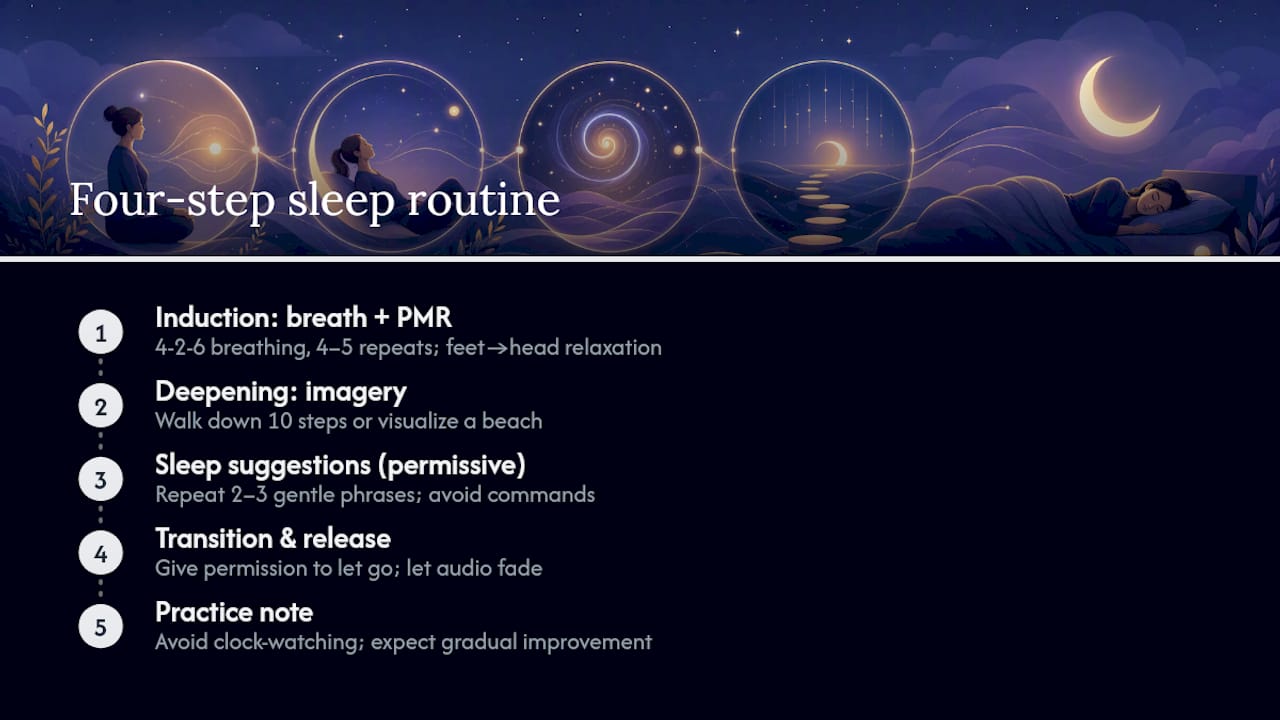
Step 4: Transition and release. Give yourself explicit permission to stop trying: “I can let go now. I don’t need to finish this thought to fall asleep.” If you’re using a recorded audio, most are designed to trail off in volume and pacing near the end, so you can simply let it play through without needing to consciously “finish” the session. If you need to stop the audio at any point, you can open your eyes, sit up, and turn it off; nothing about the process requires you to complete it once started.
Pro Tip: Avoid checking the clock afterward if you don’t fall asleep right away. Clock watching reactivates the analytical part of your brain that hypnosis just spent ten minutes quieting down.
Consistency matters more than intensity here. Most people notice some benefit after a handful of consecutive nights, but more stable change tends to build over several weeks of regular practice, so treat the first week as a trial run rather than a verdict. If a particular phrase or image doesn’t resonate, swap it for another; there’s no single correct script, only the one that keeps your attention gently engaged without pulling you back into alertness.
How to Choose a Sleep Hypnosis Audio That Actually Works
Not all hypnosis audios are built the same way, and the difference between a good one and a mediocre one usually comes down to a handful of concrete details rather than production value alone.
Before you commit to a recording for regular use, check it against this list:
Sleep-specific language. Does it explicitly address sleep onset, or is it a generic relaxation or meditation script relabeled for bedtime?
Voice pacing and tone. A slow, low, evenly paced voice works better than one with dramatic pauses or shifting volume.
No jarring elements. Skip anything with sudden music swells, abrupt sound effects, or ads that cut in mid-session.
Clear structure. Look for induction, deepening, and sleep suggestion phases, rather than one continuous ambient loop.
Reasonable length. Ten to twenty minutes is typical; anything under five rarely has time to build a deepening phase.
On the technical side, headphones genuinely change the experience. They block ambient noise and create a more immersive sense of the voice being “close,” which helps sustain the narrowed attention hypnosis depends on. Some recordings layer in binaural beats, low frequency tones meant to influence brainwave activity, but the evidence for their added benefit is thin, so treat them as optional rather than essential. If a binaural track feels distracting rather than soothing, a plain spoken-word version will usually work just as well.
Let the audio play through to its natural end rather than looping it immediately; most scripts are paced to trail off, and restarting it abruptly can reactivate alertness right when you were closest to sleep. On language and availability, Spanish-language sleep hypnosis content is growing but still less abundant than English-language options; if you adapt an English script yourself, keep the permissive phrasing intact rather than translating it into commanding language, since “debo dormir” carries the same performance pressure as “I must sleep” and works against you either way. A 2025 review of hypnosis apps found that most include sleep-focused content, but few carry meaningful clinical validation, so treat app store ratings as a popularity signal, not a clinical one, and favor clinician-recorded audio when you can find it.
When Hypnosis Isn’t Enough: Warning Signs to Watch
Hypnosis is a genuinely useful tool for the racing-mind kind of insomnia, but it isn’t the right response to every sleep problem. A few signs point toward needing a clinical evaluation instead of, or alongside, an audio routine:
Loud snoring with breathing pauses noticed by a partner, which can indicate sleep apnea and needs medical assessment rather than relaxation techniques; treatment options beyond standard devices are worth discussing with a sleep specialist.
Severe daytime sleepiness that interferes with driving or work, regardless of how much time you spend in bed.
Insomnia that persists for months despite consistent sleep hygiene and hypnosis practice.
Trauma-related awakenings, nightmares, or panic that occurs specifically at night.
Medication interactions or side effects affecting sleep, which should go through a prescriber, not a workaround.
If any of these apply, hypnosis can still play a supporting role, but it works best alongside CBT-I and a proper medical evaluation, not as a replacement for either. A practical first step is keeping a simple sleep diary for one to two weeks, noting bedtime, wake time, and how you felt, then bringing it to a GP, sleep clinic, or a clinician trained in both hypnotherapy and CBT-I.
A Clinical View on Hypnosis for Sleep and Anxiety
At Hesketherapy, we work with sleep problems as part of a broader picture, most often tied to anxiety, burnout, or unresolved stress that keeps the nervous system on alert long after the lights go out. Our approach draws on hypnotherapy, Rapid Transformational Therapy, EMDR, and CBT, chosen based on what’s actually driving your sleeplessness rather than a one-size script.
Most people who come to us for sleep issues aren’t dealing with sleep in isolation. The racing mind at 2 a.m. usually has a source, whether that’s work stress, an unresolved life transition, or anxiety that never gets a quiet moment during the day. Hypnotherapy works well here because it addresses the nervous system state directly, rather than just adding another habit to manage.
A typical brief hypnotherapy pathway starts with a conversation about your sleep pattern and its likely drivers, followed by sessions that combine hypnotic suggestion with the underlying issue, whether that’s anxiety or trauma. This tends to suit people whose insomnia tracks closely with stress spikes, rather than those with a primarily physical sleep disorder.
What I Tell Clients Who Feel Discouraged After a Few Nights
Sleep doesn’t respond to force, and I remind clients of that constantly. A few nights of practice without dramatic change doesn’t mean hypnosis isn’t working; it usually means the nervous system needs more repetition before it trusts the new pattern. Give it a week of consistent practice before judging results, and treat any night that doesn’t go well as data, not failure. If sleeplessness has been going on for months despite real effort, that’s the point to bring in professional support rather than pushing through alone.
— Heske
Free Self-Hypnosis Audio and Support From Hesketherapy
If you want a clinician-recorded starting point instead of building your own script from scratch, Hesketherapy offers a downloadable self-hypnosis audio for deep relaxation built around the same sleep-specific structure covered here: induction, deepening, and permissive suggestion, without the guesswork of writing your own wording.
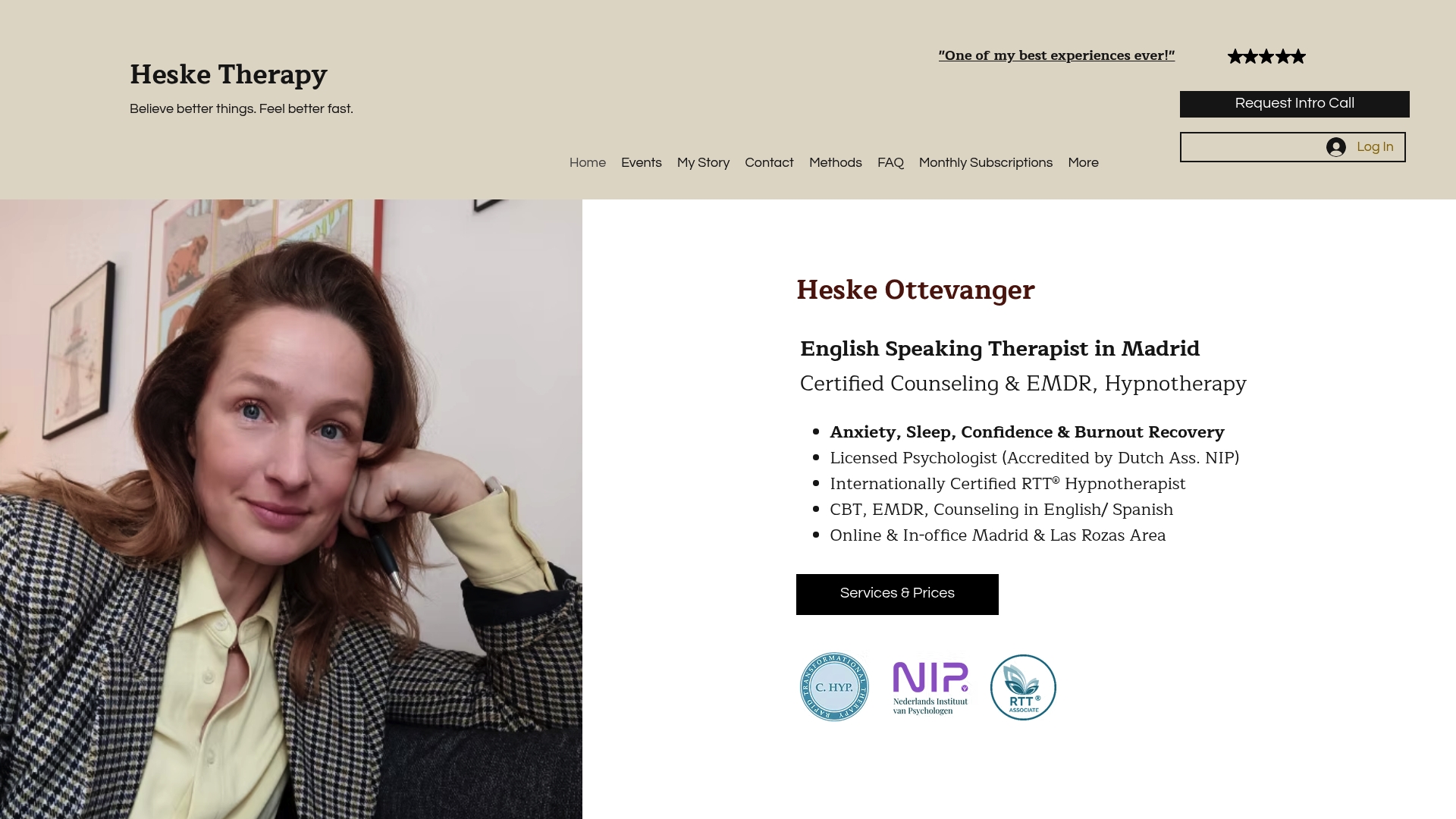
For readers whose sleep problems are tangled up with anxiety, burnout, or something harder to name, an audio alone often isn’t enough, and that’s where working with a therapist makes the difference an app can’t. Hesketherapy provides both in-person and online hypnotherapy and EMDR sessions in Madrid, with multilingual support in English, Spanish, and Dutch for expats and international clients who want care that doesn’t require explaining their situation twice in a second language. If persistent insomnia or anxiety is behind your sleepless nights, book a free discovery call to talk through what’s actually driving it and whether a short-term therapy plan makes sense for you.
Sources
This article draws on systematic review findings on hypnosis and sleep outcomes, clinical background on altered states of consciousness, practical routine guidance from Livlab’s practical guide, and clinical cautions from Unobravo and the WHO/EMRO-hosted clinical paper.
Recommended
Comments