Guided Meditation Benefits: What the Evidence Supports


Guided meditation can modestly reduce stress and anxiety, help you notice unhelpful thought patterns earlier, and support better sleep and mood. The research is encouraging, but it is not magic, and it works best as a practice you repeat rather than a one-off fix. Below we separate what is well supported from what is marketing, show how to start, and explain when meditation is not enough and it is time to talk to a professional.
TL;DR
Mindfulness programs probably reduce stress and anxiety moderately in healthy adults, according to a Cochrane evidence report.
Guided meditation is a good entry point because a voice tells you where to place your attention, so you do not have to work out the method alone.
Results vary from person to person. Some people feel no benefit, and a minority report uncomfortable experiences.
Meditation is a complement to care, not a replacement. If anxiety, trauma or burnout is running your life, see a licensed mental health professional.
Start small: five to ten minutes at a regular time beats an occasional hour.
Table of Contents
What guided meditation is, and why people start with it
In a guided meditation, a teacher or recording leads you through the practice: where to put your attention, how to breathe, what to do when your mind wanders. Unguided meditation asks you to do that alone, in silence. For beginners, and for busy people whose minds are already loud, a voice to follow lowers the barrier a great deal.
Most guided practices are built on mindfulness. Johns Hopkins Medicine describes its mindfulness meditation practices as developing awareness of present experience, whether that experience is pleasant, unpleasant or neutral. That last part matters. The goal is not to feel calm on command. It is to notice what is here without immediately fighting it.
You will meet a few common formats:
Breath-focused practice: you anchor your attention on breathing and return to it each time you drift.
Body scan: you move attention slowly through the body, noticing tension and sensation.
Open awareness: you observe thoughts, sounds and feelings as they arise and pass.
The NHS describes formal mindfulness meditation as sitting silently and paying attention to thoughts, sounds, the breath or parts of the body, and bringing attention back when it wanders. A guided recording simply narrates that process.
The benefits with the strongest support
Because the internet is full of confident claims, it helps to rank benefits by how much evidence stands behind them.
Lower stress
This is the best-supported benefit. The Centro Cochrane Iberoamericano’s evidence report on mindfulness concluded that mindfulness programs probably reduce stress moderately in healthy adults compared with doing nothing, with moderate to high certainty. A 2023 individual participant data meta-analysis of teacher-led programs for adults outside clinical settings found a small to moderate reduction in psychological distress, with high confidence in the result.
The Mayo Clinic adds a physiological angle: it lists reduced cortisol, the stress hormone, among the benefits of mindfulness practice.
Less anxiety, with caveats
The same Cochrane report rates the evidence for anxiety as moderate: mindfulness programs probably help, but with less certainty than for stress. A 2014 meta-analysis of meditation programs found moderate evidence of improved anxiety and depression at 8 weeks and again at 3 to 6 months.
When researchers compare mindfulness with other established approaches, the picture becomes more modest. A 2020 meta-review of mindfulness-based interventions found a moderate effect on anxiety symptoms, comparable to cognitive behavioral therapy, but noted inconsistent results and a need for better-designed trials. And the 2014 analysis found insufficient evidence that meditation programs beat active treatments such as exercise or group CBT. In plain words: meditation helps, and it is one good tool among several, not a uniquely superior one.
For people with a diagnosed anxiety disorder, the NCCIH summarizes a 2021 analysis in which mindfulness-based approaches beat usual treatments for reducing symptom severity in the short term, while long-term effects beyond two months were not clearly shown. That is a reason to keep practicing and to combine it with treatment, not to drop treatment.
Better self-awareness
This is the benefit people often value most, and it is hard to measure. The NHS explains that mindfulness lets you observe thoughts and feelings as they happen, step back from unhelpful patterns and deal with problems more productively. It also helps you spot the early signs of stress or anxiety. In therapy terms, this is the skill of noticing a spiral at minute two instead of minute forty.
Mood, sleep and the body
The Mayo Clinic lists easing anxiety by focusing on the present, managing long-lasting pain, improved mood and better sleep quality among the reported benefits of mindfulness. It also says mindfulness may help lower blood pressure by easing stress. These are plausible and commonly reported, but treat them as supportive effects, not treatments for the underlying condition.

The link between pain and mood runs both ways. If you live with persistent pain, this overview of chronic pain and mental health explains why movement and psychological care often go together, and why a calming practice can sit alongside physical treatment.
If sleep is your main reason for looking into meditation, our 10-minute sleep autohypnosis and four-step script is a practical next step.
Benefits you will see claimed, and what to make of them
Top-ranking pages in Spanish often promise more empathy, better decisions, higher pain tolerance, memory gains and a transformed life. Some of these may have early research behind them. The reviews we trust most, however, are about distress, stress, anxiety and depression. For other claims, the honest answer is “possible, not yet well established.” We would rather tell you that than oversell.
A Spanish official report is similarly careful. The 2020 report from the SESCS on meditation, excluding mindfulness, found effects of small to moderate size on anxiety, depression and stress, while noting uncertainty about clinical significance and a high risk of bias in many studies.
A quick guide to reading claims:
Claim | How well supported | Practical reading |
Lower everyday stress | Moderate to high certainty in healthy adults | Reasonable to expect |
Less anxiety | Moderate certainty, comparable to CBT in reviews | Helpful, often alongside therapy |
Better mood and sleep | Reported by the Mayo Clinic | Likely a supportive effect |
Self-awareness | Described by the NHS | Real, but personal and hard to measure |
Life transformation | No evidence either way | Treat as marketing |
Guided meditation for anxiety: a realistic view
Anxiety is the reason many of our readers search for this topic, so it deserves honesty.
Guided meditation can help when anxiety is the everyday kind: a racing mind before a meeting, tension at the end of a long week, trouble switching off. In those cases a regular ten-minute practice can change your relationship with the worry, because you learn to notice it without feeding it.
It is less reliable when anxiety is severe, long-standing or linked to trauma. The averages in the research hide wide variation. The 2023 meta-analysis noted that while programs help on average, there is wide variability and some participants may not benefit or could be harmed. Sitting quietly with your thoughts can bring up memories or panic sensations that a recording cannot respond to.
If your anxiety shows up in your body, for example jaw clenching at night, you may find our article on bruxism and anxiety useful alongside meditation. And if you are curious about other body-based approaches, there is a review of the evidence on craniosacral therapy for anxiety.
Is guided meditation safe?
For most people, yes, but not for everyone every time. The NCCIH states that meditation may be associated with negative experiences such as anxiety or depression, and that it should not replace conventional care or delay seeing a health care provider. A 2020 review of 83 studies found that roughly 8 percent of participants reported negative experiences, a rate the NCCIH describes as similar to that seen in psychological therapies. By contrast, the Cochrane report found no adverse effects in the mindfulness programs it reviewed. Researchers also note that adverse effects are inconsistently reported across studies, so absence of reports is not proof of absence.
What this means in practice:
Stop if it feels worse, not just unfamiliar. A little restlessness is normal. Rising panic, flashbacks or a heavy low mood are not.
Shorten the session and keep your eyes open, or focus on sounds in the room rather than internal sensations.
Speak to a professional if difficult feelings continue after a few sessions. A psychologist or psychiatrist can tell you whether meditation suits you right now, and what else would help.
How to start: a simple four-week plan
The Mayo Clinic suggests short, regular moments during the day to help the body and mind release stress and reset. The NHS suggests beginners notice everyday sensations or choose a regular time to practice. We build on that:
Week 1: five minutes, same time daily. Choose a breath-focused recording. Your only job is to come back when you drift. Drifting is the exercise, not a failure.
Week 2: extend to ten minutes. Try a body scan in the evening.
Week 3: add one “micro-moment” a day: three slow breaths before opening your laptop, or paying full attention to the first sip of coffee.
Week 4: review. What changed in your sleep, your tension, your reactions? Keep what helped.
A few practical tips for expats and busy internationals:
Pick a recording in the language you think and feel in. Many people find emotional content lands differently in their mother tongue, and Madrid has plenty of people in that position.
Attach practice to something that already happens, such as your morning coffee or the metro ride home (with headphones, eyes open, on a seat).
Do not chase a feeling of calm. Chase consistency.
If culture shock and the pressure of a new city are part of your stress, our guide to reducing culture shock anxiety pairs well with a daily practice.
Our perspective at Heske Therapy
We work with English-speaking expats and international clients in Madrid and online, mostly on anxiety, burnout, trauma and sleep. We like guided meditation, and we offer free mindfulness and hypnosis audio on our site. We also see where it stops.
People arrive after months of apps and recordings, tired and a little ashamed that “it didn’t work.” Usually it was never going to work alone. Burnout, trauma and entrenched anxiety have causes that need to be understood and treated, not only soothed. That is why our approach is integrative: Rapid Transformational Therapy (RTT), EMDR, CBT, counseling and clinical hypnotherapy, chosen around the person and structured around a defined time frame.
Our honest advice is this. Use guided meditation daily if it helps you. If after four to six weeks you still feel stuck, wake at 3 a.m. with the same thoughts, or notice the old patterns returning, that is information, not failure. It is a good moment for a conversation with a professional.
— Heske
When meditation is a start and therapy is the next step
Consider professional support if:
anxiety or low mood has lasted more than a few weeks and affects work, sleep or relationships;
meditation brings up distressing memories, flashbacks or panic;
you are exhausted and detached from work, a pattern often called burnout;
you have recurring nightmares or trauma symptoms. See our piece on recurrent nightmare therapy for what to try meanwhile;
you have thoughts of harming yourself. In that case, contact emergency services or a crisis line in Spain straight away.
In those situations, a licensed clinician can combine the calming skills of meditation with methods designed to resolve the cause.
Working with us
If you want structure and a plan tailored to you, our core program, Create a Breakthrough in 3 Months, is €600 per month over a three-month engagement, in our Madrid office or online. If you prefer a shorter, focused route, the 21-day just RTT package online is €550 one-off, and a pack of 4 counseling sessions in the office is €375 one-off. Sessions can be held in English, Spanish or Dutch.
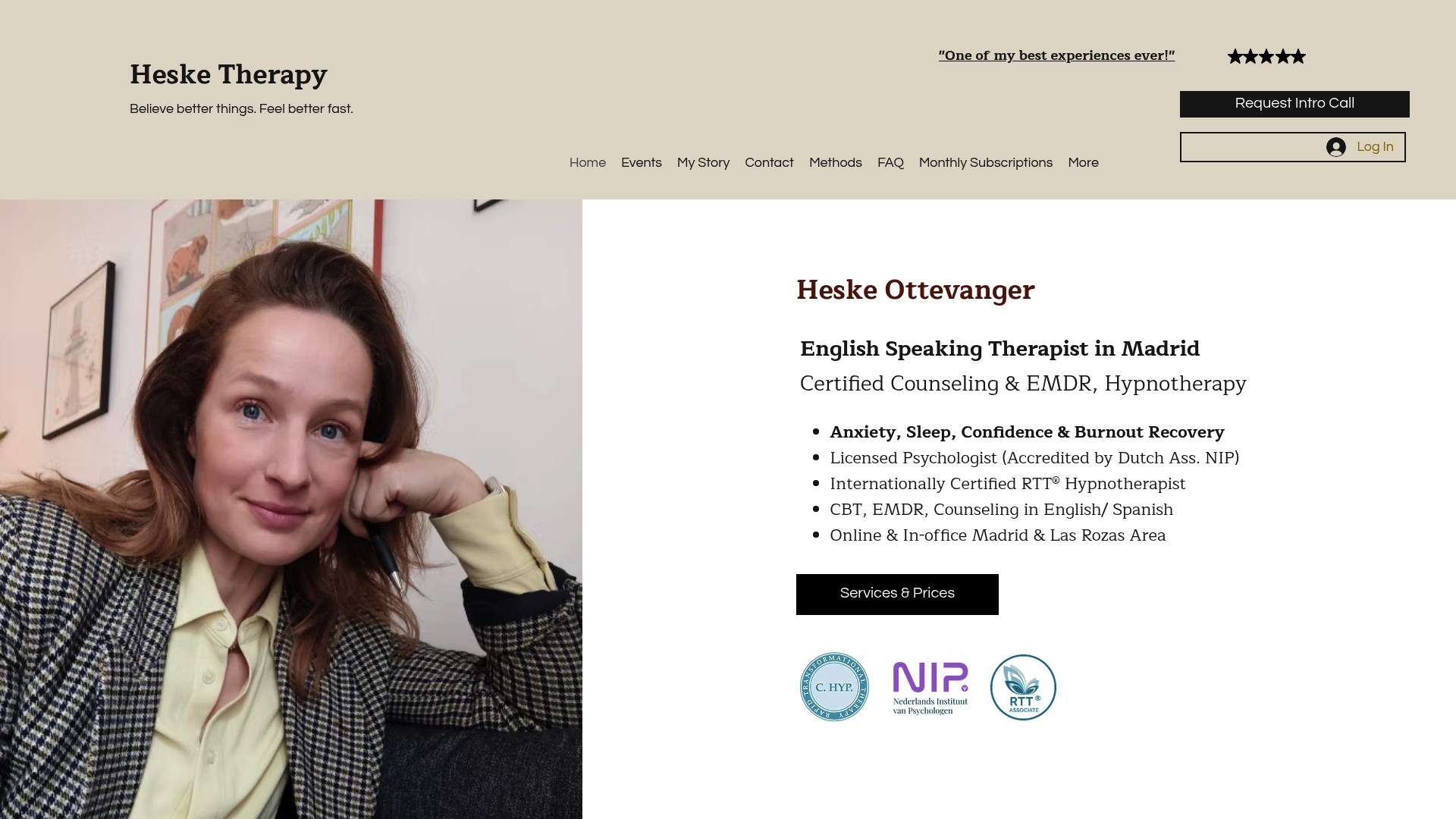
The first step is a free discovery call, where we listen, explain how we would work and tell you honestly whether we are the right fit. You can apply from the Heske Therapy home page.
FAQ
What are the main benefits of guided meditation?
The best-supported benefits are lower stress and moderately lower anxiety in healthy adults, according to Cochrane and large meta-analyses. Many people also report better mood, better sleep and clearer awareness of their own thoughts. Claims about life transformation go beyond the evidence.
Is guided meditation good for anxiety?
It can help with everyday anxiety, and reviews find effects comparable to CBT on average. The results are inconsistent, though, and long-term effects in diagnosed anxiety disorders are not clearly proven. If anxiety disrupts your daily life, combine meditation with professional treatment.
How long until I notice a difference?
The studies measuring effects typically look at programs of about eight weeks. Some people feel calmer within days, but expect to practice for several weeks before judging. Five to ten minutes a day is enough to begin.
Can meditation make things worse?
Sometimes. The NCCIH reports that around 8 percent of participants in a review of 83 studies had negative experiences, such as anxiety or depression. If a practice stirs up distress, stop, shorten it or talk to a mental health professional.
Is guided meditation better than meditating alone?
Neither is better for everyone. Guidance gives beginners a clear structure and something to follow when the mind races. Over time, many people move toward shorter guidance or silence.
Sources
Centro Cochrane Iberoamericano, evidence report on mindfulness (2022)
Individual participant data meta-analysis of mindfulness-based programs (2023)
Meditation programs for psychological stress and well-being (2014)
The effectiveness of mindfulness-based interventions on anxiety (2020)
The empirical status of mindfulness-based interventions (2021)
Recommended
Comments