Mental Health Tips for Expats: Evidence-Based Therapy


The single most effective clinical approach for expatriates dealing with trauma, PTSD, anxiety, or burnout is manualized, trauma-focused psychotherapy — specifically Cognitive Processing Therapy (CPT), Eye Movement Desensitization and Reprocessing (EMDR), or Prolonged Exposure (PE). The VA/DoD Clinical Practice Guideline (2023) names these three as first-line treatments for adults with PTSD, and all three can be delivered effectively via secure telehealth when the clinician is trained and licensed to provide them remotely.
Here is where to start right now:
Verify your prospective therapist’s licensure and confirm they are legally authorized to treat you remotely in your current country.
Confirm they are trained in at least one manualized protocol (CPT, EMDR, or PE), not just general talk therapy.
Check language availability — sessions in your native language reduce cognitive load and improve outcomes.
Schedule a free discovery call to ask direct questions before committing to a package.
Pro Tip: Ask one screening question early: “Have you experienced a specific event or period that still causes distress, avoidance, or intrusive memories?” A “yes” points toward trauma-focused therapy as the priority modality.
Key Takeaways
Trauma-focused psychotherapy (CPT, EMDR, or PE) is the first-line clinical recommendation for expatriates with PTSD or trauma-related presentations, and telehealth delivery is evidence-supported when done securely with a licensed clinician.
Point | Details |
First-line therapies | CPT, EMDR, and PE are guideline-recommended; choose based on your presentation and clinician training. |
Telehealth is effective | Secure, licensed telehealth produces outcomes comparable to in-person delivery for manualized protocols. |
Verify licensure first | Confirm your therapist is licensed and legally authorized to treat you in your current country before starting. |
Typical session ranges | PE runs —; CPT and EMDR typically 8–16; WET as few as 5–6 for shorter-term needs. |
Hesketherapy | Licensed expat-focused practice in Madrid and online, offering EMDR, CBT, RTT, and hypnotherapy in English, Spanish, and Dutch. |
This article is general information, not a substitute for advice from a qualified doctor. Consult a qualified healthcare professional about your own circumstances before acting on anything here.
Table of Contents
Which evidence-based psychotherapies treat clinical problems common in expats?
The 2023 VA/DoD Clinical Practice Guideline places CPT, EMDR, and PE at the top of the evidence hierarchy for PTSD — and the clinical problems expats most commonly present with (trauma responses, anxiety, burnout, sleep disruption) overlap significantly with that diagnostic territory. Understanding what each therapy actually does helps you choose with confidence.
Cognitive Processing Therapy (CPT) targets the distorted beliefs that trauma produces — thoughts like “I should have known better” or “The world is completely unsafe.” Structured sessions guide you through written accounts and cognitive worksheets to challenge and reframe those beliefs. It is highly structured, which suits people who want a clear roadmap.
Prolonged Exposure (PE) works through two complementary mechanisms: imaginal exposure (revisiting the traumatic memory in a controlled way) and in vivo exposure (gradually approaching avoided situations). A systematic review of 114 RCTs identified PE, CPT, and Cognitive Therapy as the most strongly supported manualized trauma-focused therapies, with clinically important reductions in PTSD symptoms.
EMDR processes traumatic memories using bilateral stimulation — typically guided eye movements — while you hold the memory in mind. It requires less verbal narration than PE, which some clients find more accessible, particularly across a language barrier.
For expats whose trauma presentations are less severe or who are not yet ready for trauma-focused work, Written Exposure Therapy (WET) (five to six sessions) and Present-Centered Therapy (PCT) offer validated, shorter alternatives. One clinical note: trauma-focused therapy should not begin while a client is in active crisis or immediate safety risk. Stabilization comes first.
You can read more about trauma-focused methods for expatriates and how they apply to common expat presentations.
How does telehealth actually work for expats seeking therapy?
Telehealth is not a compromise. Telemedicine-delivered trauma-focused psychotherapy, including PE and CPT, produces outcomes comparable to in-person delivery and meaningfully expands access for people who cannot attend clinic sessions. For expats in Madrid or anywhere abroad, that is a significant clinical advantage.
Practical setup matters, though. Before your first session, work through this checklist:
Time zones: Anchor your sessions to a fixed weekly slot that works in both your time zone and your therapist’s. Drifting appointment times erode consistency.
Platform security: Use a HIPAA-compliant or equivalent encrypted video platform. Ask your therapist which platform they use and why.
Internet backup: Have a mobile hotspot ready. A dropped connection mid-session is disruptive, especially during exposure work.
Session environment: Choose a private, quiet space where you will not be interrupted. A parked car or a room with a white noise machine outside the door both work.
On licensure: ask your therapist directly where they hold their license, whether that license permits remote treatment of clients in your current country, and what happens to your care if you relocate. These are not awkward questions — they are standard due diligence. For teletherapy best practices and platform guidance, specialist resources can help you evaluate your setup before you begin.
Regarding insurance: many U.S.-based health plans offer out-of-network reimbursement. Ask your therapist for a superbill (an itemized receipt with diagnostic and procedure codes) and submit it to your insurer directly.
Pro Tip: Share a two-week availability window with your therapist at intake. Scheduling anchor times — the same day and hour each week — reduces the cognitive overhead of managing sessions across time zones.
How do you choose the right therapist as an expat?
Prioritize licensed clinicians trained in at least one manualized, trauma-focused protocol who can work in your preferred language. Everything else is secondary to those three criteria.
Research on help-seeking expatriates shows that perceived socioemotional support links directly to better adjustment and lower psychological distress. A therapist with genuine multicultural competence — not just a claim of it — provides that support structurally, not just interpersonally.
Criterion | What to ask or verify |
Licensure and scope | “Where are you licensed, and can you legally treat me in my current country?” |
Modality training | “Are you trained in CPT, PE, or EMDR? Have you completed supervised hours in that protocol?” |
Expat or multicultural experience | “What percentage of your current caseload are expats or international clients?” |
Language match | Confirm the therapy language before the first session, not during it |
Telehealth setup | “Which platform do you use, and is it encrypted?” |
Fees and cancellation policy | Ask about per-session cost, package structure, and late-cancellation terms upfront |
Red flags to watch for: a therapist who cannot name their specific training in trauma-focused protocols, who avoids discussing licensure, or who promises symptom resolution in a fixed number of sessions without an assessment. Prepare for your first session by bringing a brief personal history and a short list of your current symptoms — practical preparation guidance can help you structure that.
What does a typical treatment pathway look like?
Assessment always precedes treatment. A thorough intake covers personal and trauma history, safety screening, and standardized symptom measures (such as the PCL-5 for PTSD or the GAD-7 for anxiety). That baseline shapes the treatment plan and gives both you and your clinician a way to measure progress objectively.
Most protocols include between-session work. CPT uses cognitive worksheets; PE includes audio recordings of imaginal exposure for home review. EMDR typically does not assign formal homework but may include stabilization exercises. Progress is tracked using the same standardized scales from intake periodically.

Pro Tip: Bring a brief self-rating on a 0–10 distress scale to each session. It takes thirty seconds and gives your therapist a real-time signal that structured measures might miss between formal check-ins.
For a deeper look at psychotherapy methods for expats and what to expect session by session, Hesketherapy’s clinical overviews walk through each protocol in plain language.
What are your options when first-line therapy is unavailable or unwanted?
When CPT, PE, or EMDR are not accessible or a client declines them, validated alternatives exist. WET and PCT are both manualized and guideline-supported. A comprehensive comparative review of 193 RCTs found that several psychological treatments produce moderate-to-high strength of evidence for reducing PTSD symptoms, though comparative effectiveness between psychotherapy and pharmacotherapy remains inconclusive in many direct comparisons.
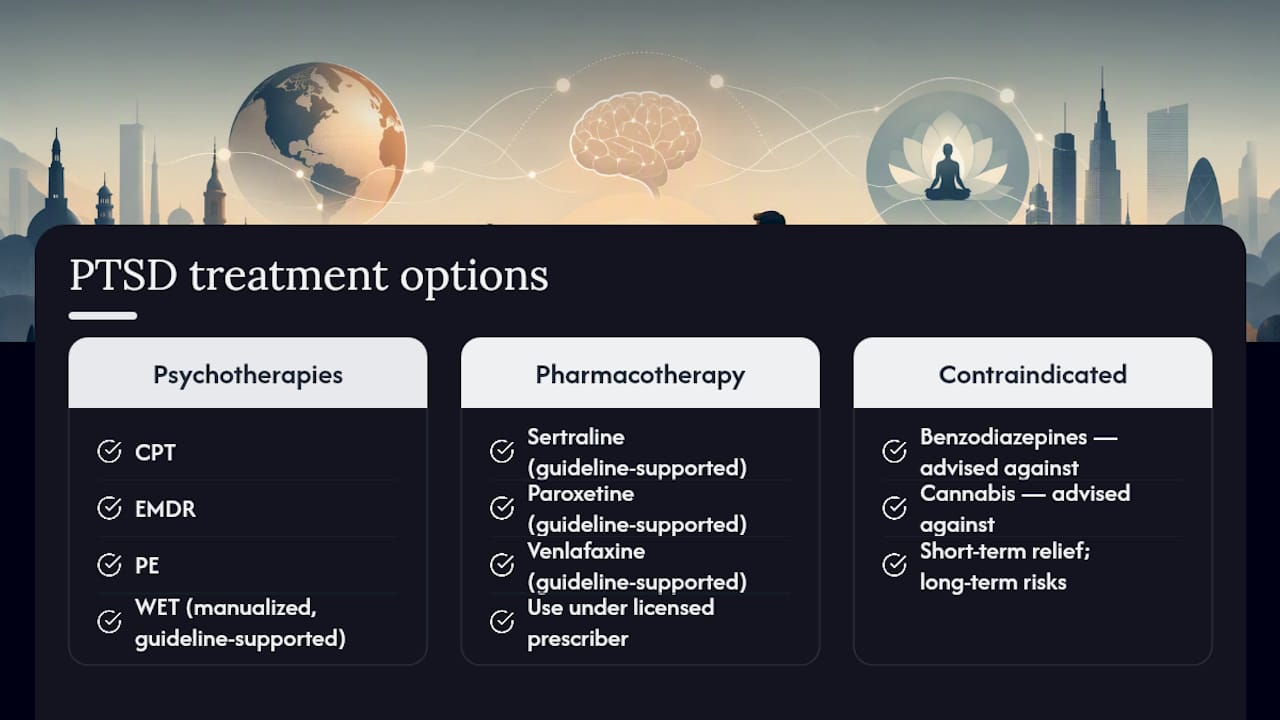
When medication is considered, guidelines support sertraline, paroxetine, and venlafaxine as options, always under the supervision of a licensed prescriber. Side effects vary and require monitoring, particularly in the first four to six weeks.
Two substances the guidelines explicitly advise against for PTSD: benzodiazepines and cannabis. Both carry risks of worsening long-term outcomes despite short-term symptom relief.
Shared decision-making with your clinician is the right framework here. Bring your preferences, your logistical constraints, and your questions. A good clinician will lay out the evidence for each option and help you weigh them against your specific situation, not prescribe a path without your input.
What should you do if you are in crisis right now?
If you are in immediate danger of harming yourself or others, contact local emergency services now. Do not wait for a therapy appointment.
In the U.S.: Call 911 or go to the nearest emergency room. Call or text 988 (Suicide and Crisis Lifeline) for immediate mental health support.
Outside the U.S.: Call the local emergency number (112 in most of Europe, including Spain). The International Association for Suicide Prevention maintains a directory of crisis centers by country.
If you are unsure: Calling is always the right decision. Crisis lines are staffed for exactly this uncertainty.
Confirm your clinician’s crisis coverage protocol before your first session. Ask: “What happens if I am in crisis between sessions or during a session and lose connection?” A clear answer is a sign of a prepared, responsible clinician.
How Hesketherapy works with English-speaking expatriates
Hesketherapy is a licensed psychotherapy practice based in Madrid, offering in-person and online sessions for English-speaking expatriates and international adults. The integrative protocols include EMDR, CBT, Rapid Transformational Therapy (RTT), counseling, and clinical hypnotherapy — selected and combined based on each client’s clinical presentation and goals.
Key service features:
Languages: English, Spanish, and Dutch — sessions conducted in your native language when possible.
Formats: In-person in Madrid and secure telehealth for online clients globally, subject to licensure.
Specialization: Anxiety, burnout, trauma, sleep disturbance, and related presentations common in expat populations.
Package model: Three-month engagement at €600/month, structured to support meaningful clinical progress rather than open-ended, indefinite sessions.
Free discovery call: A 30-minute consultation to assess fit, answer your questions, and outline a proposed approach before any commitment.
Research on expat adjustment and social support confirms that culturally competent, language-matched care produces better outcomes. Hesketherapy’s multilingual, expat-specialized model is built around exactly that evidence.
Pro Tip: Use the discovery call to ask specifically about the clinician’s training in your preferred protocol (EMDR, CPT, or RTT) and their experience with clients in your country of residence. Thirty minutes of direct questions saves months of misaligned treatment.
For more on online therapy for expats and how culturally sensitive telehealth works in practice, Hesketherapy’s resource library covers the clinical and logistical details.
What working with expats has taught me about effective care
The expats I work with are not fragile. They are often high-functioning, resourceful people who have built lives across borders — and who are quietly carrying more than they let on. What I have seen consistently is that the gap between “managing” and genuinely recovering is almost always a structured, evidence-based protocol delivered by someone who understands the expat context. Generic talk therapy can help. But when trauma, burnout, or chronic anxiety is the presenting problem, a manualized approach with measurable milestones is what produces lasting change. Clients who engage fully with the process — completing between-session work, tracking their own progress, asking hard questions — tend to move faster and hold their gains longer. That is what I aim for in every engagement. If you are ready to stop managing and start recovering, a discovery call is the right first step.
Hesketherapy: a practical next step for expats ready to begin
For English-speaking expatriates who want licensed, evidence-based psychotherapy without the friction of finding a culturally competent clinician from scratch, Hesketherapy offers a concrete alternative. In-person sessions are available in Madrid; online sessions serve clients globally where licensure permits. The three-month package model at €600/month is structured for real clinical progress, not indefinite support.
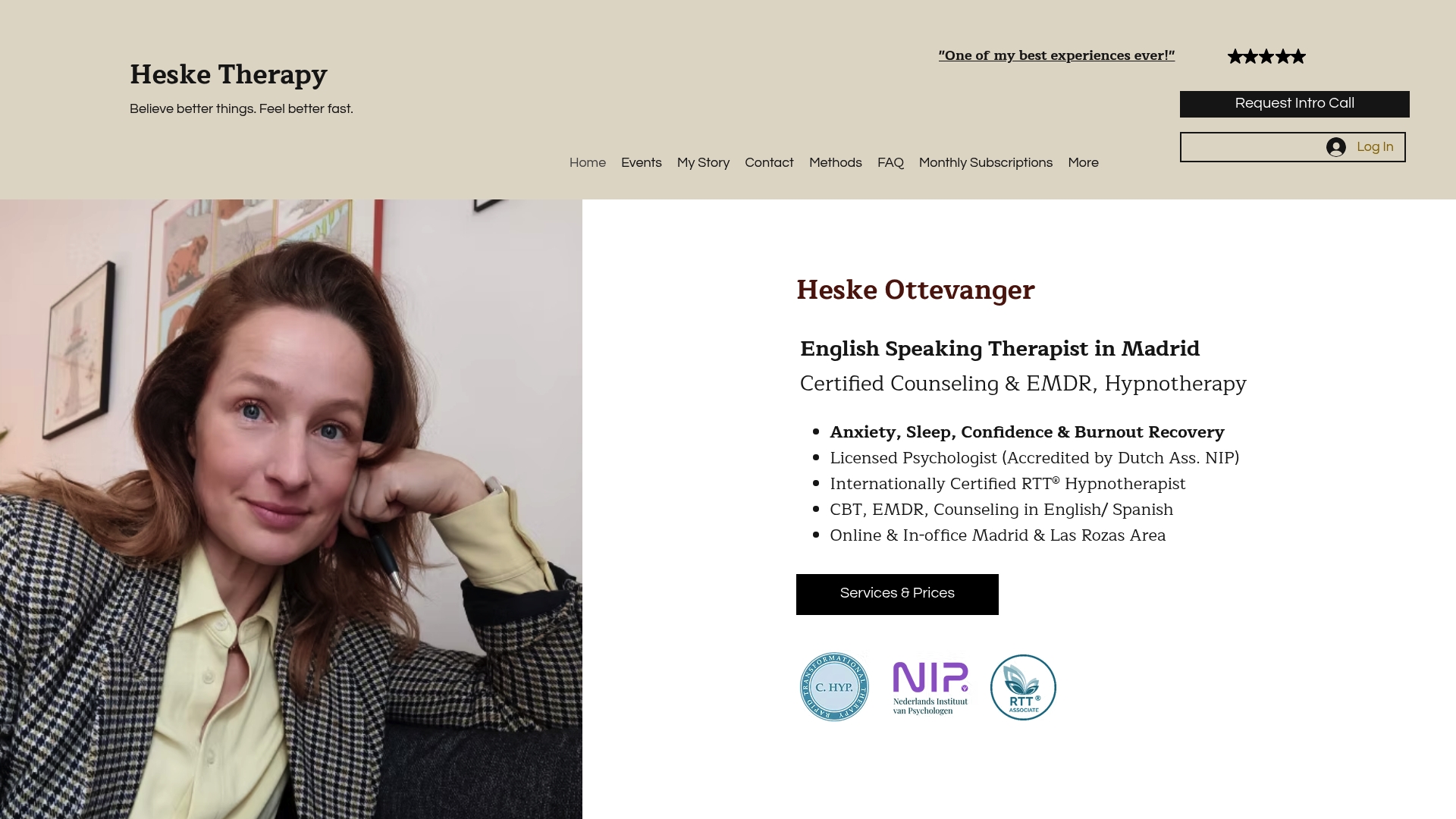
The first step is a free 30-minute discovery call. You will speak directly with the clinician, confirm language and protocol fit, and leave with a clear sense of whether the approach matches your needs. No obligation, no pressure. Book your session and review service details at Hesketherapy.
Sources
Overview of Psychotherapy for PTSD - PTSD: National Center for PTSD
The Management of Posttraumatic Stress Disorder and Acute Stress Disorder: Synopsis of the 2023 U.S. Department of Veterans Affairs and U.S. Department of Defense Clinical Practice Guideline
Systematic review and meta-analysis of psychological therapies for PTSD (PMC7144187)
Comparative effectiveness review of PTSD treatments (NCBI Bookshelf NBK525132)
Recommended
Comments