Mindfulness for Insomnia: A Practical Guide to Falling Asleep


Mindfulness can reduce the rumination and physical hyperarousal that keep many people staring at the ceiling at 2 a.m. It works best for sleep-onset insomnia tied to anxiety and racing thoughts, and mindfulness helps by shifting your relationship with sleep from forcing rest to allowing it. It is not a substitute for medical evaluation if you suspect sleep apnea or are dealing with major depression.
Here’s what to try tonight, in ten minutes:
Minute 0 to 3: settle into bed and bring soft attention to your breath.
Minute 3 to 8: run a slow body scan, noticing sensations without trying to relax them away.
Minute 8 to 10: notice any thoughts that arise, label them, and return to your breath.
Statistic to know: research on mindfulness-based programs for insomnia shows small-to-moderate gains often appear within 2 to 4 weeks of consistent practice, with more reliable change by week eight.
Key Takeaways
Mindfulness reduces the hyperarousal and rumination behind most sleep-onset insomnia, but chronic or severe cases need CBT-I or medical evaluation alongside it.
Point | Details |
Try it tonight | Run the 10-minute breath, body scan, and thought-labeling routine before sleep. |
Practice by day too | Add 20 to 30 minutes of daytime mindfulness to lower baseline arousal. |
Pair with sleep hygiene | Cut screens 60 to 90 minutes before bed and keep a consistent wake time. |
Expect a gradual timeline | Look for small gains in 2 to 4 weeks, clearer results by 8 weeks or beyond. |
Know the red flags | Loud snoring, gasping, or symptoms past 3 months call for medical assessment. |
Table of Contents
How Do You Practice Mindfulness for Insomnia Tonight?
You don’t need an app, a course, or forty minutes you don’t have. You need ten minutes and a willingness to stop fighting your own mind. This routine is built for the moment your head hits the pillow and your thoughts start racing.
Start by preparing the space. Turn off screens 60 to 90 minutes before bed, dim the lights, and keep the room cool. This isn’t optional dressing. Blue light and stimulation delay the release of melatonin your body needs to wind down, and pairing mindfulness with basic sleep hygiene makes each exercise meaningfully more effective.
Minutes 0 to 3, breath anchor. Lie down, close your eyes, and rest your attention on the sensation of air moving in and out. Don’t control it. If your mind wanders to tomorrow’s meeting, that’s fine. Just notice, then come back to the breath. A gentle extended exhale (longer out-breath than in-breath) signals your nervous system to downshift.
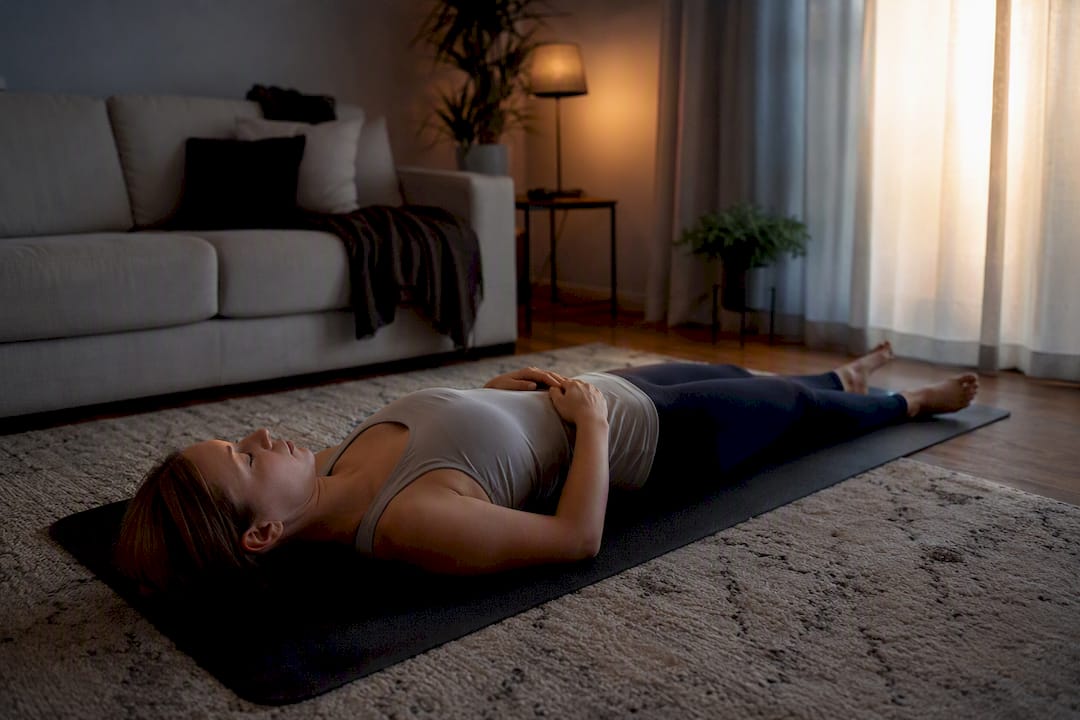
Minutes 3 to 8, body scan. Move your attention slowly from your toes to your scalp. Notice tension, warmth, heaviness, whatever is there. The goal is presence, not relaxation. Trying to force your shoulders to loosen often backfires. It turns rest into another task, and that pressure spikes arousal rather than lowering it.
Minutes 8 to 10, thought labeling. When a thought pulls you away, name it quietly: “planning,” “worrying,” “remembering.” Then let it drift and return to your breath. This small act of labeling creates distance between you and the thought, so it stops feeling urgent.
If you’re still awake after 20 to 30 minutes, get up. Go to another room, keep the lights low, and do something quiet until you feel sleepy again. Staying in bed while wired trains your brain to associate the bed with wakefulness, which is the opposite of what you want.
Pro Tip: Record this routine once on your phone in your own voice, slow and unhurried, and replay it nightly. Hearing a familiar voice removes the mental effort of remembering the steps, so your mind has less to do and more room to settle.
Which Mindfulness Exercises Match Your Sleep Problem?
Not every insomnia pattern needs the same fix. Someone who can’t fall asleep needs a different tool than someone who wakes at 3 a.m. and can’t drift back off.
Breath-focused anchors, including a 4-7-8 variant (inhale for four counts, hold for seven, exhale for eight), work well for sleep onset. Keep it gentle. If counting to seven feels like straining, shorten it. Breathing rhythms like this one are commonly recommended by sleep and anxiety specialists precisely because they’re easy to adapt without turning into another performance to get right.
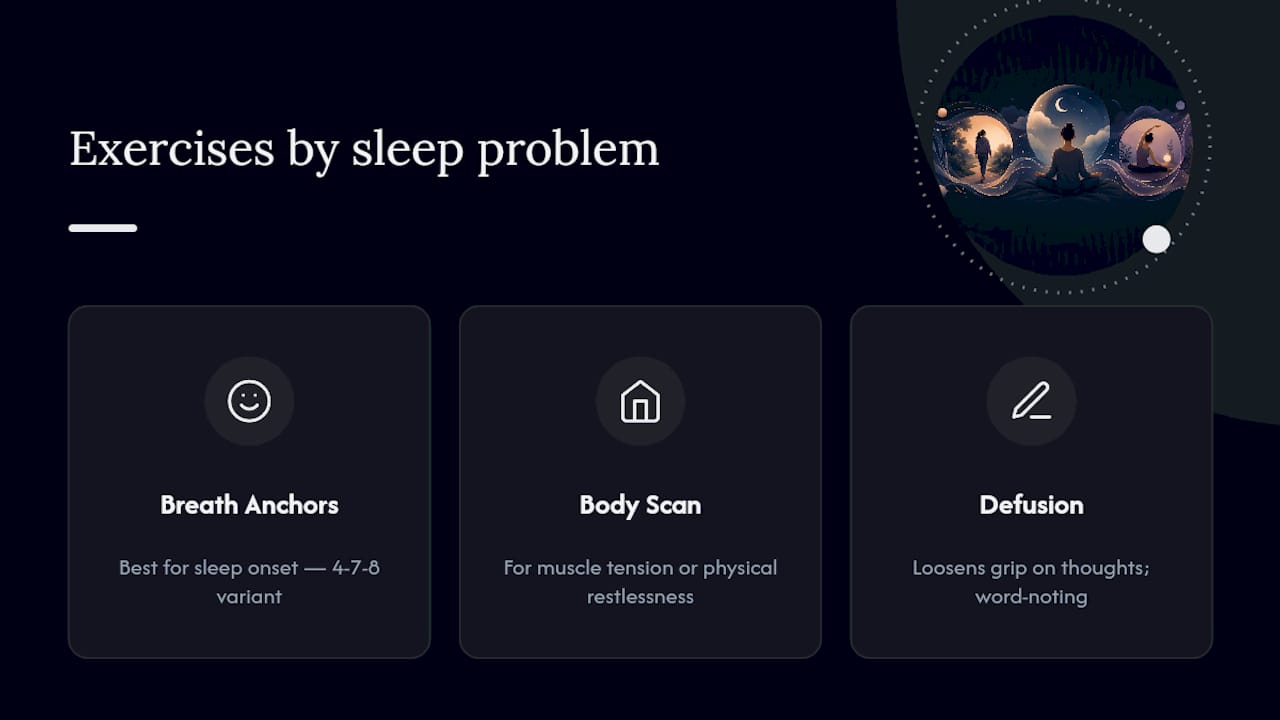
Progressive body scans suit people whose insomnia comes with muscle tension or physical restlessness. The trap to avoid: treating the scan as a relaxation exercise you have to succeed at. Notice sensations, don’t chase a specific feeling.
Defusion techniques (labeling, brief imagery, or simple word-noting like “thinking, thinking”) help when your mind won’t stop generating to-do lists or replaying conversations. These work by loosening your grip on the content of a thought rather than trying to argue it away.
For middle-of-night waking, a short breathing anchor from bed can work, but if fifteen minutes pass with no results, sit up or step into another room. Low-light activity like reading something neutral, paired with a brief five to ten minute mindfulness anchor, tends to work better than lying there willing yourself back to sleep.
Guided audio removes decision fatigue and works well for beginners, though some people find a narrator’s voice becomes one more thing to track. Self-led practice offers more flexibility once you know the steps, but it demands more discipline on nights when your mind is loudest. Clinical reviews note that mindfulness-based interventions show growing evidence for improving sleep quality, though it remains a complement to, not a replacement for, structured behavioral treatment.
Why Does Daytime Mindfulness Practice Improve Sleep at Night?
What you do at 2 p.m. shapes what happens at midnight. Practicing mindfulness only in bed asks your nervous system to downshift from a standing start, which is a much harder job than lowering an already-calm baseline.
Daily practice of 20 to 30 minutes builds a carry-over effect that reduces your baseline physiological arousal, so bedtime practice has less work to do. Pair it with:
A formal sitting practice once a day, plus brief informal anchors (three conscious breaths before a meeting, noticing your feet on the ground while waiting for coffee).
A consistent wake time, even on weekends.
Caffeine cut off by early afternoon.
Screens off 60 to 90 minutes before bed, room kept cool and dark.
Break the 20 to 30 minutes into two shorter sessions if a workday won’t allow one long block. Morning and lunchtime sessions both count.
When Should You Get Professional Help for Insomnia?
Mindfulness has real limits, and knowing them matters as much as knowing the technique.
Treat these as red flags: symptoms lasting longer than three months with clear daytime impairment, loud snoring or gasping during sleep, or mood symptoms that include hopelessness or suicidal thoughts. Insomnia connected to sleep apnea or major depression needs medical assessment; mindfulness supports treatment, it doesn’t replace it.
For chronic insomnia without those red flags, cognitive behavioral therapy for insomnia (CBT-I) is the first-line, best-supported treatment. Mindfulness works well alongside it, targeting the anxiety and rumination that CBT-I’s behavioral tools don’t always reach directly.
Ask your doctor about a sleep study if apnea symptoms are present.
Ask about CBT-I referral if insomnia has persisted past three months.
Discuss any sleep medication changes with a clinician before adjusting them yourself.
On timeline: expect small shifts within 2 to 4 weeks of consistent practice, with more dependable improvement by week eight or beyond.
How Do Therapists Combine Mindfulness With Other Treatments?
At Hesketherapy, mindfulness rarely stands alone when sleep is the presenting problem. Insomnia is often downstream of anxiety, trauma, or unresolved stress, so a therapist typically pairs breath and body-scan work with approaches that address the root pattern, whether that’s Rapid Transformational Therapy for anxiety-driven arousal or EMDR and CBT for underlying trauma or thought loops.
A typical pathway starts with an assessment session to map what’s actually driving the sleeplessness, followed by a structured plan, often running several weeks, combining talk therapy with practical mindfulness homework between sessions. Sessions run online or in person, which matters for expatriates managing sleep problems across time zones or without a fixed base.
Self-help mindfulness gets many people meaningfully better. Clinician-guided work matters most when anxiety, trauma, or grief sit underneath the sleep problem itself.
Point | Details |
Assessment first | A clinician maps what’s driving insomnia before assigning technique. |
Multilingual support | Sessions run in English, Spanish, and Dutch, in person or online. |
Integrated method | Mindfulness pairs with RTT, EMDR, or CBT depending on the root cause. |
Which Apps and Guided Meditations Actually Help You Sleep?
A guided recording removes the hardest part of mindfulness at bedtime: deciding what to do next while half-asleep and irritable. Look for sleep-specific tracks rather than general meditation apps repurposed for nighttime. The best ones share three traits: a slow, unhurried narrator voice, a clear structure (breath, then body, then release), and a fade-out that doesn’t demand you stay alert to the end.
Body-scan recordings designed specifically for sleep tend to outperform generic relaxation tracks because they’re built around lying-down positions and slower pacing throughout. Breath-count tracks using a 4-7-8 or similar extended-exhale pattern work well for sleep onset specifically. Look for anything labeled “sleep story” with caution. Some are genuinely calming; others are narrated at a pace built for engagement, not rest.
If you already have a favorite meditation app for daytime stress, check whether it has a dedicated sleep category before downloading something new. Consistency with one voice and one format, rather than jumping between programs, tends to produce better results over time. And if none of the recordings you try feel restful, that’s useful information. It may mean the underlying anxiety needs more than an audio track.
What Actually Matters When You’re Trying to Sleep Better?
Most advice on mindfulness for insomnia treats it as a technique to master, like it’s a lock you pick with the right combination of breath counts and body positions. That framing is backwards. The people who improve fastest are the ones who stop trying to make themselves sleep and start practicing acceptance of being awake. That’s a harder sell than a ten-minute routine, but it’s the actual mechanism at work.
The conventional advice oversells self-help mindfulness for anyone whose insomnia is tangled up with an anxiety disorder or unresolved trauma. A breathing exercise won’t undo a nervous system stuck in a threat response built over years. If you’ve tried the routines in this guide consistently for a month with no real movement, that’s not a personal failure. It’s information telling you to get an assessment.
Start with the nightly routine. Give it three to four weeks of honest effort. If nothing shifts, stop treating it as a discipline problem and treat it as a data point.
For readers whose sleep troubles trace back to anxiety, stress, or something harder to name, Hesketherapy’s Spanish-language therapy services in Madrid combine mindfulness with evidence-based approaches like EMDR and RTT, available online or in person for English-speaking expatriates and international clients. A free discovery call is the simplest way to find out whether the problem is technique or something deeper.
Frequently Asked Questions
Does mindfulness for insomnia actually work, or is it just relaxation? It works differently than relaxation. Instead of trying to force calm, mindfulness changes your relationship to the effort of trying to sleep, which lowers the mental pressure that keeps you awake. Clinical reviews describe growing evidence for this approach, particularly alongside CBT-I.
How long does it take for meditación para dormir to improve sleep? Most people notice small shifts within 2 to 4 weeks of nightly practice. More consistent improvement tends to show up around week eight.
How do I sleep with anxiety when my thoughts won’t stop? Try labeling each thought as it arises (“planning,” “worrying”) rather than engaging with its content, and use an extended-exhale breathing pattern like 4-7-8 to signal your nervous system to downshift. Scheduling a short worry period earlier in the day also reduces nighttime rumination.
Can mindfulness help with jet lag insomnio or insomnia in expatriates adjusting to a new time zone? Mindfulness helps manage the anxiety and racing thoughts that often accompany jet lag, though it won’t reset your circadian rhythm on its own. Combining daytime light exposure with consistent nightly mindfulness practice tends to ease the adjustment faster than either alone.
When should insomnia be treated with therapy for insomnia rather than self-help? Seek professional support if insomnia has lasted more than three months, comes with daytime impairment, or includes signs of sleep apnea like loud snoring and gasping. Hesketherapy’s clinical approach to sleep issues combines mindfulness with structured therapy for cases that need more than a nightly routine.
Sources
Recommended
Comments