Multilingual counseling for expats: faster anxiety relief


Most English-speaking expats in Madrid assume that finding a therapist who speaks English is enough. It isn’t. The language you think in, dream in, and feel in is the language where your deepest emotional processing happens. Multilingual counseling enables English-speaking expatriates in Madrid to express emotions precisely in their native language, reducing barriers in therapy for anxiety, burnout, and trauma. When you pair that native-language access with fast-acting methods like Rapid Transformational Therapy (RTT) and hypnotherapy, the results can come faster than most people expect.
Table of Contents
Key Takeaways
Point | Details |
Native language is crucial | Therapy in your first language speeds up breakthroughs and reduces emotional barriers. |
Fast-acting methods deliver relief | Techniques like RTT and hypnotherapy can resolve anxiety and trauma in as few as 1-3 sessions. |
Empirical support for rapid therapy | Hypnotherapy is well-researched for anxiety reduction; RTT is promising but still needs more validation. |
Personalization for expats | Multilingual counseling in Madrid is tailored for expat stressors, burnout, and cultural context. |
Trusted local providers | Specialized multilingual institutes in Madrid help expats get effective mental health support. |
Why native language matters in therapy
Many expats believe speaking fluent English with a therapist is enough, but the language you process feelings in matters profoundly. Think about the last time you tried to describe a gut-wrenching emotion in a second language. Something gets lost. You reach for a word, settle for a close approximation, and the therapist works with that approximation instead of the real thing. That gap is small in casual conversation but enormous in therapy.
Native language therapy bypasses translation losses, enabling deeper emotional processing. When paired with fast methods like EMDR, RTT, and hypnotherapy, this creates rapid root-cause intervention rather than surface-level symptom management.
“The language of your emotions is the language of your healing. Working in your mother tongue removes the filter between what you feel and what your therapist hears.”
Here is why this matters practically for expats:
Precision: You can name emotions exactly, not approximately.
Speed: Less cognitive effort spent translating means more mental energy for actual healing.
Trust: You feel understood at a deeper level, which accelerates the therapeutic relationship.
Depth: Subconscious material surfaces more readily in your first language.
Understanding the multilingual therapy benefits goes beyond comfort. It is about measurable outcomes. And when you combine native-language access with modern rapid-change methods, the timeline for relief shortens significantly. Expats dealing with trauma and expat anxiety often find that this combination unlocks progress they had been stuck on for months.
Core benefits: overcoming expat anxiety, burnout, and trauma
Understanding why language is critical leads to the question: what specific problems can multilingual counseling help solve for expats in Madrid?
Anxiety, burnout, and trauma are not rare among expats. They are the norm. Relocating to a new country means rebuilding your social network, navigating an unfamiliar system, often working in a second language all day, and managing the quiet grief of leaving your home culture behind. That is a heavy load.
Multilingual counseling removes the communication stress that compounds these challenges. When you do not have to work hard just to be understood, you can focus entirely on the work of healing. Multilingual therapists in Madrid use approaches like CBT and EMDR specifically adapted for expat anxiety, stress, and burnout, with EMDR leveraging pre-hypnotic states for fast trauma reprocessing.
Pro Tip: If you have been feeling emotionally flat, exhausted, or disconnected since moving to Madrid, that is not just adjustment fatigue. It may be burnout or unprocessed trauma, and it responds well to targeted therapy.
Common expat challenges that multilingual counseling addresses directly:
Chronic anxiety about job security, visa status, or social belonging
Burnout from performing in a second language all day
Trauma from difficult relocations, relationship breakdowns, or past experiences
Sleep disruption linked to unresolved stress
Low self-esteem from cultural comparison and identity confusion
Exploring personalized therapy in Madrid can help you identify which combination of approaches fits your specific situation. Reading therapy testimonials from Madrid expats also gives you a realistic picture of what progress looks like.
Rapid results: RTT, hypnotherapy, and fast-acting approaches
With the core benefits defined, it is essential to explore the specific therapies that deliver these rapid changes for expats.
RTT combines hypnosis, CBT, and NLP for fast results, typically within 1 to 3 sessions, targeting anxiety, burnout, and trauma by addressing root causes through regression and reprogramming. That is not a marketing claim. It is the structural design of the method. Instead of spending months building insight, RTT goes directly to the subconscious belief driving the problem and rewrites it.
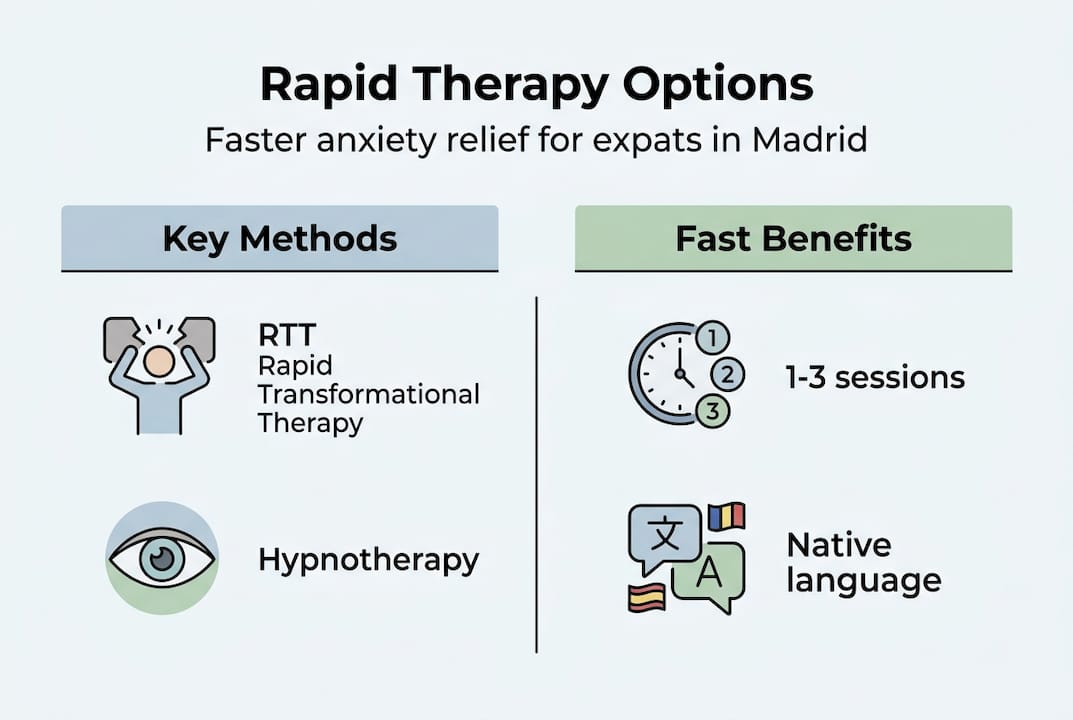
Hypnotherapy on its own also carries strong empirical support. A single hypnotherapy session improves executive function and reduces stress and anxiety in stressed individuals, with an effect size of d=0.62. Ericksonian hypnotherapy shows a large effect versus controls, with a standardized mean difference of 1.17. Those are meaningful numbers.
Here is how these rapid approaches compare:
Therapy | Typical sessions | Primary mechanism | Best for |
RTT | 1 to 3 | Regression and reprogramming | Root-cause anxiety, trauma, burnout |
Hypnotherapy | 1 to 6 | Subconscious suggestion | Stress, sleep, habit change |
EMDR | 6 to 12 | Bilateral stimulation | Trauma reprocessing |
CBT | 12 to 20 | Cognitive restructuring | Ongoing anxiety, depression |
A practical sequence for expats seeking rapid relief:
Book a discovery call to identify your primary challenge.
Complete an initial assessment in your native language.
Begin with RTT or hypnotherapy for fast root-cause work.
Layer in CBT or EMDR if deeper processing is needed.
Use self-hypnosis recordings between sessions to reinforce change.
Pro Tip: Ask your therapist specifically about what RTT therapy involves before your first session. Understanding the process reduces anxiety about the process itself, which makes the session more effective.
For a broader comparison, reviewing rapid therapy methods for anxiety and trauma and understanding CBT vs RTT helps you make an informed choice rather than guessing.
What to expect: the multilingual therapy experience in Madrid
With an understanding of therapy options, here is what the actual process looks like for expats seeking multilingual support in Madrid.
Your first session is not about diving straight into trauma. It is a structured needs assessment conducted entirely in your preferred language. The therapist listens for the emotional patterns underneath your presenting problem, not just the surface story.
Multilingual therapists in Madrid provide English-speaking therapy using CBT, EMDR, and other modern techniques adapted for expat needs. Sessions are shaped around your cultural context, not a generic template.

Here is a realistic session-by-session breakdown:
Session | Focus | What happens |
1 | Assessment | Language preference confirmed, goals set, method selected |
2 | Root-cause work | RTT regression or EMDR processing begins |
3 | Reprogramming | New beliefs installed, coping tools introduced |
4 and beyond | Integration | Progress reviewed, maintenance strategies built |
Progress is monitored every session using brief check-ins on symptom intensity. This keeps the work focused and gives you visible evidence that things are shifting. Exploring the personalized therapy process in more detail can help you walk into your first session with realistic expectations and confidence.
Common concerns and misconceptions about fast-acting multilingual therapy
Knowing what to expect is empowering, but many still wonder: can these rapid, language-based therapies truly deliver lasting change?
The honest answer is: yes, with nuance. RTT and hypnotherapy are praised for speed but have faced criticism for relying on anecdotal evidence and lacking large randomized controlled trials. That is a fair critique. CBT has decades of large-scale research behind it. RTT is newer and the evidence base is still growing.
“Speed without sustainability is not healing. The goal is rapid relief that holds, not a temporary lift that fades.”
But here is the counter-argument that skeptics often miss:
Hypnotherapy reduces anxiety and stress significantly, with a meta-analytic standardized mean difference of 1.17 versus controls.
Regression therapy cuts symptoms by 47% in four months, which is faster than most CBT protocols.
For expats who need urgent relief, waiting 20 sessions for CBT to work is not always a realistic option.
Rapid approaches are not replacing evidence-based care. They are complementing it.
The advantages of RTT are most visible when the method is used by a trained therapist who integrates it with other validated approaches rather than using it in isolation. Reading about RTT therapy success from real client experiences gives you a grounded sense of what is realistic.
The bottom line: if you are an expat in Madrid dealing with anxiety, burnout, or trauma, waiting for a perfect evidence base before seeking help is itself a risk. Effective, culturally sensitive, native-language therapy is available now.
Ready to try multilingual counseling in Madrid?
If you are facing anxiety, burnout, or trauma as an English-speaking expat, the right counselor can make all the difference. Heske Therapy offers multilingual support in English, Spanish, and Dutch, with specialized experience working with expatriates navigating exactly the challenges described in this guide.
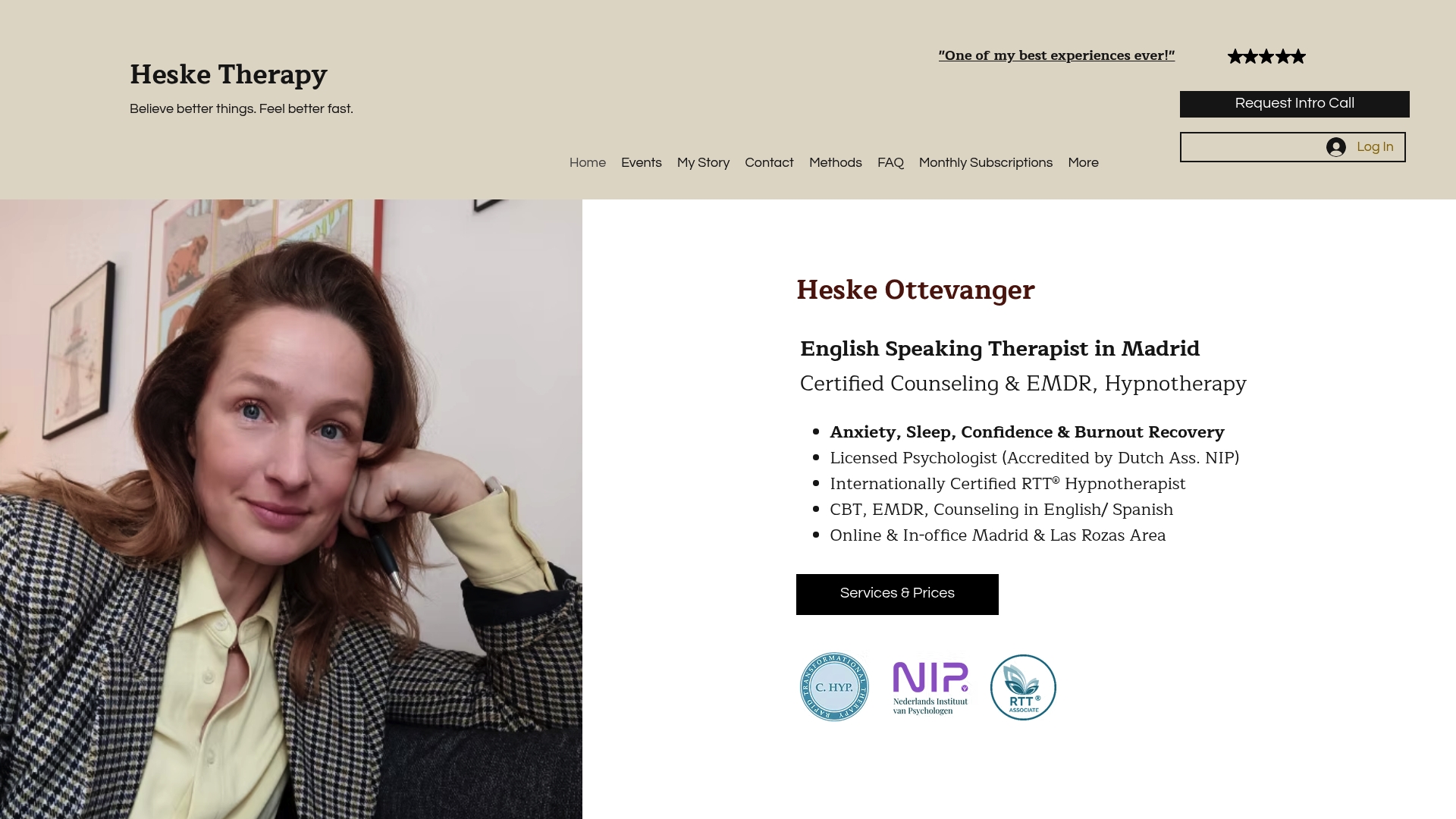
Sessions are available both online and in-office in Madrid, using RTT, EMDR, CBT, and hypnotherapy tailored to your specific needs and preferred language. You can also explore self-hypnosis for relaxation as a between-session tool to reinforce your progress. Whether you are just starting to consider therapy or ready to book your first session, Heske Therapy offers a free discovery call so you can ask questions and find out if the approach is right for you, with no pressure and no commitment required.
Frequently asked questions
Can therapy in my native language really speed up progress?
Yes. Therapy in your first language allows deeper emotional processing because you express feelings precisely rather than approximately, which leads to faster breakthroughs.
How many sessions does RTT or hypnotherapy usually take?
Many clients see significant improvement in just 1 to 3 sessions for anxiety, burnout, or trauma, though some choose to continue for deeper integration work.
Is there strong scientific proof for rapid therapies like RTT?
Hypnotherapy shows large effect sizes versus controls in empirical studies, while RTT is promising for speed but still needs more large-scale randomized trials to match CBT’s evidence base.
Are these therapies suitable for all expats in Madrid?
Most expats can benefit, but therapists personalize methods based on individual needs, presenting challenges, and preferred language to ensure the approach fits.
How does multilingual counseling address expat burnout?
It helps you process stress in your strongest language, making it easier to identify triggers and build new coping strategies, as native-language expression removes the cognitive load of translating your inner world.
Recommended
Comments