The Process for Rapid Transformation: A Practical Guide


TL;DR:
Rapid Transformational Therapy combines hypnotherapy, CBT, and NLP to quickly reprogram subconscious beliefs. It typically results in lasting change within 1 to 3 sessions, reinforced by a 21-day audio routine. Active participation after therapy is essential to solidify new neural pathways and ensure permanent improvement.
Rapid Transformational Therapy (RTT) is defined as a structured therapeutic method that combines hypnotherapy, cognitive behavioral therapy (CBT), and neuro-linguistic programming (NLP) to resolve emotional blocks at their subconscious root. The process for rapid transformation works by bypassing the conscious mind’s defenses, accessing the memories and beliefs that drive anxiety, burnout, and self-sabotage, then rewriting them with precision. Unlike traditional talk therapy, which can take years, RTT typically delivers permanent resolution within 1–3 sessions. That compression of timelines is not a marketing claim. It reflects a fundamentally different mechanism: working with the subconscious rather than around it.
What are the core components of the rapid transformation process?
RTT’s power comes from combining three well-established therapeutic disciplines into a single session. RTT integrates hypnotherapy, CBT, and NLP to access and reprogram subconscious beliefs that standard counseling rarely reaches. Each discipline plays a distinct role. Hypnosis creates the access point, CBT provides the reframing structure, and NLP interrupts the behavioral patterns that keep people stuck.
Before the session begins, several prerequisites determine how effective the process will be:
Clear intention: You need a specific issue to address, whether that is chronic anxiety, burnout, a phobia, or low self-worth. Vague goals produce vague results.
Willingness to be hypnotized: Hypnosis requires consent and relaxation. Resistance blocks the induction.
Time and space: Sessions typically run 90–120 minutes to allow deep subconscious exploration. Rushing the process defeats its purpose.
Post-session commitment: A personalized audio recording must be listened to daily for 21 consecutive days after the session. This is non-negotiable for lasting change.
Component | Role in the process |
Hypnosis induction | Creates focused, relaxed state for subconscious access |
CBT reframing | Restructures negative beliefs into accurate, empowering ones |
NLP pattern interruption | Breaks automatic behavioral and emotional loops |
Personalized audio | Reinforces new neural pathways daily for 21 days |
Pre-session goal setting | Focuses the session on the root issue, not surface symptoms |
Pro Tip: Write down your three most persistent negative beliefs about yourself before your first session. Your therapist will use these as entry points for the hypnotic work, and having them clear in your mind accelerates the root-cause discovery.

How does a rapid transformation session work, step by step?
A single RTT session follows a deliberate sequence. Each step builds on the last, and skipping or rushing any stage reduces the outcome. Here is what actually happens.
Pre-session assessment and goal setting. Your therapist asks targeted questions about your presenting issue, its history, and what resolution looks like for you. This is not small talk. It shapes the hypnotic suggestions used later in the session.
Hypnotic relaxation induction. The therapist guides you into a deeply relaxed, focused state. Hypnosis induces focused attention that allows access to subconscious material safely and without force. You remain aware throughout. You are not asleep, and you cannot be made to say or do anything against your will.
Accessing root memories. Once in the hypnotic state, you revisit memories connected to your issue. These are often childhood experiences that formed the original belief. A person with chronic anxiety may trace it back to a moment of public humiliation at age seven, not to any adult experience they consciously remember.
Reframing and emotional reprocessing. The therapist guides you to view those memories through an adult lens. The goal is not to erase the memory but to strip it of its emotional charge and replace the false belief it created. A child who concluded “I am not safe” can recognize, as an adult, that the danger has passed.
Delivering positive suggestions. With the subconscious open and the old belief neutralized, the therapist introduces new, accurate beliefs directly. This is where CBT and NLP techniques layer in, reinforcing the reframe with language patterns that the subconscious accepts readily.
Creating the personalized audio. At the close of the session, the therapist records a customized audio track built from the specific language and suggestions used during your session. This audio reinforces positive subconscious changes daily, continuing the rewiring process long after you leave the room.
Pro Tip: Listen to your personalized audio in the morning before checking your phone or at night just before sleep. Both windows give the subconscious mind its best chance to absorb new patterns without interference from daily noise.
What role does neuroplasticity play in sustaining rapid transformation?
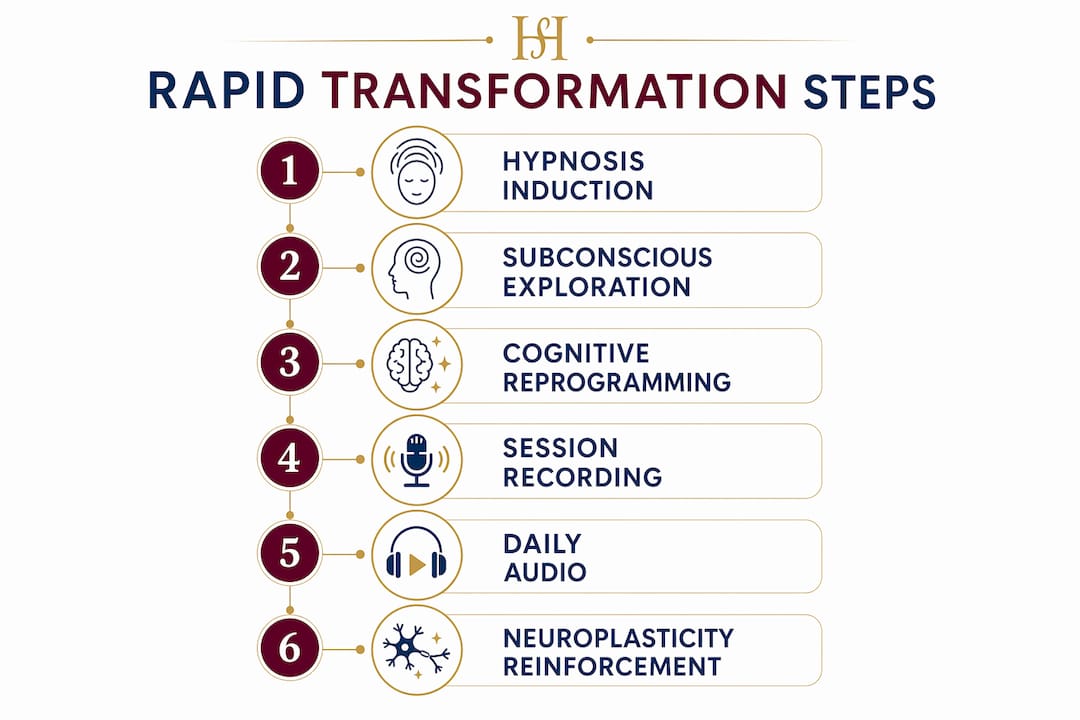
Neuroplasticity is the brain’s ability to form new neural pathways in response to repeated experience. RTT uses this mechanism deliberately. The session creates the initial shift, but the 21-day audio routine is what converts that shift into a permanent new default.
Listening to the personalized audio for 21 consecutive days is the critical post-session commitment that makes the difference between a temporary insight and a lasting change. Each listening session fires the same neural circuits activated during hypnosis. Repetition strengthens those circuits until the new belief becomes automatic.
“The 21-day audio routine is the hidden engine of RTT. The session opens the door; the audio walks you through it every day until the new pattern is home.”
Practical ways to build the daily audio habit:
Anchor it to an existing routine. Pair the audio with your morning coffee, your commute, or your pre-sleep wind-down. Habits attach more easily to existing triggers.
Use quality audio equipment. Earbuds or headphones improve focus and reduce ambient distraction, which matters when the content is working at a subconscious level. Wellness audio platforms like U4RIA offer guided listening environments that complement this kind of daily practice.
Track your streak. A simple calendar check-mark creates accountability. Missing one day is recoverable. Missing several in a row disrupts the neuroplastic momentum significantly.
Skipping audio days resets transformation momentum in a way that is hard to recover from without repeating the session. This is not a metaphor. The neural pathways being built require consistent activation to strengthen. Inconsistency leaves them fragile.
What misconceptions should you know before starting rapid transformation?
The most common misconception is that the session alone is enough. It is not. The session is the surgery; the audio is the rehabilitation. Expecting permanent change without the 21-day commitment is like expecting a broken bone to heal without a cast.
A second misconception involves emotional pain during hypnosis. When difficult memories surface, many people interpret the discomfort as a sign something is going wrong. The opposite is true. Emotional intensity during the session signals that the root cause has been found. That is the material the therapist needs to work with.
Misconception 1: “One session fixes everything instantly.” Reality: transformation unfolds as immediate, gradual, and retroactive effects over days and weeks. Some shifts are felt the same day; others become visible only in hindsight.
Misconception 2: “Hypnosis means losing control.” Reality: you remain conscious and can exit the state at any time. The therapist facilitates; you participate.
Misconception 3: “If I don’t feel different right away, it didn’t work.” Reality: incremental change is normal. Clients often notice the shift when they realize they have stopped reacting to a trigger that used to derail them.
Misconception 4: “My anxiety is just who I am.” Reality: emotional blocks often originate in past experiences rather than innate personality. They were learned, which means they can be unlearned.
Pro Tip: Keep a brief daily journal during your 21-day audio period. Note any changes in mood, reaction, or thought patterns, even small ones. This builds self-awareness and helps you recognize retroactive shifts that might otherwise go unnoticed.
For a deeper look at how these techniques apply specifically to anxiety, the RTT anxiety relief guide at Hesketherapy covers clinical applications in detail.
Key Takeaways
The process for rapid transformation works because it targets the subconscious root of emotional blocks directly, then reinforces new beliefs through structured daily repetition over 21 days.
Point | Details |
RTT combines three disciplines | Hypnotherapy, CBT, and NLP work together to access and rewrite subconscious beliefs. |
Sessions run 90–120 minutes | Longer than standard therapy to allow deep hypnotic exploration of root memories. |
21-day audio is non-negotiable | Daily listening builds the neural pathways that make new beliefs permanent. |
Change unfolds in three ways | Expect immediate, gradual, and retroactive shifts rather than one dramatic moment. |
Emotional pain signals progress | Discomfort during hypnosis means the root cause has been reached, not that something is wrong. |
What I have learned from watching clients transform
The moment that surprises clients most is not the hypnosis itself. It is the memory that surfaces. Time and again, I watch someone come in convinced their anxiety is about their job or their relationship, only to find themselves revisiting a moment from childhood they had not thought about in decades. That is RTT doing exactly what it is designed to do.
What I have also learned is that the session is the easy part. The 21 days afterward are where commitment is tested. Clients who listen to their audio every single day, without exception, report changes that feel almost unfair in how quickly they arrive. Clients who skip days often come back frustrated, wondering why the shift has not held. The neuroscience is unambiguous on this point: consistency is the mechanism.
I want to be honest about expectations, too. RTT is not a single magic session that erases decades of pain in 90 minutes. What it does is give you the fastest known route to the root of the problem, and then hands you a tool to rebuild from there. The advantages of RTT are real, but they require your active participation after the session ends.
For clients dealing with burnout or anxiety as expats navigating a new culture, the combination of speed and depth that RTT offers is genuinely different from anything else I have worked with. The integration of CBT reframing and NLP pattern interruption means the work does not stop when the hypnosis ends. It continues every time you press play on your audio.
— Heske
RTT therapy at Hesketherapy: what to expect
If you are ready to move beyond managing symptoms and address what is actually driving your anxiety or burnout, Hesketherapy offers personalized RTT therapy sessions available both online and in-person in Madrid. Each session is tailored to your specific issue, conducted in English, Spanish, or Dutch, and includes a custom audio recording built from your session.
Hesketherapy works with English-speaking expatriates and international clients who need results without spending years in weekly sessions. A free discovery call is available to help you decide whether RTT is the right fit before you commit. The step-by-step RTT success guide on the Hesketherapy site walks through what to prepare and what to expect at every stage.
FAQ
What is Rapid Transformational Therapy (RTT)?
RTT is a therapeutic method that combines hypnotherapy, CBT, and NLP to access and reprogram subconscious beliefs driving emotional and behavioral problems. It is designed to deliver lasting results in 1–3 sessions.
How many RTT sessions does it take to see results?
Most clients achieve lasting change within 1–3 sessions, with the post-session 21-day audio commitment playing a critical role in sustaining those results.
Is hypnosis during RTT safe?
Yes. During RTT, clients enter a focused, relaxed state and remain conscious throughout. They cannot be made to act against their will and can exit the hypnotic state at any time.
Why is the 21-day audio recording so important?
The audio recording fires the same neural circuits activated during the session, building new pathways through repetition. Skipping days disrupts neuroplastic momentum and can prevent the new beliefs from becoming permanent.
Can RTT help with anxiety and burnout specifically?
RTT is particularly effective for anxiety and burnout because both conditions are rooted in subconscious belief patterns that hypnosis can access directly. Hesketherapy specializes in these presentations for expat and international clients.
Recommended
Comments