Trauma Migratorio: What It Is and How to Heal


Trauma migratorio is the cluster of stress and grief responses that follow forced or difficult migration, and it shows up as somatic symptoms, hypervigilance, and unresolved mourning rather than a single diagnosable condition. It overlaps with duelo migratorio (the layered grief of leaving home, family, and identity behind) and can intensify into what Spanish-language clinical literature calls Síndrome de Ulises when chronic stress goes unaddressed for too long.
If you recognize yourself in this, three things matter right now:
Stabilize the basics first. Sleep, food, and a few minutes of grounding (slow breathing, naming five things you see) calm the nervous system before anything else can help.
Find culturally informed care. A therapist who understands migration, not just trauma in general, matters more than credentials alone.
Address legal and material stressors directly. Contact a rights organization or legal aid service if immigration status or documentation is adding to the weight.
Neither DSM-5 nor ICD-11 lists trauma migratorio as its own diagnosis, which is part of why so many people go undiagnosed for years. Clinicians often draw instead on psychiatrist Joseba Achotegui’s seven losses model and tools like EMDR to treat what shows up.
Migratory grief isn’t a phase you pass through once. It’s a set of losses that can resurface for years, especially when the reception you receive on arrival is cold or precarious.
Key Takeaways
Trauma migratorio combines traumatic stress and layered grief tied to migration, and it responds best to phased care that pairs somatic regulation with culturally informed therapy and social support.
Point | Details |
Not a single diagnosis | Trauma migratorio and Síndrome de Ulises fall outside DSM-5 and ICD-11 but describe real, treatable suffering. |
Symptoms hide as physical complaints | Watch for sleep disturbance, somatic pain, and hypervigilance rather than expecting textbook trauma signs. |
Reception conditions shape outcomes | Legal status, discrimination, and access to rights predict recovery as much as individual resilience. |
Combine therapy with social support | EMDR and trauma-focused CBT work best alongside legal aid, community ties, and language-matched care. |
Heske Therapy offers a starting point | Multilingual EMDR and integrative therapy in Madrid, online or in person, for expats facing migration-related trauma. |
Table of Contents
What Is Trauma Migratorio and How Does It Differ From PTSD?
Duelo migratorio describes the layered, partial, and often recurring losses that come with leaving a country: family, language, social status, landscape, and a sense of belonging. Trauma migratorio refers more specifically to the traumatic stress responses tied to migration events themselves, whether that’s violence during the journey, family separation, or the chronic strain of navigating a new legal and social system.
Síndrome de Ulises sits between the two. It’s a reactive condition, not a formal diagnosis, caused by chronic and multiple social stressors that block normal grief processing. Someone can meet criteria for depression or post-traumatic stress disorder and still not fully capture what’s happening; migratory grief often includes identity disruption and social invisibility that standard mood and trauma scales don’t measure well.
The overlap with PTSD and depression is real, but the mechanism is different: it’s not one traumatic event, it’s an accumulation of losses without space to grieve them.
That distinction shapes how clinicians assess and prioritize care.
How Does Trauma Show Up Across Migration Phases?
Migration isn’t one event. It’s a sequence of phases, and stress presents differently in each one.
Pre-migration: Exposure to violence, persecution, or economic collapse that triggers the decision to leave. A person might describe recurring dreams about the danger they fled even years later.
The journey: Risk of assault, exploitation, or loss of companions en route. Survivors often report emotional numbness that only lifts once they feel physically safe.
Early arrival: Bureaucratic uncertainty, language barriers, and the shock of an unfamiliar system. This is when someone might present in a clinic with insomnia and no clear explanation why.
Long-term settlement: Identity strain, discrimination, and the slow erosion of hope if legal status or social integration stalls for years.
Distress that persists or worsens well past the arrival phase, especially alongside functional impairment, warrants screening for complex trauma rather than a wait-and-see approach.
What Symptoms Point to Migration-Related Trauma?
Migration-related trauma rarely announces itself as “trauma.” It tends to arrive disguised as physical complaints, sleep problems, or a vague sense that something is wrong.
Common clusters include somatization (headaches, gastrointestinal issues, unexplained pain), sleep disturbance, hypervigilance, intrusive memories, avoidance of reminders, depressive symptoms, and a disrupted sense of identity. Chronic activation of the body’s stress response can produce fatigue and pain syndromes that show up first in a primary care office, not a therapist’s chronic HPA-axis activation and autonomic dysregulation that often gets treated as a physical problem alone.
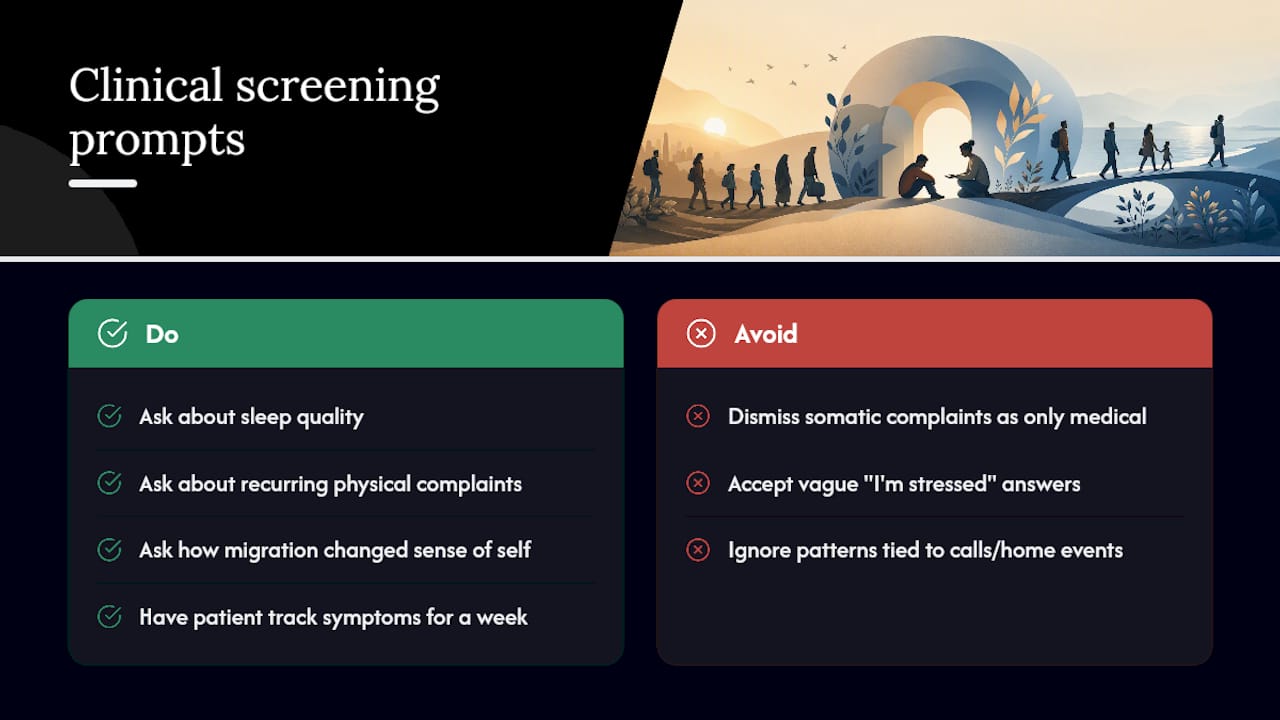
For clinicians, a useful checklist includes asking about sleep quality, recurring physical complaints without clear medical cause, and how the person describes their sense of self since migrating. For those describing their own experience, naming specific sensations, tight chest, racing thoughts at night, stomach pain with no diagnosis, gives a clinician far more to work with than “I feel stressed.”
Pro Tip: Write down your physical symptoms for a week before your appointment. A pattern of headaches every Sunday night or stomach pain before calls home says more than a general description ever will.
What Risk Factors Make Migratory Trauma Worse?
Not everyone who migrates develops chronic distress, and the difference often comes down to circumstances more than personality.
Risk factors: Separation from family, irregular legal status, violence exposure during the journey, discrimination, loss of professional or social status, and pre-existing trauma history.
Protective factors: Stable social networks, access to legal rights and services, culturally sensitive care, and support in one’s own language.
Reception conditions, whether a country meets someone with dignity or with hostility, are one of the strongest predictors of long-term mental health outcomes for migrants.
Policy and local reception conditions shape recovery as much as any individual factor does, which means advocacy and access to rights belong in the treatment conversation, not outside it.
When Should You Seek Professional Help for Migration Trauma?
A brief structured check can clarify whether someone needs immediate care or ongoing support.
Establish physical and emotional safety first.
Screen for suicidal thoughts or self-harm directly and without euphemism.
Ask about somatic symptoms: sleep, pain, appetite, energy.
Ask about legal stressors and family separation specifically.
Use culturally adapted questions rather than assuming a Western symptom checklist fits.
Certain signs call for urgent referral rather than a wait-and-see approach:
Risk behaviors or expressed hopelessness
Severe or worsening somatic complaints
Functional impairment that persists for weeks
Signs consistent with Síndrome de Ulises: persistent sadness, irritability, and a sense of identity loss alongside physical symptoms
When raising this with a clinician or support worker, bring a simple timeline: when symptoms started, what’s changed since arrival, and any physical complaints you’ve tracked.
What Treatments and Supports Actually Help?
Trauma-focused CBT and EMDR are the most commonly used evidence-based approaches for migration-related trauma, and both work well when adapted to a person’s language and cultural context rather than applied as a rigid protocol. EMDR in particular doesn’t require the person to narrate every detail verbally, which matters for those who find it hard to put the journey into words. Culturally adapted psychotherapy, ideally in a shared language, consistently outperforms generic approaches because so much of migratory grief is tied to meaning, identity, and social context that a mismatched therapeutic frame can miss entirely.

Community-level supports matter just as much as individual therapy. Peer groups, legal aid, ongoing family contact, and small cultural rituals, cooking a dish from home, marking a holiday, help rebuild a sense of continuity. Community-based approaches work best as a complement to individual therapy rather than a replacement for it.
While waiting for or alongside formal care, a few practices genuinely help:
Diaphragmatic breathing for a few minutes, several times a day
Grounding exercises during moments of overwhelm
Consistent sleep hygiene, even when life circumstances are unstable
Small rituals that maintain a connection to people and places left behind
Pro Tip: If legal status is part of your stress, loop your therapist and a legal aid contact together early. Migration-related trauma rarely resolves through therapy alone when a legal case is still unresolved.
Trauma recovery techniques built specifically for people navigating life abroad can offer a useful starting point for daily practice.
What Does the Research Say About Migratory Grief?
Joseba Achotegui’s seven losses model remains the clearest clinical framework in this field: family and loved ones, language, culture, land and landscape, social status, group belonging, and physical safety. Each loss shapes what a clinician should prioritize, and losing several at once is what pushes grief toward chronification.
Síndrome de Ulises grew out of clinical observation of migrants facing chronic, compounding stressors with no path to resolution. It isn’t a diagnosis you’ll find in a manual, but it names something real: suffering caused by circumstances, not by individual pathology.
The clinical implication is straightforward: combine body-based regulation, narrative work that lets the migration story be told at the person’s own pace, and social or rights-based interventions that address the conditions causing the distress in the first place.
A note from Heske Therapy
At Heske Therapy, working with expats across English, Spanish, and Dutch has shown me how much migratory grief depends on being understood in one’s own language and cultural frame. EMDR and integrative therapy can help; reaching out for an intake is a reasonable next step if this resonates.
How Heske Therapy Can Help You Move Forward
If the phases and symptoms described here sound familiar, working through them alone gets harder the longer legal uncertainty or isolation drags on. Heske Therapy offers EMDR, integrative psychotherapy, and multilingual sessions in English, Spanish, and Dutch, both online and in person, built specifically for people navigating life away from home.
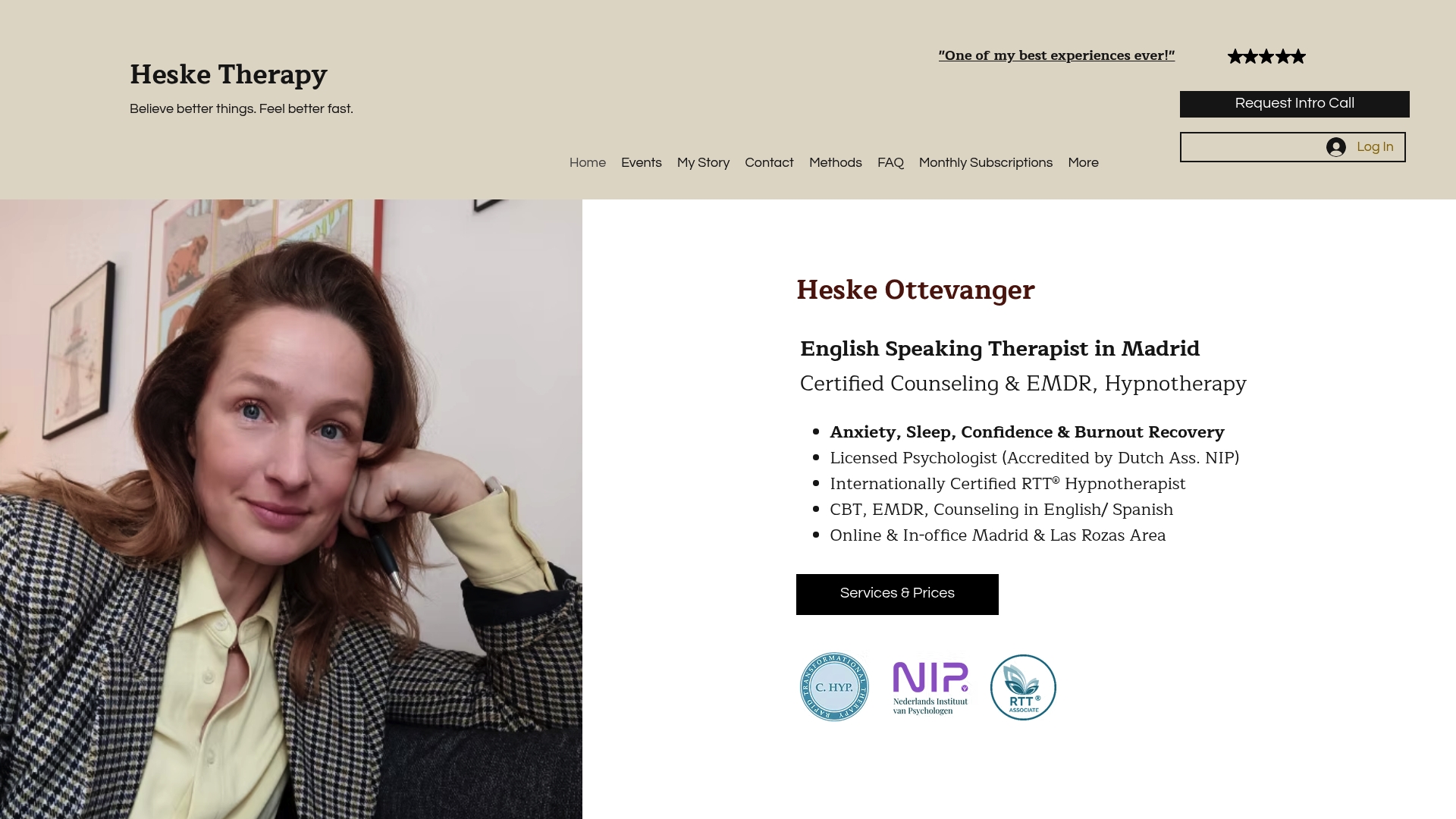
A first intake typically starts with a conversation about your migration story, current symptoms, and what support looks like practically, whether that’s weekly sessions, multilingual therapy in your first language, or a mix of EMDR and integrative approaches. Sessions are confidential, and the format adapts to whether you’re based in Madrid or connecting from elsewhere. If migratory trauma or unresolved grief has been sitting untreated, book an EMDR or hypnotherapy consultation to start with a clear, structured first step.
Sources
Treat academic sources as background framing and clinical guides as practical direction for assessment and care.
This article is general information, not a substitute for advice from a qualified doctor. Consult a qualified healthcare professional about your own circumstances before acting on anything here.
Recommended
Comments