Why Treat Stress Proactively: Benefits and Strategies


TL;DR:
Proactive stress management involves addressing early warning signals through consistent habits to prevent chronic mental and physical health issues. It protects brain functions, reduces recovery time, and builds resilience, ultimately enhancing long-term well-being and performance. Small, routine actions like mindful breathing, journaling, and therapy serve as effective, sustainable strategies for maintaining stress health before crises develop.
Proactive stress management is the practice of addressing stress before it escalates into chronic mental or physical illness. Most people wait until they’re overwhelmed to act. 68% of adults practice self-care reactively, reaching for relief only when they’re already struggling. That gap between early signals and late action is where burnout, anxiety disorders, and physical symptoms like migraines and IBS take root. Understanding why treat stress proactively matters is not just reassuring. It’s the first step toward doing something about it before the cost becomes too high.
Why treating stress proactively protects your brain and body
Treating stress early preserves the prefrontal cortex, the part of your brain responsible for decision-making, planning, and emotional regulation. When stress goes unmanaged, the brain shifts resources away from this region and toward the amygdala, the threat-detection center. Early stress intervention prevents this shift, keeping your thinking clear and your reactions measured rather than reactive.
The benefits of proactive stress management extend well beyond mental clarity. Here is what the research shows:
Reduced recovery time. Catching stress early means your nervous system never reaches full dysregulation. You bounce back from hard days faster because your baseline is more stable.
Prevention of emotional amplification. Preserving prefrontal cortex function stops the cycle where small frustrations feel catastrophic. Your emotional responses stay proportionate.
Lower risk of burnout. A 2026 randomized controlled trial published in BMC Public Health found that proactive stress training reduces psychological strain, anxiety, and depression even in short formats. Prevention works faster than recovery.
Sustained sense of control. When you manage stress as a routine rather than a crisis, you build confidence in your own capacity to cope. That confidence itself becomes a buffer.
Pro Tip: Track your stress signals for one week before trying to fix anything. Patterns like jaw tension, poor sleep, or irritability before certain meetings are early warning data. Use them.
The physiological case is equally strong. Chronic stress triggers the HPA axis, the hormonal cascade involving the hypothalamus, pituitary gland, and adrenal glands. Interrupting this cascade early requires far less effort than reversing full dysregulation later. Think of it as catching a small leak before it floods the basement.

How proactive stress treatment differs from reactive approaches
Reactive stress management treats stress like an emergency. You feel overwhelmed, you reach for relief. Proactive stress management treats it like nutrition. You maintain it consistently so you never reach depletion. That shift in mindset changes everything about how you respond to pressure.
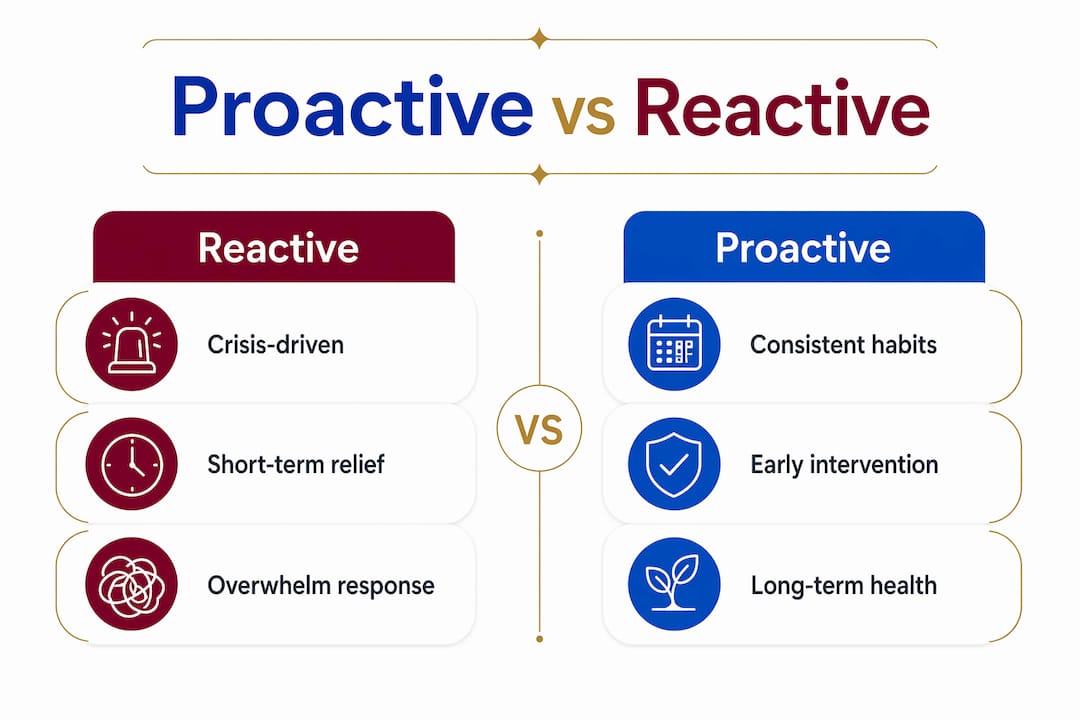
The neuroscience behind this distinction matters. Neuroplasticity research shows that early intervention prevents the HPA axis from forming persistent hypervigilant pathways. Once those pathways are established through chronic stress, rewiring them takes significantly more time, effort, and often professional support. Acting early keeps the brain flexible.
A common misconception is that proactive stress care requires major lifestyle overhauls. It does not. The American Institute of Stress notes that the myth of stress being necessary for success keeps many people from adopting small, effective habits. The reality is that minor, consistent adjustments restore energy and capacity far more reliably than dramatic changes.
Reactive approach | Proactive approach |
Acts only when overwhelmed | Acts consistently as a daily routine |
Focuses on symptom relief | Focuses on building resilience |
Requires significant recovery time | Reduces recovery time through prevention |
Treats stress as an emergency | Treats stress management as maintenance |
High emotional cost before action | Low ongoing cost with cumulative gains |
Pro Tip: If you notice you only think about stress management when you’re already struggling, set a weekly 10-minute check-in with yourself. Ask: “What is my stress level today, and what small thing can I do right now?” That question alone shifts you from reactive to proactive.
What practical strategies help you manage stress early
The most effective proactive strategies are the ones you will actually sustain. That means starting small and building from there. Micro-habits like short mindful breathing exercises, hydration rituals, and gratitude journaling build cumulative resilience without requiring time-intensive lifestyle changes. They work because they lower your baseline stress level day by day.
Here are the strategies with the strongest evidence base:
Mindful breathing (2 to 5 minutes daily). Activates the parasympathetic nervous system, directly countering the fight-or-flight response. Box breathing, where you inhale for four counts, hold for four, exhale for four, and hold for four, is one of the most studied formats.
Gratitude journaling. Writing three specific things you are grateful for each morning rewires attention away from threat-scanning. Specificity matters more than volume.
Physical exercise. Even 20 minutes of moderate movement three times per week lowers cortisol and raises BDNF, a protein that supports brain resilience. You do not need a gym membership to get this benefit.
Preventive therapy and counseling. Therapy as preventive care acts as a psychological buffer, helping you manage everyday stress before it snowballs into full crises. Approaches like CBT, EMDR, and Rapid Transformational Therapy (RTT) build coping skills you carry into every stressful situation. You can explore anxiety relief methods that work before stress becomes acute.
Social support and boundary-setting. Maintaining connections before crises arise offers the strongest protection against chronic stress. Boundaries are not about saying no to everything. They are about protecting the energy you need to show up well.
The “adjust, don’t stop” mindset. When stress signals appear, make a small real-time change rather than pushing through or shutting down entirely. Reduce one commitment, take a shorter break, or shift your environment. Small real-time adjustments sustain productivity and health rather than forcing a breaking point.
Pro Tip: Stack micro-habits onto existing routines. Mindful breathing while your coffee brews. Gratitude journaling while you wait for your computer to start. Habit stacking removes the friction of “finding time.”
How proactive stress treatment shapes long-term mental health
The long-term case for why manage stress proactively is built on compounding returns. Every week you maintain a proactive routine, your nervous system becomes more regulated, your emotional responses more measured, and your relationships more stable. These gains reinforce each other.
The CDC’s mental health guidance links proactive stress treatment directly to reduced risk of anxiety disorders, clinical depression, and burnout. These are not minor outcomes. Anxiety and depression are among the leading causes of disability worldwide, and burnout costs organizations billions annually in lost productivity. Prevention is not just a personal investment. It is a structural one.
Proactive care also changes how you perform under pressure. When your baseline stress level is low, you have more cognitive bandwidth for creative thinking, problem-solving, and clear communication. Relationships improve because you are not operating from a place of depletion. You listen better, react less impulsively, and recover faster from conflict.
“Preventive therapy is shifting mental health care paradigms, emphasizing routine stress management rather than crisis intervention, increasing resilience and faster recovery.” — Wellbeing Magazine
For expatriates and international professionals navigating cultural transitions, language barriers, and social displacement, the importance of stress prevention is even more pronounced. The absence of a familiar support network amplifies every stressor. Building proactive habits and accessing burnout recovery support early prevents the kind of accumulated strain that can derail careers and relationships in a new country.
Key takeaways
Proactive stress management works because early intervention preserves brain function, prevents emotional escalation, and builds resilience before chronic patterns form.
Point | Details |
Act before overwhelm | 68% of adults wait until they’re struggling; acting early costs far less effort than recovery. |
Protect prefrontal function | Early intervention keeps decision-making and emotional regulation intact under pressure. |
Use micro-habits, not overhauls | Breathing, journaling, and hydration build cumulative resilience without major lifestyle changes. |
Therapy prevents, not just treats | Preventive counseling and RTT build coping skills that reduce crisis risk over time. |
Long-term gains compound | Consistent proactive care reduces anxiety, depression, and burnout risk while improving relationships and output. |
What I’ve learned from working with stress before it becomes a crisis
Most of the clients who come to me are not in crisis when they first reach out. They are tired, slightly overwhelmed, and have a nagging sense that something needs to change before it gets worse. That instinct is exactly right, and I wish more people trusted it sooner.
What I have observed consistently is that the clients who engage with proactive care, whether through RTT, EMDR, or regular counseling sessions, build a kind of internal infrastructure. They do not just feel better in the short term. They develop a relationship with their own stress signals that makes future challenges far less destabilizing. They recognize the early signs, they know what to do, and they do it without drama.
The barrier I hear most often is: “I’m not bad enough to need therapy.” That framing treats mental health care as a last resort rather than a maintenance practice. You do not wait until your teeth are falling out to see a dentist. The same logic applies here. Exploring hypnotherapy for stress relief or preventive counseling before you hit a wall is not weakness. It is good judgment.
Small, consistent actions outperform dramatic interventions every time. The clients who make the most lasting progress are not the ones who overhaul their lives in a week. They are the ones who show up for themselves in small ways, regularly, before things get hard.
— Heske
How Hesketherapy supports proactive stress care
Hesketherapy offers specialized therapy for English-speaking expatriates and international clients in Madrid and online, with a focus on treating stress, anxiety, and burnout before they become crises. Rapid Transformational Therapy (RTT) is one of the most effective tools in this work. It combines hypnotherapy, CBT, and NLP to produce rapid, lasting shifts in how your mind responds to stress. The RTT therapy method is designed for people who want results without years of weekly sessions. For a structured start, the 21-day RTT package provides a focused, supported program that builds proactive stress resilience from the ground up. Sessions are available in English, Spanish, and Dutch, in person or online.
FAQ
What does it mean to treat stress proactively?
Treating stress proactively means addressing stress signals early through consistent habits, mindset shifts, and professional support before they escalate into chronic anxiety, burnout, or physical illness. It is the opposite of waiting until you are overwhelmed to seek relief.
How early should you start managing stress?
The earlier the better. Interrupting the HPA axis cascade before chronic pathways form requires significantly less effort than reversing full dysregulation. Starting when stress is mild, not severe, produces the fastest and most lasting results.
Can micro-habits really make a difference for stress?
Yes. Micro-habits like mindful breathing and gratitude journaling build cumulative resilience over time without requiring major lifestyle changes. Consistency matters more than intensity.
Is therapy only for people in crisis?
No. Preventive therapy acts as a psychological buffer that helps manage everyday stress before it becomes a crisis. Many people benefit most from therapy precisely when they are not yet at a breaking point.
What is the fastest proactive stress relief technique?
Mindful breathing, specifically box breathing or diaphragmatic breathing, activates the parasympathetic nervous system within minutes. For deeper and faster results, RTT and evidence-based anxiety therapies produce lasting change in significantly less time than traditional talk therapy alone.
Recommended
Comments