CBT vs RTT for Expats: Which Therapy Fits You?


TL;DR:
Cognitive Behavioral Therapy and Rapid Transformational Therapy offer different approaches to managing expat anxiety and low mood. CBT focuses on conscious thoughts and skills, providing measurable progress through structured sessions, while RTT targets subconscious beliefs for rapid, deep change. Combining both therapies can lead to long-lasting improvement by addressing root causes and building daily habits.
If you need structured, skills-based tools to manage daily anxiety or low mood, Cognitive Behavioral Therapy (CBT) is likely your best starting point. If you’ve tried the logical approaches and still feel stuck, Rapid Transformational Therapy (RTT) often reaches the subconscious beliefs that conscious effort alone can’t shift. Your clearest next step: book a free discovery call with a licensed therapist who offers both, so you can describe your situation and get a personalized recommendation rather than guessing.
Quick orientation before you read further:
CBT uses randomized controlled trials (RCTs) and meta-analyses as its evidence base, making it a first-line clinical choice for anxiety, depression, and phobias.
RTT combines hypnotherapy, Neuro-Linguistic Programming (NLP), and psychotherapy to work at the subconscious level, typically in 1–3 sessions plus a 21-day audio recording practice.
Both are available online, which matters enormously when you’re living across time zones.
Table of Contents
How CBT and RTT compare across the dimensions expats care about
Dimension | CBT | RTT |
Focus | Conscious thoughts, skills, behaviors | Subconscious beliefs, root causes |
Core techniques | Cognitive restructuring, exposure, behavioral activation | Hypnosis, regression, NLP, personalized recording |
Typical sessions | several weekly sessions over multiple weeks | a few sessions plus a few weeks of recording practice |
Speed of change | Gradual, skill-building over weeks | Often reported as rapid, within days to weeks |
Evidence level | Strong RCTs and meta-analyses | Practitioner reports and integrative case outcomes |
Best for | Anxiety, phobias, depression, avoidance | Stuck patterns, deep-rooted beliefs, confidence blocks |
Online access | Widely available via teletherapy | Available online; recordings support between-session work |
Cultural fit | Structured; adapts to diverse backgrounds | Flexible; personalized recordings can reflect cultural context |
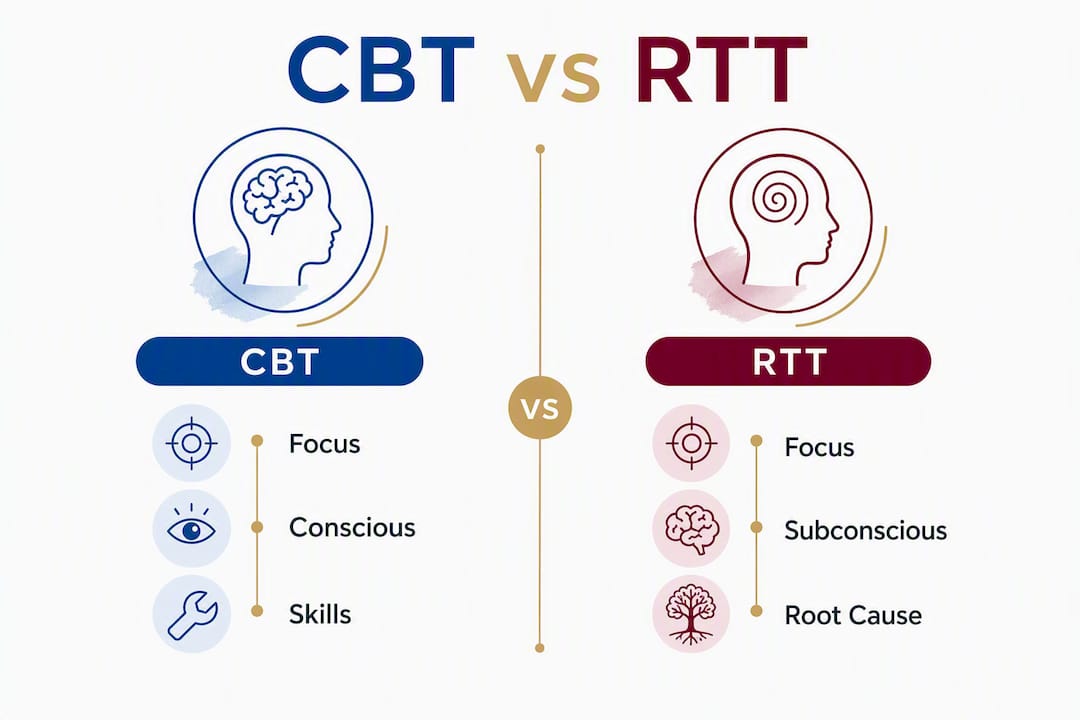
The columns that matter most for expats: online availability, language options, and whether the therapist has genuine experience with cross-cultural clients. A technically skilled therapist who has never worked with someone navigating dual identities will miss things a culturally attuned one catches immediately.
Clearest practical differences at a glance:
CBT requires consistent weekly attendance and structured homework between sessions.
RTT front-loads the work into fewer, longer sessions, then relies on a daily audio recording for reinforcement.
CBT change tends to be measurable and incremental; RTT change is often described as a shift in how you feel about yourself, sometimes within the first week of the recording practice.
How Cognitive Behavioral Therapy works in practice
CBT operates at the conscious level. It teaches you to notice the thought-feeling-behavior loop and interrupt it with evidence-based skills. The mechanism is straightforward: change the thought, and the emotional and behavioral response begins to shift.
Core techniques include:
Cognitive restructuring: Identifying distorted thinking patterns (catastrophizing, black-and-white thinking) and replacing them with balanced alternatives.
Exposure therapy: Gradually facing feared situations to reduce avoidance, particularly effective for anxiety in expat contexts like social anxiety during relocation.
Behavioral activation: Scheduling meaningful activities to counter low mood and withdrawal.
Skills practice: Homework between sessions to consolidate learning.
CBT is widely recommended as a first-line therapy for phobias, panic, and avoidance-based problems because its structured exposure work produces measurable skill gains. Sessions typically run about an hour each, and a full course extends over several weeks.
For expats, the structured homework model is both a strength and a challenge. You can practice skills anywhere in the world, but you need enough schedule stability to attend weekly sessions. Teletherapy platforms have largely solved the logistics; the time-zone math is the remaining variable.
How Rapid Transformational Therapy works and why practitioners call it “rapid”
RTT is a hybrid model developed by Marisa Peer that integrates hypnotherapy, NLP, CBT, and psychotherapy to access and reframe subconscious beliefs. Where CBT asks “what are you thinking?”, RTT asks “where did that belief come from, and is it still true?”
A typical RTT session runs 90–120 minutes. The therapist guides you into a relaxed, hypnotic state, then uses regression techniques to locate the root experiences that formed a limiting belief. The session closes with a personalized audio recording, which you listen to daily for 21 days to reinforce new neural pathways.
“Clients who feel stuck despite knowing what they should do often find RTT more effective than standard CBT, because it bypasses the analytical mind’s resistance to change and allows the subconscious to adopt new, empowering belief systems.” — Practitioner insight, Paramount Shift
Importantly, clients remain fully aware and in control during hypnosis. This is worth knowing if you’ve been hesitant about hypnotherapy based on stage-show misconceptions.
For expats, the recording-based model is a genuine advantage. You can listen on a flight, in a hotel room, or during a quiet morning in a new city. The advantages of RTT for expat mental health are especially clear for internationally mobile professionals who can’t commit to 20 consecutive weekly appointments.

Which therapy fits common expat concerns?
Most expat mental health challenges fall into recognizable patterns. Here’s how each therapy maps to them:
Relocation anxiety and social anxiety: CBT’s exposure-based approach works well for building confidence in new social environments step by step. RTT is more useful when the anxiety traces back to a deep-rooted belief about belonging or self-worth.
Homesickness and identity loss: RTT tends to address the subconscious grief and identity confusion that coping with homesickness can involve. CBT helps with the behavioral side: staying connected, building new routines.
Imposter syndrome: RTT is frequently the faster route here, because imposter syndrome is almost always a belief problem, not a skills problem. CBT can help with the surface thought patterns once the core belief has shifted.
Burnout: A combination often works best. RTT to address the underlying beliefs driving overwork; CBT to build sustainable boundaries and behavioral habits.
Sleep problems: CBT-I (Cognitive Behavioral Therapy for Insomnia) has the strongest evidence base for sleep. RTT’s recordings can support relaxation and reduce the anxiety that disrupts sleep.
Trauma: Both approaches have roles, but stabilization comes first. Neither CBT nor RTT should be the starting point for unprocessed acute trauma without a proper clinical assessment.
Sequential treatment is common and often the most effective path. Many clients begin with RTT to shift a core belief, then use CBT skills to consolidate the change in daily life.
How to choose a therapist for CBT or RTT
Questions to ask on a discovery call:
Are you a licensed psychotherapist or counselor in your country of practice?
What is your specific training in CBT and/or RTT, and how long have you been practicing each?
Do you have experience working with expatriates or internationally mobile clients?
What languages do you offer sessions in?
How do you handle time-zone scheduling and session cancellations for traveling clients?
What does aftercare look like once the main sessions are complete?
Red flags to watch for:
No clear license or credential when asked directly.
Guarantees of specific results (“You will be anxiety-free in one session”).
Pressure to commit to a long package before you’ve had an initial assessment.
No mention of contraindications or when they would refer you elsewhere.
No aftercare plan or follow-up structure.
Expat accessibility checklist:
Flexible time-zone scheduling (early morning or evening slots).
Sessions available fully online with a secure, HIPAA-aware platform.
Multilingual capacity or at minimum fluency in your preferred language.
Cultural competence with expat-specific stressors (dual identity, re-entry, corporate relocation).
Between-session materials (recordings, worksheets) you can use while traveling.
Pro Tip: Ask the therapist directly: “Have you worked with clients who travel frequently or live across time zones?” Their answer tells you more about practical fit than any credential alone.
When does it make sense to combine or sequence CBT and RTT?
Both therapies can complement each other. CBT within an RTT framework is sometimes used to identify surface thinking patterns that RTT then addresses at their root. The sequence depends on whether your primary issue is skill-based or belief-based.
Common sequences:
RTT first, then CBT: Best when a deep belief is blocking progress. RTT shifts the root; CBT builds the daily habits that make the shift stick.
CBT first, then RTT: Useful when you need immediate coping tools while exploring whether a deeper belief is driving the problem.
Parallel integration: Some therapists trained in both weave techniques within a single session or program, which is the approach at Hesketherapy.
Pro Tip: If you travel frequently, schedule RTT sessions before a stable period at home so you can complete the 21-day recording practice without major disruptions. CBT homework, by contrast, is easier to maintain across time zones because it requires only a journal and 10–15 minutes of daily practice.
What to expect in a first session and realistic timelines
First session, CBT:
The therapist conducts a structured assessment of your current symptoms and history.
You agree on specific, measurable goals.
You receive an introduction to the CBT model and your first homework task.
Timeline: measurable change typically appears within a few weeks; a full course generally extends over multiple weeks.
First session, RTT:
The therapist conducts an intake conversation about your goals and background.
You move into the hypnotic state and regression work within the same session.
You leave with a personalized audio recording to use daily for 21 days.
Timeline: many clients report a noticeable shift early in the recording practice; the full course of a few sessions is typically complete within several weeks.
Online sessions are effective for both approaches, and many clients report relaxing more deeply in their own home than in an office. For expats, this removes the logistical barrier of finding a qualified English-speaking therapist locally, which in many cities is genuinely difficult.
Between-session maintenance:
CBT: structured worksheets, thought records, behavioral experiments.
RTT: daily audio recording, journaling optional but encouraged.
Evidence, safety, and contraindications
CBT carries the strongest evidence base of any psychological therapy. CBT is supported by RCTs and meta-analyses for anxiety, depression, OCD, PTSD, and insomnia, making it a first-line recommendation in most clinical guidelines, including those used in the U.S. context.
RTT’s evidence base is different in nature. It is supported primarily by practitioner reports, integrative case outcomes, and client-reported results rather than large-scale RCTs. That doesn’t make it ineffective; it means the evidence is at an earlier stage of formal research.
Safety considerations and contraindications:
Active psychosis: neither CBT nor RTT is appropriate without psychiatric stabilization first.
Severe, unmanaged substance use: both therapies require a baseline of cognitive stability.
Acute trauma without stabilization: regression-based RTT work carries risk if trauma processing hasn’t been properly staged.
Dissociative disorders: hypnosis-based approaches require specialist assessment.
For expats navigating U.S.-based insurance, CBT is far more likely to be covered by a standard health plan than RTT, which is typically paid out of pocket. If you’re using international health insurance, check whether “psychotherapy” or “counseling” is covered and ask the insurer whether the therapist’s license type qualifies.
This article provides general information, not clinical advice. Confirm your specific situation with a licensed mental health professional or your primary care provider.
Hesketherapy: online CBT and RTT for expats
Hesketherapy is a licensed psychotherapy practice based in Madrid, offering both in-person and fully online sessions for English-speaking expatriates and international clients. Services include RTT, EMDR, CBT, counseling, and clinical hypnotherapy, delivered in English, Spanish, and Dutch.
Specializations: anxiety, burnout, trauma, sleep issues, low self-esteem, and stress-related physical symptoms.
Online availability: fully online sessions with flexible scheduling for clients across time zones.
Languages: English, Spanish, Dutch.
Session format: personalized therapy plans; three-month engagement model.
Discovery call: free initial call to assess fit before any commitment.
Explore RTT and online therapy options or view in-person and multilingual services to find the right starting point for your situation.
What expats say about CBT and RTT
Because fabricated testimonials serve no one, the accounts below reflect the kinds of experiences practitioners and expat support communities consistently document, drawn from publicly available practitioner pages and expat mental health resources.
Expats who have completed RTT programs frequently describe a shift in how they relate to a long-standing belief, often one they hadn’t consciously connected to their presenting problem. Someone who came in for burnout discovers a belief about never being enough that has been running quietly since childhood. The recording practice is often cited as the element that makes the change feel real rather than theoretical.
Expats who complete a CBT course tend to describe a growing sense of agency: they know what to do when anxiety spikes, they have a toolkit, and they feel less at the mercy of their own reactions. For internationally mobile professionals who value measurable progress, that sense of skill-building is itself therapeutic.
The clients who report the most durable outcomes are often those who used RTT to shift a core belief and CBT to build the daily habits that support the new way of seeing themselves. That combination reflects what therapy for expats looks like when it’s done well.
Key Takeaways
CBT is the evidence-backed first choice for skill-based expat challenges like anxiety and avoidance; RTT reaches subconscious beliefs faster for clients who feel stuck despite knowing what to do.
Point | Details |
CBT suits skill-based problems | Choose CBT for anxiety, phobias, and depression backed by RCTs and structured multiweek programs. |
RTT works faster for stuck patterns | RTT’s 1–3 session model plus 21-day recording targets root beliefs that conscious effort hasn’t shifted. |
Online access matters for expats | Both therapies are effective online; recordings give RTT clients an extra advantage across time zones. |
Combination is often most effective | RTT to shift a core belief, then CBT to build daily habits, produces the most durable outcomes. |
Hesketherapy offers both | Hesketherapy provides licensed CBT and RTT online in English, Spanish, and Dutch, with a free discovery call. |
A practitioner’s perspective on treating expats
Working with expats means working with people who are often high-functioning, highly self-aware, and genuinely puzzled about why they still feel stuck. They’ve read the books, they know the techniques, and yet something isn’t shifting. That’s where RTT tends to earn its place: not as a shortcut, but as a way of reaching the part of the mind that logical effort can’t access on its own. CBT remains the foundation for building the daily skills that make any deeper change sustainable. What I find most meaningful in this work is that cultural sensitivity isn’t an add-on; it’s the whole frame. An expat’s sense of identity, belonging, and self-worth is shaped by the experience of living between worlds, and any therapy that ignores that context is working with incomplete information. Online sessions, multilingual capacity, and genuine familiarity with expat life aren’t conveniences. They’re clinical necessities.
Useful sources and further reading
For evidence and clinical background:
CBT vs RTT comparison: Paramount Shift — practitioner overview of session models and timelines.
What is RTT Hypnotherapy: PAO Hypnosis — plain-English explanation of RTT’s hybrid methodology.
CBT vs RTT Hypnotherapy: Happy Minds Hypnotherapy — technique comparison and evidence notes.
Best therapist for anxiety: ReWired — clinical guidance on CBT for anxiety presentations.
RTT and CBT integration: ReWired — how the two approaches work together.
For expat mental health context:
Understanding mental health abroad — foundational concepts for internationally mobile clients.
Online therapy for expats: Expathy — guidance on finding culturally matched licensed therapists.
For practical next steps with Hesketherapy:
Therapy methods for expatriates explained — where CBT and RTT fit among other approaches.
Rapid therapy methods for expat mental health — RTT’s role in expat-specific psychological care.
How to choose the best therapy approach — practical checklist for selecting between methods.
Hesketherapy is the right next step for expats ready to act
For expats who’ve spent months researching therapy options and still haven’t booked a session, the real barrier is usually uncertainty: which method, which therapist, which commitment level. Hesketherapy removes that uncertainty with a free discovery call before any package begins.
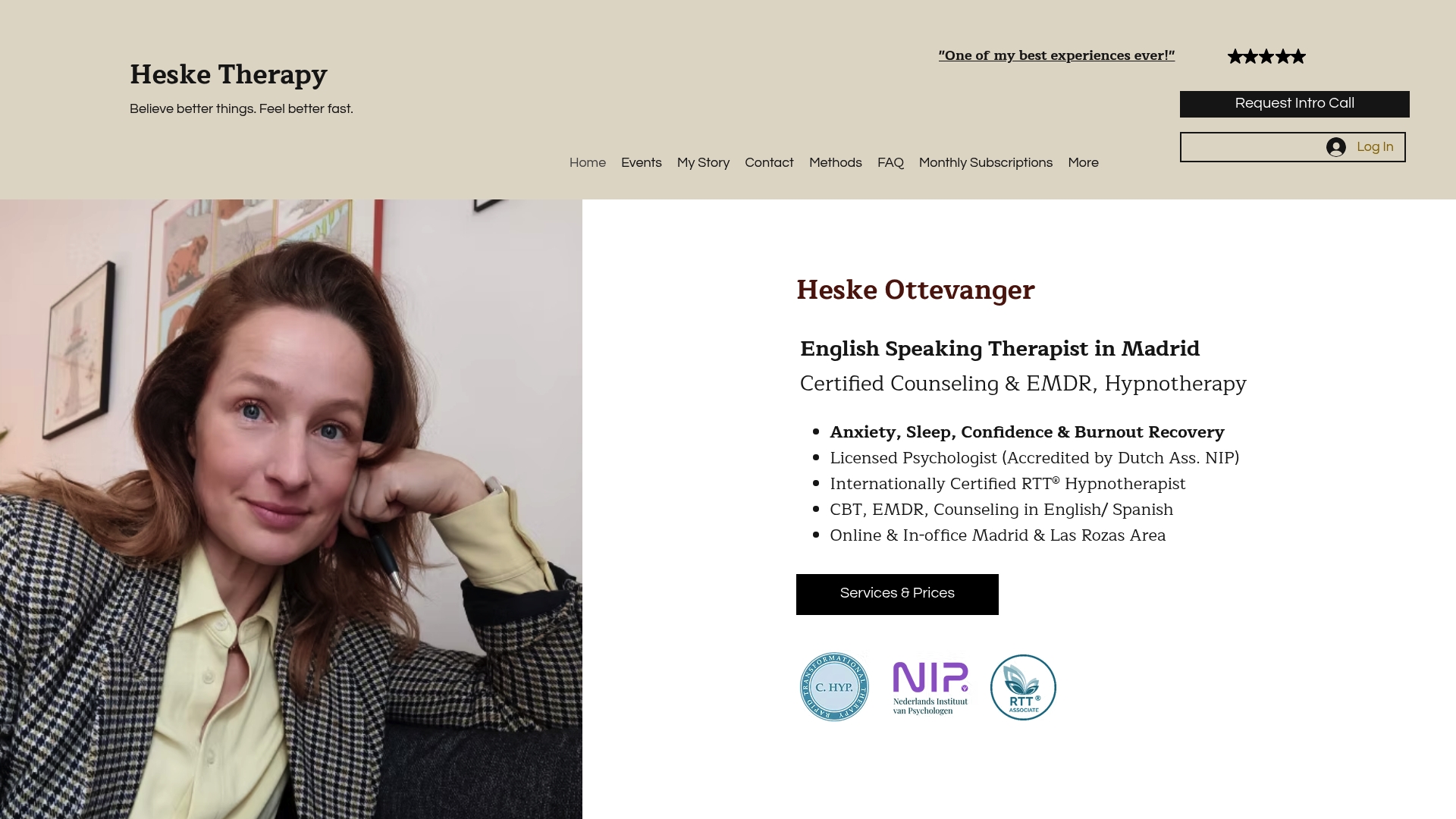
The practice offers licensed psychotherapy in English, Spanish, and Dutch, fully online or in-person in Madrid. Whether CBT’s structured skill-building or RTT’s belief-level work is the right fit for you, the starting point is the same: a conversation with a therapist who understands what it means to live between cultures, manage a career across time zones, and still show up for yourself.
Book a counseling session or view the full RTT program to take the first concrete step toward feeling like yourself again, wherever in the world you happen to be.
Recommended
Comments