Emotional Resilience: Essential Skills for Expats

Over 60 percent of English-speaking expatriates in Madrid report feeling persistent anxiety and burnout while adjusting to daily stresses abroad. For the American expat community, adapting emotionally in a new cultural environment is more than a personal challenge—it directly impacts well-being and success. Discover how targeted strategies like RTT and hypnotherapy offer effective resilience tools so you can transform setbacks into manageable growth and thrive despite uncertainty.
Table of Contents
Key Takeaways
Point | Details |
Understanding Resilience | Emotional resilience is a learnable skill that enables effective adaptation to stress and challenges, particularly for expatriates. |
Key Models of Resilience | Awareness of different resilience models helps create personalized strategies to address cultural and emotional challenges. |
Barriers to Resilience | Recognizing and avoiding misconceptions about resilience as a fixed trait can promote more flexible and effective coping strategies. |
Utilizing Therapeutic Techniques | Evidence-based therapeutic methods can rapidly enhance emotional resilience, particularly for those facing the complexities of expatriate life. |
Defining Emotional Resilience in Daily Life
For expatriates navigating complex cultural transitions, emotional resilience represents more than just survival—it’s a dynamic psychological capacity to adapt and thrive under challenging circumstances. Psychological resilience emerges as the critical ability to bounce back from adversity, transforming obstacles into opportunities for personal growth and emotional strength.
Understanding resilience requires recognizing it as a multifaceted process involving both internal psychological resources and external support systems. The American Psychological Association defines resilience as the profound mechanism of adapting well in the face of trauma, significant stress, or life disruptions. For expats, this means developing a flexible mindset that can navigate cultural misunderstandings, professional challenges, and personal transitions without becoming overwhelmed.
Emotional resilience isn’t about avoiding stress—it’s about learning to process and respond to challenges constructively. Key components include emotional awareness, adaptive coping strategies, positive reframing, and maintaining a support network. Individuals with strong resilience can experience setbacks without being psychologically derailed, instead using difficulties as catalysts for personal development and deeper self-understanding.
Pro Tip: Practice daily mindfulness techniques that help you recognize and process emotions without judgment, creating a foundation for emotional flexibility and resilience.
Core Types and Neuroscience of Resilience
Resilience is not a singular, monolithic concept but a complex interplay of multiple models and neurological mechanisms. Researchers have identified several comprehensive frameworks explaining how individuals develop and maintain psychological adaptability, each offering unique insights into the intricate process of emotional strength and recovery.
Neuroscientific research reveals that resilience is deeply rooted in specific brain circuits and neurochemical pathways. Key brain regions like the prefrontal cortex and amygdala play critical roles in modulating stress responses, with neural connectivity determining an individual’s capacity to process and recover from challenging experiences. These biological foundations suggest that resilience is not just a psychological trait, but a complex neurophysiological phenomenon influenced by genetic predispositions and environmental interactions.
The multidimensional nature of resilience is evident through six primary models: Adaptation, which focuses on adjusting to new circumstances; Biological, examining genetic and neural bases; Community, highlighting supportive environments; Developmental, tracking resilience evolution across life stages; Existential, exploring meaning-making; and Sociocultural, analyzing broader contextual influences. For expatriates, understanding these models provides a comprehensive framework for developing personalized resilience strategies that address individual psychological needs and cultural challenges.
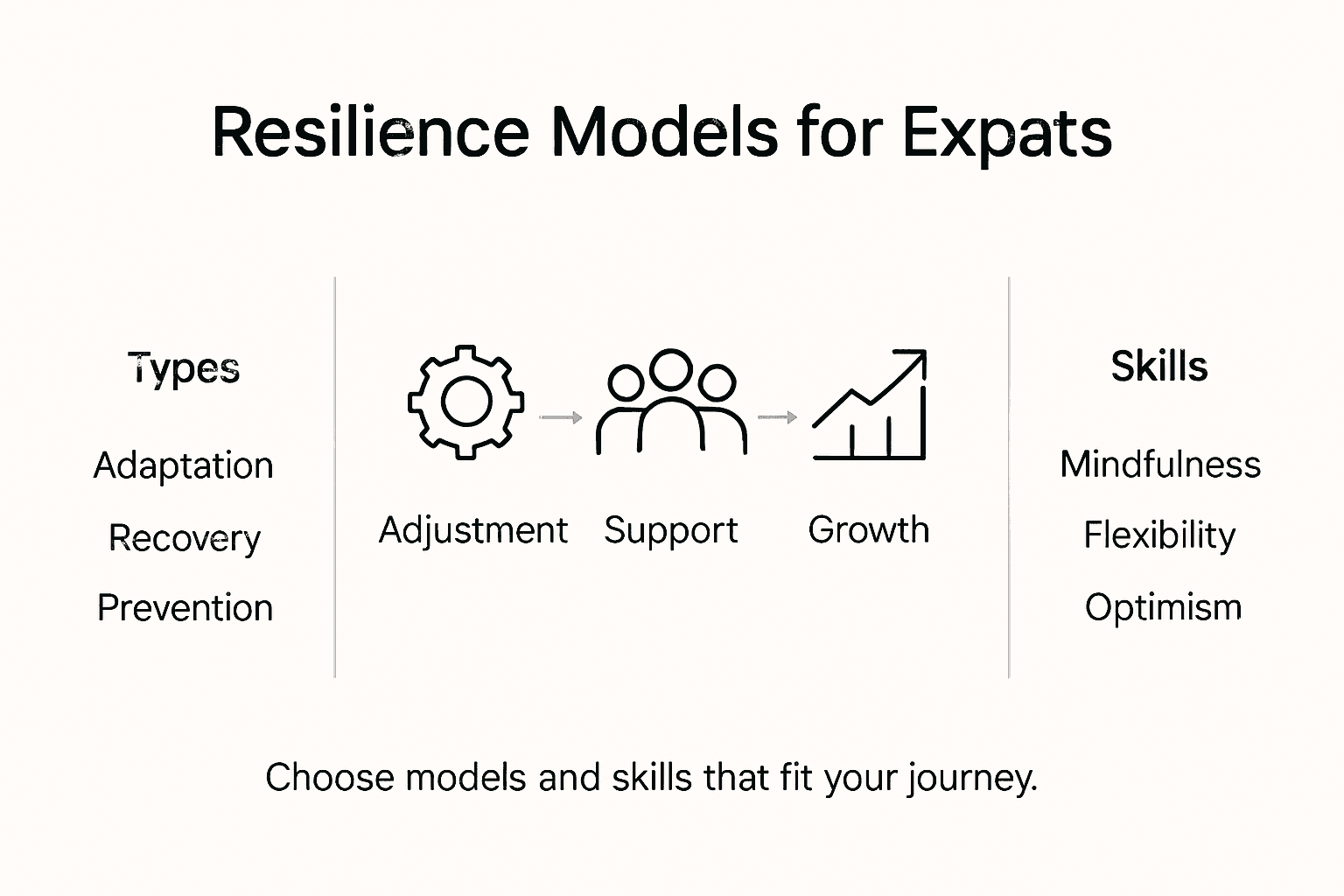
Here’s a summary of six primary resilience models and how they are applied by expatriates:
Model Type | Key Focus | Example Application for Expats |
Adaptation | Adjusting to change | Navigating new local customs |
Biological | Genetics and brain mechanisms | Managing stress through sleep and diet |
Community | Supportive environments | Building networks in a new country |
Developmental | Growth across life stages | Learning from each stage of relocation |
Existential | Meaning-making | Finding purpose during life transitions |
Sociocultural | Cultural context and influences | Understanding unwritten social rules abroad |
Pro Tip: Create a personal resilience toolkit by identifying which resilience model most resonates with your experiences, then develop targeted strategies that align with your unique psychological and neurological strengths.
Key Traits and Skills of Resilient People
Resilience is not an innate quality but a set of skills that can be consciously developed and refined. Stress-resilient individuals demonstrate specific characteristics that enable them to navigate challenging circumstances with remarkable adaptability, transforming potential setbacks into opportunities for personal growth and psychological strength.

The core traits of resilient people include a positive, optimistic outlook that reframes challenges as temporary experiences. These individuals excel at emotional regulation, utilizing techniques like deep breathing and mindfulness to manage stress responses effectively. They concentrate on aspects within their control, maintaining flexibility and proactively seeking constructive solutions rather than becoming overwhelmed by circumstances beyond their influence. Critical to their approach is the ability to maintain strong social connections, which provide emotional support and alternative perspectives during difficult times.
Beyond individual psychological mechanisms, resilient people cultivate a comprehensive toolkit of adaptive skills. They intentionally practice emotional intelligence, develop robust coping strategies, and maintain a sense of humor that allows them to navigate stressful situations with grace. For expatriates, this means developing cultural adaptability, learning to interpret and respond to unfamiliar social dynamics, and maintaining psychological equilibrium while experiencing significant life transitions. By understanding that difficulties are temporary and viewing challenges as opportunities for learning and personal development, resilient individuals create a powerful mental framework for sustained emotional well-being.
Pro Tip: Create a personal resilience journal to track your emotional responses, document successful coping strategies, and reflect on how you transform challenges into growth opportunities.
Rapid Therapeutic Methods to Build Resilience
Cutting-edge resilience research demonstrates multiple evidence-based interventions that can rapidly transform psychological adaptability, offering expats powerful tools to navigate complex emotional landscapes. Modern therapeutic approaches integrate biological, cognitive, and behavioral strategies designed to rewire stress responses and build psychological flexibility with unprecedented speed and precision.
Therapeutic methods like Rapid Transformational Therapy (RTT), cognitive-behavioral interventions, and mindfulness practices target neuroplasticity directly, enabling individuals to recalibrate emotional responses and develop more adaptive coping mechanisms. These approaches go beyond traditional talk therapy, utilizing targeted techniques that can create significant psychological shifts in remarkably short timeframes. Key strategies include reframing negative thought patterns, developing stress management skills, and cultivating positive psychological resources that enhance emotional regulation and resilience.
The following table compares rapid therapeutic methods to build emotional resilience for expatriates:
Method | Main Mechanism | Typical Benefit |
Rapid Transformational Therapy (RTT) | Deep subconscious re-patterning | Accelerates behavior change |
Cognitive-Behavioral Interventions | Negative thought reframing | Improves stress management skills |
Mindfulness Practices | Present-moment awareness | Enhances emotional regulation |
EMDR | Memory reprocessing | Reduces impact of traumatic memories |
Intensive Coaching | Personalized skills training | Accelerates adaptive coping |
For expatriates facing unique cultural and personal transitions, specialized therapeutic methods offer customized pathways to emotional strength. Techniques such as hypnotherapy, EMDR, and intensive coaching can help individuals quickly process cultural shock, manage expatriate-specific stressors, and develop robust psychological frameworks. By addressing underlying emotional blocks and providing practical emotional management tools, these rapid therapeutic interventions empower individuals to transform challenges into opportunities for personal growth and psychological transformation.
Pro Tip: Schedule an initial consultation to explore personalized resilience-building techniques that match your specific emotional landscape and expatriate challenges.
Common Barriers and Mistakes to Avoid
Research reveals significant psychological obstacles that can systematically undermine emotional resilience development, particularly for expatriates navigating complex cultural transitions. Understanding these barriers is the first critical step in constructing a robust emotional management strategy that prevents self-sabotage and promotes genuine psychological growth.
One of the most pervasive mistakes expatriates make is treating resilience as a fixed personality trait rather than a dynamic, learnable skill. This misconception leads individuals to adopt rigid coping mechanisms that ultimately create more psychological strain. Avoidant strategies like emotional suppression, denying stress, and refusing to acknowledge vulnerability can create significant long-term psychological barriers. Expatriates often mistakenly believe that strength means handling everything independently, which paradoxically weakens their actual resilience by isolating them from crucial social support networks.
Another critical barrier involves inadequate personalization of resilience-building techniques. Many individuals adopt generic stress management approaches without considering their unique cultural background, personal history, and specific expatriate challenges. This one-size-fits-all approach fails to address the nuanced psychological needs of individuals experiencing significant life transitions. Effective resilience development requires a tailored approach that recognizes the complex interplay between personal experiences, cultural contexts, and individual psychological mechanisms. By understanding these potential pitfalls, expatriates can design more intentional and adaptive strategies for emotional management and psychological growth.
Pro Tip: Conduct a monthly personal resilience audit, critically examining your coping strategies and identifying areas where you might be unconsciously sabotaging your emotional growth.
Build Your Emotional Resilience with Expert Support Tailored for Expats
Navigating the complex emotional challenges of expatriate life requires more than willpower. The article highlights key struggles such as stress management, cultural adaptation, and overcoming emotional blocks. At Heske Therapy, we understand how important it is to develop your personal resilience toolkit using proven methods like Rapid Transformational Therapy (RTT), EMDR, and Cognitive Behavioral Therapy (CBT). These approaches target the neurological and psychological roots of stress to help you recover faster and with lasting results.
You do not have to face these challenges alone. Our expert therapists specialize in helping expatriates just like you manage anxiety, burnout, trauma, and sleep difficulties in a culturally sensitive and compassionate environment. Whether you are living in Madrid or abroad, you can access personalized therapy sessions online or in our office. Begin your journey toward emotional flexibility and strength today by visiting Heske Therapy and learning more about our personalized treatment plans.
Take action now to transform setbacks into growth by scheduling your free discovery consultation.
Ready to unlock your inner resilience and thrive in your new environment Explore how Heske Therapy can help you develop essential emotional skills with rapid and lasting effects. Don’t wait to receive the culturally attuned support that will empower your expatriate experience.
Frequently Asked Questions
What is emotional resilience?
Emotional resilience is the ability to adapt and thrive in the face of challenges, stress, or trauma. It involves processing emotions constructively and using adversity as an opportunity for growth.
How can expats build emotional resilience?
Expats can build emotional resilience by practicing mindfulness, developing adaptive coping strategies, maintaining social connections, and personalizing resilience-building techniques to their unique experiences and challenges.
What are some key traits of resilient individuals?
Resilient individuals tend to have a positive outlook, strong emotional regulation skills, flexibility in problem-solving, and robust social support networks that provide emotional nourishment during difficult times.
What common mistakes undermine emotional resilience for expats?
Common mistakes include viewing resilience as a fixed trait instead of a learnable skill, using avoidant coping mechanisms, and not personalizing resilience strategies to fit individual circumstances and cultural contexts.
Recommended
It’s Lockdown O’Clock: Mental Health in Isolation| Heske Therapy
Grief - Loss of what was, and the 5 stages towards acceptance & hope| Heske Therapy
Using RTT Hypnotherapy to recover from trauma| Heske Therapy
How Stigma Impacts Substance Abuse Recovery - 12PanelNow | 12 Panel Drug Test | Free Shipping
Comments