3 Verified Ways to Find English Therapy in Madrid


If you need English-language therapy in Madrid, start with three channels at once: the Colegio Oficial de la Psicología de Madrid registry to confirm a professional is legitimately licensed, established directories such as Psychology Today for English-speaking listings, and specialized practices like Heske Therapy that work primarily with expats. Before booking anyone, verify their colegiación number and ask directly how they handle emergencies if sessions happen online.
TL;DR:
The Madrid registry lists 22,233 professionals but does not confirm English fluency, so use directories or referrals to build a shortlist, then verify registration numbers.
Before booking, request the clinician’s registration number, specific training such as EMDR or CBT, experience with expatriates, written pricing terms, and a local emergency plan.
Remote care requires documented locations for both parties and a local emergency protocol; choose in person care for acute crises or complex diagnostic needs.
Sessions typically last 50 to 60 minutes and occur weekly or biweekly; agree on measurable goals, then review progress every few weeks.
Table of Contents
Where to search: official registry, directories, and local English-language resources
How to handle language barriers or misunderstandings during therapy sessions
Cultural considerations and language nuances in English-language therapy
Resources and support groups for English-speaking therapy clients in Madrid
Privacy laws and patient rights for English speakers in Spain
A therapist’s view on treating English-speaking expats in Madrid
Getting started with English-language therapy at Heske Therapy
Where to search: official registry, directories, and local English-language resources
Finding a therapist who speaks fluent English in Madrid takes a bit more legwork than a quick web search, but the paths are well established once you know where to look.
Your first stop should be the Colegio Oficial de la Psicología de Madrid, the regional body that maintains the official registry of licensed psychologists. The registry currently lists 22,233 psychology professionals, though presence on that list does not mean a given clinician offers sessions in English. Use the search function to narrow by specialty or location, then cross-check any name you find elsewhere against this registry before moving forward. A colegiado listing confirms the person holds a real registration number and is accountable to a professional body, which matters more than any star rating you will find online.

International and local directories are the next practical layer. Psychology Today maintains Spanish listings for the Madrid area where therapists self-describe their languages and specialties, and local directories like Psicologiaymente or Terappio serve a similar function for the Spanish market. These listings are useful for speed: you can filter by language, read a short bio, and often see client reviews within minutes. What they do not guarantee is accuracy. A therapist can list “English” as a working language without native fluency, and reviews on these platforms are rarely verified in any formal way.
Referrals round out the picture. Expat Facebook groups, international employer assistance programs (EAPs), hospitals with English-language services such as HM Hospitales or Anglo-American Medical Unit, and community centers serving the international population in Madrid often maintain informal lists of therapists their members have actually used. These referrals carry real weight because they come from people who went through the process themselves, but they still require the same verification step as any other lead.
Each channel has trade-offs worth weighing before you commit time to it:
Official registry: highest verification, but no filter for English fluency or expat experience.
Directories (Psychology Today, local platforms): fast and language-filtered, but self-reported and not independently audited.
Referrals from expat networks or employers: personally vetted, but limited in volume and sometimes skewed toward a narrow set of specialties.
Specialized English-language practices: built specifically for the expat population, often combining several modalities, though coverage tends to concentrate in private practice rather than public health options.
None of these routes is wrong on its own. The most reliable approach combines them: use a directory or referral to generate a shortlist, then confirm each name against the official registry before you reach out.
How to evaluate an English-speaking therapist in Spain
Once you have a few names, the real work starts: figuring out whether this particular person is a safe, competent match for what you need.
Confirming colegiación is non-negotiable. Every legitimate psychologist practicing in the Comunidad de Madrid should be able to give you a registration number on request, and you can verify it directly on the Colegio Oficial de la Psicología de Madrid site. Treat any hesitation to share this number as a serious warning sign rather than an oversight.
Beyond basic licensing, ask about specific training rather than accepting broad labels like “trauma-informed” or “holistic” at face value. COP Madrid maintains professional working groups in areas such as EMDR, mindfulness, and workplace health, and membership in one of these groups is a concrete signal of supervised, ongoing training rather than a self-assigned specialty.
Here is a practical sequence for vetting a potential therapist:
Request the registration number and verify it independently on the Colegio Madrid site before your first conversation.
Ask about specific modality training (EMDR, CBT, telepsychology certification) rather than accepting general descriptions of approach.
Confirm experience with expatriates specifically, since cultural context and language nuance shape how therapy actually unfolds.
Request that clinical explanations happen in English, including diagnosis, treatment plan, and any paperwork you need to sign.
Ask about the emergency plan: what happens if you are in crisis outside normal office hours, and who handles it.
Clarify pricing and cancellation policy in writing before your first paid session.
Red flags are usually easy to spot once you know what to look for: no registration number, reluctance to name a local emergency contact or crisis protocol, or an inability to explain how they document consent and clinical records in Spain. Spanish law gives patients a right to clear information and access to their own clinical records, a protection that applies to mental health care the same as any other medical service, and a therapist who cannot speak to this plainly is not operating the way the patient autonomy framework expects.
Pro Tip: Send your questions about colegiación, modalities, and emergency planning in a single email before booking a call. A thoughtful, specific written response tells you more about a therapist’s professionalism than a thirty-minute consultation ever will.
Online vs. in-person therapy for English speakers in Madrid
Teletherapy has become a normal part of mental health care in Spain, but it operates under specific guidance rather than an anything-goes approach. National guidance from the Consejo General de la Psicología de España notes that structured online programs, including online CBT, show good evidence of effectiveness for many patients, while high-risk cases still need access to local, in-person clinical pathways.
COP Madrid’s own telepsychology guidance sets out what responsible remote practice looks like: an initial suitability assessment, verified identity and documented locations for both patient and therapist, and an explicit emergency plan agreed before treatment begins. This matters especially for expats, since your crisis resources in Madrid are not the same as back home, and a therapist working remotely needs to know exactly where you are during each session.
Before you commit to online sessions, check for the following:
A documented emergency plan naming local crisis resources in Madrid, not just a generic hotline from another country.
A private, reliable setting for both of you, with a backup plan if the connection drops mid-session.
Written consent covering how your data and clinical notes are stored.
Clarity on what happens if you travel, since the guidance requires providers to account for jurisdictional differences when a patient’s location changes.
One in-market reference is clear: telepsychology guidance from the national professional body in Spain explicitly requires documenting both therapist and patient locations at each remote session and preparing emergency protocols that account for jurisdiction, which is a higher bar than many informal video-call services meet.
In-person sessions are usually the better choice for acute crises, complex diagnostic situations, or any case where fast access to local emergency services could matter. Online therapy tends to work well for ongoing support, scheduling flexibility, and situations where travel or work commitments make a weekly office visit impractical.
Practical steps: booking, preparing, and early expectations
Getting started is simpler once you know what to prepare and what to ask.
When you first contact a therapist, include your language needs, your general availability, a brief reason for seeking therapy, and a direct question about their colegiación number. This saves a back-and-forth and signals that you have done some homework.
For your first session, bring the following:
A list of current medications and any existing diagnoses, even informal ones from a previous provider.
Two or three concrete goals, written in your own words, for what you want therapy to address.
An emergency contact name and number, ideally someone reachable in Madrid.
A clear statement of your preferred language for all clinical decisions and paperwork.
Any consent forms reviewed in advance, so you can ask questions about data handling or record-keeping before signing.
On logistics: most therapy in Madrid runs in 50- to 60-minute sessions, offered either weekly or biweekly depending on the issue. Pricing structures vary between single-session billing and multi-session packages, and the difference usually comes down to commitment and cost per session rather than the quality of care itself. A package tends to suit someone ready to commit to a defined course of treatment, while per-session billing suits someone still deciding whether a particular therapist is the right fit.
Early progress should be measurable in a straightforward way: you and your therapist agree on specific goals at the outset, then revisit them at set points, typically every few weeks, to check whether the approach is working or needs adjustment. If several sessions pass without any discussion of progress against your original goals, that is worth raising directly.
How to handle language barriers or misunderstandings during therapy sessions
Even a therapist with strong English can occasionally miss a nuance, especially with idioms, emotional tone, or culturally specific references. The fix is usually simple: say so in the moment. A good therapist will welcome the correction rather than treat it as a disruption, since accurate understanding is the entire point of the work.
If a misunderstanding keeps recurring, ask your therapist to repeat back what they understood before responding, a technique that catches gaps early rather than letting them compound over several sessions. For concepts that carry emotional weight in your native language but translate awkwardly into English, it can help to name the original word or phrase and briefly explain what it means to you.
If language mismatches happen often enough to interfere with the work itself, that is a legitimate reason to look for a different therapist, not a personal failing on your part. Therapy depends on precise communication, and persistent friction there is a fit issue worth addressing directly.
Cultural considerations and language nuances in English-language therapy
Receiving therapy in English in Madrid often means working with a therapist whose first language is Spanish and whose clinical training may blend Spanish and international frameworks. This can be an advantage: a bicultural therapist often understands both the expat experience of isolation or culture shock and the local context you are navigating day to day.
Cultural nuance also shows up in less obvious ways, like differing norms around family involvement, work-life boundaries, or how openly emotions are typically discussed. A therapist experienced with international clients will usually ask about your cultural background directly rather than assuming shared context, and that question itself is a good sign.
If you come from a culture where mental health carries more stigma than it does in parts of Western Europe, say so early. It shapes how comfortable you will feel being direct about symptoms, and a therapist who knows this can adjust pacing accordingly.
Resources and support groups for English-speaking therapy clients in Madrid
Beyond one-on-one therapy, Madrid’s expat community maintains a number of informal and formal support structures, including information on how an ESA for depression actually can help you cope. English-language support groups, often organized through international community centers or expat associations, give people a space to discuss shared experiences like relocation stress, isolation, or adjusting to a new healthcare system.
Some employers with international staff offer Employee Assistance Programs that include short-term counseling in English as a workplace benefit, worth checking if you have recently relocated for work. International hospitals and clinics in Madrid sometimes host informational sessions or maintain referral lists specifically for English-speaking patients seeking mental health support.
These resources work best as a complement to individual therapy rather than a replacement for it, particularly if you are dealing with anxiety, trauma, or burnout that benefits from sustained, one-on-one clinical attention.
Privacy laws and patient rights for English speakers in Spain
Spanish law gives patients clear rights around their mental health treatment, and these apply to you the same as to any Spanish national. The Ley de autonomía del paciente establishes your right to clear information about your care and access to your own clinical records, along with rules around informed consent before any treatment begins.
In practice, this means you can request documentation of your treatment plan and consent forms in a language you understand, and a responsible therapist should accommodate that request without friction. It also means your clinical records are protected and cannot be shared without your consent, a protection that holds regardless of your nationality or residency status.
If a therapist cannot clearly explain how they document consent or handle your records, that is worth raising directly before you continue treatment with them.
A therapist’s view on treating English-speaking expats in Madrid
Working with English-speaking expats in Madrid, the concerns that come up most often are anxiety, burnout, trauma, and disrupted sleep, frequently tangled together with the stress of building a new life in an unfamiliar system. An integrative approach, drawing on EMDR, CBT, and other evidence-based methods, lets treatment planning adjust to what each person actually needs rather than forcing everyone through the same framework.
Multilingual practice shapes assessment from the first conversation: understanding not just what someone says in English but what they mean when a concept does not translate cleanly from their native language. That nuance matters for accurate diagnosis and for building real trust.
Whichever therapist you choose, verify their credentials and ask plainly how they plan for emergencies. It is a reasonable question, and any good clinician will answer it without hesitation.
— Heske
Getting started with English-language therapy at Heske Therapy
We work specifically with English-speaking expats and internationals dealing with anxiety, burnout, trauma, and sleep issues, combining several therapy approaches into a plan built around your specific situation rather than a one-size-fits-all approach. Sessions run both online and in a Madrid office, which matters if your schedule or travel makes in-person visits inconsistent.
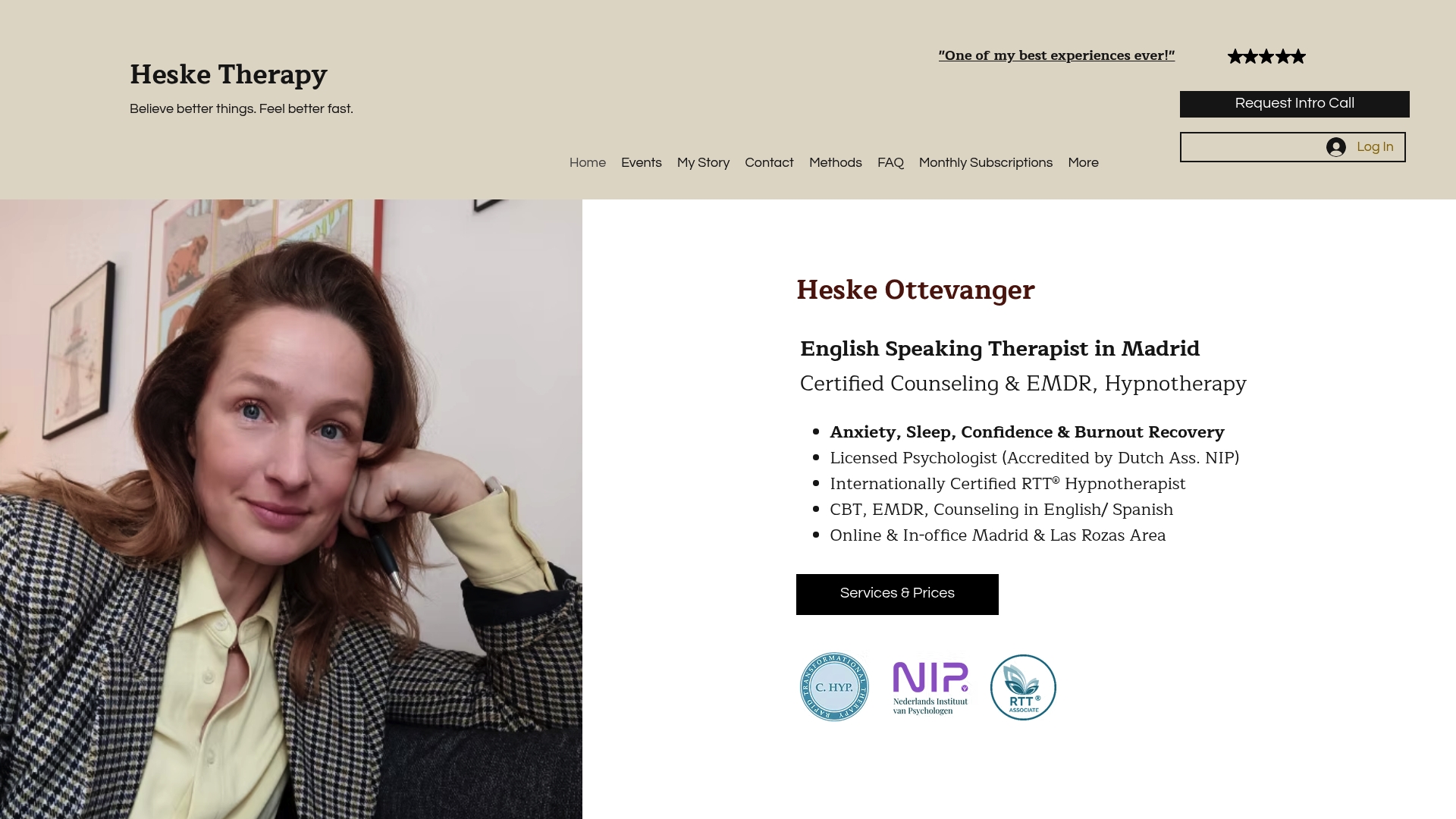
This tends to suit busy professionals and expats who want a structured, time-limited course of treatment rather than open-ended weekly sessions with no clear endpoint. Our Create a Breakthrough in 3 Months program runs at €600 per month, and for those who prefer a defined, shorter engagement, The Classic RTT all-in Package is available as a 750 euro one-off, with an online version at the same price for clients who prefer remote sessions.
If you are ready to take the next step:
Book a free discovery call through our main page to discuss what you are dealing with.
Review package options and pricing on our plans and pricing page.
Consider a shorter, focused option like the 21-day RTT package if you want fast, structured results.
This article is general information, not a substitute for advice from a qualified doctor. Consult a qualified healthcare professional about your own circumstances before acting on anything here.
FAQ
How do I verify a therapist’s license in Madrid?
Search the therapist’s name or registration number on the Colegio Oficial de la Psicología de Madrid registry, which lists licensed psychologists in the region. Ask the therapist directly for their colegiado number before your first session, since a legitimate clinician will provide it without hesitation.
Is online therapy legal and safe in Spain?
Yes, online therapy is a recognized practice in Spain under guidance from the Consejo General de la Psicología de España, which supports structured online programs while requiring an emergency plan and documented patient location. Confirm your therapist follows these telepsychology standards, including a local crisis contact, before starting remote sessions.
How much does English-language therapy cost in Madrid?
Pricing varies by format and provider; for example, Heske Therapy’s three-month program runs at €600 per month, while The Classic RTT all-in Package is a one-off 750 euros. Many practices offer a choice between package pricing for a defined course of treatment and per-session billing for more flexibility.
What should I ask before booking an English-speaking therapist?
Ask about their colegiación number, specific training such as EMDR or CBT certification, experience working with expatriates, and their emergency plan for crises outside office hours. Confirming these details in writing before your first paid session helps you avoid unlicensed or poorly matched providers.
What happens if my therapist and I misunderstand each other in English?
Say so directly in the moment, since a competent therapist will welcome the correction and adjust rather than treat it as a problem. If language mismatches happen frequently enough to disrupt the work, it is a legitimate reason to look for a therapist whose English fluency better matches your needs.
Sources
Comments