15–20 Sessions? Check Therapy Insurance Rules Before You Buy in Spain


If you are comparing a seguro psicología España option, check DKV, Sanitas, ASISA, Caser, Adeslas, and AXA first, since all six commonly build psychology into their main health products. The number that matters most is sessions per year, usually between 15 and 20, plus whether you need a prescription and whether you can choose your own psychologist or must use the insurer’s directory. Pull the coverage table before you sign anything.
TL;DR:
DKV lists up to 20 psychotherapy sessions yearly and up to 40 for specified conditions, requires a prescription, and offers network or reimbursement access.
Caser may impose a six month waiting period, while Sanitas emphasizes online sessions through Blua for people who travel or prefer care from home.
Before buying, get written terms on session limits, referrals, copays, waiting periods, and whether you may choose a psychologist and claim reimbursement.
At 15 to 20 sessions yearly, weekly appointments exhaust coverage in under five months; extended therapy may require private payment or waiting for renewal.
Reimbursement claims need invoices with the clinician’s registration details and session dates; missing paperwork, a required prescription, or a tax ID can delay payment.
Table of Contents
Insurer-by-insurer: what DKV, Sanitas, ASISA, Caser, Adeslas, and AXA actually cover
How to choose a policy that actually covers the therapy you need
How to use your coverage: booking, referrals, and filing a claim
How long does insured therapy typically take, start to finish?
Heske Therapy: a self-pay option that works alongside your insurance paperwork
Insurer-by-insurer: what DKV, Sanitas, ASISA, Caser, Adeslas, and AXA actually cover
Each of these insurers treats psychology a little differently, and the gaps show up the first time you try to book a session or file a claim.
DKV publishes up to 20 psychotherapy sessions per year on many products, rising to 40 sessions in specified cases such as eating disorders or school bullying. A medical prescription is required, and DKV offers both medical-directory and reimbursement routes along with telepsychology support.
Sanitas typically includes psychology with a standard limit around 15 sessions per year, with some products extending to 20. Sanitas leans heavily on its Blua platform for telepsychology. This matters if you move between cities or prefer sessions from home.
ASISA advertises 20 psychotherapy sessions per year as a standard feature of its policies, along with teleconsultation through its Doctor Virtual service. That session count puts ASISA among the more generous options on paper, though the access route still depends on the specific product you buy.
Caser offers up to 20 sessions per year on several products, with extra sessions carved out for minors and for conditions like eating disorders, plus teleconsultation access. Some Caser policies apply a waiting period of around six months before psychological coverage activates, so timing your purchase matters if you need care soon.
Adeslas lists psychology among its covered services across a broad national network, but session limits and access rules vary by product line, so you need to request the coverage table for the policy you are considering rather than assuming a flat number.
AXA also covers psychology on a product-by-product basis, with coverage details, session caps, and access models that shift depending on which plan you choose, so asking for written terms is advised before comparing price.
None of these six insurers runs an unlimited benefit. Every one caps sessions, and most ask for proof that the therapy is medically indicated before they will pay for it, whether through a referral, a prescription, or prior authorization. The practical difference between them is less about whether psychology is “included” and more about how many sessions you get, how fast you can start, and whether you are locked into a short list of in-network psychologists or free to choose your own and claim the cost back.
How to choose a policy that actually covers the therapy you need
Picking a policy for psychology coverage is less about the headline premium and more about four details that rarely show up in the marketing copy.
Confirm the session limit and what it actually covers. Twenty sessions a year sounds generous until you learn it only applies to short-term psychotherapy and not psychiatric follow-up.
Check the access model. Some policies restrict you to a cuadro médico of in-network psychologists, while others let you choose any licensed psychologist and submit for reimbursement.
Ask whether a prescription or prior authorization is required before your first session, since several insurers will not pay without one.
Find out the carencia, or waiting period, before mental health benefits activate, and whether there is a copay per session or an annual cap.
Request the exact coverage table and a sample claim form in writing before you buy, not after a sales call.
Ask specifically about telepsychology terms if you travel often or prefer online sessions.
Private session prices in Spain commonly fall in a wide range depending on the city and the therapist’s specialization, so it helps to estimate your likely out-of-pocket cost if your sessions run past the covered limit.
Pro Tip: Call the insurer’s customer line and ask them to read you the exact wording on psychology coverage from your specific product, not the general brochure. Products within the same insurer can differ substantially.
How to use your coverage: booking, referrals, and filing a claim
Once you have a policy, the process splits into two paths depending on whether your insurer uses a medical directory or a reimbursement model.
For cuadro médico access, you search the insurer’s online directory for a psychologist, book directly, and in some cases obtain prior authorization before your first visit counts toward coverage. For reimbursement-based policies, you pay the psychologist directly, then submit a claim with the right paperwork attached.
Keep these documents ready:
The invoice, showing the clinician’s full name and professional registration number.
Appointment dates and the number of sessions billed.
A medical prescription or referral, when your insurer requires one.
A brief clinical summary, if the insurer specifically requests it for ongoing claims.
Reimbursements typically process within a few weeks once the paperwork is complete, though missing documents are the most common reason for delay. If a claim is denied, ask the insurer in writing for the specific clause it is citing, since many denials come down to a missing prescription rather than the therapy itself being excluded.
A Madrid therapist’s view on working with insured clients
In practice, the paperwork side of insurance reimbursement is where most clients get stuck, not the therapy itself. We provide clear invoices listing session dates, our professional registration details, and a clinical summary when an insurer specifically asks for one, and that small amount of documentation is usually what separates a smooth reimbursement from a frustrating back-and-forth.
Expat clients often ask whether their insurer will accept paperwork in English. We handle invoicing and summaries in a way that keeps the details insurers look for front and center, and we encourage clients to request their invoice with their tax ID (NIF) included from the start, since insurers frequently reject claims missing that detail. For anyone exploring English-speaking therapy options in Madrid, getting this admin right from session one saves weeks later.
— Heske
Public system versus private insurance for psychology care
Spain’s public health system and private insurers approach psychological care from very different starting points, and understanding the gap helps explain why so many residents buy supplemental coverage.
A peer-reviewed review of psychiatry in Spain notes that only around 6% of the population holds additional private health insurance, meaning the vast majority rely on the public Sistema Nacional de Salud for mental health care. Public provision tends to prioritize psychiatric treatment and severe cases, while access to ongoing talk therapy through public channels can involve longer waits and fewer sessions than many people want.
Private insurers fill that gap by offering a defined, usually short-term, number of psychotherapy sessions per year, which is a different model from open-ended public psychiatric care. The same review notes that private insurers commonly set limits on outpatient consultations, so even paid coverage is not unlimited. For anyone weighing the two systems, the practical answer is that public care remains the default for psychiatric treatment and acute cases, while private policies are built for shorter, structured psychotherapy, and the choice often comes down to how quickly you want to start and how many sessions you expect to need.

Does the type of therapy affect whether insurance pays?
Insurers generally write their coverage around the category of treatment, psychology or psychotherapy, rather than around a specific named method like Rapid Transformational Therapy (RTT), EMDR, or CBT. That means a prescription typically needs to describe the clinical need, such as anxiety or trauma treatment, rather than requesting a particular technique by name.
In practice, this creates a gap between what insurers reimburse and what some clients actually seek out. A policy’s session count applies the same whether a psychologist uses CBT, integrative counseling, or another evidence-informed approach, but insurers rarely itemize coverage by method. If your therapist combines approaches, such as EMDR alongside CBT or hypnotherapy, that blend does not usually change your eligibility for reimbursement as long as the provider is a licensed psychologist or psychotherapist and the invoice and documentation meet the insurer’s standard requirements.
The practical takeaway is to focus your questions on the provider’s licensing and the clinical justification on your paperwork, not on whether a specific named technique appears on the insurer’s list, since most Spanish insurers simply do not maintain one.
How long does insured therapy typically take, start to finish?
Most insurer-backed psychotherapy in Spain is built around a defined number of sessions per year rather than an open timeline, which shapes how long treatment realistically runs. With a 15 to 20 session annual cap, weekly sessions would use up the benefit in under five months, so many clients space sessions every two to three weeks to stretch coverage across the year.

The timeline from first consultation to the end of covered treatment depends heavily on the access route. Reimbursement-based policies let you start as soon as you find a psychologist and, where required, obtain a prescription, often within one to two weeks. Cuadro médico access can take longer if prior authorization is needed or if in-network availability is limited.
For focal, short-term work, many clients complete a defined course of treatment within the session cap in three to six months. Anyone expecting longer-term, open-ended therapy should plan for the likelihood that insurance will cover an initial phase and that continuing past the annual limit means paying privately or waiting for the next coverage year to reset.
What the insurance comparison actually teaches you
The real lesson from comparing DKV, Sanitas, ASISA, Caser, Adeslas, and AXA is not which one wins on paper. It is that session limits and access routes matter far more than the premium you are quoted, and most buyers never ask about either before signing.
Conventional advice tells people to shop by price or by brand recognition. That misses the point entirely. A policy with a lower premium but a six-month waiting period and a restrictive cuadro médico can leave you waiting exactly when you need care fastest, while a slightly pricier reimbursement-based option might let you start with your own psychologist next week.
If there is one thing worth prioritizing above all else, it is asking for the written coverage table and a sample claim form before you buy, not after. That single document tells you more about real-world usability than any comparison chart, including this one.
Heske Therapy: a self-pay option that works alongside your insurance paperwork
When insurer session limits run out, or when you want to start therapy without waiting on prior authorization, we offer a straightforward self-pay path that many clients use alongside their insurance claims. We combine several evidence-based therapy methods delivered online or in office, with multilingual support.
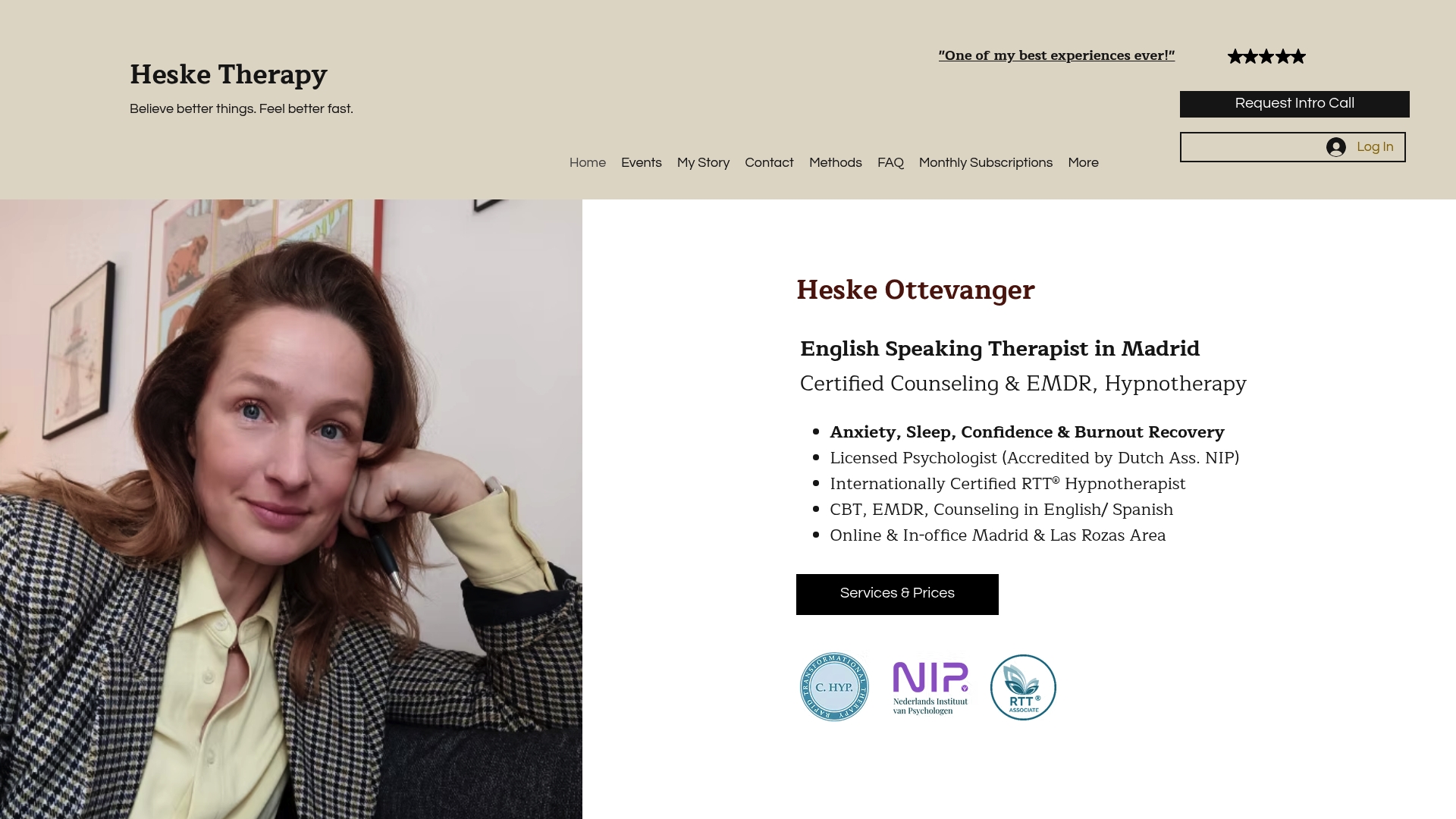
Our invoices include the information most insurers ask for when you file a reimbursement claim.
We recommend requesting your invoice with your tax ID included from the first session, which helps avoid common delays in reimbursement claims.
Packages include The Classic RTT all-in Package at 750 euros one-off, and our Pack of 4 Counseling Sessions Office at 375 euros one-off for shorter, structured support.
If you would rather pair professional sessions with a self-help routine, MindPanda’s mental health resources cover journaling and stress management tools that complement therapy between appointments. To see current options and book a session, visit our plans and pricing page.
This article is general information, not a substitute for advice from a qualified doctor. Consult a qualified healthcare professional about your own circumstances before acting on anything here.
FAQ
What insurance covers psychology in Spain?
Major insurers including DKV, Sanitas, ASISA, Caser, Adeslas, and AXA commonly include psychology in their main health products, typically with 15 to 20 sessions per year. Coverage details, access routes, and prescription requirements vary by specific product, so always request the written coverage table before buying.
How can I get free psychological help in Spain?
Spain’s public health system provides psychological and psychiatric care through the Sistema Nacional de Salud, and anyone in crisis can reach Línea 024, a free, confidential, 24/7 service that handled 204,449 interactions in 2025. Public mental health access typically involves a referral from your primary care doctor.
How much does a psychologist charge per session in Spain?
Private psychology sessions in Spain commonly fall in a wide price range depending on the city and the therapist’s specialization and experience. Insured clients should compare that private cost against their policy’s session limit and copay terms to estimate likely out-of-pocket spending.
Where can I find free psychological support in Spain?
Beyond the public health system, Línea 024 offers free, confidential crisis support by phone or chat around the clock. For ongoing care, your primary care doctor can refer you into the public mental health network at no direct cost.
Do I need a prescription to get psychology covered by insurance in Spain?
Many Spanish insurers, including DKV, require a medical prescription or referral before they will authorize or reimburse psychotherapy sessions. Requirements vary by insurer and product, so confirm this detail with your specific policy before booking your first session.
Sources
Psychology sessions in health insurance | DKV
Seguro médico con psicólogo | Sanitas
Seguro médico con psicólogo | ASISA
Recommended
Comments