Your Guide to Personal Transformation as an Expat in Madrid
- Heske Ottevanger
- 15 hours ago
- 8 min read

TL;DR:
Personal transformation depends on aligning identity and emotions, not just changing habits or routines.
System-based habits like environment design and automation support sustained change, especially under stress.
Start with one keystone habit, add a five-minute emotional-regulation practice each morning, and schedule an initial psychotherapy intake within the next two weeks. That combination, done consistently, tends to produce measurable shifts in mood, self-awareness, and daily functioning within 4–12 weeks. Three things you can do today: write down the single area of your life you most want to change, set a five-minute breathing or body-scan practice for tomorrow morning, and research one English-speaking therapist in Madrid.
Table of Contents
What does personal transformation actually mean?
Personal transformation is not about willpower or motivation. It is identity-aligned change supported by systems and, when needed, clinical foundations. The difference matters because surface-level self-improvement (new routines, productivity hacks) rarely sticks unless the underlying identity and emotional patterns shift too.
Self-improvement vs. deep transformation:
Self-improvement targets behaviors: sleep earlier, exercise more, read daily.
Deep transformation targets identity: who you believe you are, what you believe you deserve, and how you regulate emotion under pressure.
Transformation also requires context: your environment, relationships, and cultural stressors all shape what is possible.
Consider a common expat pattern. An English-speaking professional relocates to Madrid, loses their social network, and finds that anxiety and low motivation creep in despite having clear career goals. The problem is rarely a missing habit. It is an identity under stress, a nervous system that has not adapted, and a context that no longer supports the old self. Identity-level change means aligning your outer life with who you are becoming, not just fixing what is broken.
Pro Tip: Pick one keystone focus before you do anything else. Attempting multiple pillars simultaneously is the fastest route to burnout and abandonment of the whole effort.
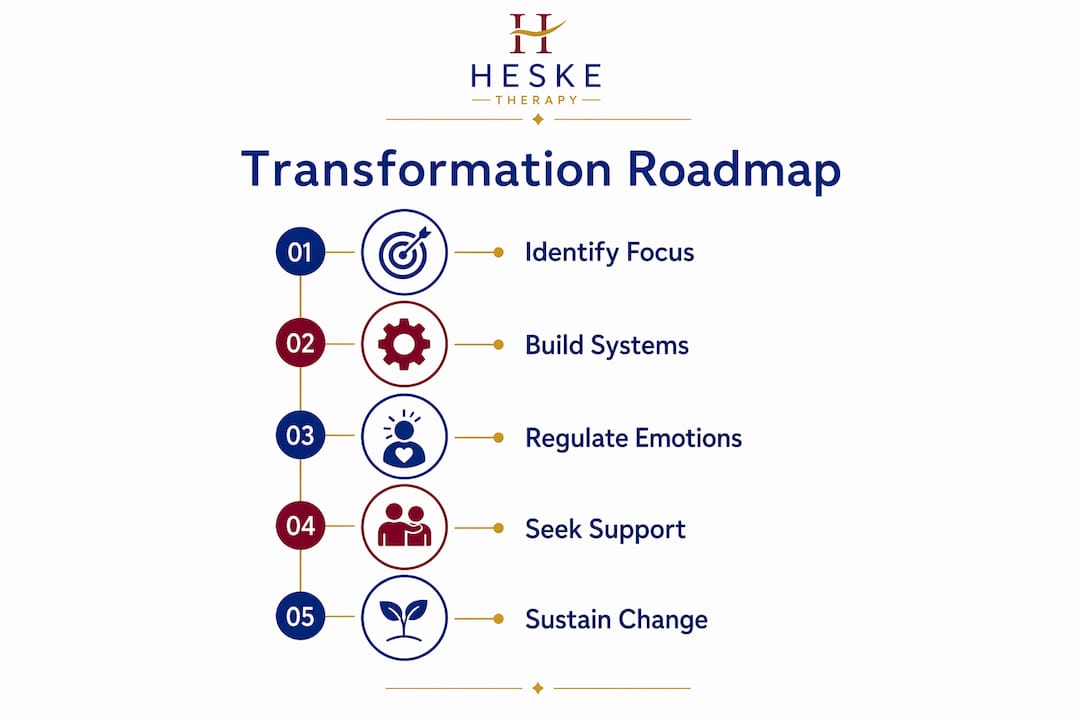
Why willpower alone fails and how systems carry you further
Willpower depletes under stress. That is not a character flaw; it is how the brain allocates resources. Coaching and behavior-change research consistently recommend automating positive choices because systems keep working when motivation does not.
Three system types do most of the heavy lifting:
Habit stacking: Attach a new behavior to an existing one (after morning coffee, write three sentences in a journal).
Environment design: Remove friction for good choices and add friction for unhelpful ones (put running shoes by the door; delete social apps from your phone’s home screen).
Automation: Schedule therapy appointments, meal prep, and sleep times so they require no daily decision.
Statistic callout: A 51-study meta-analysis of 4,266 participants found a mean effect size of r = 0.29 for well-being improvements from personal development strategies, with the strongest results when strategies were matched to specific growth areas and progress was measured consistently.
Three short experiments worth running for 7–21 days: (1) Stack a two-minute mindfulness practice onto your existing morning routine and note your mood at noon. (2) Redesign one physical space, your desk or kitchen counter, to make one healthy behavior the default. (3) On high-stress days, shrink your habit rather than skip it entirely: a 30-minute workout becomes a 5-minute walk. Consistency beats intensity every time.
Pro Tip: Track input metrics (did you show up?) rather than outcome metrics (did you feel better?) during the first 21 days. Outcomes lag behind inputs by weeks.

Emotional regulation is the foundation, not a bonus
Without emotional regulation, even the best system collapses. Psychologists identify emotional regulation as the core skill for maintaining behavior change under stress. When you cannot stay regulated, you revert to old coping patterns regardless of how clear your goals are.
The following table maps the main therapeutic modalities to what they address and how sessions typically feel:
Modality | Core target | Typical session shape |
RTT (Rapid Transformational Therapy) | Limiting beliefs, rapid identity shift | One to three intensive sessions with hypnotic regression and recorded audio |
EMDR | Trauma reprocessing, nervous system reset | Structured bilateral stimulation sets across multiple sessions |
CBT (Cognitive Behavioral Therapy) | Thought patterns, behavioral skills | Weekly structured sessions with between-session homework |
Clinical hypnotherapy | Belief change, habit rewiring at subconscious level | Relaxation-based sessions with direct suggestion and visualization |
Counseling | Emotional processing, relational patterns | Open, conversational sessions focused on insight and support |
Signs that professional psychotherapy is recommended rather than self-guided methods:
Anxiety, low mood, or sleep disruption persists beyond four weeks despite consistent self-care.
Emotional reactions feel disproportionate or uncontrollable in daily situations.
Physical symptoms (IBS, migraines, chronic tension) appear without a clear medical cause.
Past attempts at change repeatedly stall at the same point.
Cultural or language stress is compounding emotional load.
For practical skill-building between sessions, emotional regulation resources that cover self-regulation and emotional intelligence can supplement clinical work effectively.
A practical 6-step roadmap with realistic timelines and costs
A 90–120 day development cycle anchored to one keystone goal, with weekly input tracking and a quarterly audit, is the most reliable structure for durable personal change.
Assess your baseline. Identify your current patterns, stressors, and the one area with the highest leverage.
Pick one keystone habit. Structured goals paired with coaching produce some of the strongest effects across personal development strategies.
Match a therapeutic modality if needed. Use the table above to identify whether RTT, EMDR, CBT, or counseling fits your primary challenge.
Run a 90-day cycle. Implement weekly inputs (sessions, journaling, habit tracking) and resist changing the plan mid-cycle.
Track weekly inputs, not just feelings. Did you attend your session? Did you complete your habit? Log it.
Conduct a quarterly audit. Scheduled audits prevent growth stagnation and reveal what to adjust next.
Involvement level | Typical timeline | Estimated cost range |
Self-guided (books, apps, free audio) | 90–120 days for habit consolidation | Minimal |
Weekly therapy (individual sessions) | 8–12 weeks for targeted symptom relief | Varies by provider |
Therapeutic package (e.g., three-month minimum) | 90 days structured engagement | approximately €600 per month (Hesketherapy rate) |
Escalate to therapy when self-guided efforts stall twice in the same area, or when emotional symptoms begin affecting work, relationships, or physical health. The clinical process for rapid transformation at Hesketherapy outlines what to expect in a structured therapeutic engagement.
How to choose a therapist as an English-speaking expat in Madrid
Prioritize language match, multicultural experience, modality fit, and transparent fees. Those four criteria filter out most poor matches before the first session.
Licensing and credential signals to look for:
A licensed psychologist or accredited psychotherapist registered in Spain.
Specialist training in your preferred modality (RTT, EMDR, CBT, or hypnotherapy).
EMDR practitioners ideally hold EMDRIA-recognized training, the international standard for EMDR competency.
Multilingual capacity (English as a primary therapy language, not just conversational).
Online vs. in-person for expats: Online sessions offer continuity when you travel, remove commute time, and make it easier to maintain a three-month engagement across schedule changes. In-person sessions can feel more grounding for trauma work and somatic approaches. Many expats in Madrid use a hybrid model.
Red flags to watch for: vague pricing, no clear modality framework, resistance to discussing outcomes, or no initial assessment call offered.
Questions to ask at intake:
What modalities do you use, and how do you decide which fits my situation?
How do you track progress across sessions?
What is your experience working with expatriates or cross-cultural clients?
Pro Tip: Ask specifically whether the therapist has worked with clients navigating cultural adjustment or identity stress. A technically skilled therapist without multicultural experience may miss the expat-specific layer entirely. For a deeper look at psychotherapy methods for expats, Hesketherapy’s clinical overview is a useful starting point.
Key Takeaways
Durable personal transformation requires pairing identity-level work and emotional regulation with consistent, system-based habits, and professional psychotherapy when self-guided efforts repeatedly stall.
Point | Details |
Systems beat willpower | Habit stacking and environment design sustain change when motivation drops. |
Emotional regulation first | Without it, new behaviors collapse under stress; therapy builds this skill directly. |
One keystone habit | Starting with a single focus prevents overwhelm and creates compound momentum. |
90-day audit cycle | Weekly input tracking plus a quarterly review prevents stagnation and guides adjustment. |
Hesketherapy for expats | Offers RTT, EMDR, CBT, and counseling in English, in-person or online, at ~€600/month for a three-month engagement. |
What I’ve seen work, and what most guides miss
Most personal transformation content focuses on mindset and habits while treating emotional regulation as optional. That is exactly backwards for expats. When you are living in a second language, navigating unfamiliar systems, and rebuilding a social world from scratch, your nervous system is already carrying a heavier baseline load than it was designed for. A habit-stacking system that works beautifully in your home country can fall apart in Madrid within weeks, not because the system is wrong, but because the emotional substrate is overwhelmed.
What I see consistently is that clients who pair a clear behavioral system with even a few sessions of targeted therapy, whether RTT to shift a limiting belief, EMDR to process a past stressor, or CBT to restructure a thought pattern, move faster and hold their gains longer than those who rely on either approach alone. The therapy does not replace the system. It makes the system work. And for expats specifically, having a therapist who understands cultural adjustment, speaks your language fluently, and does not require you to explain why Madrid feels both exciting and isolating is not a luxury. It is a clinical advantage.
Hesketherapy: professional support built for English-speaking expats in Madrid
Hesketherapy offers licensed psychotherapy in English, Spanish, and Dutch, in-person in Madrid and online, with a focus on anxiety, burnout, trauma, sleep issues, and the emotional complexity of expat life. The integrative approach combines Rapid Transformational Therapy, EMDR, CBT, clinical hypnotherapy, and counseling, matched to each client’s specific needs rather than applied as a one-size formula.
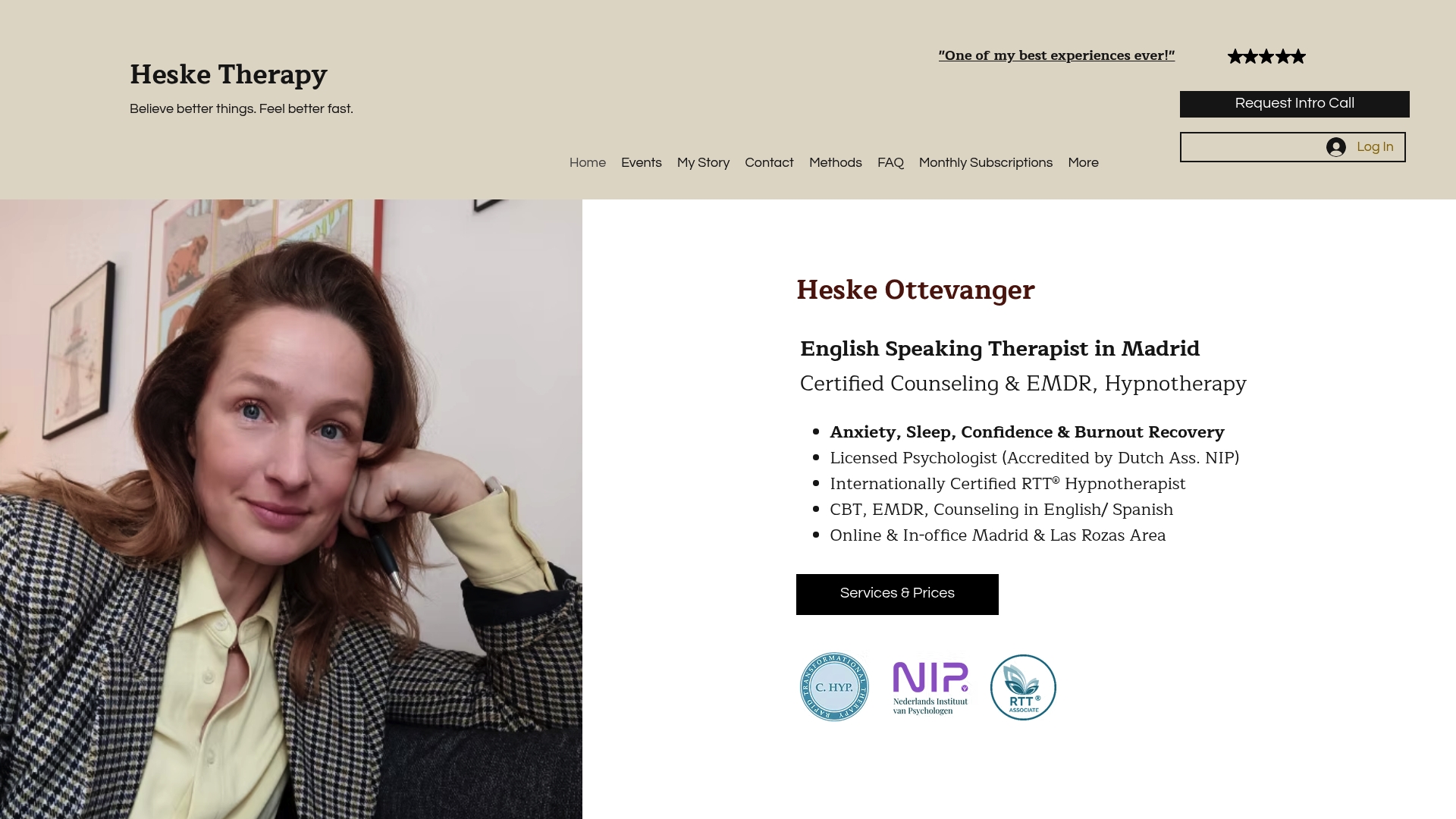
A typical first month includes an initial assessment, a personalized treatment plan, and weekly sessions. The standard engagement is a three-month minimum at €600/month, which covers consistent therapeutic input across a full 90-day cycle. Free downloadable mindfulness and hypnosis audio content is also available for clients between sessions.
The next step is straightforward: book a free discovery call to discuss your situation, your goals, and which modality fits best. No commitment required at that stage, just a clear, honest conversation about whether Hesketherapy is the right fit for where you are now.
Useful sources for deeper research
Personal Development Strategies: What Research Says Works — Covers the meta-analytic evidence base for personal development, including the 51-study review and the Development Audit Loop framework.
What Is Personal Development and Why Does It Matter? — Positive Psychology’s overview of emotional regulation as a core change skill, with practical exercises.
How Change Yourself: A Practical 8-Stage Guide to Real Transformation — Stage-by-stage breakdown of the internal process of self-change, from awareness through alignment.
Emotional Regulation: Building Resilience in Relationships — Practical guidance on how emotional regulation supports relational resilience, useful for expats rebuilding social contexts.
EMDRIA — The international professional body for EMDR practitioners; use it to verify a therapist’s EMDR training and credentials.
Recommended