How therapy can solve sleep issues for expats in Madrid


TL;DR:
Many expats in Madrid struggle with insomnia due to disrupted circadian rhythms, cultural differences, and stressors associated with living abroad. Cognitive Behavioral Therapy for Insomnia (CBT-I) is the most evidence-based treatment, providing long-lasting results through targeted behavioral and cognitive techniques, while approaches like RTT and hypnotherapy can address emotional roots. Finding qualified English-speaking therapists who understand the expat experience is crucial, with private and online options widely available to fit busy schedules.
You moved to Madrid for opportunity, adventure, or love, and now you’re staring at the ceiling at 2 a.m. wondering why sleep feels impossible. Many English-speaking expats quietly assume bad sleep is just part of adjusting to life abroad, so they reach for sleeping pills or push through exhaustion. But CBT-I delivers a 70-80% improvement rate for insomnia sufferers, with benefits that last long after the sessions end. Therapy is not a last resort. For most expats, it is the smartest first move.
Table of Contents
Key Takeaways
Point | Details |
CBT-I is best proven | Cognitive behavioral therapy for insomnia offers the highest long-term success for sleep problems among expats. |
Rapid therapies need caution | RTT and hypnotherapy show promise but should be viewed as adjuncts since they lack strong evidence for insomnia. |
Find certified therapists | Choose English-speaking therapists with specific training in sleep therapies for the best results in Madrid. |
Therapy beats medication | Therapy is safer and more sustainable than sleeping pills for most long-term expats with sleep issues. |
Why sleep issues are common among expats
Now that you understand therapy is a real solution, let’s look at why so many expats find their sleep disrupted in the first place. Living in a foreign country puts your nervous system through a constant low-level workout, even when life feels exciting and manageable on the surface.
Madrid runs on a schedule that surprises most newcomers. Dinner at 10 p.m., social events that start at midnight, and afternoon sunlight flooding apartments until 9 p.m. in summer all collide with the circadian rhythms you spent decades building back home. Your body clock does not reset overnight, and the mismatch can trigger persistent insomnia before you even realize what’s happening.
Beyond the schedule, there are subtler pressures that chip away at sleep quality:
Language anxiety — navigating Spanish all day keeps the brain in a hypervigilant state, making it hard to fully unwind at night
Social isolation — being separated from your closest support network raises cortisol levels, the stress hormone most directly linked to disturbed sleep
Work uncertainty — visa concerns, contract types, and unfamiliar workplace cultures create background worry that surfaces the moment your head hits the pillow
Sensory overload — urban noise, different building acoustics, and new neighborhood rhythms interrupt sleep architecture, especially light sleep stages
As how sleep therapy transforms mental health explains, the ripple effects of poor sleep reach far beyond tiredness. Concentration drops, emotional regulation weakens, and the effort needed to build a new life in a foreign city becomes disproportionately hard.
“Sleep problems among expatriates are not a character flaw or a sign that you made the wrong decision moving abroad. They are a predictable physiological and psychological response to major life change — and they respond well to targeted treatment.”
The important takeaway here is that these challenges are shared. You are not uniquely fragile. You are human, navigating a genuinely demanding transition, and your sleep system is telling you it needs support.
Overview of therapy solutions: What really works?
Understanding why you’re struggling opens the door to choosing the most effective treatments for sleep problems. Three approaches come up most often when expats search for help: CBT-I, RTT, and hypnotherapy. Each works through a different mechanism, and their evidence bases are not equal.
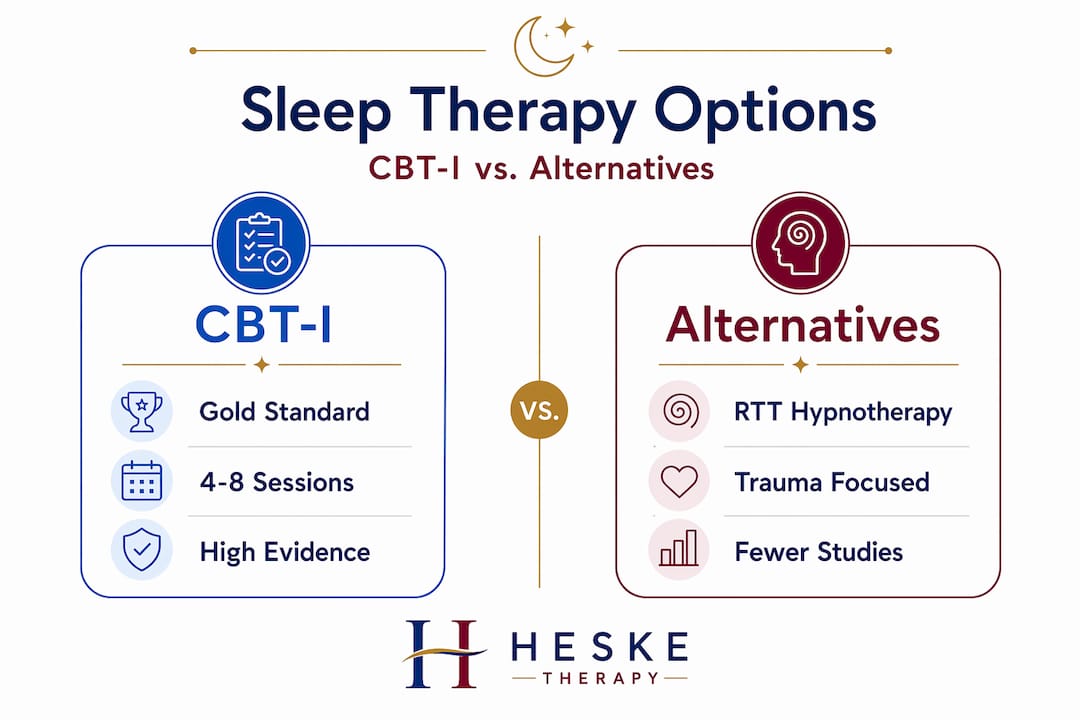
CBT-I (Cognitive Behavioral Therapy for Insomnia) is the gold standard. It targets the thoughts, behaviors, and physiological habits that perpetuate insomnia. Core techniques include sleep restriction (temporarily compressing your sleep window to rebuild sleep drive), stimulus control (retraining your brain to associate the bed with sleep only), cognitive restructuring (challenging the catastrophic thoughts that make 3 a.m. feel terrifying), and sleep hygiene education. CBT-I typically runs 4-8 sessions and produces results that hold up months and years later, not just while you’re in active treatment.
RTT (Rapid Transformational Therapy) is a hybrid method that blends hypnosis, neuro-linguistic programming, and psychotherapy. RTT claims rapid results in 1-3 sessions and has a strong following among people who feel stuck in traditional talk therapy. It can be powerful for anxiety-driven sleep problems by addressing root beliefs and subconscious patterns. The honest limitation is that randomized controlled trials specifically testing RTT for insomnia are not yet available. The anecdotal and clinical evidence is promising, but it isn’t the same depth of proof that CBT-I carries. You can read more about what is RTT therapy and RTT for anxiety relief to understand when it fits best.
Hypnotherapy works by inducing a deeply relaxed, focused state that makes the mind more receptive to suggestion and change. For sleep, it’s most useful when anxiety or physiological arousal is the primary driver. Like RTT, it lacks the rigorous trial data of CBT-I for primary insomnia, but it can serve as a valuable complementary tool.
Therapy | Evidence level | Sessions needed | Best for | Long-term durability |
CBT-I | Strong (gold standard) | 4-8 | Primary insomnia, behavioral patterns | High |
RTT | Promising, limited trials | 1-3 | Anxiety-driven sleep issues, root beliefs | Moderate |
Hypnotherapy | Moderate, limited for insomnia | 3-6 | Arousal, anxiety, relaxation | Moderate |
Medication alone | Moderate short-term | Ongoing | Acute or severe cases | Low (dependency risk) |
Research confirms that therapist-guided CBT-I outperforms fully automated digital programs, which themselves still beat doing nothing. Human guidance matters, especially when cultural and emotional context is part of the picture.

Pro Tip: If your sleep problems feel tightly wound around anxiety, worry, or unresolved stress from the move, ask your therapist to combine CBT-I techniques with a modality like RTT or hypnotherapy. The behavioral core of CBT-I holds the structure; the deeper emotional work speeds the process. You can explore whether does RTT really work for your specific situation during an initial consultation.
Evidence for CBT-I and the realities of alternative methods
After seeing how the therapies compare at a glance, let’s look closer at what the science and guidelines say about how and why they work.
In April 2026, the American Academy of Sleep Medicine published updated guidelines that recommend CBT-I as standalone first-line treatment for chronic insomnia. The guidelines specifically note that combining CBT-I with medication is acceptable for complex or resistant cases, but CBT-I alone is preferred precisely because its results persist without the dependency risks and side effects that come with long-term medication use.
Here’s what a typical CBT-I process looks like, step by step:
Assessment session — Your therapist maps your sleep patterns, history, and driving factors using a sleep diary and structured interview
Sleep restriction protocol — Your sleep window is temporarily limited to match actual sleep time, building strong sleep pressure
Stimulus control work — You retrain your bedroom associations so bed means sleep, not worry or screen time
Cognitive restructuring — Catastrophic beliefs (“I’ll never sleep again,” “I need 8 hours or I’ll fall apart”) are examined and replaced with accurate, calming alternatives
Relaxation training — Progressive muscle relaxation, breathing techniques, or mindfulness reduce the physiological arousal that blocks sleep onset
Relapse prevention — Your therapist helps you build a personal plan for handling future rough patches without sliding back into insomnia
Compare that to a typical RTT or hypnotherapy approach, which tends to begin with a detailed intake covering history and emotional patterns, moves into a hypnotic induction session designed to access subconscious material, and then uses suggestion and visualization to reframe how your mind relates to sleep and rest. It’s a fundamentally different mechanism, and rapid therapy methods guide explores this in detail.
Research confirms that CBT-I reduces insomnia severity and improves sleep efficiency across diverse populations. The durability is the real differentiator. Unlike medication, which loses effectiveness when you stop taking it, CBT-I essentially teaches your brain new sleep habits. Those habits don’t disappear when therapy ends.
“The goal of CBT-I isn’t to fix sleep for the next week. It’s to permanently change the relationship between your mind and sleep so that insomnia loses its power over you.”
For expats specifically, the advantages of RTT are worth considering when anxiety, trauma from the relocation, or deep-seated beliefs about your capability to thrive abroad are part of the picture. CBT-I addresses the behavioral surface; RTT can address the emotional foundation beneath it.
Finding English-speaking therapy options in Madrid
Once you know what works and why, next comes actually getting help and finding the right therapy for your situation in Madrid. This is where many expats get stuck. The Spanish mental health system is excellent but largely conducted in Spanish, and searching for qualified English-speaking therapists with specific insomnia training takes more effort than a basic Google search.
Here’s what to look for and how to navigate it effectively:
CBT-I certification — Look for therapists who specifically mention CBT-I training, not just general cognitive behavioral therapy. Insomnia requires a specific protocol that not all CBT therapists are trained to deliver
RTT or hypnotherapy credentials — Verify training through recognized institutions. Marisa Peer’s RTT training program is widely recognized for RTT practitioners
Language fluency — Sessions conducted in your native language reduce cognitive load and allow you to access deeper emotional material more easily, which matters for both CBT-I and RTT work
Cultural competence — A therapist who understands expat-specific stressors (visa anxiety, identity challenges, relationship strain from the move) will ask better questions and build a more accurate picture faster
Session format — Madrid-based options include private practice (in-person), international clinics with dedicated expat services, and fully online formats that work around Spanish working hours
English-speaking CBT-I and RTT practitioners are available in Madrid, including certified specialists at sleep clinics that offer English-language therapy packages. The key is knowing what questions to ask before you book.
Pro Tip: During your first consultation, ask directly: “Have you worked with clients on insomnia specifically?” and “How do you approach sleep issues when anxiety is also present?” A confident, specific answer tells you whether the therapist has genuine expertise or is generalist. Vague answers are a red flag worth acting on.
For deeper guidance on navigating options, multilingual counseling for expats and CBT for anxiety in Madrid offer practical context for what to expect. Accessing mental health benefits of sleep therapy can also help you build the case internally for making therapy a priority rather than a last resort.
Private practice in Madrid is generally more flexible and faster than the public system, which has long wait times even for Spanish speakers. Many expat-focused therapists also offer evening or weekend slots to work around corporate schedules, and online sessions have become fully normalized since 2020 without any loss of therapeutic effectiveness.
The expert’s view: What most expats overlook about therapy for sleep
With practical options clear, it’s important to understand what really makes therapy effective for expats seeking long-term sleep improvement. And this is where I want to be genuinely honest with you, even if it challenges what you hoped to hear.
Many expats arrive at therapy drawn to rapid or novel approaches because they feel exciting and promise fast transformation. There’s nothing wrong with that instinct. But the pattern I see repeatedly is this: people invest in an RTT session or a few hypnotherapy appointments, experience real relaxation and even some improvement, then hit a rough week and find the gains haven’t fully stuck. That’s not a failure of those methods. It’s a failure of sequence. RTT and hypnotherapy are powerful, but they work best when the behavioral infrastructure is already in place or built alongside them.
The “quick fix” mindset is understandable when you’re exhausted and under pressure. But sleep is ultimately a behavioral and neurological habit system. Changing it requires consistent application of specific techniques over several weeks, not a single transformative session. The impact of sleep therapy on mental health extends well beyond the bedroom, which makes investing those weeks entirely worth it.
The other factor that almost nobody talks about is therapist fit. For expats, working with someone who genuinely understands what it feels like to live between cultures, to navigate identity shifts, and to carry the particular loneliness of being far from your roots is not a luxury. It’s a clinical advantage. A therapist who gets your world will spot the patterns that keep you awake in ways that a therapist unfamiliar with expat life simply won’t.
My recommendation is to start with CBT-I as your foundation, add RTT or hypnotherapy if anxiety or emotional blocks are driving the problem, and prioritize finding a therapist who speaks your language both literally and experientially.
How Heske Therapy can help you sleep better in Madrid
Ready to improve your sleep? Here’s the next step for expats in Madrid who want solutions that work and fit their lifestyle.
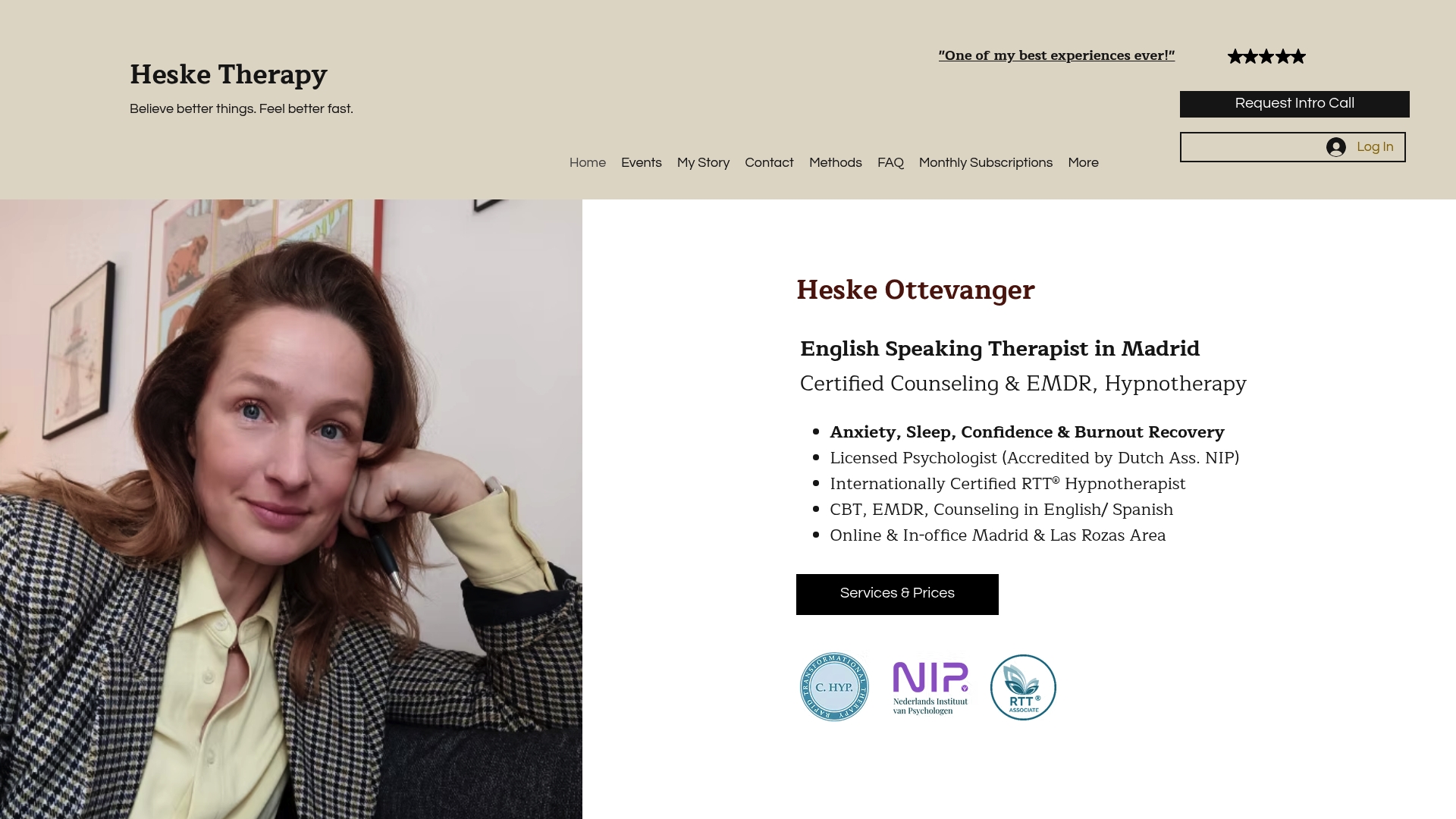
At Heske Therapy, we work specifically with English-speaking expatriates in Madrid who are struggling with sleep, anxiety, burnout, and the emotional weight of life abroad. Our integrative approach brings together CBT-I techniques, RTT, hypnotherapy, and EMDR within personalized treatment plans built around your actual situation, not a generic protocol. Sessions are available both in-person in Madrid and fully online, so you can access expert support regardless of your schedule or location. If you’re not sure where to start, a free discovery call gives you direct access to real clinical guidance within minutes. You don’t have to keep losing sleep waiting for things to improve on their own.
Frequently asked questions
How long does it take for therapy to improve sleep?
CBT-I typically produces meaningful improvement within 4-8 sessions, and the benefits continue to strengthen after treatment ends rather than fading like medication effects.
Is therapy more effective than medication for sleep issues?
Yes, for chronic insomnia, the AASM 2026 guidelines recommend CBT-I as the preferred standalone treatment because its results are more durable and it carries none of the dependency or side-effect risks associated with long-term sleep medication.
What if I’ve tried CBT-I and still can’t sleep?
For cases where CBT-I alone hasn’t resolved insomnia, current guidelines support combining it with medication or exploring additional modalities like RTT or hypnotherapy with a qualified sleep specialist.
Are therapy sessions offered in English in Madrid?
Yes, certified English-speaking practitioners offering CBT-I, RTT, and hypnotherapy are available in Madrid, including both in-person and online formats designed specifically for expatriates.
Recommended
Comments