How to Build Self-Esteem Naturally Step by Step
- Methode sure pour gagner a la roulette
- Jan 20
- 8 min read

Moving to Madrid brings excitement but can trigger moments of doubt and self-criticism, especially for expatriates adjusting far from familiar support. Struggling with low self-esteem might make everyday challenges feel overwhelming in a new country. This guide offers practical, research-backed steps for assessing and transforming your self-image, beginning with the Rosenberg Self-Esteem Scale to measure your current state and laying the foundation for rapid personal growth and emotional well-being.
Table of Contents
Quick Summary
Key Takeaway | Explanation |
1. Assess Self-Esteem Regularly | Use the Rosenberg Self-Esteem Scale to understand your baseline and track progress over time. |
2. Identify Negative Self-Talk | Keep a thought journal to recognize harmful patterns that contribute to low self-esteem. |
3. Challenge Limiting Beliefs | Document persistent negative beliefs and replace them with evidence-based affirmations. |
4. Practice Positive Self-Statements | Create and repeat affirmations that focus on your growth and capabilities daily. |
5. Monitor Progress Consistently | Develop a tracking system to document achievements and reflect on your emotional growth regularly. |
Step 1: Assess Your Current Self-Esteem Levels
Assessing your current self-esteem is the foundational first step in building lasting confidence. Using a standardized evaluation will help you understand your baseline and track meaningful progress.
The most reliable approach involves completing the Rosenberg Self-Esteem Scale, a scientifically validated 10-item questionnaire that measures global self-esteem. This assessment captures both positive and negative feelings about yourself, providing a quantitative snapshot of your current emotional state. Research demonstrates that this scale offers high reliability across different contexts, making it an excellent starting point for your self-improvement journey.

To complete the assessment, answer each statement honestly using a four-point scale ranging from strongly agree to strongly disagree. Typical questions might include statements like “I feel I have many good qualities” or “At times I think I am no good at all.” Your total score will indicate whether your self-esteem is low, moderate, or high, giving you clear insight into areas needing development.
Pro tip: Take the self-esteem assessment when you are calm and have sufficient uninterrupted time to reflect thoughtfully on each question.
Step 2: Identify Negative Self-Talk Patterns
Understanding and recognizing negative self-talk is crucial for transforming your inner dialogue and building genuine self-esteem. This step will help you pinpoint destructive thought patterns that undermine your confidence and emotional well-being.
Research reveals that negative self-talk often manifests in specific patterns, such as the emotional self-regulation challenges that can significantly impact personal motivation. Common patterns include the “Worrier” who constantly anticipates worst-case scenarios, the “Victim” who feels perpetually helpless, and the “Perfectionist” who criticizes every perceived shortcoming. Start by keeping a thought journal where you document your internal dialogue throughout the day. Pay close attention to statements that begin with “I always,” “I never,” or absolute judgments like “I’m not good enough.”
To effectively challenge these patterns, learn to recognize their origins. Are these thoughts based on actual evidence or simply learned responses from past experiences? Negative self-talk strategies suggest reframing these statements by asking yourself whether you would speak to a close friend in the same harsh manner. This technique helps create emotional distance and allows for more compassionate self-assessment.
Pro tip: Create a “thought interrupt” ritual where you consciously pause and challenge negative statements as soon as they arise.
Here’s a comparison of common negative self-talk patterns and practical approaches for overcoming them:
Pattern | Typical Thought Example | Challenge Strategy | Positive Outcome |
Worrier | “Something will go wrong” | Reframe with realistic thinking | Reduced anxiety, increased control |
Victim | “I have no choice” | Identify alternatives and strengths | Feeling empowered, more optimism |
Perfectionist | “I must never make mistakes” | Accept imperfection, show self-kindness | More resilience, self-acceptance |
Step 3: Challenge Limiting Beliefs Effectively
Limiting beliefs are deeply ingrained thought patterns that restrict your potential and undermine self-esteem. This step will help you systematically identify and dismantle these mental barriers that prevent you from reaching your true capabilities.
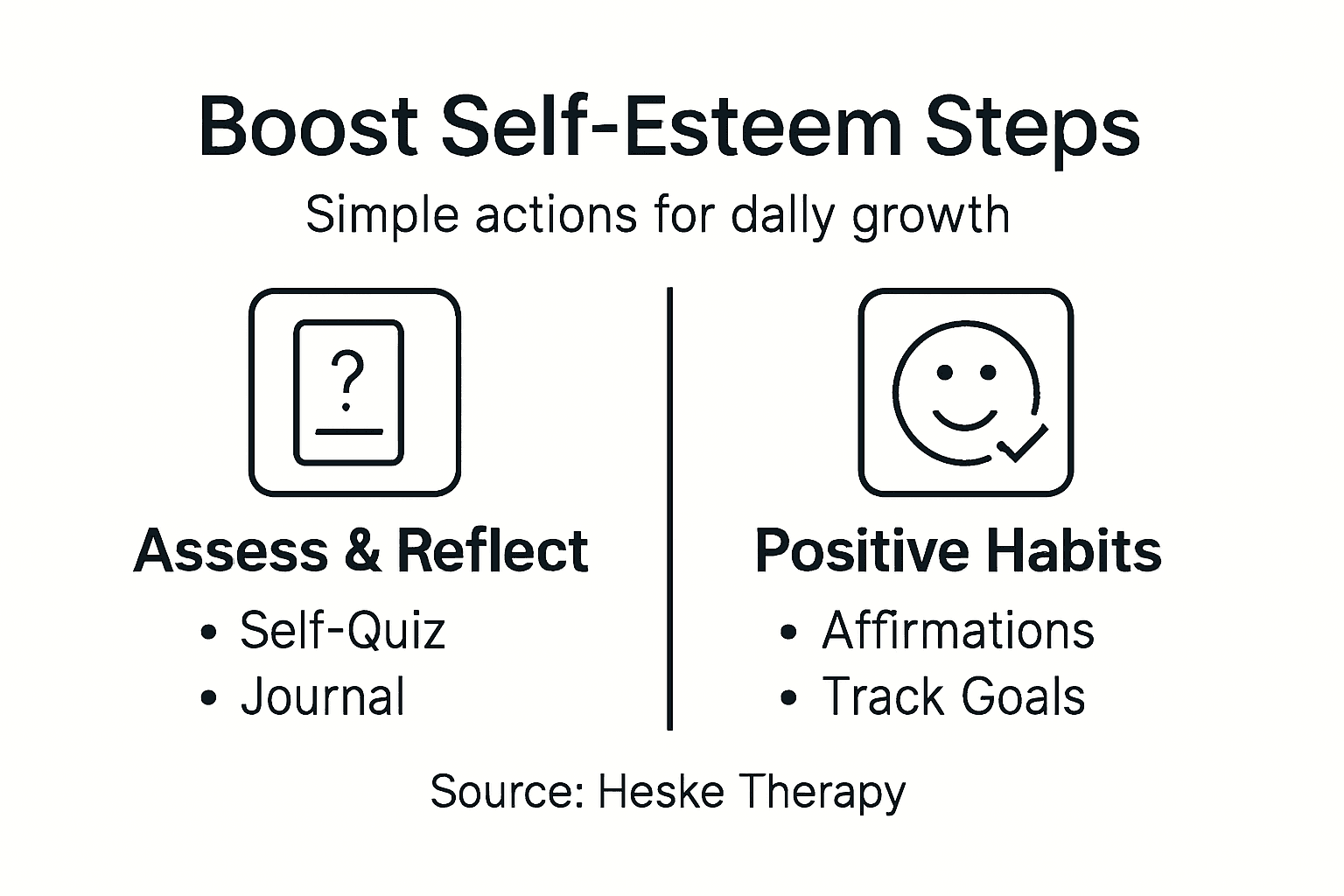
Understanding the root of these beliefs is crucial. Academic performance research reveals that fear of failure and poor self-regulation often generate limiting beliefs about personal capability. Start by documenting your most persistent negative thoughts. Ask yourself critical questions: What evidence supports this belief? Is this thought based on fact or past emotional experiences? Examine each belief through an objective lens, seeking concrete proof or challenging its validity.
The process of challenging limiting beliefs requires consistent practice and cognitive restructuring. Develop a method of replacing negative self statements with evidence-based, constructive alternatives. For instance, transform “I always fail” to “I am learning and improving with each attempt.” Research suggests that cognitive dissonance techniques can help realign your belief system by introducing perspectives that contradict your existing negative narratives. Create a personal accountability system where you regularly review and challenge these beliefs, tracking your progress and celebrating small victories along the way.
Pro tip: Write down your limiting beliefs and create a corresponding evidence log that systematically dismantles each negative assumption.
Step 4: Cultivate Positive Self-Statements
Positive self-statements are powerful tools for transforming your internal dialogue and rebuilding self-esteem. This step will guide you through creating intentional, supportive language that reinforces your inherent worth and potential.
Positive thinking practices demonstrate that strategic self-talk can significantly impact emotional resilience and personal growth. Begin by identifying your most common negative self-statements and systematically replace them with constructive, affirming alternatives. For example, transform “I am not good enough” to “I am continuously learning and growing.” Focus on crafting statements that are realistic, believable, and present tense. These statements should feel authentic rather than forced or overly optimistic.
Educational research shows that structured self-concept development involves consistent practice and intentional reinforcement. Create a daily ritual of repeating your positive self-statements. Write them in a journal, record voice memos, or place sticky notes in visible areas. Practice saying these statements out loud with conviction, paying attention to your tone and body language. Over time, these intentional statements will gradually rewire your neural pathways, helping you develop a more compassionate and supportive internal narrative.
Pro tip: Record your positive self-statements and listen to them during morning routines or before challenging situations to reinforce your new mental script.
Step 5: Reinforce New Habits Daily
Building self-esteem requires consistent effort and strategic habit reinforcement. This step focuses on creating a sustainable framework that transforms your newfound insights into lasting personal growth.
Habit reinforcement strategies reveal that consistent daily practices are crucial for solidifying meaningful behavioral changes. Develop a structured approach by creating a daily checklist that tracks your progress in implementing positive self-statements, challenging limiting beliefs, and maintaining supportive internal dialogue. Consider using a dedicated journal or digital tracking app to monitor your emotional growth. Each evening, spend 10 minutes reflecting on your day and documenting moments where you successfully applied your new self-esteem techniques.
Accountability plays a critical role in sustaining change. Share your goals with a trusted friend, therapist, or support group who can provide encouragement and objective feedback. Set up weekly check-ins to discuss your progress, challenges, and emotional breakthroughs. Visual representation of your journey can be incredibly motivating create a progress board or digital dashboard that highlights your milestones and personal achievements.
Pro tip: Establish a reward system that celebrates small victories and reinforces your commitment to personal growth.
Below is a summary of effective daily self-esteem reinforcement activities for lasting growth:
Activity | Purpose | Suggested Frequency | Tracking Method |
Daily positive self-statements | Strengthen self-worth | Every morning and evening | Journal or voice memos |
Reflection on achievements | Build motivation and awareness | Nightly | Progress board or checklist |
Accountability check-ins | Maintain focus and receive support | Weekly | Support group or trusted friend |
Step 6: Monitor Progress and Celebrate Growth
Tracking your personal development journey is essential for maintaining motivation and recognizing your emotional transformation. This step focuses on creating meaningful methods to document and appreciate your ongoing self-esteem growth.
Progress monitoring techniques demonstrate that systematic assessment helps individuals make informed decisions about their personal development. Develop a comprehensive tracking system that captures both quantitative and qualitative aspects of your self-esteem journey. Create a journal with specific sections for tracking your emotional milestones, recording positive self-statements, noting challenges overcome, and reflecting on personal insights. Use a numerical rating scale from 1 to 10 to assess your daily confidence levels, allowing you to visualize your incremental improvements over time.
Research indicates that social emotional learning assessment is crucial for recognizing growth. Schedule monthly self review sessions where you thoroughly examine your progress. During these reflections, highlight specific moments of personal breakthrough no matter how small. Consider creating a visual progress board that showcases your achievements highlight moments of courage, instances where you challenged negative self talk, and times you stepped outside your comfort zone.
Pro tip: Take periodic photographs or create video journals to capture your emotional transformation and provide tangible evidence of your personal growth.
Unlock True Confidence with Professional Support
Building self-esteem naturally involves understanding and reshaping your inner dialogue, challenging limiting beliefs, and reinforcing new positive habits daily. If negative self-talk, emotional blocks, or persistent feelings of low worth are holding you back from living your fullest life, you are not alone. Heske Therapy provides specialized mental health services designed to help English-speaking expatriates in Madrid overcome these exact challenges using proven methods like Rapid Transformational Therapy, CBT, and EMDR.
Our personalized treatment plans address anxiety, burnout, trauma, and emotional obstacles that often undermine self-esteem. Through culturally sensitive care and a compassionate approach, we guide you in replacing limiting beliefs with empowering positive self-statements for lasting change. Ready to take the next step toward lasting confidence and emotional freedom?
Experience rapid and lasting results tailored specifically for expatriates and international clients at Heske Therapy. Discover how our expert therapists can support your journey by scheduling a free discovery call today. Start transforming your self-esteem and unlock your true potential now with personalized therapy solutions.
Frequently Asked Questions
How can I assess my current self-esteem levels?
To assess your current self-esteem levels, complete the Rosenberg Self-Esteem Scale, a reliable 10-item questionnaire. Take it when you are calm and able to focus for accurate results, then use your score to identify areas for improvement.
What should I do if I recognize negative self-talk patterns?
If you recognize negative self-talk patterns, start a thought journal to document these destructive thoughts. Challenge them by asking if you would say the same to a friend, and use this perspective to reframe your inner dialogue positively.
How can I effectively challenge my limiting beliefs?
To challenge your limiting beliefs, document your negative thoughts and evaluate the evidence for each one. Replace them with constructive statements like “I am learning and improving” to help dismantle these barriers to your self-esteem.
What are positive self-statements, and how do I create them?
Positive self-statements are encouraging phrases that reinforce your self-worth. Identify common negative self-thoughts and replace them with affirmations that feel authentic; repeat these daily to help reshape your internal narrative.
How can I reinforce new habits to build self-esteem?
Reinforce new habits by creating a daily checklist to track your progress with positive self-statements and reflection. Commit to reviewing this checklist regularly to ensure consistency and hold yourself accountable for your growth.
How can I monitor my progress in building self-esteem?
Monitor your progress by keeping a journal that tracks both quantitative and qualitative aspects of your personal growth. Schedule monthly reviews to reflect on milestones and celebrate small victories, which will help maintain motivation.
Recommended
Comments