How trauma drives expat anxiety: a guide for 2026


If you’ve been living in Madrid as an expat and can’t shake a persistent sense of dread, racing thoughts, or emotional exhaustion, you might be blaming the city, the culture, or the pressure of starting over. But for many English-speaking expats, trauma increases vulnerability to anxiety disorders including GAD, panic disorder, and partial PTSD symptoms that often get folded into other diagnoses. The real driver isn’t just culture shock. It’s unresolved trauma quietly running the show beneath the surface.
Table of Contents
Key Takeaways
Point | Details |
Trauma often underlies anxiety | For many expats, unresolved trauma drives persistent anxiety symptoms that may be misdiagnosed. |
Brain changes sustain symptoms | Trauma alters brain circuits, making anxiety responses more frequent and intense. |
Specialized therapies are most effective | Integrative and trauma-focused therapies consistently lead to better outcomes for complex anxiety. |
Culturally sensitive care matters | Choosing English-speaking, trauma-informed therapists prevents re-traumatization and boosts progress for expats. |
Why expat anxiety is often trauma-based
Relocation is stressful. But stress and trauma are not the same thing. Stress is a reaction to pressure; trauma is what happens when an experience overwhelms your nervous system’s ability to process it. For expats, the combination of cultural isolation, language barriers, loss of social identity, and the pressure to perform in a foreign environment can activate old wounds that were never fully healed.
Common expat anxiety triggers include:
Cultural isolation and the loss of familiar social support networks
Language barriers that make you feel invisible or incompetent
Identity disruption when your professional or social status doesn’t transfer
Relocation grief over leaving family, friends, or a previous life behind
Accumulated micro-stressors that compound over months or years
When unresolved trauma is already present, these stressors don’t just feel hard. They feel catastrophic. That’s because trauma lowers your threshold for threat perception, meaning your nervous system is already primed to react. A difficult conversation with a Spanish colleague or a bureaucratic nightmare at the local office can trigger a response that feels completely out of proportion.
One of the most common clinical oversights is partial PTSD misdiagnosed as GAD. You might meet some but not all criteria for PTSD, so a clinician unfamiliar with trauma labels it generalized anxiety and treats the surface symptoms. The underlying cause stays untouched.
Burnout is another area where trauma hides in plain sight. Research shows burnout prevalence among junior doctors in Spain reached 93.9% on at least one dimension and 50.9% across all three, with links to sleep disruption and chronic stress. For expats across professions, burnout often looks like exhaustion and detachment, but the root is frequently traumatic overload, not just overwork. Understanding this distinction is the first step toward burnout recovery for expats that actually lasts.
“What looks like burnout or anxiety in an expat is often the nervous system’s response to unprocessed trauma. Treating the label without addressing the root keeps people stuck.”
If you recognize yourself in this, exploring trauma recovery steps designed specifically for expats in Madrid is a meaningful place to start.
How trauma rewires the anxious brain
Trauma doesn’t just affect your mood. It physically changes how your brain and body function. Understanding this helps explain why anxiety that’s rooted in trauma feels so stubborn and why willpower alone rarely fixes it.
Here’s a summary of the key biological mechanisms involved:
System | What trauma does | Result |
HPA axis | Dysregulates cortisol release | Chronic stress response, fatigue |
Amygdala | Becomes hyperactivated | Exaggerated fear and threat detection |
Hippocampus | Shrinks under prolonged stress | Fragmented memory, poor context processing |
Gut-brain axis | Disrupted microbiome signaling | IBS, nausea, digestive issues |
Inflammation | Elevated IL-6 and CRP markers | Fatigue, brain fog, low mood |
These biological mechanisms of trauma explain why trauma responses are so “sticky.” The amygdala, your brain’s alarm system, stores emotional memories without the time-stamp that the hippocampus normally provides. So a smell, a tone of voice, or a social situation can trigger a full-blown anxiety response because your brain genuinely cannot tell the difference between the past threat and the present moment.
Think of it like a smoke alarm that goes off every time you make toast. The alarm isn’t broken. It’s just calibrated to a fire that happened years ago.
Pro Tip: If you notice that your anxiety spikes in specific situations that seem unrelated to real danger, that’s a signal worth exploring with a trauma-informed therapist. The trigger is rarely the problem. The unprocessed memory behind it usually is.
For expats, this wiring becomes especially problematic because daily life in a foreign country is full of unpredictability. Novelty and uncertainty are constant, and a hyperactivated amygdala reads novelty as threat. Learning about psychotherapy for anxiety that targets these neurological patterns can help you understand why certain approaches work better than others.

Common anxiety disorders linked to trauma
Trauma doesn’t produce a single, clean diagnosis. It creates a spectrum of anxiety presentations that overlap, shift, and often get mislabeled. Here’s how the most common ones compare:
Disorder | Core feature | Trauma link |
PTSD | Flashbacks, avoidance, hypervigilance | Direct trauma exposure |
Partial PTSD | Some PTSD symptoms, not full criteria | Often misdiagnosed as GAD |
GAD | Chronic worry, tension, restlessness | Can mask underlying trauma |
Panic disorder | Sudden intense fear episodes | Trauma activates panic pathways |
Social anxiety | Fear of judgment, avoidance | Shame-based trauma responses |
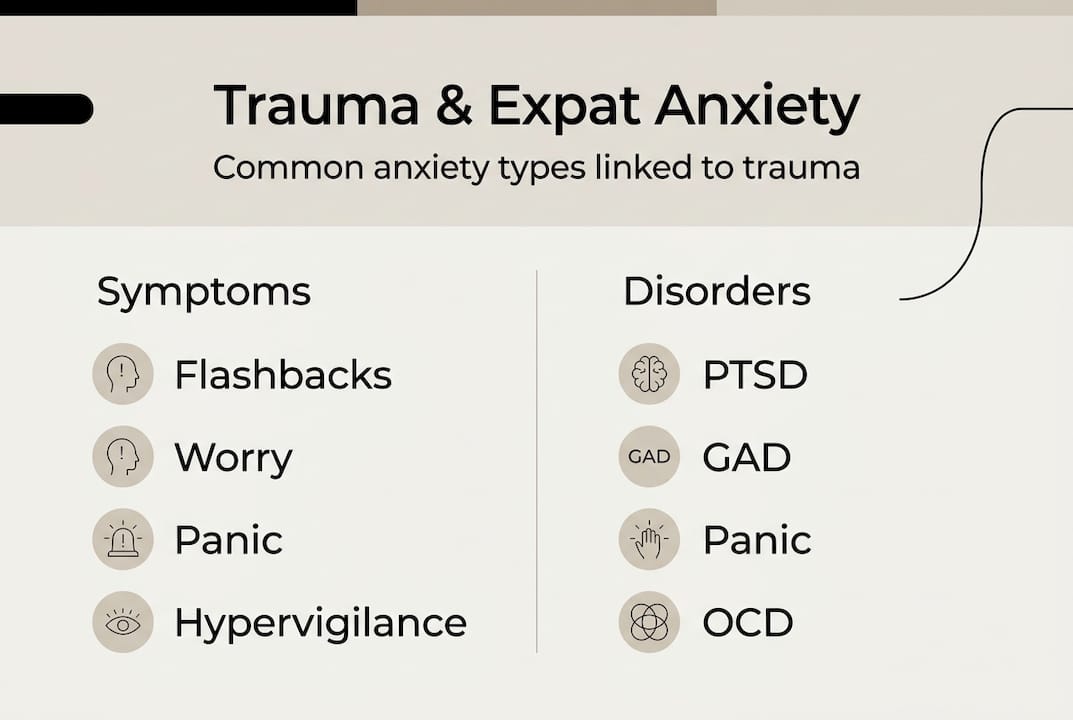
The clinical reality is that trauma raises the risk of GAD, panic disorder, and partial PTSD, with symptoms frequently absorbed into other diagnoses. For expats, this misdiagnosis problem is amplified by language barriers, cultural differences in how distress is expressed, and clinicians who may not be trained in expat-specific presentations.
Key symptoms that suggest trauma may be driving your anxiety:
Anxiety that spikes in response to specific sensory triggers (sounds, smells, places)
Difficulty sleeping due to intrusive thoughts or nightmares
Emotional numbness alternating with intense emotional reactions
A persistent sense of being “on guard” even in safe environments
Physical symptoms like headaches, IBS, or muscle tension with no clear medical cause
Many expats in Madrid spend months or years treating the anxiety without ever addressing the trauma underneath. Exploring trauma recovery techniques that are evidence-based and expat-informed can shift the entire trajectory of your recovery.
Why integrative and trauma-focused therapies work best
Once you understand that anxiety often has a traumatic root, the next question is practical: which therapies actually work? Standard talk therapy has its place, but for trauma-rooted anxiety, it often isn’t enough on its own.
Here’s why integrative and trauma-focused approaches produce better outcomes:
They target the body, not just the mind. Trauma is stored somatically, meaning in the body. Approaches that include somatic work, EMDR, or hypnotherapy reach the nervous system directly.
They process the memory, not just the reaction. EMDR (Eye Movement Desensitization and Reprocessing) helps the brain reprocess traumatic memories so they lose their emotional charge.
They combine modalities for complex cases. Expats often present with layered issues: anxiety, burnout, identity disruption, and sleep problems simultaneously. A single-modality approach rarely addresses all of them.
They adapt to cultural context. Integrative therapists trained in expat-specific challenges can adjust their approach to your background, language, and lived experience.
They produce measurable results. A meta-analysis found trauma-focused therapies reduce anxiety with an effect size of g=1.25 for anxiety in complex PTSD cases, a clinically significant outcome.
Multimodal phasic approaches, which combine stabilization, trauma processing, and integration phases, are particularly effective for dissociation, anxiety, depression, and sleep disruption. Integrative trauma therapy that incorporates EFT and somatic work has shown strong results for expats dealing with complex, layered presentations.
“Treating trauma-rooted anxiety with talk therapy alone is like trying to reboot a computer by only changing the screensaver. The underlying program needs attention.”
Pro Tip: When evaluating a therapist, ask specifically whether they use trauma-focused modalities like EMDR or RTT alongside CBT. A therapist who only offers one approach may not be equipped for complex trauma-anxiety presentations.
For a clearer picture of what this looks like in practice, reviewing integrative therapy examples for expat anxiety can help you identify what to look for in a provider.
Getting help as an English-speaking expat in Madrid
Finding the right therapist in a foreign country is its own challenge. Language matters enormously in therapy. Processing trauma in a second language adds cognitive load and can actually reduce the emotional depth of the work. Prioritizing a language-matched therapist is not a luxury. It’s a clinical necessity, especially when trauma is involved.
Here are the steps to finding effective support in Madrid:
Search specifically for trauma-informed therapists who list EMDR, RTT, or integrative therapy as core competencies, not just general counseling.
Filter by language first. English-speaking therapists in Madrid exist, but not all are trained in trauma. Confirm both language and trauma specialization.
Ask about cultural competence. A good therapist will understand expat-specific stressors and won’t pathologize your experience of cultural adjustment.
Request a discovery call. Most reputable therapists offer a free initial consultation. Use it to assess whether they understand trauma-rooted anxiety specifically.
Check credentials and modalities. Look for training in EMDR, CBT, RTT, or somatic approaches alongside general psychotherapy qualifications.
Once you’ve started therapy, supporting your progress outside sessions matters too. Helpful self-care practices include:
Consistent sleep hygiene, since trauma disrupts sleep and poor sleep worsens anxiety
Somatic practices like yoga, breathwork, or progressive muscle relaxation
Community connection through expat groups in Madrid to reduce isolation
Limiting alcohol, which temporarily numbs anxiety but worsens trauma symptoms over time
For expats dealing with exhaustion alongside anxiety, burnout counseling for expats offers targeted support. And if you’re not sure where to begin, the burnout recovery guide provides a structured starting point for understanding your symptoms and options.
Take the next step toward effective anxiety and trauma support
Understanding the trauma-anxiety connection is powerful, but knowledge alone doesn’t heal the nervous system. That’s where specialized, integrative therapy makes the difference.
At Heske Therapy in Madrid, we work specifically with English-speaking expats navigating anxiety, burnout, and trauma using a combination of RTT rapid transformation, EMDR, CBT, and hypnotherapy. Our approach is designed to reach the root of your symptoms, not just manage them. Whether you prefer in-person sessions or online therapy, we offer flexible options tailored to your schedule and needs. If you’re ready to move from surviving expat life to genuinely thriving in it, explore our 21-day RTT package or book a free discovery call to find out which approach fits your situation best.
Frequently asked questions
How do I know if my anxiety is trauma-related?
Look for recurring fears, nightmares, or disproportionate reactions tied to specific triggers or past events. A trauma-informed therapist can assess whether partial PTSD or GAD better explains your symptoms and guide you toward the right treatment.
Can trauma be the reason for burnout, not just anxiety?
Yes. Burnout and trauma frequently coexist, especially for expats under relocation stress. Burnout in Spanish professionals is strongly linked to sleep disruption and chronic stress, both of which are also core features of unresolved trauma.
Are some therapies more effective for trauma-related anxiety?
Trauma-focused therapies like EMDR and integrative approaches consistently outperform talk therapy alone. Effect sizes for anxiety reduction in complex PTSD reach g=1.25, which is a clinically meaningful improvement.
How do I find an English-speaking, trauma-informed therapist in Madrid?
Filter your search by language and trauma specialization together. Language-matched therapy reduces re-traumatization risk and allows for deeper emotional processing, making it a critical factor for expats seeking effective care in Madrid.
Recommended
Comments