Step-by-Step: Fast-Track Your Madrid trauma healing


TL;DR:
Evidence-based trauma therapies like emdr, ART, CPT, and PE effectively reduce symptoms in expats.
Preparation, including self-assessment and finding a culturally competent therapist, boosts therapy success.
Rapid, integrative methods such as RTT can accelerate healing, especially when traditional approaches plateau.
Moving to Madrid is exciting until anxiety, sleepless nights, and emotional weight you thought you’d left behind start following you around. For many English-speaking expats, trauma doesn’t announce itself neatly. It shows up as irritability, disconnection, or a sense that something is quietly wrong. Starting trauma therapy in a new country can feel overwhelming, especially when you don’t know which method works fastest or what to expect in that first session. This guide walks you through the most effective, evidence-based trauma therapy approaches step by step, so you can move from confusion to clarity and from surviving Madrid to actually living here.
Table of Contents
Key Takeaways
Point | Details |
Evidence drives results | Therapies like EMDR, ART, and CBT are proven to reduce trauma symptoms quickly and effectively. |
Preparation matters | Assessing readiness and gathering essentials before therapy makes the step-by-step process smoother. |
Benchmarked progress | Regular self-checks and clear milestones help ensure your therapy is working and guide any needed adjustments. |
Online and in-person options | Effective trauma therapy is available in both online and office settings for expats in Madrid. |
Understanding trauma therapy: Methods and what to expect
Trauma therapy is not a single thing. It’s a family of structured, evidence-backed approaches designed to help your nervous system process painful experiences so they stop controlling your daily life. For expats in Madrid, the added layers of cultural adjustment, language stress, and social isolation can intensify both anxiety and trauma symptoms. Understanding your options is the first real step toward healing.
The leading methods you’re likely to encounter include:
Eye Movement desensitization and reprocessing (emdr): Uses bilateral stimulation (eye movements, taps, or tones) to help the brain reprocess traumatic memories so they lose their emotional charge.
ART (accelerated resolution therapy): A brief, directive therapy using eye movements and guided imagery, typically effective in just one to five sessions.
CPT (cognitive processing therapy): A structured approach that helps you identify and reshape unhelpful beliefs formed around trauma.
PE (prolonged exposure): A graduated method of approaching avoided trauma memories and situations, reducing their power over time.
TF-CBT (trauma-focused cognitive behavioral therapy): A well-researched blend of cognitive and behavioral strategies adapted specifically for trauma.
The APA 2025 guidelines for treating ptsd are clear that psychotherapy is preferred over medication, with CPT, PE, TF-CBT, and strong evidence for emdr listed as first-line recommendations.
Here’s a quick comparison to help you see the differences at a glance:
Method | Session range | Format | Speed of results | Best for |
emdr | 8-16 | Individual | Fast | Single/complex trauma |
ART | 1-5 | Individual | Very fast | Single-event trauma |
CPT | 12 | Individual/group | moderate | beliefs around trauma |
PE | 8-15 | Individual | moderate | avoidance-heavy trauma |
TF-CBT | 12-25 | Individual | moderate | complex/developmental |
For expats looking for rapid, integrative options, CBT combined with RTT has also shown strong results, particularly for anxiety rooted in identity change and relocation stress. The takeaway: there is no shortage of proven tools. The right one depends on your specific trauma history, timeline, and personal preferences.
preparation: What do you need before starting therapy?
Knowing the methods is one thing. Being ready to begin is another. Many expats underestimate how much the starting conditions shape their therapy experience. Getting these basics right makes the process smoother and often faster.
Self-assessment checklist before your first session:
You can identify at least one clear reason you’re seeking therapy (anxiety, nightmares, emotional numbness, relationship strain)
You have a private, quiet space for sessions (critical for online therapy)
You have stable internet if working remotely
You’ve identified a therapist who works in your language and understands expat life
You’re not currently in acute crisis requiring emergency psychiatric support
Pro tip: Before your intake session, write down three to five situations that currently trigger strong emotional reactions. This simple exercise helps your therapist design a more targeted treatment plan from session one.
Here’s what the typical intake process looks like:
Stage | What happens | Your role |
Initial contact | Brief call or form to outline goals | Share your main concerns |
intake/assessment | Full history, trauma screening | Be honest about symptoms |
Treatment planning | therapist proposes method and timeline | Ask questions, give feedback |
First active session | Begin chosen protocol | Show up, stay curious |
For expats, one of the most important considerations is selecting a therapist trained in integrative emdr and somatic approaches, since rapid integrative methods suit expats dealing with both relocation anxiety and prior trauma. The role of RTT in trauma healing is also worth exploring if you want to understand how hypnotherapy-based approaches can accelerate results in fewer sessions. Understanding the advantages of rapid transformational therapy can help you determine whether it’s the right fit alongside or instead of more traditional methods.
Step-by-step walkthrough: emdr, ART, and integrative protocols
With preparation handled, here’s how the most recommended protocols actually unfold, phase by phase.

emdr: The 8-phase protocol
emdr’s 8-phase protocol is recognized by the APA, WHO, and the UK’s National Institute for Health and Care Excellence (nice). Each phase builds on the last:
History taking: Your therapist maps your trauma history and identifies target memories.
preparation: You learn grounding and stabilization techniques to manage distress.
Assessment: Together, you identify the image, negative belief, and body sensation linked to the target memory.
desensitization: You follow the therapist’s bilateral stimulation (often eye movements) while holding the memory. The emotional charge begins to drop.
Installation: A positive belief (e.g., “I am safe now”) is strengthened and linked to the memory.
Body scan: You check for residual tension or discomfort in your body related to the memory.
closure: Every session ends with a return to calm, regardless of where you are in the process.
Re-evaluation: The next session opens by checking how the target memory feels now.
ART: A faster alternative
ART’s 4-step protocol is often effective in just one to five sessions. It combines eye movements with guided visualization and image replacement, allowing clients to change the sensory “image” they associate with a traumatic memory. You can review ART effectiveness data to see the robust research behind this approach.
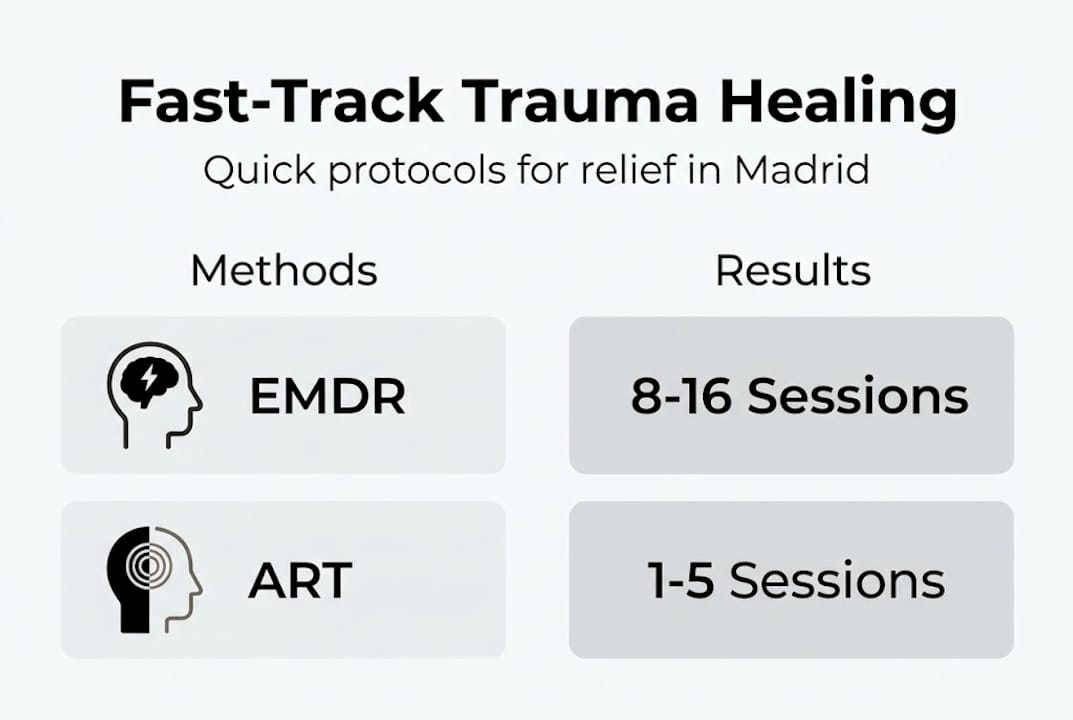
Pro tip: If you’re a time-pressed expat who can’t commit to twelve-plus sessions right now, ask specifically about ART or a step-by-step RTT approach as a starting point.
integrative add-ins for complex trauma:
For trauma that spans multiple life events (childhood experiences, repeated loss, or identity disruption from multiple relocations), somatic work, IFS (Internal Family Systems), and RTT for anxiety relief are often layered in to address the body and subconscious dimensions that talk-based methods alone don’t fully reach.
verifying progress: Common challenges and what success looks like
Following a structured protocol is one thing. Actually knowing whether it’s working is another challenge entirely, especially when progress in trauma therapy isn’t always linear.
Signs your therapy is working:
Your emotional reaction to a previously triggering memory drops in intensity
You’re sleeping more soundly or waking up less often during the night
You catch yourself responding (rather than reacting) in stressful situations
Social situations feel less exhausting
intrusive thoughts or flashbacks become less frequent or less vivid
“The goal of trauma therapy is not to forget what happened. It’s to remember it without being consumed by it. When a memory becomes just a memory, that’s success.” — Clinical framework for trauma recovery
Empirical benchmarks matter here. emdr, PE, and CPT reduce symptoms by 60 to 80% in 8 to 16 sessions. ART often achieves large effect sizes in just 3 to 5 sessions.
Common setbacks for expats specifically:
Language mismatch: processing deep emotional content in a second language adds cognitive load and can slow breakthroughs
Cultural stigma: in some expat communities, seeking therapy still carries shame
transient living: frequent moves disrupt the therapeutic relationship and continuity of care
isolation: limited social support between sessions can slow nervous system regulation
When progress stalls, it’s worth exploring faster trauma healing options designed specifically for expats, or adding hypnotherapy for trauma relief to your existing protocol. You can also explore holistic trauma recovery frameworks for broader lifestyle support alongside your clinical sessions.
Our perspective: The real keys to rapid emotional healing as an expat
After working with expats across many backgrounds and trauma histories, we’ve noticed something that most mainstream therapy articles won’t say directly: the method matters less than the fit. A technically perfect emdr protocol delivered by a therapist who doesn’t understand expat psychology will underperform a slightly less “perfect” session with someone who truly gets your experience.
The biggest mistakes we see expats make are choosing a therapy based on internet popularity alone, or sticking with an approach long past the point where it’s clearly not moving the needle. Evidence-based doesn’t mean one-size-fits-all. It means the method has been tested in real populations and shown measurable results. Your job is to find where you sit within that evidence.
The advantages of rapid transformational therapy are most visible precisely when traditional talk therapy has plateaued. Speed without safety is never the goal. But there’s no virtue in slow healing when faster, equally safe options exist. A stepwise, benchmarked approach where you check progress every few sessions and adjust as needed is, in our experience, the most honest and effective path forward.
Take the next step toward recovery in Madrid
If this guide has clarified what’s possible, the next move is simple: connect with a therapist who specializes in exactly what you’re facing.
At learn about RTT therapy and what makes integrative approaches so effective for expats. Whether you prefer face-to-face sessions at our Madrid office or the flexibility of online or home-office counseling, we offer personalized, evidence-based trauma therapy in English. You don’t have to figure out where to start alone. Book a free discovery call and let’s map out the fastest, safest route to the relief you deserve.
frequently asked questions
How long does step-by-step trauma therapy usually take?
For most expats, emdr or ART reduce symptoms in 3 to 16 sessions depending on trauma complexity. simpler single-event traumas often resolve faster than layered or childhood-rooted experiences.
Is trauma therapy effective for anxiety related to relocating to Madrid?
Yes. rapid integrative methods like emdr combined with somatic work are especially effective for the specific anxiety patterns that come with relocation, identity disruption, and cultural adjustment.
Can I do trauma therapy online while living in Madrid?
Absolutely. Both ART and emdr adapt well to secure online formats, and integrative approaches work effectively via video when in-person visits aren’t practical.
Which therapy is most recommended by international guidelines?
CPT, PE, and TF-CBT are APA tier 1 gold standards for ptsd treatment. emdr and ART are also strongly supported by current international guidelines.
Recommended
Comments