Address anxiety holistically: faster relief for expats


TL;DR:
Holistic anxiety treatment addresses the whole person, including mind, body, and environment.
Combining evidence-based therapy with holistic methods yields faster and more lasting relief.
Tailored approaches effectively target unique expat triggers and cultural adjustment challenges.
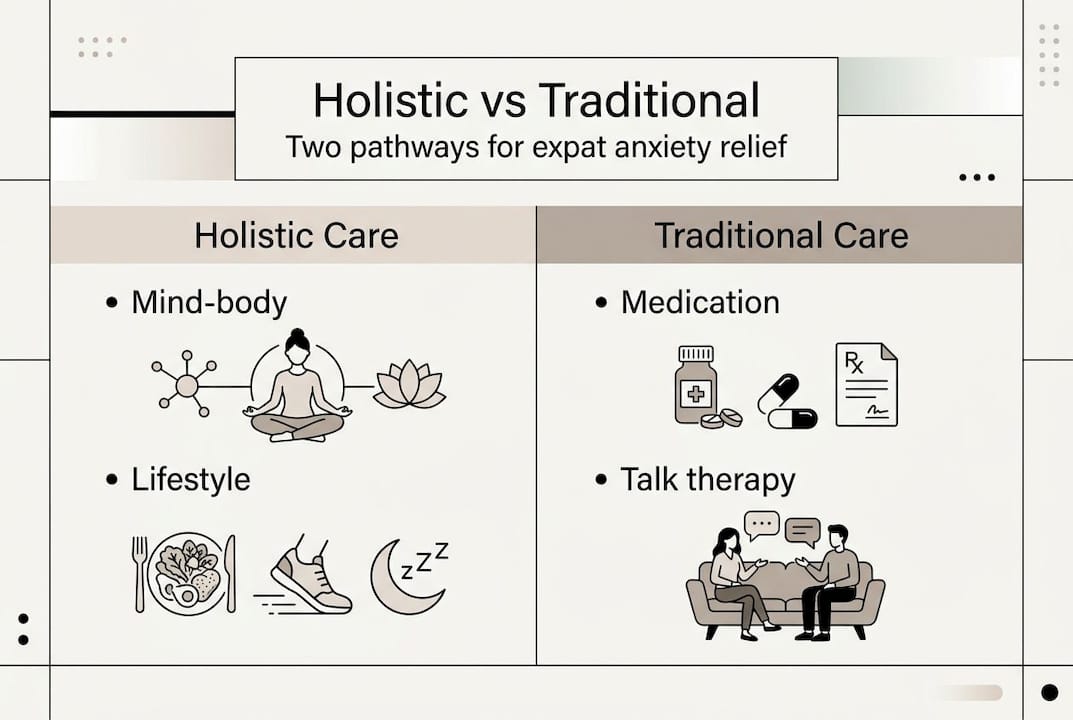
Most expats dealing with anxiety in Madrid are handed two options: try a medication or book standard talk therapy. Neither is wrong, but both alone can leave you spinning in place. Research consistently shows that combined holistic approaches outperform single-method treatment for lasting mental health recovery. When you are living abroad, managing a new culture, a new language, and a new identity all at once, generic care simply does not reach deep enough. This guide breaks down what holistic anxiety treatment actually means, how it compares to conventional options, which strategies target real expat triggers, and how to build a personalized plan that gets results.
Table of Contents
Key Takeaways
Point | Details |
Holistic therapy integrates mind and body | Tackling anxiety holistically addresses emotional, physical, and lifestyle factors for better outcomes. |
Combining approaches works best | Research shows blending evidence-based and holistic methods leads to faster and longer-lasting anxiety relief. |
Tailored strategies for expats | Holistic care helps expats navigate cultural, social, and language stresses unique to living abroad. |
Practical, step-by-step support | You can build a personalized plan combining therapies, tools, and expert advice specific to your needs. |
What does it mean to address anxiety holistically?
The word “holistic” gets used loosely, so let’s get specific. Holistic anxiety care means treating the whole person, not just the symptom. According to Frontiers in Neurology (2025), holistic mental health combines mind, body, and environment to resolve anxiety at multiple levels. That means your therapy goes beyond weekly check-ins to consider what you eat, how you move, how well you sleep, and how connected you feel to the people around you.
For expats in Madrid, this distinction matters a lot. Standard therapy in your home country was probably delivered in your native language, by someone who understood your cultural frame of reference. Here, you may be navigating sessions in your second language, explaining cultural context your therapist may never have experienced, and processing emotions tied to identity shifts that do not fit a textbook diagnosis. Holistic care, when done well, accounts for all of that.
Here is what a genuinely holistic approach covers:
Body: Nutrition, regular movement, sleep hygiene, and somatic (body-based) awareness
Mind: Cognitive patterns, emotional processing, trauma history, and belief systems
Lifestyle: Social connection, community belonging, daily routines, and purpose
Culture and environment: Language comfort, cultural adjustment, expat identity, and sense of safety in a new place
Practical examples of holistic modalities include mindfulness meditation, acupuncture, yoga, nature-based therapy, and journaling combined with evidence-based methods like CBT or EMDR. These are not alternative medicine replacements. They work best alongside structured psychological care, which is exactly why integrative solutions for expats are gaining serious traction in Madrid’s international community.
Pro Tip: When evaluating a new therapist, notice whether they ask about your lifestyle, sleep, social environment, and cultural background, not just your symptoms. That curiosity signals a genuinely integrative approach.
Comparing holistic and traditional approaches: Which offers lasting results?
Let’s put the options side by side so you can make an informed decision. The table below covers the most common approaches you will encounter as an expat seeking anxiety treatment in Madrid.
Approach | Speed of relief | Long-term stability | Side effects | Cultural fit | Client involvement |
Medication (SSRIs) | Moderate (weeks) | Requires ongoing use | Possible; varies | Low | Passive |
Standard CBT | Moderate | High with practice | None | Moderate | Active |
Acupuncture | Fast (sessions 1-4) | Moderate | Minimal | High | Moderate |
Mindfulness/yoga | Moderate to fast | High | None | High | Active |
Nature-based therapy | Moderate | Moderate | None | High | Active |
Integrative (CBT + holistic) | Fast | Highest | Minimal | Highest | Very active |
The data behind this table is worth knowing. Research confirms that CBT combined with holistic therapies yields better executive function and emotional outcomes than either approach alone. Even more striking, mindfulness is non-inferior to SSRIs for anxiety relief, meaning it works as well as antidepressants for many people without the side effect profile.
“Combining evidence-based therapy with holistic interventions does not dilute the science. It amplifies it. The result is faster symptom relief and more durable change than either method delivers alone.”
For expats specifically, cultural fit and client involvement are not minor footnotes. When you feel seen, heard in your language, and understood within your cultural context, therapy moves faster. Approaches that invite you to actively participate, rather than passively receive treatment, also tend to produce more lasting internal shifts. You can explore specific expat psychotherapy types and compare CBT for anxiety expats to understand how evidence-based and holistic methods overlap in practice.
How holistic strategies address real expat anxiety triggers
Knowing that holistic care works is only useful if you can see how it maps to the actual challenges you are facing. Expat anxiety does not usually look like textbook generalized anxiety disorder. It tends to show up in more specific, contextual ways.
Expat trigger | Holistic intervention | Expected outcome |
Homesickness and loneliness | Community-based mindfulness, group therapy | Reduced isolation, improved mood |
Language barriers and communication stress | Multilingual therapy, somatic grounding | Lower daily stress, increased confidence |
Culture shock and identity confusion | Integrative counseling, journaling | Clearer sense of self, better adjustment |
Work stress and burnout | Nature-based walks, yoga, CBT | Restored energy, reduced overwhelm |
Trauma (relocation, past events) | EMDR, body-based therapy | Processed trauma, less reactive anxiety |
Research published by Frontiers in Neurology (2025) confirms that nature-based interventions, acupuncture, and yoga directly reduce anxiety symptoms and improve mood. These are not feel-good extras. They are clinically supported tools.
Here are practical tactics you can start using in Madrid right now:
Take structured walks through Retiro Park or the Casa de Campo, which are both excellent for nature-based nervous system regulation
Search for English-friendly mindfulness or yoga studios in neighborhoods like Malasana or Chamberi
Ask your therapist about somatic techniques to use between sessions when anxiety spikes
Connect with expat community groups on Meetup or Internations to counter isolation
Consider expat integrative therapy examples to understand which methods match your specific triggers
For expats whose anxiety has roots in past experiences, understanding the role of trauma in expat anxiety can be a turning point. When standard medication has not worked for you, it is often because the underlying driver is emotional or relational, not purely chemical. Holistic care meets you there. Many therapists also find that overcoming anxiety in different settings requires adapting the environment, not just the method, which reinforces why location and cultural safety matter in treatment.

Designing your holistic anxiety plan: Steps, tools, and expert tips
Building a plan that actually works requires more than choosing a modality. Here is a clear, five-step approach tailored to expats in Madrid.
Self-assess your triggers and patterns. Before your first session, write down when anxiety peaks, what it feels like physically, and which situations or environments set it off. This gives any therapist a head start.
Choose the right therapist. Look for someone who is multilingual, experienced with expats, and trained in both evidence-based and holistic methods. Resources like multilingual therapists in Madrid confirm that individualized, combined CBT and holistic plans deliver the best outcomes for expat populations.
Build your lifestyle toolkit. Alongside therapy, commit to at least two holistic daily practices. Options include a morning mindfulness routine, weekly yoga, regular time in nature, or consistent sleep and nutrition habits.
Track progress honestly. After four to six weeks, review what is shifting. Are your physical symptoms easing? Is your mood more stable? Are social situations feeling less threatening? Adjust based on evidence, not just hope.
Combine methods without hesitation. Do not wait to see if one method “works” before adding another. Research supports stacking approaches. Consider hypnotherapy for expat anxiety alongside CBT, explore multilingual counseling options for faster rapport, and check out online therapy for expats if scheduling in-person sessions is a barrier.
Pro Tip: The therapist-client relationship is one of the strongest predictors of therapeutic success. If you do not feel genuinely understood after two or three sessions, it is not failure. It is data. Keep looking.
Why the old approach to anxiety management doesn’t work for expats
Here is an honest observation from working with expats in Madrid: standard treatment protocols were designed for a relatively stable, culturally homogeneous patient. They assume you have a consistent social network, a shared language with your therapist, and a single fixed cultural identity. Most expats have none of those things.
When you show up to a standard clinic presenting anxiety, you may get a prescription or twelve weeks of CBT. Both can help. But neither alone addresses why you feel anxious: the identity fragmentation, the daily effort of functioning in a second language, the grief of leaving home, and the pressure to look like you are thriving abroad.
Real, lasting change comes from therapists who treat your whole context, not just your symptoms. Practitioners who ask about your sleep, your social life, your cultural background, and your sense of purpose are not being nosy. They are being thorough. Explore integrative psychotherapy insights to see how combining scientific rigor with mind-body methods produces results that one-size-fits-all treatment simply cannot match. The expats who recover fastest are not the ones who found the right pill. They are the ones who found the right combination.
Take the next step toward holistic anxiety support in Madrid
If this article has helped you see anxiety through a wider lens, the next step is finding support that actually matches that lens. At Heske Therapy, we work specifically with English-speaking expats and international clients in Madrid, combining RTT, EMDR, CBT, hypnotherapy, and counseling into personalized plans built around your life, not a textbook.
You can book a counseling session in-office or from anywhere via our online counseling for expats platform. If you are ready to commit to real change, our discounted counseling package makes starting even easier. Sessions are conducted in English, with deep respect for your cultural background and individual pace. Start with a free discovery call and see what a genuinely holistic plan feels like.
Frequently asked questions
Is holistic anxiety treatment safe for everyone?
Most holistic strategies like mindfulness and yoga are safe for mild to moderate anxiety, but those with severe symptoms should combine them with conventional care under professional guidance, as evidence gaps in long-term holistic data still exist.
What holistic therapy works fastest for anxiety relief?
Acupuncture shows some of the fastest symptom reductions in clinical studies, with significant anxiety score drops measured by HAMA, SAS, and GAD-7 scales, particularly when paired with evidence-based therapies like CBT.
Can I find English-speaking holistic therapists in Madrid?
Yes, Madrid has a growing network of multilingual therapists offering integrative and holistic counseling in English for expats, both online and in-person, as confirmed by multilingual therapy resources tailored to the city’s international community.
Is holistic therapy effective even if past treatments failed?
Holistic approaches frequently help expats who did not respond to medication or single-method therapy because they address lifestyle, identity, and mind-body factors that standard non-responder care often overlooks entirely.
Recommended
Comments