Why expats in Madrid need specialized psychotherapy


TL;DR:
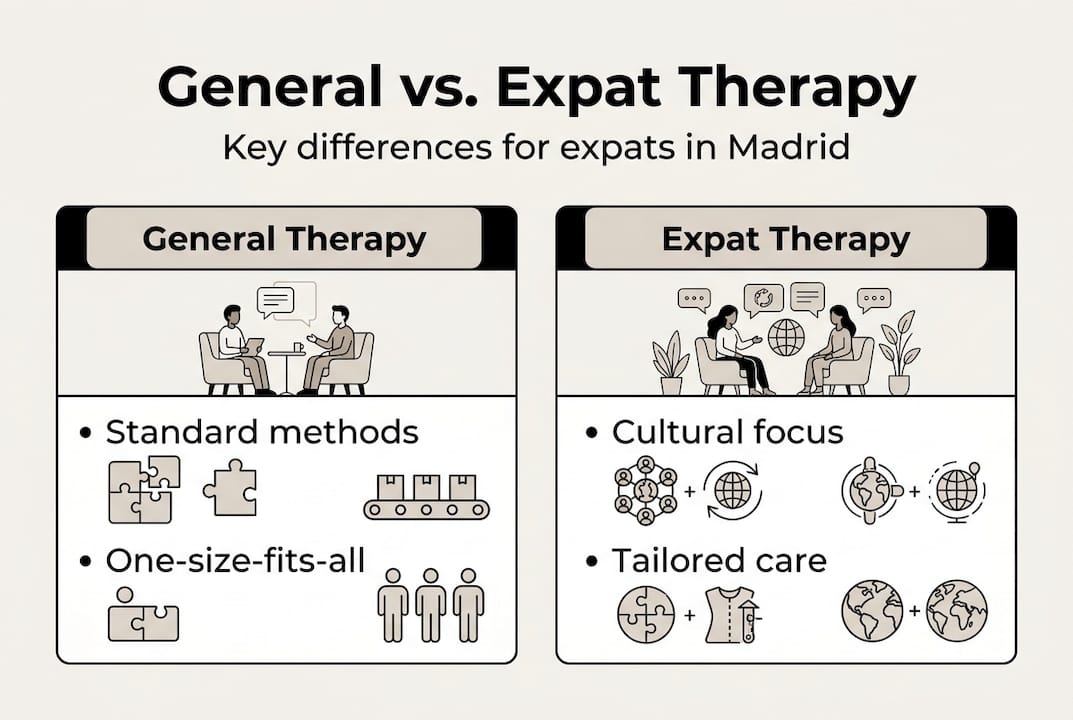
General therapy often misses expat-specific issues like migration trauma, cultural identity, and language barriers.
Specialized expat psychotherapy uses cultural awareness, flexible methods, and native languages for better outcomes.
Choosing an experienced, culturally attuned therapist in Madrid can lead to faster, more lasting mental health improvements.
Moving to Madrid as an expat sounds exciting on paper, but the emotional reality is far more complex. Studies show that migrants face disproportionate rates of anxiety, trauma, and adjustment-related distress compared to local populations, yet most expats end up in general therapy that was never designed for their situation. The result? Slow progress, surface-level results, or the frustrating feeling that your therapist just doesn’t quite get what you’re going through. This guide breaks down why general therapy often falls short for expats, what specialized psychotherapy actually looks like, and how to find the right fit in Madrid.
Table of Contents
Key Takeaways
Point | Details |
General therapy limits | Standard therapy may not address unique cultural and emotional challenges expats face. |
Specialized methods work | Integrative CBT, TF-CBT, and EMDR are proven effective for PTSD, anxiety, and depression in expats. |
Cultural fit matters | Therapists attuned to migration and identity issues deliver stronger, lasting results. |
Personalization is key | Rapid and integrative therapy should be matched to individual expat needs for true effectiveness. |
Madrid support available | Specialized, English-speaking therapists in Madrid can help you find the right path to mental well-being. |
The limits of general psychotherapy for expats
General therapy models are scientifically sound. Standard cognitive behavioral therapy (CBT), for example, has decades of evidence behind it and works well for many people. But working well for many people is not the same as working well for you, especially when your life includes visa stress, cultural identity shifts, language barriers, and the quiet grief of leaving your home country behind.
The research confirms this gap. General CBT is effective for common issues but lacks the nuance required to address expat-specific stressors. A therapist who hasn’t trained in migration psychology may interpret your symptoms through a one-size-fits-all lens, missing the root causes entirely.
Here’s what general therapy frequently overlooks for expats:
Cultural identity confusion: Feeling caught between your home culture and your adopted one is a real psychological stressor, not just “adjustment.”
Migration trauma: The losses involved in relocating, relationships, routines, a sense of belonging, can create grief that looks like depression but isn’t.
Language barriers: Even if you’re fluent in Spanish, processing emotional content in a second language creates cognitive distance that affects therapy outcomes.
Cross-cultural misdiagnosis: A therapist unfamiliar with expat life may pathologize behaviors that are perfectly normal responses to radical environmental change.
“Therapists not trained in migration psychology may miss root causes for expats, leading to superficial interventions that address symptoms rather than the underlying cultural and identity-based stressors.”
This isn’t a criticism of general therapy as a field. It’s a recognition that psychotherapy methods for expats require a different lens. If your therapist has never navigated the experience of living abroad, they may struggle to validate challenges that feel invisible to most locals. The international client therapy space exists precisely because this gap is real, documented, and has real consequences for mental health outcomes.
For expats dealing with anxiety specifically, the stakes are even higher. Misaligned therapy doesn’t just waste time. It can reinforce the belief that your struggles are somehow your fault. Understanding types of therapy for anxiety that account for expat context is the first step toward meaningful progress.
What makes psychotherapy specialized for expatriates?
Specialized expat psychotherapy isn’t a single technique. It’s a clinical orientation that combines evidence-based methods with cultural awareness, migration-specific knowledge, and a genuine willingness to adapt the treatment to the person sitting in front of you.
Specialized therapy for migrants addresses cultural identity and migration psychology in ways that general models simply don’t prioritize. And the impact is measurable: cultural sensitivity enhances the therapeutic alliance for migrants, directly reducing the risk of misdiagnosis and increasing treatment engagement.
Here’s what specialized expat psychotherapy typically includes:
Language accommodation: Sessions conducted in your native language or the language where you feel most emotionally fluent
Migration-specific frameworks: Tools and language that normalize culture shock, relocation grief, and identity transitions
Integrative method selection: Combining CBT, EMDR, RTT (Rapid Transformational Therapy), and counseling based on what fits your presentation
Validation of expat identity: Recognition that the expat experience is complex, not just “exciting”
Faster results focus: Because expat life often moves fast, therapy should too
Feature | General therapy | Specialized expat therapy |
Cultural framework | Minimal | Central to treatment |
Language options | Usually one | Multilingual often available |
Migration psychology | Rarely addressed | Core competency |
Method flexibility | Standard protocols | Integrative and adaptive |
Speed of results | Variable | Designed for efficiency |
A therapist practicing therapy for expats in Madrid will ask different questions from the start. They’ll explore your relationship to both cultures, your sense of identity before and after moving, and what “home” currently means to you. That context changes everything about how therapy unfolds.

Pro Tip: Before booking a first session, ask the therapist directly: “Have you worked with expats before, and do you use integrative or rapid therapy methods?” Their answer will tell you a lot. Multilingual therapy for expats has been shown to improve outcomes significantly, particularly for clients who process emotions differently in their native tongue.
Evidence-based benefits: Specialized therapy versus general models
The clinical evidence here is strong. Integrative CBT, TF-CBT, and EMDR show large, sustained effects for PTSD, depression, and anxiety, with effect sizes exceeding g>1.0 in several meta-analyses. That’s a meaningful difference compared to standard talk therapy alone.
What makes these approaches stand out for expats specifically is their adaptability. EMDR (Eye Movement Desensitization and Reprocessing) is particularly well-suited for processing migration trauma, childhood trauma, or any experience that has become “stuck” in the nervous system. Trauma-focused CBT (TF-CBT) helps restructure the thought patterns that form around difficult cross-cultural experiences. RTT targets the subconscious scripts that drive anxiety and self-doubt.
However, comorbid or complex trauma requires personalized or targeted interventions rather than a generic protocol. This is the critical distinction. A cookie-cutter approach might produce some improvement, but lasting change depends on matching the method to the individual.
Comparing therapy approaches for expats:
Approach | Best for | Typical duration | Expat relevance |
Standard CBT | Mild anxiety, mood issues | 12 to 20 sessions | Moderate |
EMDR | Trauma, PTSD | 6 to 12 sessions | High |
TF-CBT | Complex trauma, comorbid issues | 12 to 16 sessions | High |
RTT | Subconscious blocks, rapid change | 1 to 3 sessions | Very high |
Integrative therapy | Multi-layered needs | Flexible | Very high |
How to identify an outcome-focused therapist in Madrid:
Ask whether they measure progress regularly using validated tools
Confirm they have experience with migration or relocation-related presentations
Request a clear explanation of which method they’d use for your specific needs
Check whether they offer personalized therapy results rather than a fixed protocol
Explore whether expat therapy methods like EMDR or RTT are part of their toolkit
How to choose the right specialized psychotherapy as an expat in Madrid
Knowing the evidence is one thing. Making a confident, practical decision about therapy is another. Here’s what to actually look for when evaluating your options in Madrid.
Factors that matter most in a specialized therapist:
Expat or migration experience: Have they worked specifically with international clients?
Integrative method range: Do they offer more than one evidence-based approach?
Language and cultural fluency: Can they meet you in your emotional language?
Rapid or focused options: Do they offer short-term, results-oriented formats alongside longer-term support?
Transparency about methods: Are they willing to explain exactly what they’d use and why?
Personalization is critical for complex trauma and comorbid presentations, and rapid or integrative options are viable when properly matched to the client. That last point matters: speed and quality are not opposites in specialized therapy.
Pro Tip: Use your first consultation as a diagnostic tool, not just an introduction. Notice whether the therapist asks about your cultural background, your relationship to Madrid, and what your life looked like before you moved. If they skip those questions, they may be working from a generic model.
Madrid has a growing network of English-speaking mental health professionals who understand expat life firsthand. Many offer online sessions alongside in-person options, which is useful during periods of travel or transition. You can learn more about relief for expatriates and why seeking help early makes a measurable difference in outcomes. Exploring personalized therapy Madrid options can also give you a clearer sense of what’s available locally. And if rapid results are a priority, rapid counseling for expats is worth considering as part of your search.
Why expats need more than the basics: Our view on specialized psychotherapy
Here’s the honest truth: expat life has layers that most therapy frameworks were never designed to hold. You’re managing legal status, career transitions, relationship strain across time zones, and the invisible weight of starting over, often without the social safety net you’d have at home. Standard models, even scientifically robust ones, often become less actionable the moment your life context doesn’t fit the template they were built for.
We’ve worked with clients who spent years in general therapy making slow progress, then experienced significant breakthroughs within weeks once the work was culturally attuned and method-matched. Rapid and integrative options are favored for efficiency, but they must be personalized for complexity to produce lasting change for expats.
Our perspective: don’t settle for therapy that flattens your experience into a generic diagnosis. Your situation is specific. Your therapy should be too. The most effective approach moves at the pace your real life demands while honoring the full complexity of who you are across cultures.
Next steps: Find your specialized support in Madrid
You’ve done the research. Now it’s time to act on it.
At Heske Therapy, we work specifically with English-speaking expats in Madrid using integrative, rapid, and culturally attuned approaches including RTT, EMDR, CBT, and hypnotherapy. Whether you’re dealing with anxiety, trauma, burnout, or the quiet disorientation of building a life abroad, we have tools designed to create real, lasting results. Learn more about our rapid RTT therapy approach, explore our 21-day RTT package, or visit Heske Therapy to book your free discovery call and find the support you actually need.
Frequently asked questions
How is specialized psychotherapy different for expats compared to general therapy?
Specialized expat therapy addresses cultural, migration, and language factors that general therapy can miss, leading to better alignment with expat challenges and fewer misdiagnoses.
What therapy methods are most effective for expats with PTSD or anxiety?
Integrative CBT, TF-CBT, and EMDR have shown large, lasting effects for PTSD and anxiety, especially when adapted to the client’s cultural and personal context.
Does specialized psychotherapy really matter if I just want quick results?
Specialized, rapid methods can deliver significant improvements quickly, but they should be tailored for complex cases to your unique cultural and emotional background for the most durable outcome.
Are there English-speaking therapists specialized for expats in Madrid?
Yes. Specialized therapy for migrants includes language accommodation and cultural awareness, and Madrid has qualified, multilingual therapists with direct expat experience available both online and in person.
Recommended
Comments