Language in therapy for expats: 2x more effective


TL;DR:
Native-language therapy is twice as effective for emotional processing and healing.
Language alignment enhances trust, depth, and speed of therapeutic progress for expats.
RTT and hypnotherapy deliver faster, more lasting results when conducted in the client’s strongest language.
Choosing a therapist in Madrid is already a challenge. Choosing one who speaks your language, truly speaks it, changes everything. Native-language psychotherapy is twice as effective as therapy conducted in a second language for non-native speakers, particularly when trauma and anxiety are involved. Yet many English-speaking expats in Madrid settle for whatever is available, assuming a skilled therapist can always bridge the gap. This guide breaks down why that assumption costs you healing time, how your language shapes every layer of the therapeutic process, and what solutions like RTT and hypnotherapy offer when therapy is delivered in the language where your emotions actually live.
Table of Contents
Key Takeaways
Point | Details |
Native language matters | Therapy in your strongest language can double your chances of emotional breakthrough and lasting change. |
Innovative methods work | RTT and hypnotherapy support faster anxiety and trauma relief, especially in your main language. |
Bilingual expats face nuance | Language switching has both upsides and risks—understand how it shapes your therapy journey. |
Specialized services available | English-speaking counselors and advanced methods like RTT are accessible to Madrid expats seeking support. |
Why language matters in therapy for expats
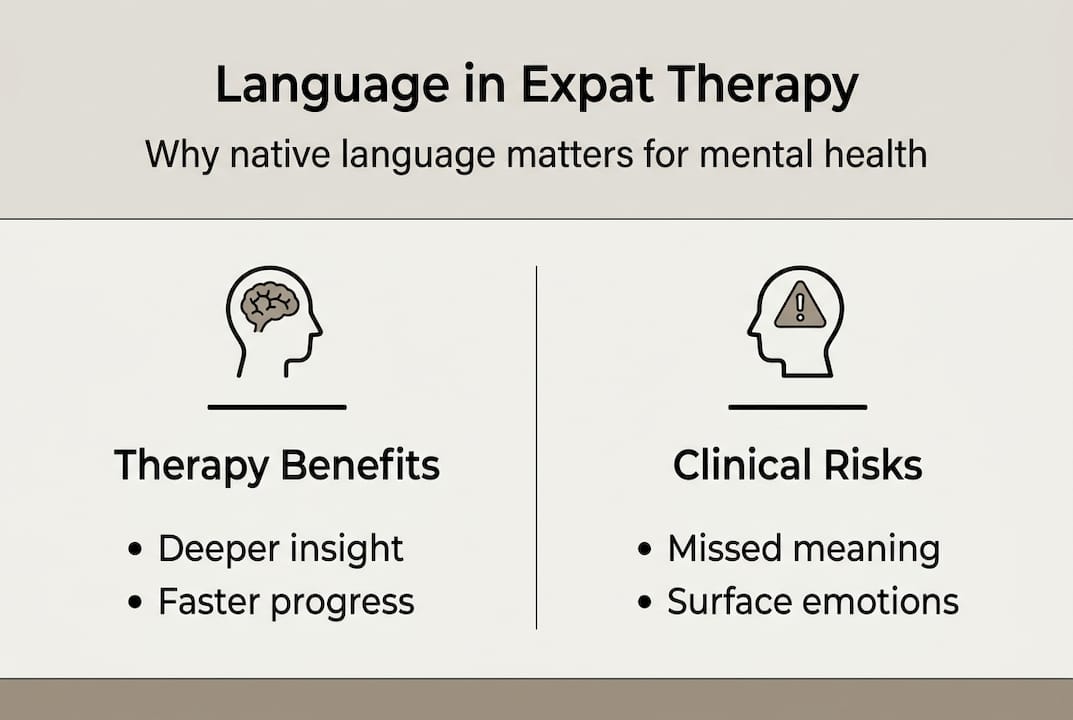
Language is not just a communication tool in therapy. It is the medium through which emotions are felt, named, and processed. When you describe grief, fear, or shame in your native tongue, you access those feelings with a precision that a second language simply cannot replicate. The words carry weight, history, and emotional color that translation strips away.
Research confirms this clearly. Native-language psychotherapy is twice as effective for non-native speakers, enabling deeper emotional processing, stronger therapeutic empathy, and more meaningful change, especially in trauma contexts. That is not a marginal difference. That is the difference between surface-level coping and genuine healing.
For expats in Madrid, this matters even more. Moving abroad already creates a kind of emotional displacement. You are navigating a new culture, a new language, and often a new identity. When your therapist does not speak your strongest emotional language, that displacement follows you into the one space where you should feel completely understood. The multilingual therapy benefits for expats go far beyond convenience. They are clinically significant.
“The language of therapy is the language of healing. When the two are misaligned, even the most skilled therapist is working with one hand tied behind their back.”
Here is a quick comparison of what changes when language is aligned versus misaligned in therapy:
Factor | Native-language therapy | Second-language therapy |
Emotional access | Deep and natural | Filtered and effortful |
Therapeutic empathy | High | Reduced |
Trauma processing | More effective | Often incomplete |
Session efficiency | Higher | Lower |
Risk of misunderstanding | Low | Elevated |
The practical implications for expats seeking therapy for expat life are significant:
You spend less energy translating your inner world and more energy healing it.
Your therapist catches emotional nuances, not just literal meanings.
You feel genuinely seen, which is the foundation of therapeutic trust.
Progress tends to be faster and more durable.
Language alignment is not a luxury. For anxiety and trauma work, it is a clinical necessity.
Emotional depth and safety: Psychological mechanisms
Therapeutic safety is not just about feeling comfortable. It is a neurological state. When you feel safe, your nervous system shifts out of threat mode, and your brain becomes capable of processing difficult memories and emotions. Language plays a direct role in creating or undermining that safety.
When you speak in your native language, emotional memories are encoded and retrieved more vividly. The words you learned alongside your earliest experiences carry emotional charge that a second language does not. Describing a childhood wound in English when Spanish or Dutch is your mother tongue creates a subtle but real emotional distance. Sometimes that distance feels protective. But in therapy, it becomes a wall.
English-speaking expats in Madrid frequently report that language barriers amplify feelings of isolation and anxiety. When they cannot fully express what they are feeling, they leave sessions with the sense that they were not truly heard. That experience, repeated over time, erodes the therapeutic relationship and slows progress significantly.
Consider a common scenario. An expat working in Madrid develops burnout and anxiety after two years abroad. She speaks functional Spanish but thinks and feels in English. In Spanish-language therapy, she describes her symptoms accurately but cannot convey the emotional texture of her experience. Her therapist, however skilled, is working from an incomplete picture.

Pro Tip: When choosing an English-speaking therapist in Madrid, ask directly whether they conduct sessions in English or simply understand it. There is a meaningful clinical difference between a therapist who is fluent and one who is conversational.
Here are the key psychological mechanisms that make native-language therapy more effective:
Emotional encoding: Memories and feelings are stored in the language in which they were first experienced.
Cognitive load: Thinking in a second language consumes mental resources that should go toward processing, not translating.
Somatic resonance: Certain words trigger physical sensations. Native-language words carry more somatic weight.
Relational trust: Feeling truly understood in your own language accelerates the therapeutic alliance.
Vulnerability access: Shame, grief, and fear are harder to express in a second language, limiting therapeutic depth.
For expats overcoming expat challenges in Madrid, working with a therapist who speaks your language is not just more comfortable. It is more effective at every measurable level.
Innovative therapies: RTT and hypnotherapy in expat contexts
Rapid Transformational Therapy (RTT) and hypnotherapy are particularly well suited to expats dealing with anxiety and trauma. Why? Because both methods work directly with the subconscious mind, where emotional memories, beliefs, and patterns are stored. And in the subconscious, language matters enormously.
RTT combines hypnosis, cognitive behavioral techniques, and neuro-linguistic reprogramming to identify and reframe the root causes of anxiety, trauma, and limiting beliefs. Sessions are typically conducted in the client’s strongest language, which allows the therapeutic suggestions to land at the deepest possible level. When the words used in a session match the language of your inner world, the results are faster and more lasting.
The evidence for hypnotherapy is compelling. A meta-analysis on hypnotherapy found that it reduces anxiety (SMD= 0.43), pain (SMD= 0.35), and stress, working through suggestions that modulate the brain’s response to distressing stimuli. For trauma and anxiety specifically, these effects are clinically meaningful.
Here is how RTT and hypnotherapy compare to conventional talk therapy for expat-specific concerns:
Therapy type | Speed of results | Language sensitivity | Subconscious access | Remote accessibility |
RTT | Fast (1-3 sessions) | Very high | Direct | Yes |
Hypnotherapy | Moderate to fast | Very high | Direct | Yes |
CBT | Moderate | High | Indirect | Yes |
Talk therapy | Slower | Moderate | Limited | Yes |
Pro Tip: If you are considering clinical hypnotherapy for anxiety, ask your therapist to explain how they personalize the language of suggestions to your specific emotional vocabulary. Generic scripts are less effective than tailored ones.
Key advantages of RTT and hypnotherapy for English-speaking expats in Madrid:
Sessions conducted entirely in English remove the cognitive barrier of translation.
Subconscious reprogramming works faster when suggestions are delivered in your native language.
Online sessions make hypnotherapy for expats accessible regardless of location within Madrid or beyond.
Both methods address root causes rather than symptoms, producing more durable change.
For expats who have tried conventional therapy with limited results, RTT and hypnotherapy in English often represent a meaningful turning point.
Navigating language switching: Bilingual and multicultural realities
Not every expat fits neatly into the category of “English speaker living in a Spanish-speaking world.” Many long-term expats and third-culture kids (TCKs) operate fluidly across two or more languages, and their therapeutic needs are correspondingly more complex.
Language switching in therapy, moving between languages mid-session, can serve a real psychological function. Some bilingual clients use their second language to discuss topics that feel emotionally overwhelming in their first language. The slight distance that a second language creates can make it easier to approach difficult material without being flooded by emotion. This is not avoidance. It is a form of self-regulation.
However, bilingual switching in therapy carries risks, particularly for long-term expats and TCKs. Over-reliance on a second language can become a way of keeping emotions at arm’s length indefinitely, which limits therapeutic depth. Conversely, for TCKs who feel equally at home in multiple languages, insisting on a single language can feel artificial and create its own barriers.
Here is a comparison of how language dynamics differ across expat profiles:
Expat profile | Language preference | Key therapeutic consideration |
Recent expat | Strong native language | Prioritize native-language therapy |
Long-term expat | Mixed or shifting | Flexible bilingual therapist needed |
TCK | Multiple “home” languages | Multicultural identity work essential |
Returning expat | Reintegrating native language | Identity and belonging themes central |
Pro Tip: If you identify as a TCK or long-term expat, look for a therapist with explicit training in multicultural identity. The multilingual counseling benefits extend beyond language fluency to cultural competence.
Key considerations for bilingual expats in therapy:
A skilled therapist will notice when language switching signals avoidance versus regulation.
Multicultural identity is a therapeutic topic in itself, not just a background detail.
Flexibility in language use should serve the client’s healing, not the therapist’s convenience.
Understanding psychotherapy methods that integrate cultural sensitivity helps you choose the right fit.
Our perspective: When language takes center stage in healing
Here is something we see consistently in our work with expats in Madrid: the most advanced therapeutic technique in the world still depends on language to deliver its effect. RTT, EMDR, CBT, none of these methods bypass the fundamental need for emotional resonance between therapist and client.
We have worked with clients who spent years in therapy with competent, caring therapists, and still felt stuck. When they switched to working in English, their strongest emotional language, the shift was immediate. Not because the previous therapist lacked skill, but because something essential was missing in translation.
The uncomfortable truth is that the mental health field underestimates language as a clinical variable. Expats are often told that a good therapist is a good therapist, regardless of language. That is simply not what the evidence or our experience supports. Exploring multilingual therapy insights reveals how consistently language alignment accelerates outcomes.
Your story deserves to be told, and heard, in the language where it actually lives.
Find your language, find your healing: English-speaking therapy in Madrid
If reading this has made you realize that language has been a barrier in your own therapeutic journey, you are not alone. Many expats in Madrid spend months or years in therapy that feels productive but never quite reaches the emotional core of what they are carrying.
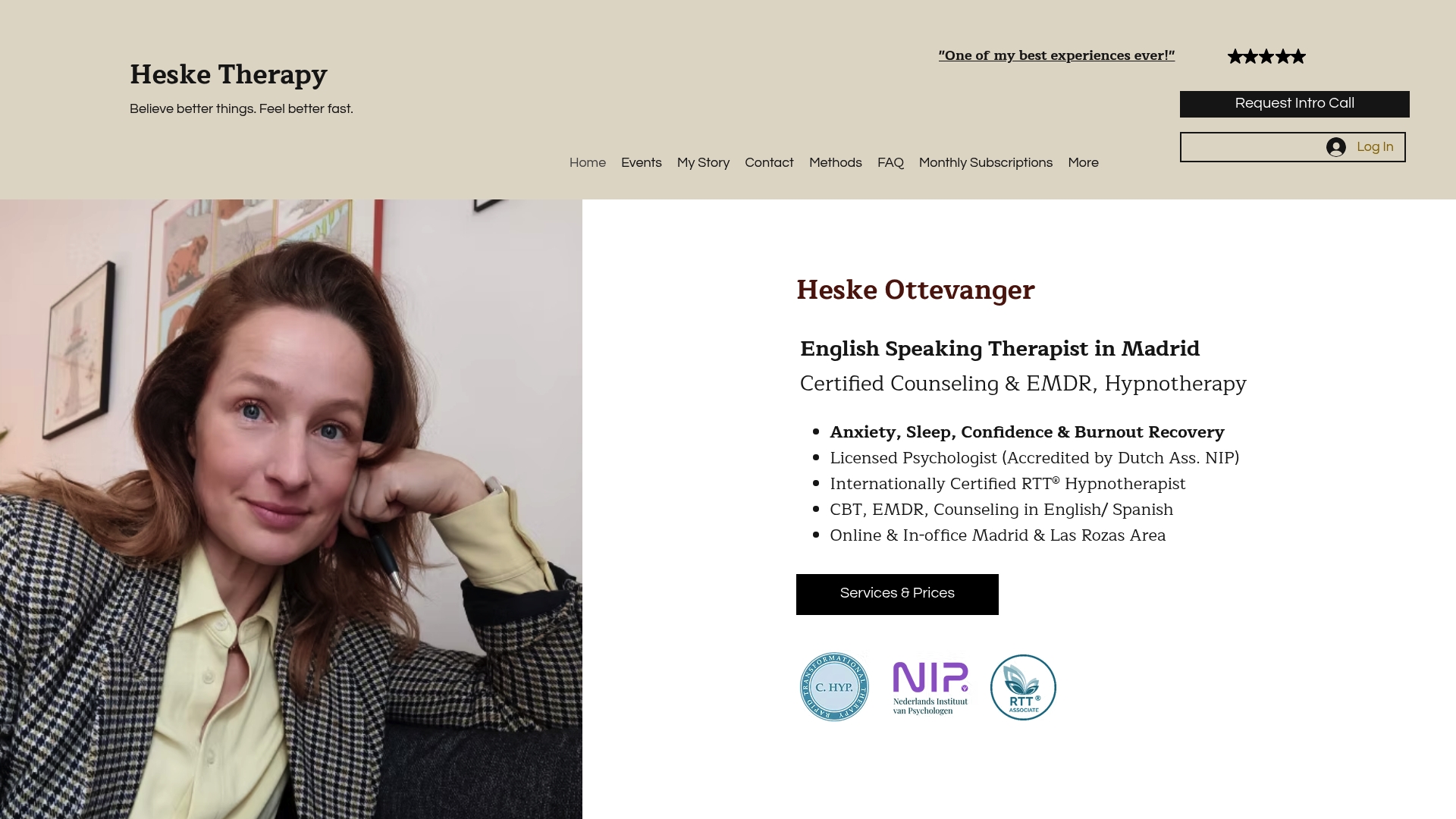
At Heske Therapy, we offer English-speaking therapy specifically designed for expats, combining RTT, hypnotherapy, EMDR, and CBT in a way that meets you where you are, linguistically and emotionally. Sessions are available both in-person in Madrid and online, so access is never a barrier. Whether you are dealing with anxiety, trauma, burnout, or simply the weight of expat life, we are here in your language. You can learn about RTT therapy or go ahead and book a session online to take the first real step toward lasting change.
Frequently asked questions
Why is therapy in my native language more effective?
Therapy in your native language gives you direct access to emotionally encoded memories and feelings, which means healing happens at a deeper level. Native-language therapy is twice as effective for non-native speakers, particularly in trauma and anxiety work.
Can innovative therapies like RTT and hypnotherapy help with anxiety if I’m not fluent in Spanish?
Absolutely. RTT and hypnotherapy are especially powerful when delivered in your strongest language because subconscious suggestions land more deeply. Hypnotherapy reduces anxiety significantly, and that effect is amplified when language resonates emotionally.
What are the risks of language switching during therapy for long-term expats?
Language switching can support emotional regulation, but it can also become a way of avoiding full emotional contact with difficult material. Bilingual switching in therapy works best when guided by a therapist trained in multicultural identity dynamics.
Are there English-speaking therapy services for expats in Madrid?
Yes. Multilingual therapists in Madrid offer English-language services including RTT and hypnotherapy, specifically designed to support expats navigating anxiety, trauma, and the emotional complexity of life abroad.
Recommended
Comments