How therapy supports expats: overcoming challenges & thriving


TL;DR:
Expats in Madrid face unique mental health challenges like anxiety, burnout, and loneliness.
Therapy helps by identifying issues, building regulation skills, and processing expat-specific stressors.
Tailored, multilingual approaches in online or in-person formats are most effective for expat adjustment.
Moving to Madrid feels like an adventure until the novelty wears off and the emotional weight sets in. You’ve sorted the visa, found an apartment, and figured out the metro. But nobody warned you about the creeping anxiety, the exhaustion that doesn’t go away, or the strange grief of missing a life you chose to leave behind. Expats face higher rates of anxiety and adjustment issues compared to local residents, yet most wait far too long before seeking support. Therapy isn’t a last resort. For expats in Madrid, it can be the single most effective tool for actually thriving, not just surviving.
Table of Contents
Key Takeaways
Point | Details |
Expats face unique stress | Isolation and cultural barriers make mental health challenges common among expatriates in Madrid. |
Specialized therapy is vital | Therapists trained for expat issues offer targeted help for managing anxiety, burnout, and emotional stress. |
Tailored methods work best | RTT, CBT, and culturally sensitive approaches are especially effective for English-speaking expats. |
Choosing the right therapist matters | Selecting a provider with language and cultural expertise greatly improves outcomes. |
Why expats in Madrid face unique mental health challenges
Relocating to a new country reshapes every corner of your life at once. Your social network, professional identity, daily routines, and sense of belonging all shift simultaneously. That’s a lot for any nervous system to handle, and it’s why so many expats in Madrid find themselves struggling in ways they didn’t anticipate.
The most common emotional challenges expats report include:
Chronic anxiety triggered by unfamiliar bureaucratic systems, language barriers, and uncertainty about the future
Burnout from overcompensating at work to prove their value in a new environment
Adaptation stress, the constant cognitive load of navigating a culture that operates differently from what you know
Loneliness and isolation, especially in the early months before a social circle forms
Identity confusion, a quiet but destabilizing feeling that you’re neither fully at home here nor fully connected to where you came from
Language is a particular amplifier of all of these. Even expats with solid Spanish skills often find that emotional conversations, therapy included, feel hollow or imprecise when conducted in a second language. Nuance matters enormously in mental health work, and losing it creates a real barrier to healing.
“Living abroad means constantly translating not just language, but your entire sense of self. That’s exhausting work that most people never name or acknowledge.”
Limited access to familiar support systems makes everything harder. Back home, you might have had a therapist you trusted, friends who knew your history, or family nearby. In Madrid, you’re starting from zero. Online therapy for expats has become a vital bridge for this reason, offering continuity and accessibility when local options feel overwhelming or simply unavailable in English.
Finding English-speaking therapy options in Madrid is possible, but it requires knowing what to look for. Not every therapist understands the specific pressures of expat life, and working with someone who doesn’t can leave you feeling more misunderstood than before.
How therapy helps expats cope with anxiety, burnout, and emotional stress
Therapy works for expats not because it removes the challenges of living abroad, but because it gives you a reliable framework for responding to them. The difference between an expat who thrives and one who quietly unravels often comes down to whether they have structured, personalized support.
Here’s how a well-matched therapy relationship actually moves the needle:
It names what’s happening. Many expats don’t realize their symptoms have a name. Labeling anxiety, burnout, or adaptation stress reduces shame and opens the door to real change.
It builds emotional regulation skills. You learn to recognize your triggers and respond rather than react, which is especially useful when cultural mismatches push your buttons daily.
It processes unresolved experiences. Expat life often surfaces old wounds. Therapy creates a safe container to work through them without derailing your daily life.
It rebuilds identity and confidence. When your professional status, social role, and daily habits all shift at once, therapy helps you reconnect with who you are beneath the external changes.
It accelerates adaptation. Tailored therapy offers fast relief and better adjustment for expats, shortening the painful early phase of relocation significantly.
Pro Tip: Don’t wait until you’re in crisis. Starting therapy within the first three to six months of your move gives you a proactive foundation rather than a reactive rescue.
Expats who engage with mental health counseling early in their relocation consistently report better sleep, stronger relationships, and greater confidence navigating their new environment. The investment pays off quickly because the work is targeted and relevant to your actual daily life, not generic coping advice.

Key therapy methods used with expats in Madrid
Not all therapy approaches are equally suited to the expat experience. Some methods are particularly effective because they work quickly, address deep-rooted patterns, and adapt well across cultural and linguistic contexts.
Proven therapy methods for expats include RTT, CBT, EMDR, and multilingual counseling, each targeting different layers of the emotional challenges expats face.
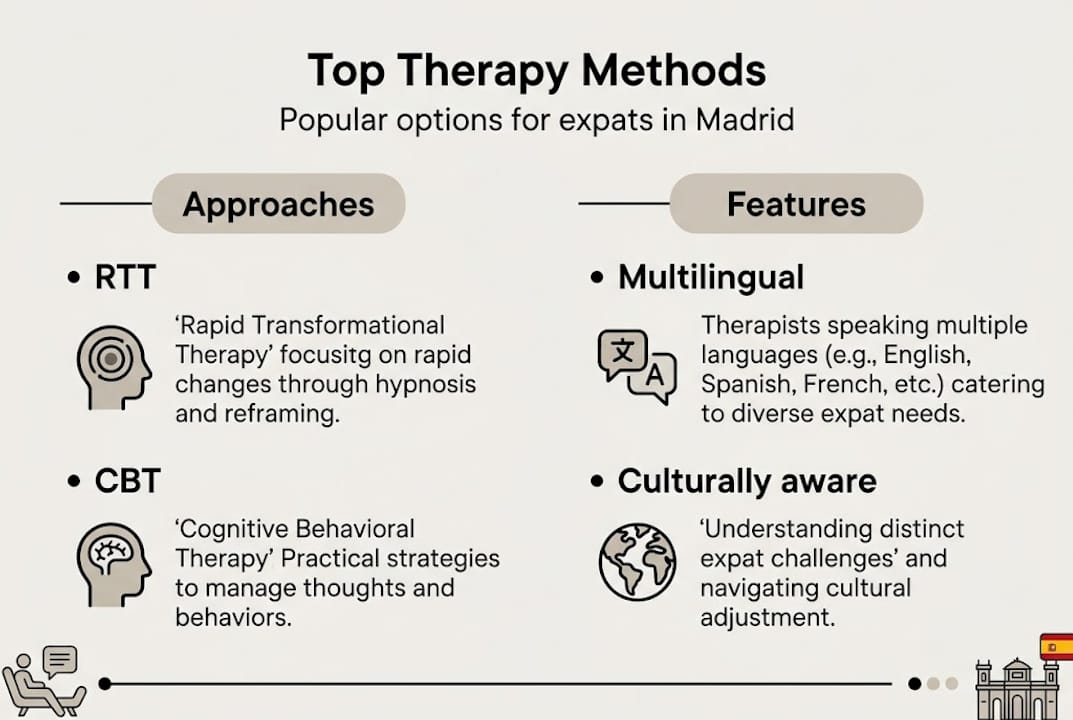
Therapy method | Primary focus | Best for expats when… |
RTT (Rapid Transformational Therapy) | Subconscious beliefs and root causes | Anxiety, low self-worth, burnout with deep roots |
CBT (Cognitive Behavioral Therapy) | Thought patterns and behavior change | Daily stress, worry spirals, adjustment difficulties |
EMDR | Trauma processing and nervous system regulation | Past trauma resurfacing during relocation |
Counseling | Emotional support and practical coping | Loneliness, identity shifts, relationship stress |
Hypnotherapy | Deep relaxation and subconscious reprogramming | Sleep issues, performance anxiety, emotional blocks |
The method that works best for you depends on more than just your symptoms. Language and cultural context play a significant role. A therapist who understands the specific pressures of expat life in Madrid, including the Spanish work culture, the social dynamics, and the bureaucratic frustrations, will apply these methods with far greater precision.
Multilingual therapy matters more than most people realize. Processing emotions in your native language activates deeper neural pathways, making breakthroughs more accessible and lasting. When therapy is offered in English, Spanish, or Dutch, clients can choose the language that feels most emotionally authentic to them.
Key factors that make a therapy method effective for expats:
Speed of results: Expats often need relief quickly, especially if work performance or relationships are already affected
Cultural adaptability: The method should flex to the client’s background, not force them into a one-size-fits-all framework
Depth of change: Surface-level coping tools help, but lasting transformation requires addressing root causes
Finding the right therapist: what expats in Madrid should look for
Choosing a therapist is one of the most personal decisions you’ll make during your time abroad. The wrong fit wastes time and money. The right fit can genuinely change the trajectory of your life in Madrid.
Therapists who speak English and understand expat issues measurably improve outcomes for international clients. Language competence is non-negotiable, but cultural competence matters just as much.
When evaluating a therapist, look for:
Demonstrated experience working specifically with expats or international clients
Fluency in your native language, not just conversational ability
Familiarity with the emotional arc of relocation: excitement, disillusionment, adaptation, and integration
Clear methodology and an ability to explain how they work and what results to expect
Positive reviews from other expats, not just local clients
One practical question to ask in a first session: “Have you worked with clients going through relocation stress before, and what does that process typically look like?” The answer tells you a lot about fit.
Format | Advantages | Considerations |
In-person therapy | Stronger rapport, non-verbal cues, full presence | Requires travel, fixed scheduling |
Online therapy | Flexible, accessible from anywhere, easier to start | Needs reliable internet, less physical presence |
For many expats, online therapy is the more practical starting point. It removes the logistical friction of finding a physical location, allows you to work from your own space, and makes it easier to maintain consistency during busy or travel-heavy periods.
Pro Tip: Book a free discovery call before committing. Most good therapists offer this, and it lets you assess language comfort, personal connection, and clarity of approach before any financial commitment.
Multilingual counseling options in Madrid are growing, but quality varies. Prioritize therapists who specialize in expat mental health rather than those who simply happen to speak English.
Why the best therapy for expats goes beyond talk — real transformation happens with tailored approaches
After working with expats in Madrid, one pattern becomes impossible to ignore. The clients who make the most meaningful progress aren’t the ones who simply vent and feel heard. They’re the ones whose therapy is built around their specific context, their cultural background, their relocation story, and the particular way their challenges show up in their body and behavior.
Generic therapy can feel supportive in the moment but leave you circling the same issues month after month. The myth that “any therapy is enough” does a disservice to expats who deserve faster, deeper results.
What actually works is a personalized approach to expat therapy that blends an understanding of international life with evidence-based methods designed to create real, lasting change. When a therapist truly understands what it means to rebuild a life from scratch in a foreign country, the work becomes far more precise and far more powerful. That’s not a luxury. For expats, it’s the difference between surviving Madrid and genuinely loving your life here.
Start your therapy journey in Madrid today
If any part of this article felt familiar, that recognition is worth paying attention to. Anxiety, burnout, and emotional exhaustion don’t resolve on their own, but they do respond remarkably well to the right support.
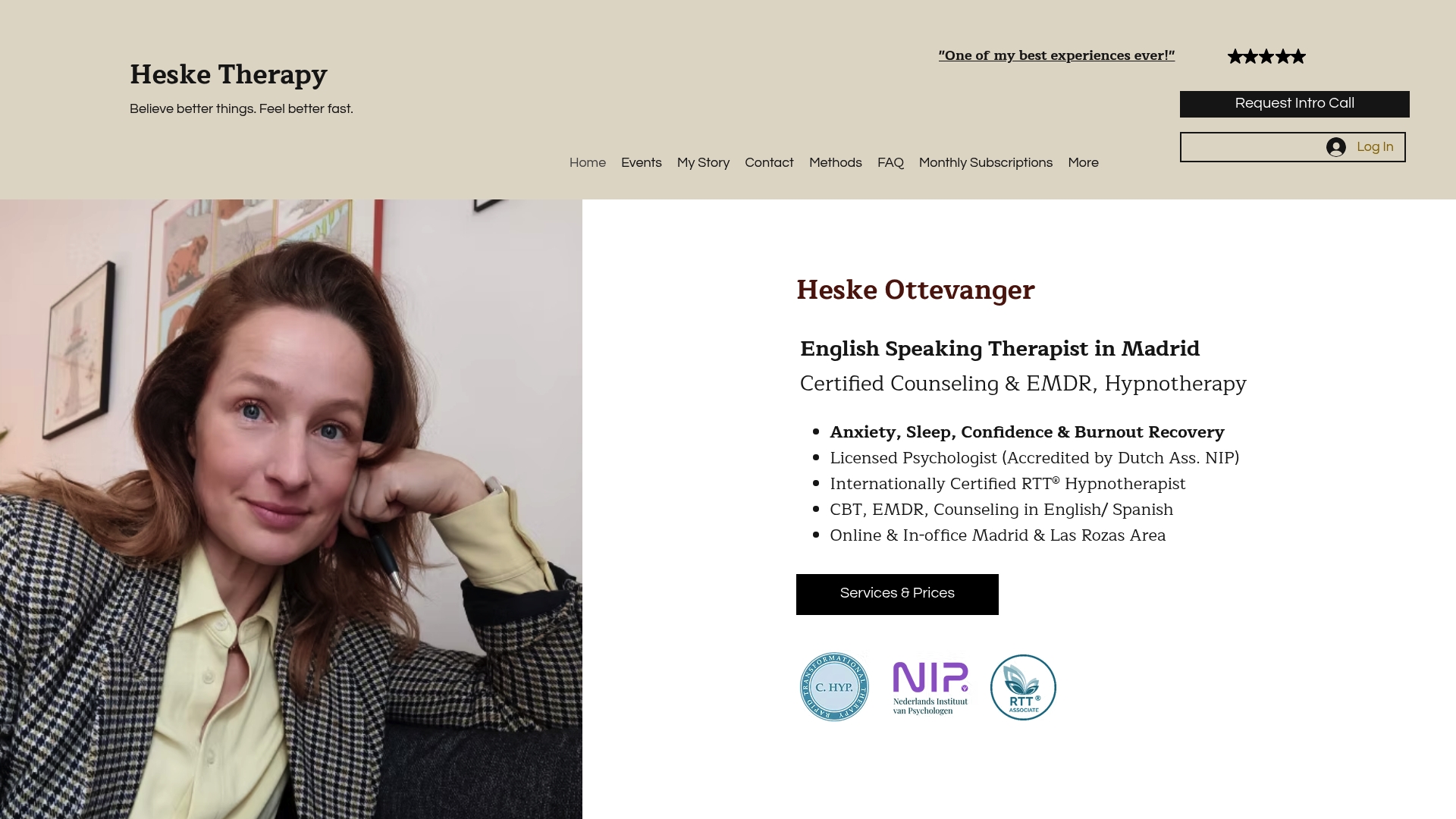
At Heske Therapy, we specialize in helping English-speaking expats in Madrid move from overwhelmed to grounded using methods that work. Whether you’re curious about what RTT therapy involves or ready to commit to a structured program, the 21-day RTT package is designed to deliver rapid, lasting transformation. Sessions are available in English, Spanish, and Dutch, in-person and online. Your first step is a free discovery call. Book it today.
Frequently asked questions
What makes therapy for expats different from standard therapy?
Therapy for expats addresses unique cross-cultural stressors, language issues, and the emotional impact of living abroad, making it far more personalized than standard therapy. Multilingual therapists who understand expat life consistently produce better outcomes for international clients.
Is online therapy effective for expats in Madrid?
Yes, online therapy provides accessible, culturally sensitive care tailored to expats’ needs, especially when in-person options feel limited or inconvenient. Online therapy has emerged as a key solution for expats facing accessibility barriers.
What are the signs I might need therapy as an expat?
Persistent anxiety, feelings of isolation, or difficulty adapting to life in Madrid are clear indicators that professional support could help. Expats often experience increased anxiety and adaptation stress that benefits significantly from structured therapeutic support.
Are therapy methods like RTT and CBT suitable for English-speaking expats?
Absolutely. Methods such as RTT and CBT are highly effective for English-speaking expats, particularly when delivered by a culturally competent therapist. RTT, CBT, and related methods are proven effective across diverse expat populations.
How do I find an English-speaking therapist in Madrid?
Look for therapists with specific experience supporting expats, fluency in your native language, and positive reviews from international clients. Therapists with expat expertise consistently deliver stronger outcomes than generalist practitioners.
Recommended
Comments