What Is Cultural Sensitivity in Therapy: a Key Guide


TL;DR:
Cultural sensitivity in therapy involves therapists actively recognizing and adapting to each client’s cultural background to ensure effective treatment. It improves communication, builds trust, and reduces misdiagnosis, leading to better client retention and progress. Clients should advocate for personalized care by asking their therapists about their approach to cultural differences and ongoing learning practices.
Most people assume therapy works the same way for everyone. You show up, talk about your problems, and a trained professional helps you work through them. But what is cultural sensitivity in therapy, and why does it matter more than most people realize? Cultural sensitivity is not a soft add-on to good clinical practice. It is the difference between a therapeutic relationship that works and one that quietly fails. Your background, beliefs, family structure, language, and experiences of discrimination all shape how you understand mental health and what kind of help feels safe to accept.
Table of Contents
Key takeaways
Point | Details |
Not one-size-fits-all | Therapy must adapt to your cultural history and beliefs, not just apply a universal framework. |
Humility over knowledge | Culturally sensitive therapists keep learning and asking, rather than assuming they already understand your culture. |
Real consequences of gaps | Ignoring cultural factors increases misdiagnosis risk and causes clients to drop out of therapy early. |
Tools exist for this | Structured frameworks like the DSM-5 Cultural Formulation Interview help therapists assess cultural context accurately. |
You have agency here | Clients can and should advocate for culturally sensitive care by asking direct questions and naming their needs. |
What is cultural sensitivity in therapy
Cultural sensitivity in therapy means a therapist actively recognizes, respects, and adapts to the cultural background, identity, and lived experiences that shape each client’s relationship with mental health. According to Medical News Today, culturally sensitive therapy requires adapting treatment to a client’s cultural history, identity, and beliefs rather than applying a universal approach.
This goes well beyond knowing that different cultures exist. It means a therapist examines their own biases, learns about the systemic barriers their clients face, and builds treatment plans around what actually fits your life. Research published in Frontiers in Psychology describes culturally sensitive psychotherapy as both a clinical technique and an ongoing therapist attitude that involves continuous self-reflection on biases and assumptions.
The distinction matters enormously. A therapist who believes they are culturally aware because they have studied different cultures in a textbook is not the same as a therapist who stays curious, asks respectfully when uncertain, and holds space for the fact that your experience may contradict every generalization they have ever read.
Core components of culturally sensitive therapy
So what does this actually look like in practice? Cultural sensitivity in therapy rests on several interconnected elements that work together.
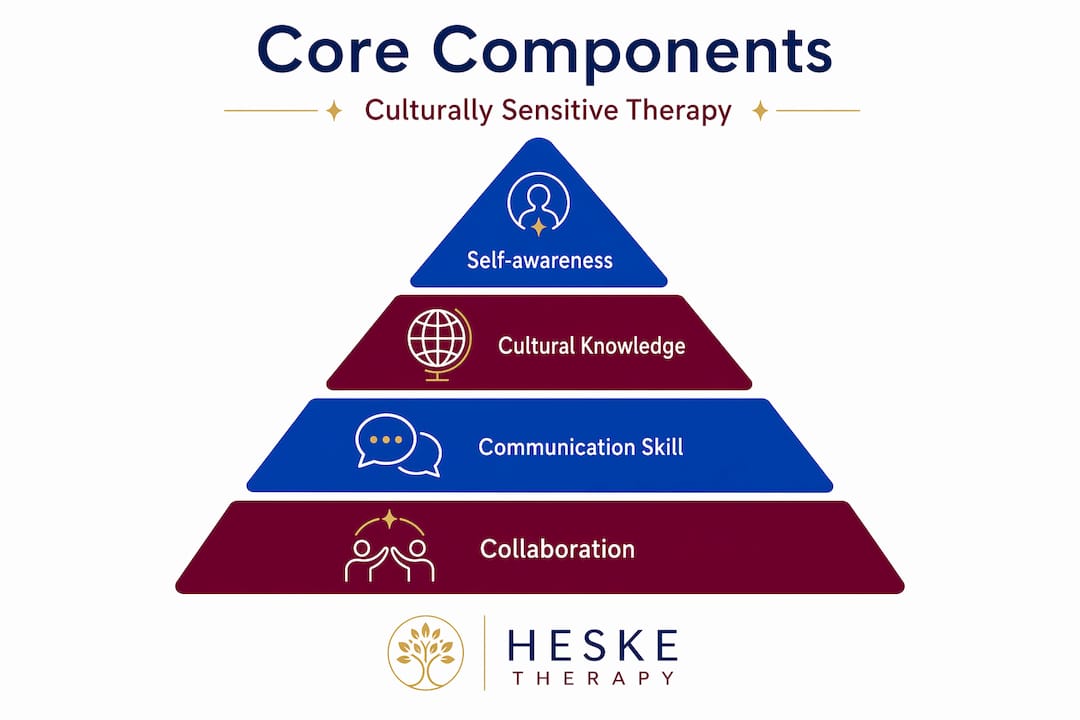
Self-awareness. A culturally competent counselor starts by examining their own cultural background and how it shapes their assumptions about behavior, family, success, and mental illness. Without this step, therapists project their own cultural lens onto clients without realizing it.

Cultural knowledge. This does not mean memorizing facts about every culture. It means having enough awareness to recognize when cultural factors are likely at play and enough humility to ask rather than assume. Researchers note that effective cultural sensitivity is less about static knowledge and more about the therapist’s willingness to learn and inquire respectfully.
Skill in culturally adapted communication. This includes how questions are framed, who is included in sessions, and how distress is described. Culturally sensitive communication must account for family roles, language use, and who translates, because each of these factors affects trust and what a client feels safe sharing.
Collaborative treatment planning. Therapists work with clients to build care plans that integrate cultural values, not override them. This is especially relevant when those values include beliefs about mental illness stigma or preferences around family involvement in treatment.
Pro Tip: If you are starting therapy, ask your therapist directly how they approach cultural differences in their work. A culturally aware therapist will welcome the question, not deflect it.
Balancing cultural inquiry with stereotype avoidance is one of the most nuanced parts of this work. A therapist who applies cultural generalizations too rigidly replaces one kind of bias with another. The goal is always to verify the individual client’s own perspective rather than rely on templates.
Why cultural sensitivity changes outcomes
The consequences of ignoring culture in therapy are not abstract. They show up as broken trust, misdiagnosis, and clients who never return after the second session.
Research published in Frontiers in Psychiatry is direct about this: cultural insensitivity creates barriers including reduced communication, eroded trust, and increased risk of clinical errors and therapeutic ruptures. Clients are significantly less likely to share critical information when they feel their cultural context is being ignored or judged.
The downstream effects are serious. When culture is assessed poorly:
Symptoms that are culturally normal get pathologized
Symptoms that reflect genuine distress get minimized because they look unfamiliar
Clients from marginalized communities face compounded harm when stigma, discrimination, and systemic barriers are not factored into care
Therapy dropout rates climb, leaving people worse off than if they had never started
The benefits of getting this right are equally clear. Studies link cultural humility with improved treatment retention and better functional outcomes for clients. When clients feel seen as whole people rather than diagnostic categories, they engage more honestly, stay longer, and make more progress.
This is the core argument for the importance of cultural sensitivity in therapy. It is not about being polite or politically correct. It is about accuracy, effectiveness, and doing the actual job of therapy well.
Tools therapists use for cultural assessment
Several structured frameworks help therapists move from good intentions to actual practice. The most clinically rigorous of these is the DSM-5 Cultural Formulation Interview.
CFI Domain | What it explores |
Cultural definition of the problem | How the client understands and describes their distress |
Cultural perceptions of cause | What the client believes is causing their problem |
Cultural factors in help-seeking | What help has been sought before, and through which channels |
Cultural treatment preferences | What kind of support the client expects and wants now |
The CFI functions as what researchers describe as a mini-ethnographic assessment, producing a nuanced, patient-centered picture of illness shaped by multiple cultural identities rather than a single diagnostic label. Pilot data confirms that CFI use across diverse populations improves communication and treatment planning, with most clients appreciating the space to share their cultural perspective.
Beyond the CFI, culturally sensitive therapists adapt their communication style, adjust how they describe treatment options, and stay alert to language barriers. Multilingual therapy improves outcomes significantly for expat and international clients, where language itself carries cultural meaning that gets lost in translation.
Pro Tip: Before your first session, consider writing down how your cultural background shapes your understanding of the problem you want help with. This gives your therapist a head start and helps you walk in with more clarity.
Applying these tools effectively requires ongoing cultural sensitivity training for therapists, not a single workshop. It requires revisiting assumptions with each new client rather than assuming prior training is sufficient.
How to recognize and advocate for this in your own care
Knowing what cultural sensitivity looks like in theory is one thing. Knowing how to spot it or request it in your own therapy is where this becomes personally useful.
Signs your therapist practices cultural sensitivity:
They ask open questions about how you understand your own problem, rather than labeling it immediately in clinical terms
They inquire about your family background, community, and values without making assumptions about what those mean
They acknowledge when they are unfamiliar with aspects of your cultural experience and stay curious rather than dismissive
They adapt their language and communication style based on your feedback
They build your treatment plan around your goals and values, not a generic protocol
If you are not experiencing this, you have every right to name it. Some practical ways to advocate for yourself:
Say directly: “My cultural background shapes how I experience this. I want to make sure that context is part of how we work together.”
Ask whether your therapist has experience working with clients from your specific background or with expats navigating identity challenges
Review questions to ask your therapist before your first session so you can assess cultural fit early, not after months of misaligned work
For international clients and expatriates, therapy for international clients often requires an additional layer of cultural awareness. Being between cultures, living outside your home country, and navigating identity in a foreign context are unique stressors that a culturally sensitive therapist should recognize explicitly.
Cultural humility works in both directions. As a client, you can also examine what assumptions you bring about what therapy should look like, which can help you recognize when a therapist is offering something genuinely adapted to you rather than something that simply feels familiar.
My perspective on cultural sensitivity in practice
I have worked with clients from dozens of countries, in three languages, across a wide range of cultural frameworks for mental health. And the most consistent thing I have observed is this: cultural sensitivity is not a skill you learn once. It is a practice you commit to indefinitely.
Early in my work, I noticed something uncomfortable. Even therapists with strong multicultural training can fall into the trap of performing cultural sensitivity, asking the right questions without genuinely listening to the answers. What actually changes outcomes is a shift in orientation. Approaching each client as someone whose cultural context I do not fully understand and may never fully understand, and remaining genuinely curious about that gap.
I have also seen how addressing power dynamics in therapy transforms the relationship. When I acknowledge that I hold institutional authority as a therapist and that my client holds expertise about their own cultural life, the work becomes genuinely collaborative. That shift is not symbolic. Clients tell me things in those conditions they have never told another therapist.
The other thing I want to name is that cultural sensitivity benefits therapists too. Every client who comes from a different background forces me to examine my own assumptions more carefully. The learning goes both ways, and that continuous challenge keeps clinical work honest.
— Heske
Culturally aware therapy at Hesketherapy
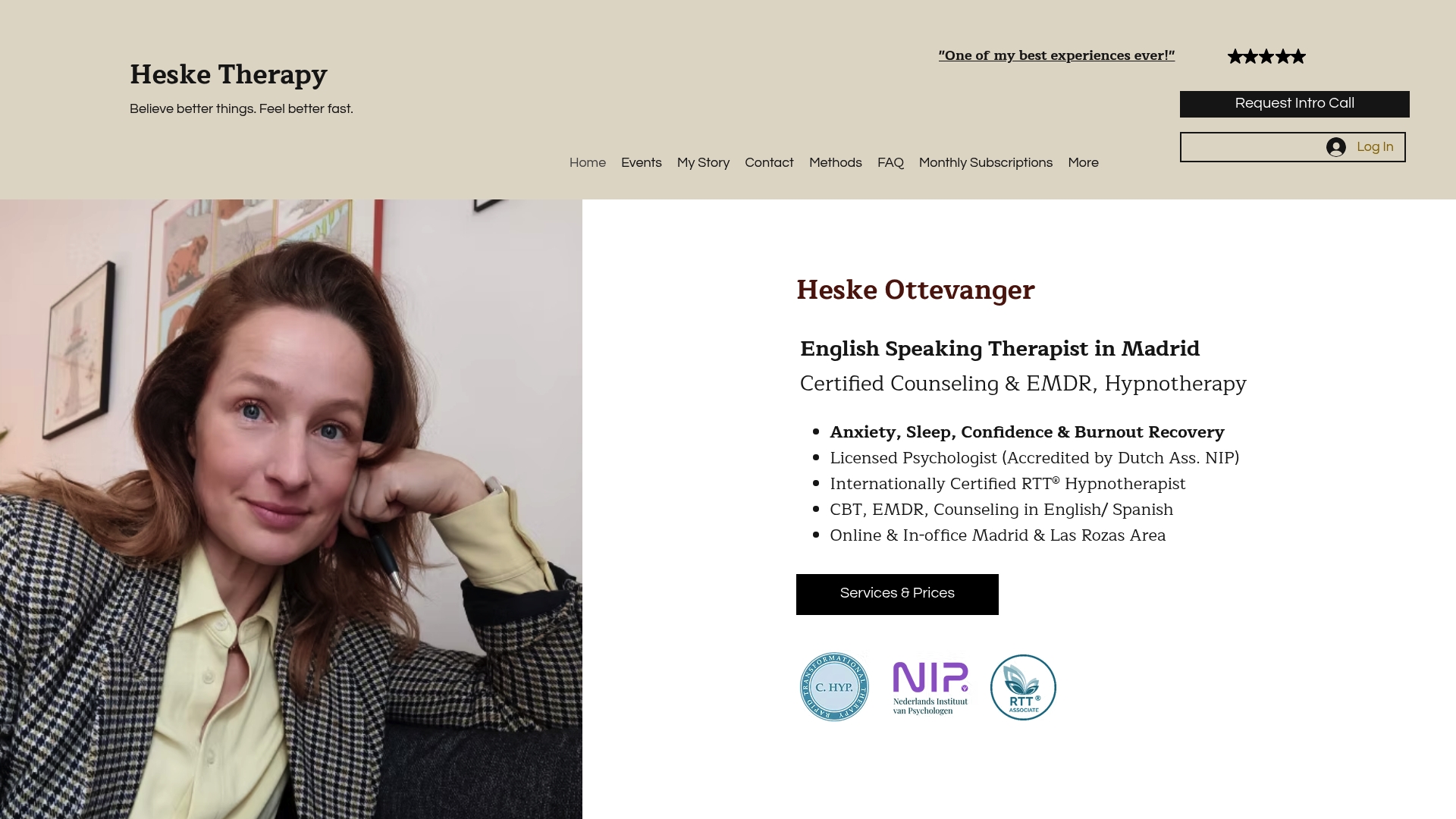
At Hesketherapy, working with international and expat clients across different cultural backgrounds is not something we adapted to after the fact. It is built into how we practice from the start. Based in Madrid and offering sessions online and in-office in English, Spanish, and Dutch, we design every treatment plan around the individual, including their cultural identity, their experience of living between worlds, and their own understanding of what healing looks like.
Our approach draws on RTT therapy, EMDR, CBT, and hypnotherapy, methods chosen for their adaptability to diverse life experiences and personal belief systems. Whether you are managing anxiety, burnout, trauma, or the compounded stress of expat life, the work we do together starts with understanding your full context. Schedule a free discovery call to see whether Hesketherapy is the right fit for where you are.
FAQ
What does cultural sensitivity in therapy mean?
Cultural sensitivity in therapy means a therapist adapts their approach to each client’s cultural background, beliefs, and identity rather than applying a single universal method. It includes self-reflection, respectful inquiry, and collaborative treatment planning.
Should therapists consider cultural differences?
Yes. Ignoring cultural differences increases the risk of misdiagnosis, reduces trust, and contributes to early therapy dropout. Research consistently shows that culturally sensitive approaches produce better retention and outcomes.
What is cultural humility vs. cultural competence in counseling?
Cultural competence refers to acquiring specific knowledge and skills about different cultures. Cultural humility goes further by requiring ongoing self-reflection, recognition of power dynamics, and a lifelong commitment to learning rather than treating culture as a fixed skill set.
How can I tell if my therapist is culturally sensitive?
A culturally sensitive therapist asks open questions about how you understand your own distress, acknowledges unfamiliarity without dismissing it, and builds treatment plans around your values. If these elements are missing, it is appropriate to raise this directly.
Does cultural sensitivity matter for expat clients specifically?
Especially so. Expats often navigate identity challenges, cultural displacement, and stress tied to living outside their home country. A therapist who recognizes these layers and adapts accordingly provides significantly more relevant and effective support.
Recommended
Comments