The Multicultural Therapy Process: A Complete Guide
- Heske Ottevanger
- 3 days ago
- 8 min read


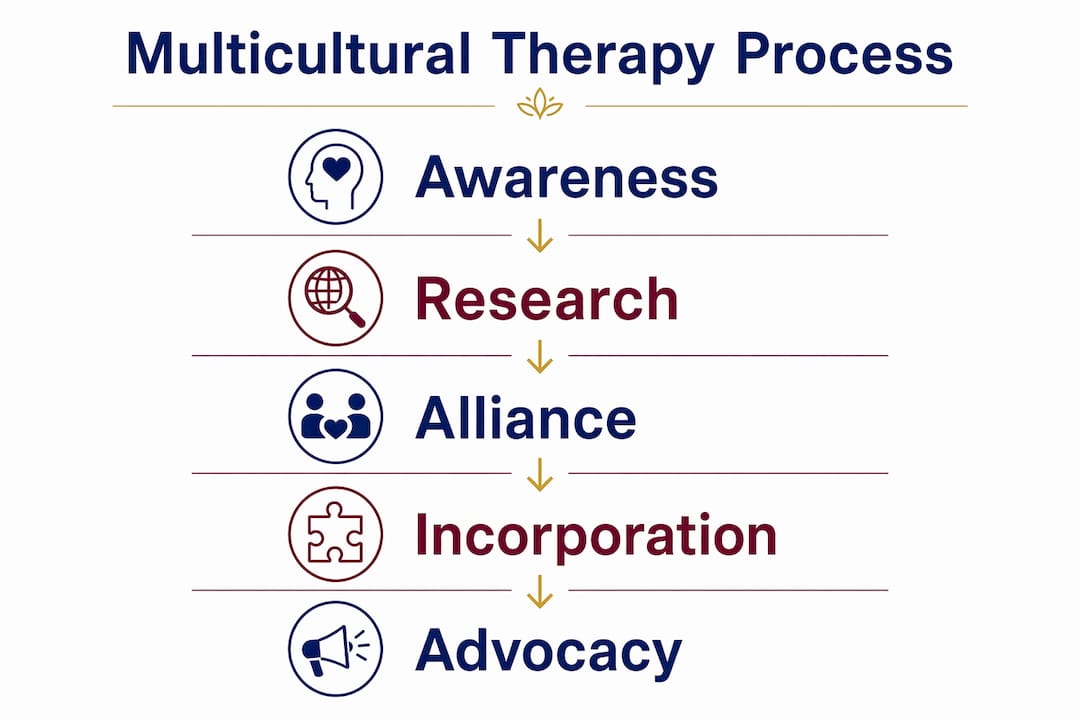
Multicultural therapy is a psychotherapeutic approach that explicitly centers a client’s cultural identity throughout every phase of treatment. Rather than applying a one-size-fits-all model, it adapts interventions to the client’s unique background, including race, ethnicity, gender identity, religion, socioeconomic status, and immigration status. The multicultural therapy process is not a single technique. It is a framework that shapes how a therapist listens, assesses, builds trust, and selects interventions from the very first session through termination.
The foundational elements of this approach include:
Cultural assessment at intake: Gathering information about the client’s cultural identities, community ties, and how those identities shape their experience of distress
Therapeutic alliance across cultural lines: Actively building trust and rapport when the therapist and client come from different backgrounds
Culturally adapted interventions: Modifying evidence-based methods so they fit the client’s worldview and lived reality
Cultural humility: The therapist’s ongoing commitment to self-reflection, learning, and acknowledging the limits of their own cultural perspective
Social justice awareness: Recognizing that many clients’ struggles are shaped by systemic barriers, discrimination, and oppression, not only internal factors
Deep-structure incorporation of culture: Weaving cultural considerations through assessment, intervention, and outcome evaluation, not just the intake form
Every person carries cultural identities that influence how they experience distress and how they relate to the idea of therapy itself. That is why multicultural therapy applies to all clients, not only those from minority or immigrant backgrounds.
How the therapy relationship works across cultural differences

The therapeutic alliance is the strongest predictor of successful psychotherapy outcomes, and in cross-cultural settings, building that alliance requires deliberate, explicit effort. When a therapist and client come from different cultural backgrounds, assumptions about communication style, family roles, emotional expression, and even what “getting better” looks like can diverge significantly. Ignoring those differences does not make them disappear. It makes them obstacles.
Building genuine rapport across cultural lines involves several interconnected commitments:
Mutual respect as the foundation: Therapists must set a tone of respect from the first session, allowing clients to tell their full story without interruption or reframing through a culturally foreign lens
Validating experiences of discrimination: Clients need to feel believed when they describe encounters with racism, sexism, or systemic exclusion. Clinicians are advised to assume reported incidents occurred as described, provide support, and then explore how those experiences connect to current symptoms
Co-creating therapy goals: Goals should reflect the client’s own values and cultural context, not the therapist’s assumptions about what a healthy life looks like
Managing countertransference: A therapist’s unexamined biases about a client’s culture can subtly shape their responses, interpretations, and recommendations in ways that undermine trust
Exploring the client’s view of therapy itself: Some clients come from cultures where seeking psychological help carries stigma. Exploring that directly, without judgment, opens the door to genuine engagement
Therapist self-awareness is not a soft skill here. It is a clinical requirement. Unexamined cultural biases in a therapist can erode the alliance before the client ever feels safe enough to be honest.
The complexity of the therapeutic alliance in multicultural settings means that therapists cannot rely on generic rapport-building techniques. They need to actively bridge worldviews, and that work never fully stops.
Practical techniques used in cross-cultural therapy
Effective cross-cultural therapy is not about replacing evidence-based methods. It is about adapting them so they actually land for the person sitting across from you. Therapists must train in cross-cultural competency, engage in ongoing self-education about specific cultural norms, and modify interventions to fit each client’s unique cultural context.
Several techniques and strategies stand out in culturally responsive practice:
Cultural genogram: A visual mapping tool that explores a client’s family history, cultural heritage, migration patterns, and intergenerational experiences. It helps both therapist and client see how cultural forces have shaped the client’s current struggles.
Narrative approaches: Inviting clients to tell their story in their own words, within their own cultural frame of reference, rather than fitting their experience into a pre-set diagnostic narrative
Strength-based methods: Identifying and building on the cultural strengths, community ties, and resilience strategies the client already possesses, rather than focusing exclusively on deficits
Culturally adapted intake and assessment: Asking about cultural identity, spiritual beliefs, family structure, and community context as part of standard intake, not as an afterthought
Technique-specific cultural modifications: Adapting CBT thought records, EMDR protocols, or other structured methods to account for collectivist values, spiritual frameworks, or different relationships to emotional expression
Delivering therapy in familiar settings: When feasible, offering sessions in community spaces, places of worship, or via telehealth can reduce the cultural distance a client feels from the therapy process. Telehealth has expanded access to culturally responsive care for clients who face geographic or logistical barriers.
Incorporating community and spiritual resources: Therapists who integrate clients’ cultural strengths and community resources into treatment actively support empowerment and resilience, rather than positioning the therapist as the sole source of healing
Pro Tip: Before your first session with a new client from a different cultural background, research the broad cultural norms of their community. Then set that research aside and approach the individual with genuine curiosity. General knowledge informs; assumptions harm.
Deep-structure incorporation of culture means that cultural considerations must run through every phase of treatment, from the first assessment question to the final termination session. Culture is not a box to check at intake.
Why multicultural counseling matters for mental health outcomes
Multicultural counseling directly addresses one of the most persistent problems in mental health care: the gap between who needs help and who actually receives effective treatment. Multicultural counseling is vital for addressing disparities in mental health care access and outcomes among diverse populations, improving therapy engagement, and reducing stigma.
The benefits extend well beyond individual sessions:
Greater treatment relevance: When therapy reflects a client’s actual worldview, the interventions feel meaningful rather than foreign, which increases engagement and follow-through
Reduced stigma: Therapists who understand cultural attitudes toward mental health can address reluctance directly, making it safer for clients to seek and stay in care
Enhanced trust: Clients who feel seen and understood in their full cultural identity are more likely to be honest about their symptoms, their history, and their goals
Resilience building: Culturally responsive therapy draws on the client’s existing strengths, community connections, and cultural identity as resources for healing
Social justice commitment: Multicultural therapy acknowledges that many clients’ emotional struggles are shaped by racism, discrimination, poverty, and systemic exclusion. Addressing those realities in therapy is not political. It is clinically accurate.
Populations that particularly benefit from culturally competent care include immigrants and refugees, LGBTQ+ individuals, people from racial and ethnic minority groups, clients navigating religious identity conflicts, and expatriates living far from their home cultures. For expats especially, the intersection of cultural displacement, language barriers, and unfamiliar mental health systems creates a specific kind of vulnerability that generic therapy often misses.
Consider the example of a client from a Latin American background where the concept of machismo shapes attitudes toward emotional vulnerability. A therapist unaware of that cultural dynamic might interpret the client’s reluctance to discuss feelings as resistance, when it is actually a deeply conditioned response to cultural norms around masculinity. Naming that dynamic, without judgment, changes the entire therapeutic conversation.
Social justice and integrative approaches in multicultural therapy
Multicultural therapy is inherently linked to a social justice commitment. Systemic racism, sexism, and marginalization are not background noise in a client’s life. They actively shape symptoms, coping strategies, and the client’s relationship to help-seeking. A therapist who treats emotional distress as purely internal misses a significant portion of what is actually happening.
Integrating social justice into therapy does not mean turning sessions into political discussions. It means acknowledging that a client’s anxiety, depression, or trauma may be a rational response to an unjust environment, and that healing sometimes requires addressing those external realities alongside internal ones.
The following table outlines how integrative, socially conscious approaches translate into concrete therapeutic practice:
Principle | What it looks like in practice |
Acknowledging systemic barriers | Exploring how racism, poverty, or discrimination contribute to the client’s distress |
Client empowerment | Collaborating on goals that build agency, not just symptom reduction |
Cultural humility | Therapist actively questions their own assumptions throughout treatment |
Community resource integration | Connecting clients to culturally relevant support networks and organizations |
Avoiding a “colorblind” approach | Recognizing cultural power dynamics rather than treating all clients as culturally identical |
A published case study illustrates these principles in action. A client named Karen, treated across multiple sessions with culturally adapted interventions and a strong collaborative alliance, reported at termination that she felt “respected, listened to, and entrusted in contributing to her own progress.” She continued applying the skills independently after therapy ended. That outcome reflects what happens when culturally adapted interventions are delivered within a genuinely collaborative relationship.
Guidelines for therapists working within this framework include:
Treat each case as unique, even after extensive multicultural training
Approach every client with curiosity and respect, regardless of how familiar their cultural background seems
Examine how historical and social themes, such as experiences of slavery, colonization, or forced migration, may shape a particular client’s relationship to therapy
Actively align with clients facing race- or culture-related stressors, rather than maintaining a neutral distance that can feel like indifference
Connect clients to culturally informed therapeutic services and community organizations when individual therapy alone cannot address the full scope of their needs
The social justice focus in multicultural therapy strengthens the therapeutic alliance because clients can sense when a therapist genuinely sees the world they are navigating, not just the symptoms they present with.
Ethical considerations in multicultural therapy
Ethics in multicultural therapy go beyond the standard codes of confidentiality and informed consent. They require therapists to actively examine how power, privilege, and cultural bias operate within the therapy room itself.
A therapist who adopts a “colorblind” stance, treating all clients as culturally identical to avoid discomfort, is not being neutral. That stance actively erases the client’s lived experience and can cause real harm. Ethical multicultural practice means recognizing that the therapist’s own cultural background, training, and worldview are never absent from the room. They shape every interpretation, every question, and every intervention.
Key ethical responsibilities in this area include:
Ongoing cultural competence development: Ethical practice requires continuous learning, not a one-time training. Cultural norms evolve, and individual clients always exceed generalizations about their group.
Informed consent with cultural sensitivity: Clients should understand the therapy model being used and have genuine input into how it is adapted to fit their cultural context.
Avoiding cultural imposition: Therapists must resist the urge to apply their own cultural values, such as Western ideals of individualism or emotional expressiveness, as universal standards of psychological health.
Recognizing the limits of competence: When a therapist lacks sufficient knowledge of a client’s cultural background, ethical practice means seeking consultation, supervision, or referral rather than proceeding without adequate preparation.
Addressing dual relationships carefully: In tight-knit cultural communities, therapists may encounter clients in social or religious settings. Managing those boundaries with cultural sensitivity requires explicit attention.
Cultural sensitivity in therapy is not a specialty add-on for therapists who work with “diverse populations.” Every therapist works with culturally situated human beings. The ethical obligation to develop cultural competence applies across the board.
Therapists also carry an ethical responsibility to advocate. When a client’s distress is rooted in systemic injustice, remaining silent about those systems, while only treating the individual, can inadvertently reinforce the idea that the problem lies entirely within the client. Naming injustice, validating its impact, and supporting the client’s own sense of agency are all ethical acts.
Key Takeaways
Effective multicultural therapy requires cultural humility, an active therapeutic alliance, and social justice awareness woven through every phase of treatment, from intake to termination.
Point | Details |
Culture shapes every phase | Cultural considerations must run through assessment, intervention, and termination, not just the intake form. |
Alliance requires active effort | Building trust across cultural lines is the strongest predictor of outcomes and demands explicit, ongoing work. |
Techniques must be adapted | Evidence-based methods like CBT and EMDR need cultural modifications to be effective for diverse clients. |
Social justice is clinically relevant | Systemic racism, discrimination, and marginalization directly shape clients’ symptoms and must be addressed in therapy. |
Therapist self-awareness is non-optional | Unexamined cultural biases undermine the alliance and can cause harm, making ongoing self-reflection a clinical necessity. |
Recommended
Comments