Free Discovery Calls: What They Are and Why They Work


A free discovery call is a short, structured diagnostic conversation that qualifies fit, builds trust, and creates a clear path to a paid engagement. It is not free coaching, not a demo, and not a substitute for the professional work that comes after. Its role is singular: to determine whether you and a prospective client are the right match before either of you commits to anything more.
The short version:
Who should use them: Coaches, therapists, consultants, and any professional whose services require a meaningful fit conversation before a client commits.
Main benefit: You filter out poor-fit prospects early, protect your time, and show up as a trusted expert rather than a vendor pitching services.
One real risk: Without a firm agenda and a clear frame, discovery calls slide into free coaching sessions that drain your energy and give away your expertise at no charge.
When to offer one: Any time the cost, complexity, or emotional weight of your service makes a prospect hesitant to book directly. A low-barrier first conversation reduces that hesitation and lets both sides verify fit.
Martindale-Avvo’s research found that nearly 48% of consumers consider a free consultation an important criterion when selecting a professional service provider. That figure alone makes the case for offering one. The rest of this guide shows you how to run it well.
Key Takeaways
Free discovery calls work when they are treated as structured diagnostics, not free coaching sessions. The most effective approach combines a firm agenda, a pre-call intake form, and a consistent qualification rubric applied after every call.
Point | Details |
Define the scope clearly | A discovery call is a 20–45 minute diagnostic, not a free session; state this before the call begins. |
Anchor the frame early | Set the agenda and purpose in the first 90 seconds to prevent the call from drifting into free work. |
Qualify every prospect | Use a four-factor rubric (need, authority, budget, timeline) to make fast, consistent post-call decisions. |
Track three core metrics | Monitor show rate, call-to-client conversion, and no-show rate to identify where your process needs adjustment. |
Hesketherapy’s model | Hesketherapy’s discovery call page demonstrates a clearly scoped, ethics-aware front door that qualifies fit before any commitment. |
Table of Contents
How does a discovery call differ from a free consultation or a sales call?
How to structure a free discovery call: agenda, timing, and boundaries
High-impact questions and scripts for every stage of the call
How to measure whether your discovery calls are actually working
What actually changes when you treat discovery calls as a diagnostic
Hesketherapy offers a structured, compassionate first conversation
What does a free discovery call actually include?
A discovery call is a diagnostic, exploratory conversation with a defined scope. Its job is to surface a prospect’s core challenges, goals, and readiness so you can decide whether to move forward together. According to Mailchimp’s guidance on discovery calls, the prospect should do most of the talking. Your role is to listen, probe, and assess, not to solve.
What a discovery call is not:
Not a free coaching or therapy session where you deliver insights, exercises, or interventions
Not a detailed professional assessment (legal, medical, or clinical) that would normally require a paid intake
Not a live product demo or a pitch presentation
Not an open-ended chat with no agenda or outcome
Most well-run discovery calls last 20–45 minutes. Aviy’s practical guide to discovery calls identifies this as the best-practice range, with a structured five-part agenda driving better outcomes than an unstructured conversation of any length. If a prospect genuinely needs more than 45 minutes to determine fit, that is a signal to offer a paid diagnostic assessment instead.
J. Settles Law describes free consultations as mutual evaluation sessions, not substitutes for deep professional work. The same principle applies in coaching and therapy: the call gives direction and tests fit; it does not replace the engagement that follows.
Why discovery calls matter for coaches and professionals
The business case for structured discovery calls goes well beyond “it’s a nice gesture.” When run with intention, they do several things at once.
Core benefits:
Qualification: You identify whether a prospect has the need, readiness, and resources to benefit from your work before investing hours in a proposal or onboarding.
Trust-building: A genuine diagnostic conversation positions you as a thoughtful expert rather than someone selling a package. Outreach’s sales leader guide describes this as the shift from vendor to trusted expert, the stage that allows professionals to command premium fees.
Higher close rates: Prospects who feel heard and understood before they buy are more likely to commit. A well-run call removes ambiguity and reduces the friction between interest and decision.
Better proposals and onboarding: When you know a client’s specific pain points, goals, and timeline before you write a proposal, the proposal lands more precisely. Onboarding is smoother because you have already mapped the terrain.
Market research: Indeed’s career development resource on discovery calls highlights this underused benefit: the patterns you hear across multiple calls directly inform how you describe your services, which problems you lead with in your marketing, and where your offer might need adjustment.
Stat to know: Nearly 48% of consumers say a free consultation is an important factor in choosing a professional service provider. Offering one is not just good practice; it is what a significant portion of your prospective clients expect before they will consider paying.
The market research value deserves a second look. Every discovery call is a live data point. Over time, the language prospects use to describe their problems becomes the language you use in your copy. The objections they raise become the FAQ on your website. Treated as a structured diagnostic rather than a casual chat, discovery calls feed your entire practice.
How does a discovery call differ from a free consultation or a sales call?
These three terms get collapsed constantly, and that confusion costs professionals time and money. Each serves a different purpose in your client funnel.
Format | Primary goal | Who talks most | Expected outcome |
Diagnose fit and readiness | Prospect (70%+) | Go/no-go decision; agreed next step | |
Provide directional guidance | Split, often provider-led | Prospect leaves with initial direction; provider assesses scope | |
Sales/closing call | Confirm decision and terms | Provider-led | Signed agreement or clear objection to address |
When to use each:
Discovery call: Use at the top of your funnel, before any proposal or detailed scoping. Run it when you need to determine whether a prospect is a realistic fit for your core service.
Free consultation: Appropriate when a prospect needs enough directional input to decide whether to engage at all. Common in legal, medical, and advisory contexts. Note that this format carries a higher risk of sliding into free work.
Sales/closing call: Schedule this only after a prospect has already expressed clear intent. Using a closing call with someone who has not yet been qualified wastes both parties’ time.
A practical example: A coach receives an inquiry from someone who says they want help with “confidence.” Running a full consultation and offering reframing exercises on that call is free coaching. Running a 25-minute discovery call to understand what “confidence” means for this person, what has already been tried, and whether they are ready to commit to a structured program is a diagnostic. The first gives away the work; the second qualifies the client for it.
When a prospect pushes for more detail than a discovery call warrants, the professional response is to acknowledge the question and redirect: “That’s exactly what we’d map out together in our first paid session. What I want to understand right now is whether this is the right fit for you.”
How to structure a free discovery call: agenda, timing, and boundaries
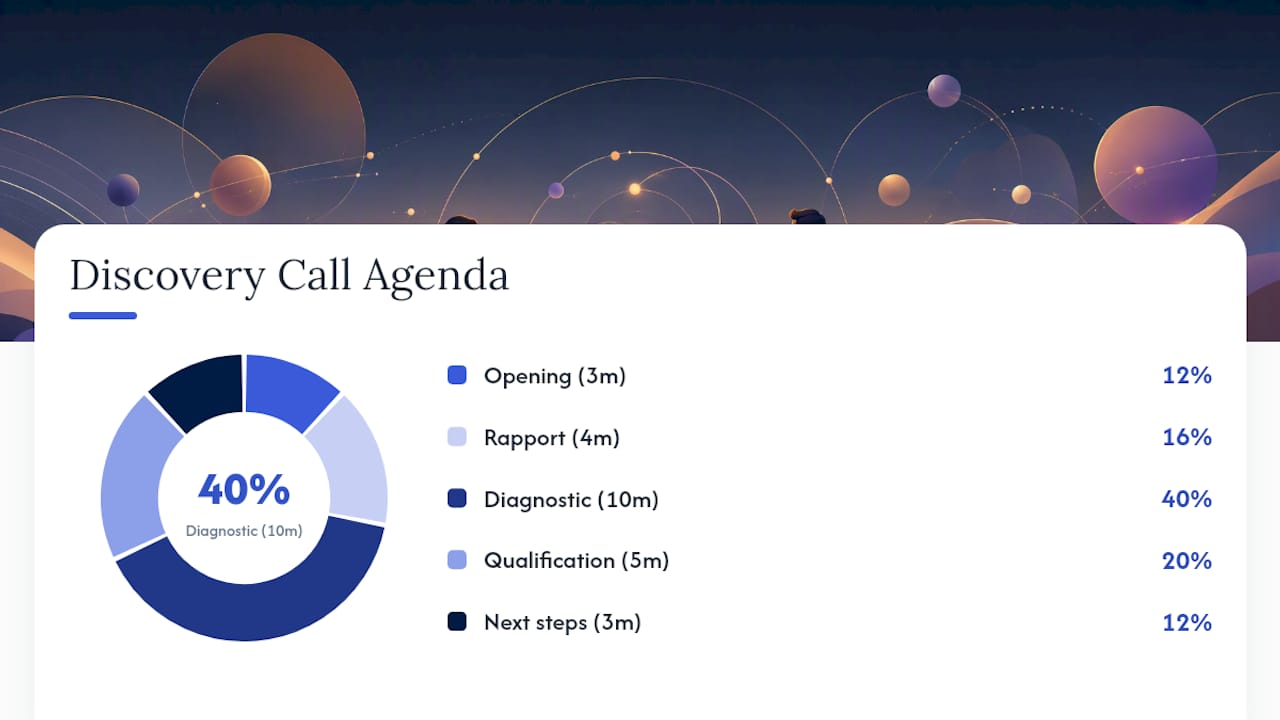
Structure is what separates a productive discovery call from a draining conversation that goes nowhere. The five-part agenda below, drawn from Aviy’s discovery call framework, fits comfortably into 20–30 minutes and protects your time while giving the prospect a clear experience.
Sample agenda (25 minutes):
Opening and frame-setting (3 minutes): Welcome the prospect, state the call’s purpose and time limit, and confirm the agenda. This is where you anchor the frame.
Rapport and context (4 minutes): Ask one or two open questions about their current situation. Keep it light; you are building connection, not yet diagnosing.
Diagnostic questions (10 minutes): Go deeper on the core problem, what they have tried, and what is at stake. This is the heart of the call.
Qualification and fit check (5 minutes): Assess readiness, timeline, and decision-making. Be honest if the fit is unclear.
Next steps and close (3 minutes): Confirm the agreed next step, whether that is a proposal, a paid assessment, or a referral. Send a follow-up within 24 hours.
Before the call: intake form essentials
Collect these fields before the call to save diagnostic time and pre-qualify:
Name, contact details, and preferred language
Primary challenge or goal in one or two sentences
What they have already tried
Availability and preferred format (phone, video, in-person)
How they found you
Boundaries and admin rules:
Set a firm cancellation policy (at least 24 hours’ notice) and communicate it in the booking confirmation.
Handle no-shows with one brief follow-up email. If there is no response, close the inquiry.
Keep the call to the stated time. Overrunning signals that you do not value your own time, and it sets a poor precedent.
Pro Tip: Anchor the frame in the first 90 seconds. Say something like: “We have 25 minutes today. My goal is to understand your situation and see whether what I offer is the right fit for you. There are no obligations on either side. Does that work?” That one sentence prevents most free-coaching drift before it starts.
High-impact questions and scripts for every stage of the call
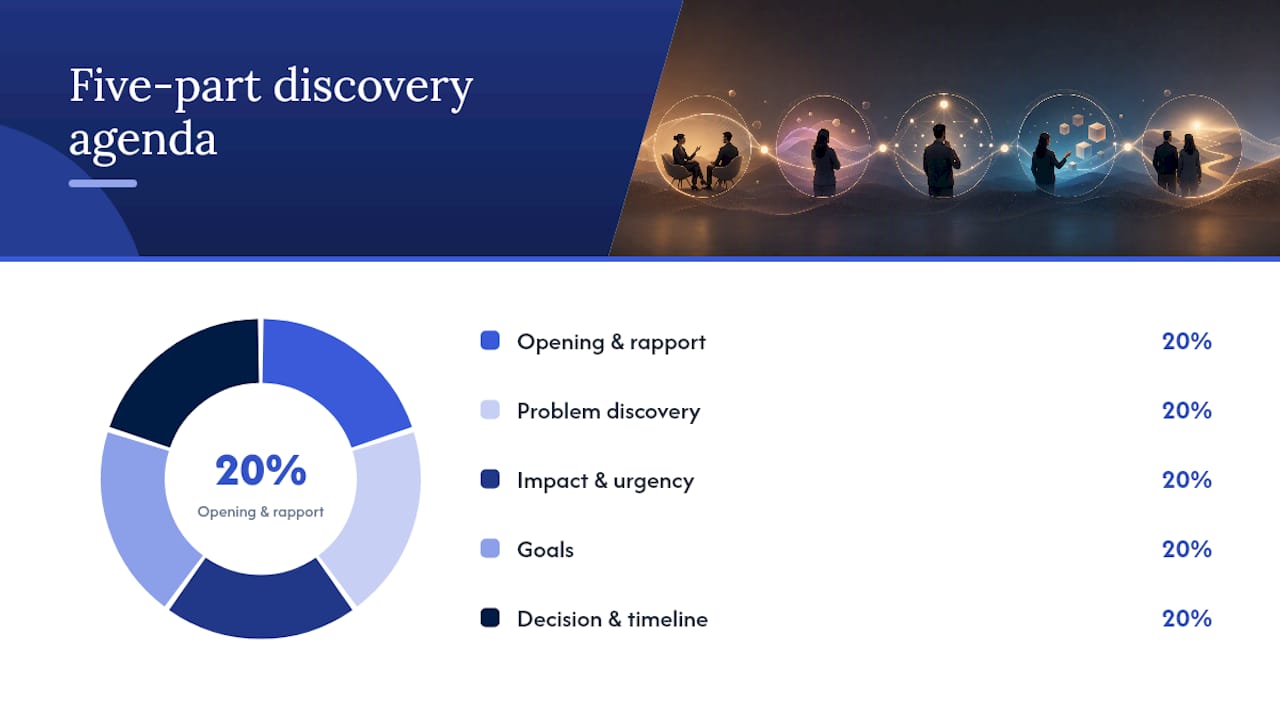
Good discovery questions do two things at once: they surface the information you need to qualify, and they help the prospect feel genuinely heard. The categories below map to the five-part agenda.
Opening and rapport:
“What prompted you to reach out right now, rather than six months ago?”
“Tell me a little about where things stand for you today.”
Problem discovery:
“What does this challenge look like on a typical day?”
“How long has this been affecting you?”
“What have you already tried, and what happened?”
Impact and urgency:
“What does it cost you, practically or emotionally, to leave this unresolved?”
“If nothing changes in the next three months, what does that look like for you?”
Goals:
“What would a successful outcome feel like six months from now?”
“How will you know when this is resolved?”
Decision, readiness, and timeline:
“Is this something you are looking to address now, or are you still exploring options?”
“Are you the primary decision-maker here, or is someone else involved?”
“Do you have a sense of what you are willing to invest to solve this?”
Handling an extraction request (when a prospect asks for advice mid-call):
This response acknowledges the question, redirects without dismissing, and keeps the call in diagnostic mode. It protects your expertise while keeping the prospect engaged.
Closing with a qualified next step:
“Based on what you’ve shared, I think there’s a real fit here. The next step I’d suggest is [specific action]. Does that feel right to you?”
“I want to be honest with you: I’m not sure my approach is the best match for what you’ve described. I’d rather tell you that now than after you’ve invested time and money. Would it be helpful if I pointed you toward someone who specializes in [X]?”
The second script matters as much as the first. A graceful disqualification builds your reputation and protects your energy.
For therapists working with expat clients, this question checklist for expats in rapid therapy offers additional prompts tailored to cross-cultural and relocation-related concerns.
Common mistakes that undermine discovery call effectiveness
Most discovery call problems fall into a small number of patterns. Recognizing them is the first step to correcting them.
The most common mistakes:
Talking too much. If you are speaking more than 30% of the time, you are pitching, not diagnosing. The prospect’s words are your data.
Giving away deliverables. Sharing frameworks, exercises, worksheets, or specific advice during the call is free work. It also signals that your paid service offers nothing more.
Skipping budget and timeline. Avoiding these questions feels polite but wastes everyone’s time. A prospect who cannot commit to a timeline or investment is not a qualified lead, regardless of how much they need your help.
Letting the call run over. Overrunning rewards poor preparation and teaches prospects that your time has no value.
Collapsing into a sales pitch. Listing your credentials, packages, and testimonials before you have understood the prospect’s situation is a reliable way to lose the call.
Ignoring red flags. Prospects who push hard for free advice, refuse to answer qualification questions, or express hostility toward the process are telling you something important. Trust that signal.
A redirection script for persistent extraction attempts:
“I hear you, and I want to give you something genuinely useful. The most useful thing I can do right now is make sure we’re a good fit. Once we’ve established that, we can get into the specifics.”
Protecting your emotional bandwidth:
Running multiple discovery calls per week without a clear qualification filter leads to burnout. Jay Mora’s framework for stopping free coaching on discovery calls frames this clearly: the call is an investment of your time, and framing determines whether it sells your expertise or gives it away. Set a weekly cap on unqualified calls and review your intake form regularly to tighten the filter.
Pro Tip: After every call, spend two minutes noting whether the prospect was qualified, what the sticking point was, and what you would ask differently next time. That habit, done consistently, turns individual calls into a pattern you can act on.
How to qualify prospects and map next steps after each call
Qualification does not need to be complicated. A simple four-factor rubric applied consistently gives you a fast, defensible decision after every call.
Qualification rubric (score 1–3 on each factor):
Need: Does the prospect have a clear, specific problem that your service directly addresses?
Authority: Are they the decision-maker, or do they need to consult someone else?
Budget: Have they indicated willingness and ability to invest at your fee level?
Timeline: Are they ready to start within a realistic window, or are they “just exploring”?
Next-step mapping by total score:
Score range | Recommended next step |
20–45 | Send a proposal or book a paid intake session within 48 hours |
20–45 | Send a follow-up with more information; schedule a second brief call if warranted |
— | Offer a referral or add to a nurture sequence; do not invest in a proposal |
Below 4 | Politely close the inquiry; this is not a fit |
Follow-up email snippet (send within 24 hours):
“Hi [Name], thank you for taking the time to speak today. Based on our conversation, [agreed next step]. I’ll send [proposal / intake form / resource] by [date]. Please let me know if anything has changed on your end. Looking forward to it.”
Keep it short. A follow-up that recaps the entire call is unnecessary; the prospect was there. One sentence confirming the next step is enough.
How to measure whether your discovery calls are actually working
Tracking a handful of metrics turns discovery calls from a gut-feel activity into a system you can improve. You do not need a complex CRM to start; a simple spreadsheet works.
Key metrics to track:
Show rate: What percentage of booked calls actually happen? Below 70% suggests a qualification or confirmation problem.
Call-to-client conversion rate: Of completed calls, how many become paying clients? This is your primary effectiveness signal.
Time-per-conversion: How many calls does it typically take before someone commits? More than two calls per conversion suggests a qualification gap.
Average deal size from calls: Are clients who come through discovery calls worth more, on average, than those who book directly? This tells you whether the call is attracting the right tier.
No-show rate: Track this separately from show rate. A high no-show rate often points to a weak intake form or a booking process that is too frictionless.
Simple benchmarks and experiments:
Test | What to measure | Why it matters |
Add a pre-call intake form | Change in show rate and call length | Pre-qualified prospects show up more prepared |
Shorten call from 45 to 25 minutes | Conversion rate and prospect satisfaction | Shorter calls often convert as well and cost less time |
Gate bookings behind a short application | Quality of prospects and no-show rate | Friction filters out low-intent inquiries |
Outreach’s enterprise research on discovery calls shows that systematized call review, where leaders analyze patterns across calls, converts individual insights into repeatable playbooks. Solo practitioners can apply the same logic at a smaller scale: review five calls per month, note what qualified prospects have in common, and adjust your intake form accordingly.
Small experiments, like A/B testing a pre-call form against no form, are low-cost ways to improve show rates and conversion without redesigning your entire process, as Aviy’s discovery call guide notes.
Ethics, privacy, and boundaries for licensed professionals
For licensed therapists and credentialed coaches, a discovery call carries responsibilities that go beyond sales best practices. A few clear principles protect both you and the person on the other end of the call.
Ethics checklist:
Informed consent: State clearly at the start that this is not a therapy session and that no therapeutic relationship is being formed during the call.
Scope of practice: Do not provide clinical assessments, diagnoses, or treatment recommendations during a discovery call. If a prospect presents with acute distress or crisis, refer them to appropriate resources immediately.
Confidentiality limits: Explain briefly what you will and will not keep confidential, particularly if the call is recorded.
Dual-relationship awareness: If you know the prospect personally or professionally, assess whether proceeding is appropriate before the call begins.
Privacy considerations for phone and telehealth discovery calls:
Use a HIPAA-compliant video platform (such as Zoom for Healthcare, SimplePractice, or Doxy.me) if the call may involve health-related disclosures.
Do not store call recordings without explicit written consent.
Collect only the intake information you genuinely need; avoid asking for sensitive clinical history before a therapeutic relationship is established.
For context on running remote sessions with international clients, this guide to international online therapy access covers cross-border privacy considerations worth reviewing.
When to move to a paid assessment:
If a prospect’s situation requires more than 30 minutes to assess, involves complex clinical history, or raises questions about diagnosis or medication, a paid intake session is the appropriate next step. A free call is not the right container for that level of work.
Hesketherapy’s discovery call page models a compliant, clearly scoped front door: it sets expectations, limits the call’s scope, and gives prospects enough information to self-select before booking. That transparency is both an ethical practice and a practical filter.
Pro Tip: Building a collaborative relationship with your client starts before the first paid session. A well-framed discovery call, where you listen carefully and respond honestly about fit, establishes the tone of the entire therapeutic relationship.
What actually changes when you treat discovery calls as a diagnostic
The single habit that shifted my conversion rate was simple: I stopped treating discovery calls as conversations and started treating them as structured diagnostics with a fixed agenda and a pre-call form. Prospects who completed the form arrived prepared. The calls ran shorter, the qualification was cleaner, and the clients who converted were better fits from the start.
The practical tip you can apply this week: write down the three questions that, if answered clearly, would tell you immediately whether a prospect is a fit. Put those questions in your intake form. Let the call go deeper on what the form surfaces, rather than covering the same ground twice.
Hesketherapy offers a structured, compassionate first conversation
If you are a professional or coach reading this guide because you want to see a well-structured discovery call in practice, Hesketherapy’s approach is worth examining directly. As a specialized psychotherapy practice serving English-speaking expatriates and international adults in Madrid, Hesketherapy runs free discovery calls that are scoped, time-limited, and designed to answer one question honestly: whether we are the right fit for you?
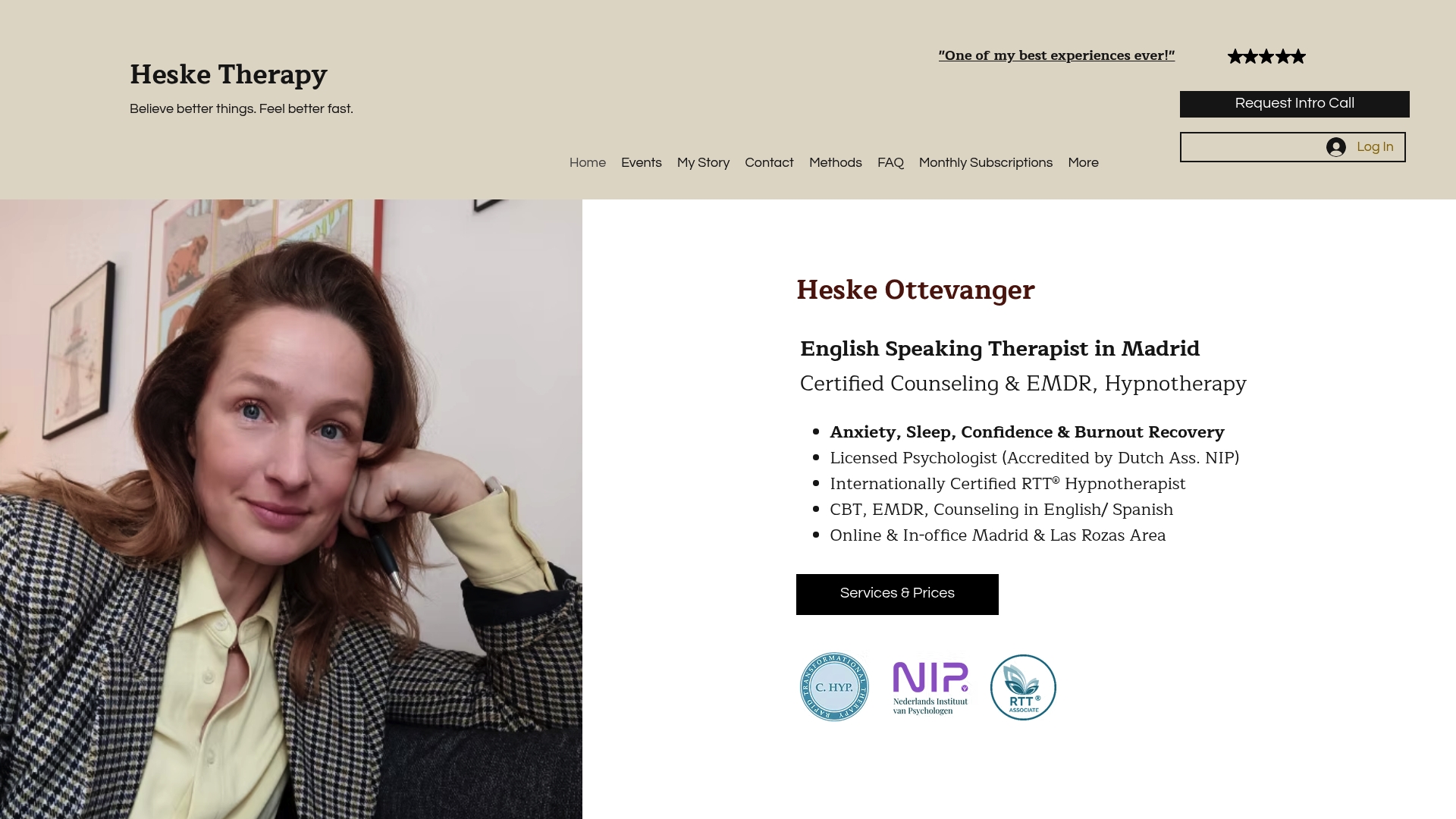
The practice integrates Rapid Transformational Therapy, EMDR, CBT, counseling, and clinical hypnotherapy, offered both in-person and online, in English, Spanish, and Dutch. Sessions are personalized from the first contact, and the discovery call is the starting point for that process, not a sales conversation.
If anxiety, burnout, trauma, or emotional blocks are what brought you here, book your free discovery call and find out whether Hesketherapy is the right next step for you.
Sources
These are the primary sources used to build this guide. Each one goes deeper on a specific aspect of discovery call practice.
What Is a Discovery Call? A Sales Leader’s Guide to Success | Outreach
Discovery Calls That Convert: A Practical Sales Guide for 2026 | Aviy
Discovery Calls: How to Get Your Prospects Talking | Mailchimp
What Is a Discovery Call? (With Benefits, Steps, and Tips) | Indeed Canada
Free Legal Consultation — What It Is and Why Firms Offer It | Martindale-Avvo
What free consultation actually covers and how to prepare for one | J. Settles Law
Recommended
Comments