Single Session Therapy Explained: What You Need to Know
- Heske Ottevanger
- 2 days ago
- 8 min read


TL;DR:
Single session therapy delivers meaningful psychological change within one focused 60-minute meeting by targeting a specific concern. It uses evidence-based techniques and provides a personalized plan for ongoing self-management, with proven results in reducing depression and anxiety symptoms. The model is flexible, available online or in person, and best suited for clients with narrow, manageable issues seeking quick, effective support.
Single session therapy (SST) is defined as a structured therapeutic model designed to deliver meaningful psychological change within one focused meeting. Unlike traditional therapy, which builds progress across weeks or months, SST targets a specific issue in a single 60-minute session and equips you with a personalized plan to continue that work independently. Research on SST has grown substantially in recent years, and a 2026 meta-analysis of 415 clinical trials confirms it effectively reduces depression and anxiety symptoms in both youth and adults. If you have been curious about short-term therapy options that produce real results without a long-term commitment, SST is worth understanding fully.
What is single session therapy and how does it work?
Single session therapy is a goal-oriented, time-limited intervention that treats one session as complete in itself, not as the first step in an ongoing series. The therapist and client enter the room with a shared expectation: something meaningful will shift today. That mindset is not wishful thinking. Research confirms that both therapist and client entering with an expectation of positive change is a core driver of session effectiveness.

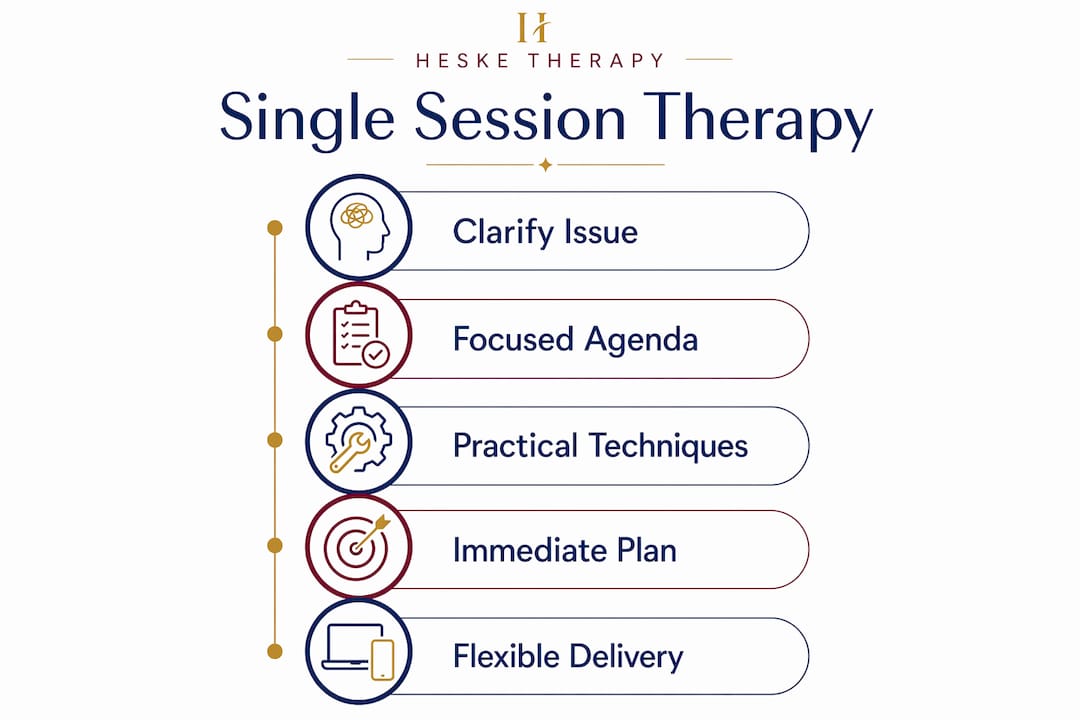
A standard SST session lasts about 60 minutes and follows a focused agenda. There is no lengthy history-taking. The therapist does not spend half the session gathering background information. Instead, the conversation moves quickly toward the specific problem you identified before arriving.
The session typically unfolds in three phases. First, the therapist helps you clarify and narrow your concern to something workable. Second, you and the therapist apply targeted techniques to shift your thinking, emotional response, or behavior around that issue. Third, the session closes with a concrete, written plan you take home. That written roadmap is not a summary. It is a personalized toolbox of coping strategies designed for your specific situation, giving you the means to keep making progress after the session ends.
Common techniques used in SST
SST draws from several evidence-based approaches depending on the client’s needs:
Solution-focused questioning directs attention toward what is already working and what small change would make the biggest difference.
Acceptance-based strategies help you stop fighting an emotion and instead observe it without being controlled by it.
Cognitive reframing challenges the automatic thought pattern driving distress and replaces it with a more accurate interpretation.
Behavioral activation assigns one concrete action to take within 48 hours of the session, creating immediate momentum.
Strengths identification surfaces personal resources you already have but may not be using.
These techniques share a common thread: they are practical, fast to apply, and designed to produce a shift you can feel by the end of the session.
Pro Tip: Before your session, write down the single most pressing concern you want to address. One specific sentence works better than a paragraph. The more focused your starting point, the more the therapist can do with the time available.
What are the benefits and effectiveness of single session therapy?
SST produces measurable results. The 2026 meta-analysis covering 415 clinical trials showed significant symptom reductions in depression and anxiety from pre-session to two-week follow-up. That is not a minor finding. It means a single structured conversation can shift clinical symptoms in a way that holds up over time.
Beyond symptom reduction, SST offers practical advantages that traditional therapy cannot always match.
“SST is a strategic, evidence-based first step that matches client readiness and contextual needs rather than a lesser therapy form. A small initial change, such as pausing before reacting, can accumulate into lasting behavioral shifts.” Leveraging the Single-Session Intervention Approach
The model also challenges a common misconception: SST is not reserved for mild or situational distress. It serves as a triage or first-step option even for clients managing persistent anxiety or trauma symptoms. For people who are skeptical of traditional therapy, SST lowers the barrier to seeking help. There is no long-term commitment, no intake process spanning multiple sessions, and no pressure to return.
Benefit | What it means in practice |
Immediate applicability | You leave with a written plan you can use the same day |
Accessibility | Available online or in person, with no ongoing schedule required |
Evidence-backed results | Significant symptom reduction confirmed across 415 trials |
Low commitment threshold | Functions as a “test drive” for therapy-skeptical clients |
Strengths-based focus | Builds on what you already do well rather than cataloging deficits |
SST is also not a replacement for longer treatment when that is what a situation requires. It is, as research describes it, a catalyst for behavioral change that can initiate a cascade of positive shifts. For many people, one focused session is enough to break a stuck pattern. For others, it becomes the entry point into deeper work.
How can SST be delivered: in-person, online, or self-guided?
One of SST’s most practical strengths is format flexibility. A 2017 meta-analysis found no significant difference in effectiveness between self-guided and therapist-led SST sessions. That finding has major implications for mental health access. It means the model scales without losing its impact.
For a fuller picture of how virtual formats compare to face-to-face sessions, the advantages of online counseling are worth reviewing before you decide which format suits you.
Format | Key advantage | Best suited for |
In-person | Direct therapeutic rapport | Clients who prefer face-to-face contact |
Online video | No travel, flexible scheduling | Expats, remote clients, busy schedules |
Self-administered | Maximum accessibility, low cost | Motivated clients with clear self-awareness |
Each format delivers the same core structure: a focused agenda, targeted techniques, and a written plan. The delivery channel changes. The therapeutic logic does not.
SST’s low resource requirements also mean it can be delivered by both specialist and non-specialist providers across clinics, schools, and community organizations. That scalability is one reason SST is gaining traction as a model for expanding mental health access in underserved settings.
Online SST removes geographic barriers entirely.
Self-administered formats work well for clients with strong self-awareness and a clearly defined concern.
In-person sessions remain the preferred choice when nonverbal communication and physical presence matter to the client.
Who benefits most from single session therapy?
SST works best for clients who arrive with a specific, narrow concern rather than a broad or complex set of issues. That is not a limitation of the model. It is a feature. Focusing on one manageable problem is what makes meaningful progress possible within a single meeting.
Clients who tend to get the most from SST include:
People managing situational anxiety tied to a specific event, decision, or relationship dynamic.
Individuals who want to address one emotional block without committing to ongoing therapy.
Clients experiencing early-stage burnout who need a practical reset, not a full treatment program.
People who are therapy-skeptical and want to test the experience before committing to more sessions.
Clients already in longer-term therapy who want to work through a specific issue between regular appointments.
SST is not the right fit for every situation. Therapists screen for risk factors including active crisis, complex trauma, or conditions requiring ongoing clinical monitoring. When those factors are present, the therapist will recommend a more appropriate level of care. SST does not try to do everything. It does one thing well.
A realistic expectation matters here. Many clients arrive hoping for a one-session “fix.” The real value is in the practical plan you leave with, not in having the issue fully resolved during the session itself. The session starts the work. The plan continues it.
Pro Tip: Prepare one sentence that completes this prompt before your session: “After this session, I want to feel differently about ___.” That single sentence will sharpen the entire conversation and help your therapist get to what matters fastest.
For clients dealing with anxiety or trauma, rapid therapy methods that complement SST principles are also worth exploring as a next step.
Key Takeaways
Single session therapy delivers meaningful psychological change in one focused meeting by targeting a specific issue, applying evidence-based techniques, and providing a personalized written plan for continued self-management.
Point | Details |
Defined structure | SST lasts about 60 minutes with a focused agenda and no lengthy history-taking. |
Evidence-based results | A 2026 meta-analysis of 415 trials confirms significant symptom reduction in depression and anxiety. |
Written plan is the product | Clients leave with a personalized coping roadmap, not just a conversation. |
Format flexibility | SST works equally well online, in-person, or self-administered. |
Best for specific concerns | Narrow, focused issues produce the best outcomes; broad problems are harder to address in one session. |
What I’ve learned from watching SST work in real time
The thing that surprises most people about SST is not that it works. It is how quickly the shift happens once a client stops trying to explain everything and starts focusing on one thing. I have seen clients arrive carrying years of accumulated stress and leave 60 minutes later with a clearer head, not because we solved everything, but because we found the one thread that, when pulled, loosened the whole knot.
What SST does exceptionally well is activate strengths the client already has. Most people in distress are not lacking insight. They are lacking a structured moment to apply what they already know. SST creates that moment. The therapist’s job is not to fix you. It is to help you see what you are already capable of and give you a concrete plan to act on it.
The mindset piece is real and often underestimated. Clients who arrive expecting something to shift almost always leave with something that shifted. Clients who arrive skeptical but curious also do well. The ones who struggle are those who arrive expecting the therapist to do all the work. SST is collaborative by design.
My honest view on when to choose SST versus longer therapy: if you have one specific issue you want to address and you are ready to act on a plan, SST is often the most efficient path. If your concerns are layered, interconnected, or rooted in long-standing patterns, SST can still be a powerful starting point, but plan for it to open a door rather than close a chapter. The two approaches are not in competition. They serve different moments in a person’s growth.
— Heske
Rapid results at Hesketherapy: where SST principles meet RTT
Hesketherapy works with English-speaking clients in Madrid and online worldwide, using methods that share SST’s core commitment: meaningful change without unnecessary delay. Rapid Transformational Therapy (RTT) goes a step further by combining hypnotherapy, CBT, and neuroscience to address the root cause of anxiety, burnout, trauma, and emotional blocks in a focused, time-efficient format. If the principles behind single session counseling resonate with you, RTT at Hesketherapy offers a structured path to the same kind of rapid, lasting shift. Book a free discovery call to find out which approach fits your situation best.
FAQ
What is single session therapy?
Single session therapy is a structured, goal-oriented intervention designed to produce meaningful psychological change in one 60-minute meeting. The session targets a specific client concern and closes with a personalized written plan for continued self-management.
Is single session therapy effective for anxiety?
A 2026 meta-analysis of 415 clinical trials confirms SST significantly reduces anxiety symptoms from pre-session to two-week follow-up. It also serves as an effective triage option for clients with persistent anxiety, not just situational distress.
How is SST different from regular therapy?
Regular therapy builds progress across multiple sessions with ongoing history-taking and treatment planning. SST treats one session as complete in itself, skips long-term history assessment, and delivers a practical coping plan within a single meeting.
Can single session therapy be done online?
Research confirms SST is equally effective delivered online via video or in person. Self-administered formats have also shown comparable results to therapist-led sessions, making SST one of the most accessible short-term therapy options available.
How do I prepare for a single session therapy appointment?
Identify one specific, narrow concern before the session and write it down in a single sentence. Broad or multifaceted issues are harder to address in one session; a focused agenda produces the best outcomes and highest client satisfaction.
Recommended
Comments