Role of Therapy in Burnout Recovery for Expats

Struggling with constant fatigue and feeling emotionally drained while adjusting to life in Madrid is more common for expatriates than many realize. Balancing high job demands with adapting to Spanish culture can leave you questioning your effectiveness at work and your sense of self. Understanding burnout for expats involves emotional exhaustion from both work stress and cultural adjustment, and this guide offers clear insight into causes, symptoms, and effective therapy solutions that truly work for English-speaking expatriates.
Table of Contents
Key Takeaways
Point | Details |
Understanding Burnout | Expat burnout combines emotional exhaustion from work stress and cultural adjustment, making it’s crucial to recognize symptoms early. |
Importance of Therapy | Effective therapy addresses burnout’s root causes, providing strategies for recovery tailored to expatriates’ unique challenges. |
Know Your Triggers | Track moments of exhaustion to identify specific stressors, helping to tackle them more efficiently. |
Seek Help Early | Delaying intervention can lead to serious mental health consequences; early action is key to preventing long-term issues. |
Burnout Among Expats: Key Causes and Symptoms
Burnout for expatriates isn’t just stress—it’s a specific state of emotional exhaustion mixed with feeling detached from your work and yourself. Understanding what causes it and how it shows up in your life is the first step toward recovery.
What Causes Burnout in Expats
Moving abroad introduces unique stressors that combine work pressure with cultural adjustment challenges. Emotional exhaustion from managing two worlds simultaneously creates a heavy toll over time.
Key burnout triggers include:
Loss of familiar routines, support systems, and daily anchors that ground you
High job demands without adequate boundaries between work and personal time
Cultural adjustment difficulties that drain mental energy before work even starts
Inadequate support networks in your new location or from your employer
Inability to disconnect from work, especially when your employer expects constant availability
Overwork combined with pressure to prove yourself in a new environment
Chronic emotional and interpersonal job stressors intensify when you’re managing cultural adjustment simultaneously. Age matters too—younger expats under 30 experience higher burnout rates than older colleagues, likely because they’re navigating career development while adapting to a foreign culture.
Recognizing Burnout Symptoms
Burnout symptoms often creep up gradually, making them easy to dismiss as normal expat struggle. Watch for these warning signs in yourself or colleagues:
Emotional exhaustion: feeling drained regardless of how much sleep you get
Depersonalization: becoming cynical about work, relationships, or your move abroad
Reduced effectiveness: struggling to accomplish tasks that once felt manageable
Feeling trapped with no way out of your current situation
Inability to use vacation time effectively or guilt when taking breaks
Neglecting self-care basics like exercise, sleep quality, and healthy eating
Low self-esteem and questioning whether you can succeed in your role
Work-life imbalance and inability to disconnect from work remain major contributors to burnout, even years after the pandemic. Many expats describe feeling trapped between work demands and the emotional labor of living in a foreign country.
Why Expats Are Particularly Vulnerable
Expats face a double burden that traditional workers don’t. You’re not just managing job stress—you’re simultaneously building a life from scratch in an unfamiliar cultural environment. This compounds the impact of work pressure significantly.
Burnout for expats combines job stress with the unique challenge of cultural adjustment, creating a more intense experience than burnout in your home country.
Younger expatriates struggle more because they lack the life experience and established coping mechanisms that older expats possess. Additionally, the loss of your previous social structure means fewer outlets to process work stress.
Pro tip: Start tracking when you feel most exhausted during your week—is it after certain meetings, specific projects, or particular cultural interactions? Identifying patterns helps you address root causes rather than just managing symptoms.
How Therapy Supports Burnout Recovery
Therapy isn’t a luxury—it’s a direct intervention that tackles burnout at its core. Rather than just managing symptoms, effective therapy addresses the emotional exhaustion and detachment that define burnout, helping you rebuild your relationship with work and yourself.
Breaking the Burnout Cycle
Burnout creates a vicious cycle: exhaustion leads to cynicism, which reduces your effectiveness, which increases stress further. Therapy interrupts this pattern by teaching you how to respond differently to work stressors.
Structured therapy reduces emotional exhaustion and depersonalization—the core components of burnout. When you work with a therapist, you gain practical tools to manage chronic work stress rather than just enduring it.
Therapy helps you by:
Identifying the specific stressors triggering your burnout, not just general overwhelm
Developing personalized coping strategies that fit your unique situation as an expat
Processing the emotional weight of living and working abroad simultaneously
Building resilience so stress impacts you less intensely over time
Creating boundaries between work demands and personal recovery time
Addressing underlying anxiety or depression that burnout often masks
How Therapy Works for Expat Burnout
Therapy for expat burnout differs from standard stress management because it acknowledges your dual challenges: career pressure plus cultural adjustment. A skilled therapist helps you separate these stressors and address each one effectively.

Therapists use evidence-based approaches tailored to your needs. Group and individual therapy sessions consistently improve emotional well-being, with effects that last beyond the treatment period. This means you’re not just feeling better temporarily—you’re building lasting change.
Key therapeutic approaches include:
Cognitive Behavioral Therapy (CBT): Reframing unhelpful thought patterns about work and your expat experience
Rapid Transformational Therapy (RTT): Identifying and shifting the beliefs driving burnout at its root
EMDR: Processing traumatic or overwhelming work experiences that contributed to burnout
Counseling: Building emotional awareness and developing healthier coping mechanisms
Real Results from Therapy
Therapy isn’t theoretical—it produces measurable changes in how you experience work. People report feeling less emotionally drained, more capable of setting boundaries, and genuinely interested in their work again.
Therapy addresses the root causes of burnout, not just the surface symptoms, creating lasting recovery rather than temporary relief.
Younger expats particularly benefit because therapy helps you develop coping skills early in your career, preventing burnout from becoming chronic. The emotional support itself—having someone understand both your work stress and cultural adjustment challenges—shifts your entire experience.
Pro tip: Look for a therapist experienced with expatriates; they understand how cultural adjustment compounds work stress in ways traditional burnout treatment might miss.
Therapeutic Methods Used for Burnout Treatment
Different therapeutic approaches work for different people, and the best method depends on your specific burnout triggers and how you respond to treatment. Understanding what each approach offers helps you choose the right fit for your recovery.
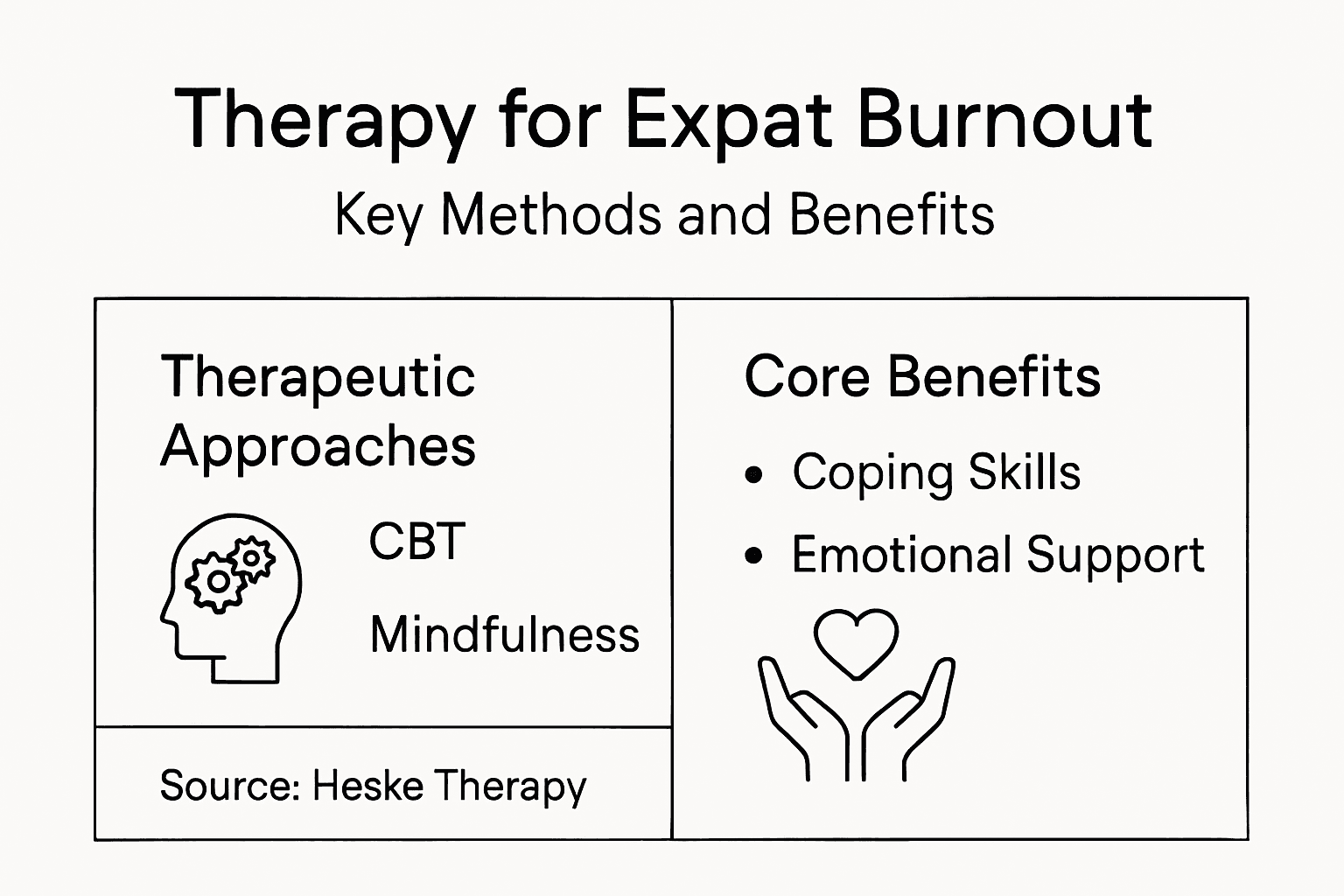
Mindfulness-Based Therapies
Mindfulness approaches teach you to observe stress without letting it overwhelm you. Rather than fighting burnout feelings, you learn to acknowledge them and respond thoughtfully instead of reactively.
Mindfulness-based interventions significantly reduce emotional exhaustion and depersonalization in people experiencing burnout. These group-based sessions work whether delivered in-person, online, or hybrid formats, making them accessible regardless of your schedule.
Mindfulness helps by:
Training your brain to notice stress patterns without judgment
Building space between stressful situations and your emotional responses
Reducing the constant mental chatter that keeps burnout alive
Improving sleep quality and physical relaxation
Increasing awareness of your actual needs versus perceived demands
Cognitive Behavioral and Third-Wave Approaches
Cognitive Behavioral Therapy (CBT) addresses the thought patterns maintaining burnout. You identify unhelpful beliefs about work and yourself, then test and replace them with realistic thinking.
Third-wave cognitive behavioral approaches effectively address emotional exhaustion while incorporating acceptance and mindfulness elements. This means you’re not just changing thoughts—you’re changing your entire relationship with burnout.
These methods target:
Perfectionist thinking that drives overwork
All-or-nothing beliefs about your professional worth
Catastrophizing about work situations
Guilt about setting boundaries
Negative self-talk that amplifies stress
Specialized Therapeutic Approaches for Expats
Heske Therapy offers Rapid Transformational Therapy (RTT), which works faster than traditional talk therapy. RTT identifies the root beliefs driving burnout—often formed long before your move abroad—and shifts them at the source.
EMDR (Eye Movement Desensitization and Reprocessing) processes overwhelming work experiences or cultural transition moments that contributed to burnout. This works particularly well for expats who’ve experienced specific traumatic events or intense stress periods.
Counseling provides continuous emotional support while you rebuild your relationship with work and your expat life. Many expats find having someone who understands both professional stress and cultural adjustment invaluable.
Each method addresses different burnout dimensions:
Emotional exhaustion: Mindfulness, EMDR, RTT
Depersonalization/cynicism: CBT, counseling, RTT
Lost sense of accomplishment: Counseling, longer-term CBT, RTT
Effective burnout treatment often combines multiple approaches tailored to your specific situation rather than relying on a single method.
Pro tip: Start with a free discovery call to discuss which method fits your personality and burnout pattern—some people respond better to structured cognitive work, while others benefit more from mindfulness or deeper therapeutic exploration.
Here is a comparison of therapeutic approaches for expat burnout:
Approach | Primary Focus | Unique Benefit for Expats | Best for Which Symptoms |
Mindfulness-Based Therapies | Observing stress nonreactively | Builds resilience under cultural stress | Emotional exhaustion |
Cognitive Behavioral Therapy | Restructuring negative thoughts | Targets work and adaptation anxieties | Cynicism, low self-worth |
Rapid Transformational Therapy | Changing root beliefs | Accelerates recovery for expats | Chronic burnout, identity loss |
EMDR | Processing traumatic events | Deals with acute culture shock | Trauma, emotional detachment |
Counseling | Ongoing emotional support | Contextualizes expat experiences | Reduced accomplishment, isolation |
Personalizing Therapy for Expatriate Challenges
One-size-fits-all therapy doesn’t work for expat burnout because your stressors are uniquely layered. A therapist who understands expatriate life can tailor treatment to address both your professional demands and cultural adjustment challenges simultaneously.
Understanding Your Unique Expat Context
Your burnout story differs from someone in your home country. You’re managing work stress while also navigating cultural adjustment, language barriers, social isolation, and distance from your support network.
A skilled therapist explores:
How long you’ve been abroad and how well you’ve adjusted culturally
Whether your burnout stems more from work overload or cultural overwhelm
Your support system in Madrid compared to your home country
Language-related stress when working in a non-native language
Unprocessed grief about leaving your previous life behind
Pressure to succeed abroad that compounds normal work stress
Whether you’re in a career transition or trying to prove yourself in your field
Why Language and Cultural Understanding Matter
Working in English when that’s not your first language adds invisible fatigue to every workday. You’re not just processing information—you’re translating it, monitoring your accent, and managing anxiety about being understood.
Choosing an English-speaking therapist removes this additional layer of stress, allowing you to express complex emotions without the cognitive load of translation. This matters more than you might think—the language you use to process emotions affects how deeply you can access and work through them.
Cultural understanding also means your therapist recognizes:
How your home country’s work culture differs from Spanish workplace norms
The specific identity struggles expats face around belonging
How “third culture” experiences shape your self-perception
Whether cultural shock is masquerading as burnout symptoms
Customizing Your Treatment Plan
Personalized therapy considers your individual factors: your age, career stage, previous mental health history, why you moved abroad, and your long-term plans in Madrid.
Younger expats might need support around career pressure and identity formation. Mid-career expats often struggle with work-life balance and questioning whether the move was worth it. Expats planning to return home need different therapeutic goals than those building permanent lives in Spain.
Your treatment plan might involve:
Specific therapy methods chosen based on your personality and burnout triggers
Session frequency that matches your current crisis level and recovery timeline
Homework exercises adapted to your actual capacity, not theoretical ideals
Cultural reframing that helps you see your challenges as expat-specific, not personal failures
Practical coping strategies that work within your real Madrid life
Effective therapy for expat burnout accounts for the cultural and emotional complexities of living abroad, not just workplace stress.
Building Trust and Connection
Personalization extends to your relationship with your therapist. You need someone who gets why you made the move, respects your choice to be an expat, and doesn’t judge the cultural differences you’ve encountered.
A good therapeutic fit means you feel heard without constantly explaining expat life. Your therapist understands that saying “I miss home” can coexist with “I’m glad I’m here.” They recognize the ambivalence unique to expatriate experience.
Pro tip: Use your free discovery call to assess whether a therapist genuinely understands expatriate challenges—ask specific questions about their experience with expats and whether they’ve lived abroad themselves.
Risks of Delaying Professional Intervention
Waiting to seek therapy when you’re experiencing burnout feels like a reasonable choice—you think you can manage it yourself or that it will pass. But delaying professional help actually makes recovery significantly harder and more painful down the road.
The Burnout Progression Without Help
Burnout doesn’t stay stable. Without intervention, symptoms intensify progressively, moving from manageable exhaustion to something much more serious. Early burnout is easier to treat than advanced burnout.
Persistent job demands without adequate coping resources increase emotional exhaustion and mental health decline, creating a downward spiral. What started as difficulty sleeping and occasional cynicism can evolve into clinical depression, severe anxiety, or worse.
The progression typically follows this pattern:
This table summarizes how delayed burnout intervention can impact an expat’s health:
Delay Duration | Progression Level | Risk to Health | Impact on Career |
1-4 weeks | Mild fatigue, irritability | Manageable, reversible | Minor performance dips |
5-12 weeks | Persistent exhaustion | Onset of anxiety, insomnia | Impaired concentration |
3-6 months | Emotional detachment | Depression risk rises | Avoidance of work tasks |
6+ months | Complete burnout | Major depressive disorder | Job loss or resignation |
Week 1-4: Fatigue, occasional irritability, slight performance dips
Week 5-12: Consistent exhaustion, cynicism about work, difficulty concentrating
Month 3-6: Emotional detachment from everything, physical symptoms, avoidance behaviors
Month 6+: Depression, anxiety, suicidal thoughts, complete burnout
Serious Mental Health Consequences
Delayed intervention allows burnout to morph into clinical mental health disorders. You might develop depression that requires medication, anxiety that interferes with daily functioning, or trauma responses from overwhelming work experiences.
Failure to address burnout timely results in chronic physical, psychological, and social exhaustion that damages your career, relationships, and health. Many expats describe reaching a crisis point—hospitalization, complete inability to work, or relationship breakdown—before seeking help.
Specific risks include:
Depression: Progresses from low mood to clinical major depressive disorder
Anxiety disorders: Develops from work stress into panic attacks or generalized anxiety
Sleep disorders: Insomnia worsens to complete sleep deprivation effects
Physical health decline: Blood pressure issues, weakened immunity, chronic pain
Substance use: Self-medicating with alcohol or other substances
Relationship damage: Emotional unavailability destroys personal connections
Impact on Your Career and Future
Burnout delayed long enough destroys your professional trajectory. You make poor decisions, miss opportunities, damage professional relationships, or leave your job abruptly without another position lined up.
For expats, this is particularly damaging because visa sponsorship often depends on employment. A mental health crisis can force you to leave your position, your company, potentially even Spain—regardless of whether you wanted to.
Early intervention prevents burnout from becoming a career-altering crisis and preserves your ability to make intentional choices about your future.
Why Now Matters More Than You Think
Therapy is most effective when burnout is caught early. The longer you wait, the more entrenched the patterns become, and the longer recovery takes. Someone who seeks help at month two recovers in weeks or months. Someone who waits until month nine might need months or years of therapy.
Your brain adapts to chronic stress, essentially hardwiring burnout into your nervous system. Early intervention prevents this hardwiring from happening.
Pro tip: Don’t wait for a crisis—book your free discovery call as soon as you notice persistent exhaustion, cynicism about work, or feeling unable to recover on weekends.
Overcome Expat Burnout with Expert Therapy Tailored to Your Unique Journey
Burnout is more than just exhaustion for expatriates. It is the intense emotional drain that blends career stress with the challenges of adapting to a new culture. If you recognize symptoms like emotional exhaustion, cynicism about work, or feeling trapped in your role abroad, you are not alone. Heske Therapy in Madrid specializes in providing personalized mental health solutions designed specifically for English-speaking expats facing burnout and emotional overwhelm.
Our integrative approach combines proven methods such as Rapid Transformational Therapy (RTT), EMDR, and Cognitive Behavioral Therapy (CBT) to address both work-related pressures and cultural adjustment struggles. By working with a therapist who understands the double burden you carry, you will learn to break the burnout cycle and rebuild resilience in a rapid and lasting way. Join numerous expats who have regained control over their work-life balance and emotional well-being through customized treatment plans.
Feeling ready to reclaim your energy and mental clarity? Discover how personalized therapy can end your burnout cycle.
Take the first step now. Schedule your free discovery call at Heske Therapy and let us help you restore balance and fulfillment in your expatriate life. Don’t let burnout decide your future—start healing today.
Frequently Asked Questions
What are the key causes of burnout for expats?
Burnout among expats is often triggered by emotional exhaustion from navigating two worlds, such as work pressures combined with cultural adjustments. Other factors include high job demands, inadequate support networks, and difficulties in disconnecting from work.
How can therapy help expats recover from burnout?
Therapy provides tools to manage stress and address emotional exhaustion. It helps expats identify specific stressors, develop coping strategies, and build resilience, allowing them to separate work demands from personal recovery time.
What therapeutic approaches are effective for expat burnout?
Various approaches are effective, including Cognitive Behavioral Therapy (CBT) for restructuring negative thoughts, Rapid Transformational Therapy (RTT) for addressing root beliefs, and mindfulness-based therapies to help manage stress nonreactively.
Why is early intervention important in burnout recovery?
Early intervention is crucial because delayed treatment can lead to chronic mental health conditions, worsening stress responses, and prolonged recovery periods. Addressing burnout symptoms promptly aids in preventing serious consequences to both mental health and professional life.
Recommended
Comments