Why Therapy for International Clients Matters Most
- Methode sure pour gagner a la roulette
- Feb 25
- 10 min read

Adjusting to life in Madrid as an English-speaking expatriate can bring challenges no guidebook prepares you for. Anxiety and trauma often feel magnified when you are separated from familiar support networks, forced to navigate cultural displacement and visa uncertainties. The need for rapid, tailored psychotherapy becomes critical, especially when traditional therapy overlooks these complex expat realities. If you are seeking culturally competent, online-friendly solutions that respect your unique context, discover how cultural understanding transforms therapy into practical, fast-acting relief.
Table of Contents
Key Takeaways
Point | Details |
Cultural Competence is Essential | Effective therapy for international clients requires therapists to possess cultural awareness and understanding specific to expat challenges. |
Personalized Therapy Improves Outcomes | Integrative approaches tailored to individual circumstances yield faster and more impactful results for managing expat-specific stressors. |
Language Fluency Matters | Therapy conducted in a client’s native language enhances emotional expression and facilitates deeper understanding. |
Generic Therapy is Ineffective | Standardized therapy fails to address unique challenges faced by expatriates, emphasizing the need for specialized, context-aware approaches. |
Defining Therapy for International Clients
Therapy for international clients goes beyond standard counseling. It’s a specialized approach designed to address the unique mental health challenges that expatriates and global professionals face in unfamiliar cultural settings.
Unlike therapy for local populations, international therapy accounts for cultural displacement, language barriers, visa stress, and identity shifts. Your therapist becomes not just a mental health provider, but someone who understands the specific pressures of living abroad.
The core difference lies in cultural competence. Research on counselors working with culturally diverse clients shows that therapists working effectively with international populations require ongoing professional development and a client-centered approach tailored to their unique circumstances.
Key elements of therapy for international clients include:
Language fluency: Receiving therapy in your native language eliminates miscommunication and ensures emotional nuance isn’t lost in translation
Cultural understanding: Your therapist grasps the specific challenges of expat life, not just general anxiety or trauma
Online accessibility: Sessions can happen from your apartment, regardless of your location in Madrid or elsewhere
Rapid, focused outcomes: Integrative approaches like EMDR, RTT, and CBT deliver measurable results quickly
You’re not just addressing surface-level stress. International clients often juggle work pressure, family separation, immigration uncertainty, and social isolation simultaneously.
Culturally sensitive online therapy solutions recognize that your anxiety or trauma exists within this specific context. Generic therapy doesn’t account for the compounding factors unique to expat life.
Effective therapy for international clients bridges cultural understanding with rapid, evidence-based treatment methods designed specifically for your situation.
This means your therapist doesn’t just listen—they actively apply methods proven to work with expat populations. They understand why sleep disruption hits differently after relocation, why imposter syndrome feels sharper in a foreign workplace, and how isolation amplifies trauma symptoms.
Therapy for international clients also recognizes language as both barrier and asset. Choosing an English-speaking therapist allows you to express complex emotions, trauma details, and cultural nuances with precision rather than struggling through translation.
The flexibility matters too. You need therapy that fits your expat schedule—online sessions mean no commute through Madrid traffic, no time zone scheduling nightmares, and continuity if you relocate.
Pro tip: When selecting therapy for international needs, prioritize therapists trained in transcultural approaches who offer flexible scheduling and understand the specific stressors of expat life, not just general mental health treatment.
Unique Mental Health Challenges Abroad
Living abroad sounds romantic in theory. The reality? You’re juggling stressors that locals never face, and your mental health pays the price.
Expat life stacks multiple pressures simultaneously. You’re managing cultural adjustment stress, language barriers, visa uncertainty, and isolation from your support network all at once. These aren’t separate issues—they compound.
Unlike someone experiencing anxiety at home, you can’t just call your parents for support. You can’t walk into a familiar doctor’s office. You’re rebuilding your entire social infrastructure from scratch while managing work stress and identity shifts.
The unique challenges you face include:
Cultural displacement: Constant low-level stress from navigating unfamiliar social norms, workplace expectations, and daily routines
Language barriers: Struggling to express needs accurately, leading to frustration and isolation
Severed support networks: Distance from family, long-term friends, and familiar systems you relied on
Professional pressure: Proving yourself in a new work environment while managing cultural differences
Identity confusion: Questions about where you belong and who you are in this new context
Research shows that acculturative stress remains prominent among international populations, alongside depression and anxiety. You’re not just homesick—you’re managing psychological adjustment on multiple fronts.
These aren’t weaknesses or oversensitivity. Your brain is working overtime to process constant novelty, navigate unfamiliar systems, and maintain connections across time zones.
International clients face compounded mental health challenges that standard therapy doesn’t address because local therapists haven’t lived this experience themselves.
The isolation factor hits harder than most people realize. Your coworkers have families in Madrid. Your friends understand the local healthcare system. You’re solving problems alone that others take for granted.
This is why rapid therapy methods for expat mental health matter. You don’t have time for slow progress when you’re managing multiple crises. You need results quickly so you can actually enjoy the opportunity you’ve sacrificed to be here.
Sleep disruption, anxiety spikes, and emotional exhaustion aren’t signs you’re failing at expat life. They’re normal responses to abnormal stress loads.
Pro tip: Name your specific stressors rather than bundling them as general anxiety—distinguishing between visa stress, workplace pressure, and loneliness helps your therapist target interventions precisely.
Language, Culture, and Therapy Outcomes
Therapy conducted in your native language isn’t a luxury—it’s a clinical requirement for effective treatment. When you’re processing trauma or anxiety, translation delays your healing.

Here’s why language matters: Your emotional vocabulary exists in English. When forced to explain complex feelings in Spanish or another language, you lose precision, nuance, and the ability to access deeper emotional content. Therapy requires emotional honesty, and that’s hardest when you’re searching for words.
Beyond language, cultural context shapes every therapy outcome. What constitutes healthy behavior, family obligations, or success differs dramatically across cultures. Your English-speaking therapist understands these distinctions without requiring lengthy explanations.
The impact of cultural alignment includes:
Faster rapport building: No time wasted bridging cultural gaps or explaining your worldview
Accurate diagnosis: Therapists recognize culturally specific presentations of anxiety and trauma
Appropriate interventions: Treatment respects your values rather than imposing Western-only approaches
Reduced misinterpretation: Cultural behaviors aren’t pathologized as symptoms
Research demonstrates that culturally adapted group therapy produces significant reductions in depressive symptoms when tailored to client backgrounds. Generic therapy simply doesn’t work as effectively.
Language proficiency combined with cultural understanding creates measurable treatment advantages. Your therapist should grasp why you feel guilty about leaving family, why certain workplace dynamics trigger disproportionate anxiety, or why decision-making feels paralyzed.
Therapy outcomes improve significantly when your therapist shares or deeply understands your cultural framework, not just your language.
Consider how expat-specific stressors intersect with your culture. A Canadian experiencing homesickness differs from someone from an Asian background managing family expectations across continents. Generic anxiety treatment misses these distinctions entirely.
Psychotherapy methods explained for expats incorporate cultural competence directly into treatment design. Your therapist doesn’t just apply techniques—they adapt them to your context.
The outcome? Faster progress, deeper insights, and treatment that actually respects who you are rather than pushing you toward some cultural ideal.
Pro tip: Explicitly discuss cultural factors affecting your mental health during your first session—family expectations, cultural identity conflicts, or values differences—so your therapist can integrate cultural understanding into every intervention.
Personalized Integrative Approaches for Expats
One-size-fits-all therapy fails expats. Your situation is too complex for standardized protocols. You need a personalized integrative approach that combines multiple evidence-based methods tailored specifically to your circumstances.
Integrative therapy means your therapist draws from several therapeutic traditions—not just one method. EMDR addresses trauma processing. RTT targets limiting beliefs and behavioral patterns. CBT manages anxiety and thought patterns. Hypnotherapy accesses subconscious blocks. Combined strategically, they work faster than any single approach alone.
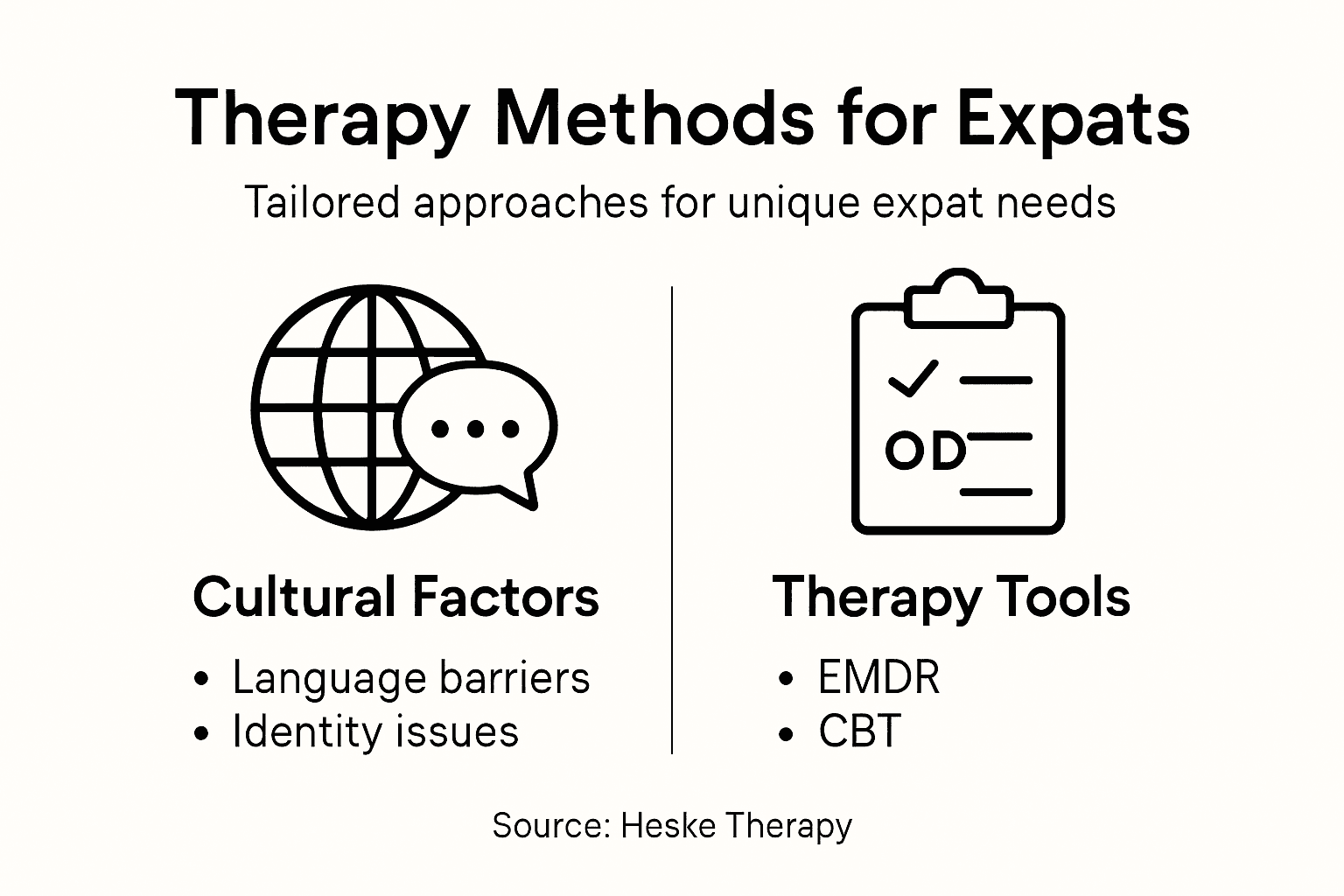
Personalization matters because your anxiety about work performance differs from anxiety about visa renewal. Your trauma may stem from cultural displacement, not just past events. Generic protocols miss these distinctions entirely.
Key elements of personalized integrative treatment include:
Initial comprehensive assessment: Your therapist maps your specific challenges, cultural background, and previous therapy experiences
Method selection: Treatment combines techniques matched to your particular issues, not predetermined protocols
Cultural adaptation: Interventions respect your values, family dynamics, and cultural identity
Flexibility: Sessions adjust based on your progress and emerging needs
Rapid outcomes focus: Integrated approaches typically produce results faster than single-method therapy
Research emphasizes integrated systemic approaches supporting expatriates personally and professionally. Tailored interventions considering cultural identity, career goals, and work environments enhance outcomes significantly.
Your therapist combines these approaches strategically. One week might emphasize RTT to shift limiting beliefs about your capabilities. The next week might focus on EMDR if trauma surfaces. CBT helps you manage daily anxiety while hypnotherapy addresses underlying patterns.
Integrative therapy for expats combines multiple evidence-based methods personalized to your unique circumstances, delivering faster, more comprehensive results than standardized approaches.
This flexibility prevents stagnation. If progress plateaus, your therapist pivots methods rather than continuing ineffective approaches. Your treatment evolves as you do.
Examples of integrative therapy for expats illustrate how therapists blend methods strategically. EMDR processes the traumatic components of relocation. RTT shifts the identity confusion underlying anxiety. CBT manages workplace triggers. Hypnotherapy addresses sleep disruption and stress responses simultaneously.
Below is a summary of integrative methods used for expat mental health and their main benefits:
Method | Focus Area | Benefit for Expats |
EMDR | Trauma processing | Addresses relocation trauma quickly |
RTT | Identity and beliefs | Reduces cultural identity confusion |
CBT | Anxiety and thought patterns | Manages workplace and visa stress |
Hypnotherapy | Subconscious patterns | Improves sleep and reduces stress |
The result? Comprehensive healing addressing root causes rather than symptom management alone. You’re not just coping—you’re transforming your relationship with expat life.
Pro tip: During your discovery call, explain your complete situation—work stress, relationship changes, visa concerns, cultural adjustments—so your therapist can design an integrated treatment plan addressing all factors simultaneously rather than treating symptoms in isolation.
Risks of Generic Therapy and Key Solutions
Generic therapy—standardized protocols applied to everyone regardless of circumstances—fails expat populations. When your therapist follows a predetermined script, they miss the critical factors shaping your mental health.
Here’s a comparison between generic therapy and specialized therapy for international clients:
Aspect | Generic Therapy Approach | Specialized International Therapy |
Assessment | Standardized questionnaires | Personalized, culturally contextual |
Treatment Techniques | Single-method protocols | Integrative, multi-method strategies |
Cultural Consideration | Minimal or absent | Deep understanding of cultural factors |
Outcomes Speed | Slow, symptom-based progress | Rapid, targeted results |
Relapse Risk | Higher due to missed root causes | Lower with tailored interventions |
Standardized approaches assume your anxiety matches textbook presentations. They ignore your specific triggers: visa deadlines, workplace cultural friction, family expectations across continents, identity displacement. Generic protocols address symptoms without addressing root causes unique to expat life.
The risks of generic therapy include:
Misdiagnosis: Therapists pathologize normal cultural adjustment as clinical pathology
Ineffective interventions: Standard anxiety protocols don’t address expat-specific stressors
Wasted time: You spend months in therapy without addressing your actual problems
Therapeutic mismatch: Generic approaches ignore your cultural background and values
Slower outcomes: One-size-fits-all methods require longer treatment duration
Relapse risk: Without addressing underlying causes, symptoms return after therapy ends
Consider the difference: A generic therapist addresses anxiety through standard CBT protocols. A specialized therapist asks whether your anxiety stems from visa uncertainty, work performance pressure, family obligation guilt, or cultural identity confusion—then tailors treatment accordingly.
Quality variability becomes an issue when therapists lack expat expertise. Quality consistency remains critical when selecting any treatment approach. Your therapist should specialize in international client issues, not simply offer generic anxiety treatment to everyone.
Generic therapy wastes your time and money by treating symptoms without addressing the expat-specific root causes driving your anxiety or trauma.
Expat therapy requires specialized assessment, not standardized questionnaires. Your therapist needs to understand cultural context, work environment pressures, visa status impact, and relationship dynamics across distance simultaneously.
The solution? Seek therapists explicitly trained in working with international populations. They recognize patterns generic therapists miss entirely. They know why sleep disruption hits harder after relocation. They understand cultural factors shaping your mental health responses.
Combining therapy methods benefits your recovery when done strategically rather than following generic protocols. Your therapist should select specific techniques addressing your particular circumstances, not apply predetermined treatment plans.
Specialized expat therapy produces measurable results faster because it targets actual causes rather than surface symptoms. You’re not spending months in generic anxiety treatment that doesn’t address visa stress or cultural identity issues.
Pro tip: When evaluating a therapist, ask directly about their experience treating expatriates—specifically their approach to cultural factors, visa-related stress, and long-distance family dynamics, not just general anxiety management.
Specialized Therapy Solutions for International Clients
Living abroad presents unique mental health challenges like cultural displacement, visa stress, and identity confusion that generic therapy often overlooks. At Heske Therapy, we understand these specific pressures and provide personalized integrative approaches combining Rapid Transformational Therapy (RTT), EMDR, CBT, counseling, and hypnotherapy designed to deliver rapid and lasting results. Our multicultural and multilingual team supports English-speaking expatriates in Madrid and worldwide, ensuring therapy is effective and culturally sensitive.
If you are overwhelmed by work pressure, family separation, or social isolation as an expat, Heske Therapy offers the expertise and flexible online sessions to help you heal efficiently in your native language. Discover how our specialized care addresses your exact stressors including sleep issues, anxiety, and trauma shaped by international life.
Take the next step toward effective mental health support tailored to your life abroad. Visit Heske Therapy to explore our integrative therapy methods and learn why choosing an English-speaking therapist makes all the difference in your healing journey.
Are you ready to transform your expat experience with proven, culturally competent therapy?
Schedule your free discovery call today at Heske Therapy and begin overcoming the unique challenges of living abroad with expert support.
Frequently Asked Questions
What are the unique challenges that international clients face in therapy?
International clients often deal with cultural displacement, language barriers, visa stress, and social isolation. These challenges can compound and impact their mental health, making standard therapy approaches less effective.
Why is cultural competence important in therapy for expatriates?
Cultural competence is crucial because it allows therapists to understand the specific pressures and experiences of living abroad. This understanding enables them to provide tailored interventions that effectively address the unique mental health challenges faced by international clients.
How does language fluency affect therapy outcomes?
Receiving therapy in one’s native language is vital for effective treatment. It ensures that clients can express complex emotions accurately, preventing miscommunication and enabling deeper emotional processing during therapy sessions.
What are integrative therapy approaches, and why are they beneficial for expats?
Integrative therapy combines multiple evidence-based methods tailored to the specific circumstances of the client. For expatriates, this personalized approach can address various anxiety triggers and cultural issues, leading to faster and more comprehensive mental health outcomes.
Recommended
Comments