Why Expats Experience Burnout: Causes and Coping
- Heske Ottevanger
- 11 hours ago
- 8 min read


TL;DR:
Expat burnout primarily results from ongoing environmental adaptation rather than work pressure alone.
It causes cognitive and emotional exhaustion due to the heightened effort required for routine tasks abroad.
Early recognition and targeted therapy help expats restore resilience by addressing root nervous system patterns.
Living abroad sounds like the adventure everyone envisions, but understanding why expats experience burnout reveals something most people never expect: the exhaustion rarely comes from your job. Clinically, this falls under what researchers call occupational and adaptive burnout, a state of chronic depletion triggered not by overwork alone, but by the relentless cognitive and emotional effort of existing in an unfamiliar environment. You are not failing. Your nervous system is simply running on overdrive, every single day, in ways you were never warned about.
Key Takeaways
Point | Details |
It’s not about work | Expat burnout stems from constant environmental adaptation, not just professional pressure. |
Autopilot is gone | Every routine task abroad requires conscious effort, draining cognitive reserves faster than you realize. |
Symptoms look different | Withdrawal, decision fatigue, and physical exhaustion signal expat burnout before obvious breakdown occurs. |
Rest is non-negotiable | Prioritizing recovery time each day actively protects your nervous system from depletion. |
Professional support works | Therapy approaches tailored for expats address root causes faster than willpower alone. |
Why expats experience burnout differently than others
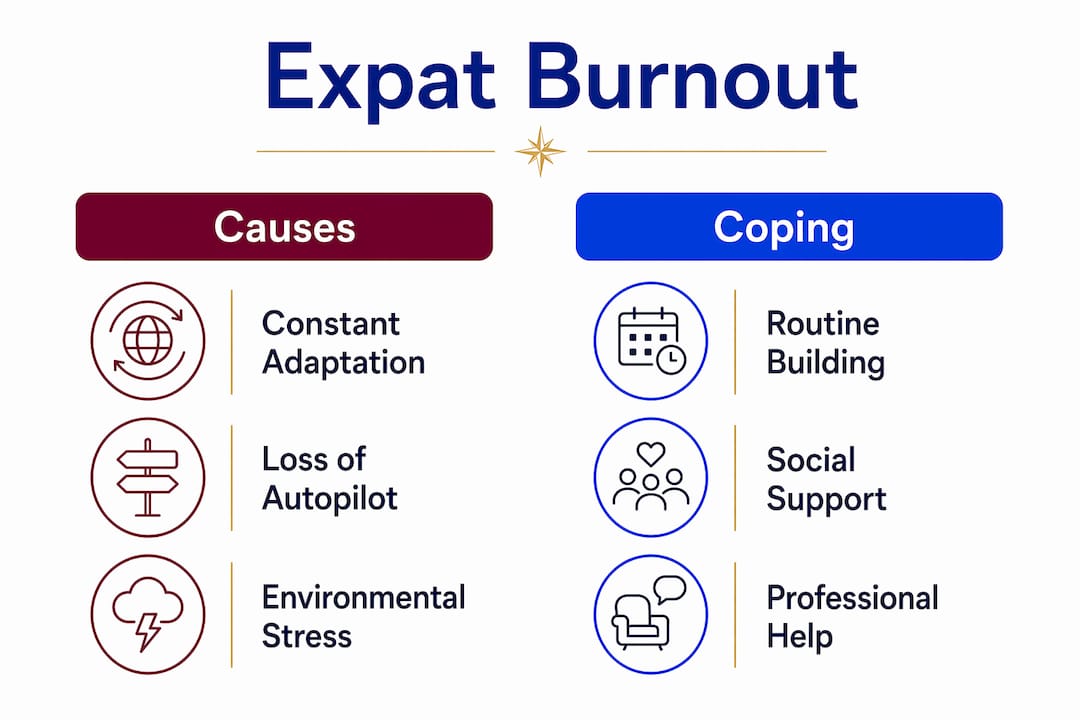
Most people associate burnout with working too many hours or having a demanding boss. For expats, that framing misses the actual problem entirely. The true cause of expat burnout is the ongoing effort required to navigate an unfamiliar environment, not workplace stress alone.
Think about what happens when you live somewhere familiar. You drive to the grocery store on autopilot. You know how to read social cues. You understand what the cashier means even when the interaction is rushed. That autopilot function conserves enormous mental energy every day. When you relocate, that autopilot disappears completely.

Abroad, every ordinary task demands conscious processing. Reading a menu, figuring out which bus to take, interpreting a neighbor’s tone, understanding a bureaucratic form in another language. Each of these takes real cognitive effort. And this decision fatigue accumulates quietly, hour by hour, until your reserves hit empty.
The physiological side is just as real. Combined physical and emotional stressors from relocation, including disrupted movement patterns, hormonal shifts from less sunlight, and social isolation, place genuine strain on your nervous system. Your body treats unfamiliarity as a low-grade threat signal. That means you are operating in a state of chronic hyper-vigilance, continuously scanning for safety, even when everything looks fine on the surface.
Here is what compounds the problem. Around 80% of globally mobile employees report significant stress linked to loneliness, financial pressure, and the loss of familiar routines. Half of those respondents specifically cite social exclusion as a major driver of their emotional difficulties. You are not uniquely sensitive. You are in the majority.
“Expat burnout is the body’s reasonable response to an unreasonable amount of sustained environmental demand.”
Pro Tip: Name what is actually costing you energy. Try keeping a brief daily log of tasks that felt surprisingly difficult. Patterns will reveal exactly where your nervous system is spending its reserves.
Recognizing the symptoms of expat burnout
The tricky part about burnout is that it rarely arrives as a dramatic breakdown. It builds slowly, which means most expats dismiss early warning signs as temporary adjustment. Recognizing the progression matters because the earlier you catch it, the faster you recover.
Here is how expat burnout typically unfolds:
Irritability and low tolerance. Small frustrations start feeling disproportionately huge. A delayed bus or a miscommunicated order becomes genuinely upsetting. Early burnout signs include exactly this: emotional reserves are already depleted before you notice anything is wrong.
Withdrawal from social situations. You start canceling plans, avoiding new people, and preferring the solitude of your apartment. This feels like introversion but it is actually avoidance. Meeting new people requires even more cognitive effort when you are already running low.
Cognitive fog and decision fatigue. Simple choices feel overwhelming. Picking what to cook for dinner or responding to a work email becomes harder than it should be. Chronic over-functioning depletes cognitive capacity alongside emotional reserves, which is why thinking clearly becomes genuinely difficult.
Emotional numbness despite “doing everything right.” You are going to language class, exploring the city, showing up at work. But you feel nothing. No excitement. No connection. This detachment is one of the clearest signals of advanced burnout and should not be ignored.
Physical symptoms without obvious cause. Disrupted sleep, headaches, digestive issues, and persistent fatigue are common physical expressions of nervous system overload. They are not unrelated to the emotional picture. They are the same picture.
The pattern most expats miss is that these symptoms feel like personal failings rather than physiological signals. Recognizing them as burnout shifts everything. You stop blaming yourself and start addressing the actual cause.
Expat burnout vs. traditional burnout
Understanding the difference between standard occupational burnout and expat burnout reduces the guilt and confusion that keeps many people stuck longer than necessary.
Factor | Traditional burnout | Expat burnout |
Primary trigger | Workplace overload and chronic pressure | Loss of autopilot, identity disruption, cultural adaptation |
Social support | Usually intact locally | Often absent or limited to digital connections |
Identity pressure | Tied to professional role | Tied to self, culture, language, and belonging |
Onset speed | Often rapid during peak work periods | Gradual and frequently misread as adjustment |
Recovery environment | Familiar surroundings support healing | Recovery environment is also the stressor |
The last row is the one that catches people off guard. With traditional burnout, going home helps. With expat burnout, home is the place where the stress lives. That is a completely different recovery problem.
The gradual nature of expat burnout follows what researchers describe as a frog in boiling water effect. The environment warms so slowly that you do not register the danger until it is already advanced. Identity shifts amplify this. You arrive as someone confident and capable. Over months, without your usual social context and cultural fluency, you begin to question your own competence. That identity erosion accelerates burnout dramatically.
Understanding the causes of expat burnout through this lens also explains why productivity tips and time management strategies rarely help. The problem is not how you are organizing your day. The problem is that your entire operating system is running without the support it was built on.
How to cope with expat stress and rebuild resilience
Recovery from expat burnout is possible, and it does not require abandoning your life abroad. It requires addressing the nervous system first, not the to-do list.
Start with predictability. Your nervous system relaxes when it knows what comes next. Simple routines and familiar activities directly reduce hyper-vigilance. This means choosing one coffee shop you go to regularly, cooking a meal from home once a week, or keeping a consistent morning routine. These feel small. They are not.
Protect your rest deliberately. Research on recovery suggests that 42% of each day should be spent resting to allow the body and mind to recover from stress. For a 16-hour waking day, that is roughly six and a half hours of genuine downtime. Not scrolling. Not “relaxing” while answering messages. Actual low-demand rest.
Build local and virtual community. Social anchors like expat clubs and buddy programs meaningfully reduce feelings of isolation and help rebuild the support networks that burnout strips away. You do not need dozens of friends. You need two or three people who know your name in the city where you live.
Seek out activity-based groups rather than purely social ones. Shared activities reduce the cognitive pressure of pure conversation.
Schedule virtual calls with home friends at a fixed time each week so connection feels automatic, not effortful.
Lower the bar for what counts as “enough” social connection during recovery.
Know when professional support belongs in the picture. Mental health resilience practices that include early intervention and structured recovery significantly improve burnout outcomes. If self-care strategies are not shifting how you feel after four to six weeks, that is not a willpower problem. That is a signal that you need specialized support. Reading a guide to overcoming expat burnout is a useful starting point for understanding what that support actually looks like.
Pro Tip: Rather than trying to fix everything at once, choose one recovery action per week and practice it consistently. Sustainable change happens through small, repeated inputs, not single dramatic efforts.
My perspective on what actually helps
I have worked with many expats who arrive at therapy describing themselves as “not a complainer” or “normally pretty resilient.” The most striking thing is how long they waited before seeking support, often years, because they believed the difficulty was a personal failing rather than a predictable response to a genuinely demanding experience.
What conventional advice gets wrong is the “push through” approach. I’ve seen it backfire consistently. Pushing through works when the stressor is temporary. Expat life is not temporary. Telling someone to tough it out when their nervous system has been in survival mode for eighteen months is the equivalent of telling someone with a broken leg to walk it off.
What actually moves the needle, in my experience, is starting with safety. Not happiness, not productivity, not integration. Safety. When clients begin restoring small areas of predictability, their nervous system starts to downregulate, and everything else becomes more accessible: connection, creativity, language learning, even their professional performance.
I also want to name something that rarely gets said directly. Burnout is not failure. It is a signal. And the earlier you treat it as useful information rather than evidence against yourself, the faster you recover. The clients I see make the most progress are the ones who stopped fighting what they were feeling and started getting curious about it instead.
If you are reading this and recognizing yourself in these pages, that recognition is not just reassuring. It is the first step toward doing something about it.
— Heske
Therapy for expat burnout at Hesketherapy
If what you have read here reflects your experience, you do not have to keep managing it alone.

At Hesketherapy, specialized support for expat burnout is exactly what we do. Working with English-speaking clients in Madrid and online worldwide, our approach combines Rapid Transformational Therapy with EMDR, CBT, and hypnotherapy to address the root causes of burnout rather than just managing symptoms. RTT is particularly effective for expat burnout because it works at the level where the deepest exhaustion lives: the beliefs and nervous system patterns that keep you stuck even after circumstances improve.
For clients who want intensive, fast-moving results, our 21-day RTT face-to-face package offers structured, hands-on support in Madrid. Online options are also available for expats anywhere in the world. Your first step is a free discovery call with no commitment required.
FAQ
What makes expat burnout different from regular burnout?
Expat burnout is driven by loss of autopilot and constant environmental adaptation, not just work overload. Unlike regular burnout, the recovery environment itself is a source of stress, making it harder to heal without targeted support.
What are the most common symptoms of burnout in expats?
The most common symptoms include emotional exhaustion, social withdrawal, cognitive fog, and physical complaints like disrupted sleep or persistent fatigue. These symptoms often appear gradually and are frequently misread as normal adjustment difficulties.
How do you cope with expat stress and start recovering?
Restoring small routines, prioritizing real rest, and rebuilding social connections are the most effective starting points. When those strategies are not enough after four to six weeks, therapy for expat burnout provides structured, faster relief.
Why does expat burnout take so long to recognize?
The gradual onset follows a slow accumulation pattern where each individual stressor feels manageable. By the time exhaustion becomes obvious, emotional and cognitive reserves are already significantly depleted.
Can therapy really help with expat burnout?
Yes. Approaches like RTT, EMDR, and CBT directly address the nervous system patterns and belief systems that sustain burnout. Research confirms that early professional intervention significantly improves recovery outcomes compared to self-management alone.
Recommended
Comments