Why seek therapy? The 2026 guide for expats in Madrid


TL;DR:
Modern rapid therapy methods deliver measurable results faster than traditional approaches.
Expats in Madrid face unique stressors like culture shock and bureaucracy impacting mental health.
2026 offers a strategic opportunity due to increasing acceptance, telehealth access, and scientific validation.
Therapy is no longer a last resort for when everything falls apart. For English-speaking expats navigating life in Madrid, it has quietly become one of the smartest, most proactive investments you can make in your career, relationships, and overall resilience. In 2026, rapid therapy methods like Rapid Transformational Therapy (RTT) and hypnotherapy are delivering measurable results faster than traditional approaches ever could. This guide breaks down the real stressors expats face, the barriers standing between you and care, the science behind modern methods, and exactly why now is the right moment to act.
Table of Contents
Understanding expat mental health in Madrid: Unique stressors and needs
Barriers to care: Why timely, English-speaking therapy matters
The science behind rapid therapy methods: Hypnotherapy, RTT, and regression
Why 2026 is the right time: Reducing stigma and maximizing new opportunities
Why conventional therapy timelines don’t fit modern expat life
Key Takeaways
Point | Details |
Unique mental health needs | Expats in Madrid face distinct stressors—like isolation and bureaucracy—that make mental health support vital. |
Rapid access is crucial | Private, English-speaking therapy offers expats quicker and more relevant support than the public system. |
Science supports rapid methods | Empirical research shows approaches like RTT and hypnotherapy provide fast, significant symptom relief. |
2026 is the ideal moment | Stigma is down and new therapy options are easier to access than ever for expats. |
Understanding expat mental health in Madrid: Unique stressors and needs
With this evolving view of therapy in mind, it is crucial to look at why expats in Madrid face particular pressures. Living abroad sounds exciting from the outside. And it often is. But the psychological load that comes with relocating to a new country is something most people underestimate until they are deep in it.
Expats in Madrid face a distinct cluster of mental health challenges that locals simply do not encounter in the same way: culture shock, isolation, homesickness, language barriers, identity shifts, and the relentless decision fatigue that comes with navigating Spanish bureaucracy. These pressures do not show up all at once. They stack up slowly, often disguising themselves as stress or tiredness until they become anxiety, burnout, or a reactivation of older trauma.
Here are some of the most common expat stressors that bring people to therapy:
Culture shock and social isolation. Making new friends as an adult is hard. Making friends in a foreign language, in a culture with different social norms, is even harder. Many expats spend months feeling disconnected before they recognize how deeply lonely they actually feel.
Language frustration. Even intermediate Spanish speakers hit a wall when dealing with landlords, banks, or the local health system. The cognitive load of functioning in a second language every day is genuinely exhausting.
Identity drift. When you leave your home country, you also leave many of the roles that defined you. Being someone’s neighbor, the local expert at work, the person who knows how things work. That loss of identity is real and often overlooked.
Bureaucracy and decision fatigue. Spain’s administrative systems can feel impenetrable. Dealing with NIE applications, empadronamiento, insurance paperwork, and tax filings in a second language drains mental energy that could go toward actual living.
Relationship strain. Couples who relocate together often experience unexpected friction when one partner adjusts faster than the other. Solo expats can feel the strain of maintaining long-distance friendships and family bonds.
“The accumulating weight of small daily challenges, each manageable on its own, is what makes expat life psychologically demanding in ways that are hard to explain to people who have not lived it.”
The good news is that addressing these issues does not require years of weekly sessions. Work on expat self-esteem in Madrid can shift long-standing patterns quickly when the right method is applied. Many expats find that once they understand the root of their struggles, progress accelerates. Proactive therapy, starting before you hit a wall, is far more effective than waiting until burnout or anxiety becomes debilitating. Exploring strategies for overcoming expat challenges early gives you tools to use across the entire arc of your time abroad. For those already feeling the physical and emotional weight of too much, learning about expat burnout prevention can stop a slow decline before it becomes a crisis. And for those whose expat experience has triggered older wounds, trauma recovery for expats offers a structured, evidence-based path forward.
Barriers to care: Why timely, English-speaking therapy matters
Understanding these stressors raises the question: how easy is it to actually get timely help in Madrid?
The honest answer is that getting mental health support through Spain’s public system is not straightforward, especially if you are not a fluent Spanish speaker. Public mental health services in Spain require a GP referral before you can see a specialist, come with long waiting lists, and rarely include English-speaking therapists. For an expat in the middle of an anxiety spiral or a burnout episode, waiting three to six months for an appointment is simply not a viable option.

Private English-speaking therapy changes the equation entirely. Here is a direct comparison of what you are actually dealing with:
Factor | Public system in Spain | Private English-speaking therapy |
Waiting time | 3 to 6 months or longer | Days to 1 to 2 weeks |
Language of care | Spanish | English (plus Spanish, Dutch) |
Referral required | Yes, via GP | No |
Session frequency control | Limited | Fully flexible |
Therapy method options | Primarily CBT | RTT, EMDR, hypnotherapy, CBT |
Telehealth availability | Rarely | Commonly available |
The practical gap here is significant. For a high-functioning professional managing a demanding job alongside the cognitive load of expat life, speed of access directly impacts outcomes. Working with specialized psychotherapy for expats means you are not sitting on a waiting list while your symptoms compound. You are getting focused, culturally informed care from someone who understands your context.
Pro Tip: When evaluating private therapy options in Madrid, always ask whether the therapist has direct experience working with expatriates. Cultural competence is not just a nice-to-have. It shapes whether your therapist can genuinely understand the pressures you are navigating. A therapist who has only worked with local clients may underestimate how structurally different expat life actually is.
Holistic expat solutions that combine multiple therapy modalities tend to be far more effective for complex presentations like burnout plus anxiety plus relationship strain. A one-size-fits-all approach rarely serves people managing several interconnected challenges at once.
The science behind rapid therapy methods: Hypnotherapy, RTT, and regression
Given these access challenges, the choice of therapy method becomes especially important. And the good news is that empirical science now supports rapid interventions with real, measurable confidence.
For a long time, hypnotherapy and regression-based therapies were dismissed as fringe or unscientific. That perception is changing fast. The research base is growing, and the effect sizes are genuinely impressive.
Here is what current data tells us about rapid therapy outcomes:
Method | Key finding | Effect size |
Hypnotherapy | Single session improves executive function, reduces sympathetic stress response | d=0.62 |
Regression therapy | BSI-53 scores drop 47% in 4 months, major symptom reduction | Hedges’ g=0.95 |
Craniosacral therapy | Reduces cortisol-related anxiety, supports nervous system regulation | Emerging |
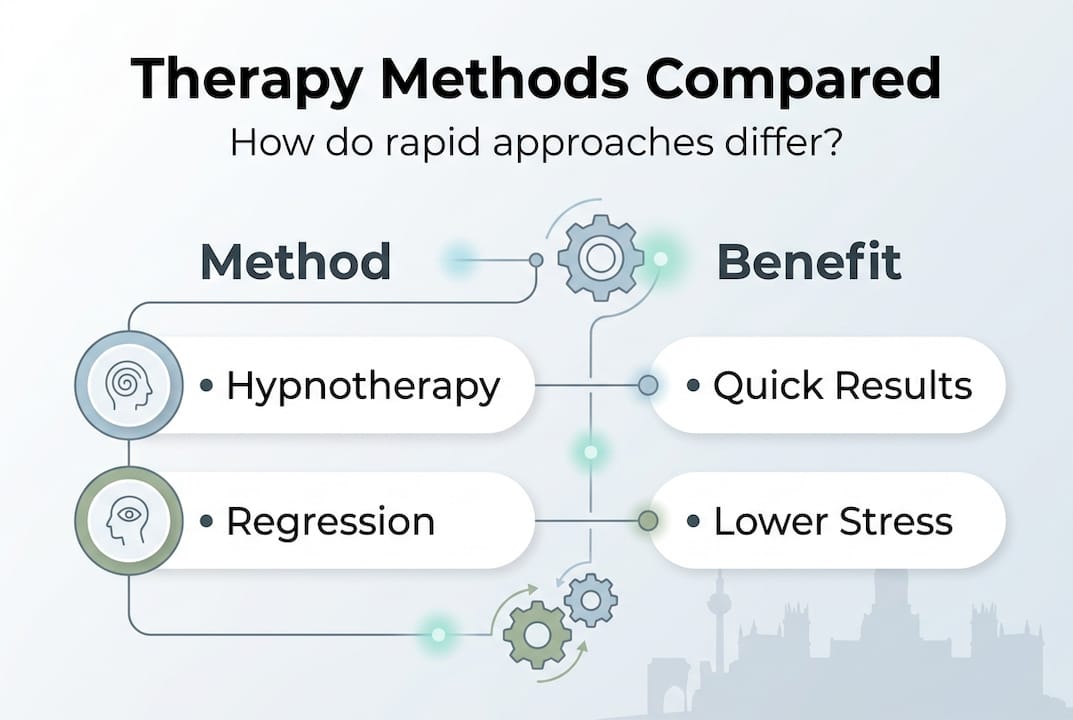
These are not small or marginal improvements. A Hedges’ g of 0.95 is considered a large effect size in psychological research. A 47% drop in psychological symptom scores over four months, often beginning with a single session, is the kind of outcome that reshapes how we should think about therapy timelines.
Here is why these methods work particularly well for expats:
They target the subconscious root causes. Many expat struggles are rooted in beliefs formed earlier in life, beliefs about belonging, worth, or safety, that get activated by the uncertainty of relocation. RTT and hypnotherapy access these roots directly rather than working around them.
They require fewer sessions. For someone managing a demanding schedule across time zones, fewer sessions with deeper impact is not a luxury. It is a practical necessity.
They reduce physical stress responses quickly. Hypnotherapy has been shown to directly reduce the sympathetic nervous system activation that drives anxiety, sleep problems, IBS, and migraines, all conditions that disproportionately affect expats under sustained pressure.
They work well for high-functioning individuals. Professionals who are functioning well externally but struggling internally often find that traditional talk therapy moves too slowly. Rapid methods match their pace.
Exploring the full range of rapid therapy methods available to you is a worthwhile starting point. Understanding types of rapid anxiety therapy helps you make an informed choice based on your specific situation rather than guessing. For those carrying the weight of past trauma that expat life has stirred up, hypnotherapy trauma relief offers an efficient and evidence-supported path to genuine relief.
Why 2026 is the right time: Reducing stigma and maximizing new opportunities
The science and logistics make therapy accessible. But why is 2026 especially pivotal for seeking help as an expat?
The short answer: the cultural moment has shifted in your favor. Therapy acceptance is rising, with 38% of Americans naming mental health as a top resolution in 2026, a figure that reflects a broader global trend. Seeking therapy is no longer something people do quietly and apologetically. It is something high-performing professionals do openly and strategically.
For expats specifically, this shift matters in a few key ways:
The stigma you may have absorbed from your home culture is losing its grip. Whether you grew up in a culture where therapy was taboo or simply never considered it necessary, the social permission to seek support is stronger now than it has ever been.
Telehealth has eliminated the geographic excuse. English-speaking therapy is now available from anywhere in Madrid, including your home, your office, or a quiet café during lunch. You do not need to commute across the city after a long workday.
Employers are increasingly supportive. Many international companies operating in Madrid now actively encourage mental health care, some covering it directly through employee assistance programs.
The window for rapid methods is wide open. Because the evidence base for RTT and hypnotherapy is still relatively new, early adopters are seeing the benefits before the methods become mainstream and harder to access quickly.
Pro Tip: If you are considering online therapy options, start with a free discovery call before committing to a full program. Most specialized expat therapists offer this, and it gives you a clear picture of fit, method, and expected timeline before any financial commitment.
One area where the timing argument is especially strong is burnout. Research on burnout solutions consistently shows that early intervention, before the full depletion phase hits, produces significantly faster and more complete recovery. Waiting until you cannot get out of bed is not strength. It is just delayed treatment with worse outcomes.
The combination of falling stigma, rising telehealth access, proven rapid methods, and a growing community of expats who are openly prioritizing their mental health makes 2026 a genuinely strong moment to start.
Why conventional therapy timelines don’t fit modern expat life
With all this in mind, it is time to challenge outdated ideas about what therapy for expats should actually look like.
The traditional therapy model, weekly sessions over months or years, was designed for a stable, settled population. It assumes you have time, a consistent local support network, and the luxury of gradual progress. Most expats in Madrid have none of those things. You are managing career demands, building a social life from scratch, navigating an unfamiliar system, and possibly managing a relationship across all of it.
The hypnotherapy research does not just show that rapid methods work. It shows they can produce autonomic nervous system shifts, the kind that underpin anxiety, sleep disruption, and burnout, within a single session. That is not a minor finding. It fundamentally changes the case for slow, open-ended therapy when faster, targeted alternatives exist.
Our perspective is that waiting for symptoms to escalate before seeking help is not resilience. It is a habit inherited from an era when therapy was misunderstood. Today’s expat, thriving abroad, is one who treats mental fitness with the same urgency as physical health. You would not ignore a muscle injury for six months and hope it resolves. The same logic applies here.
Take the next step: Effective rapid therapy for expats
If you are ready to move from insight to action, here is how to take a confident next step toward rapid relief.
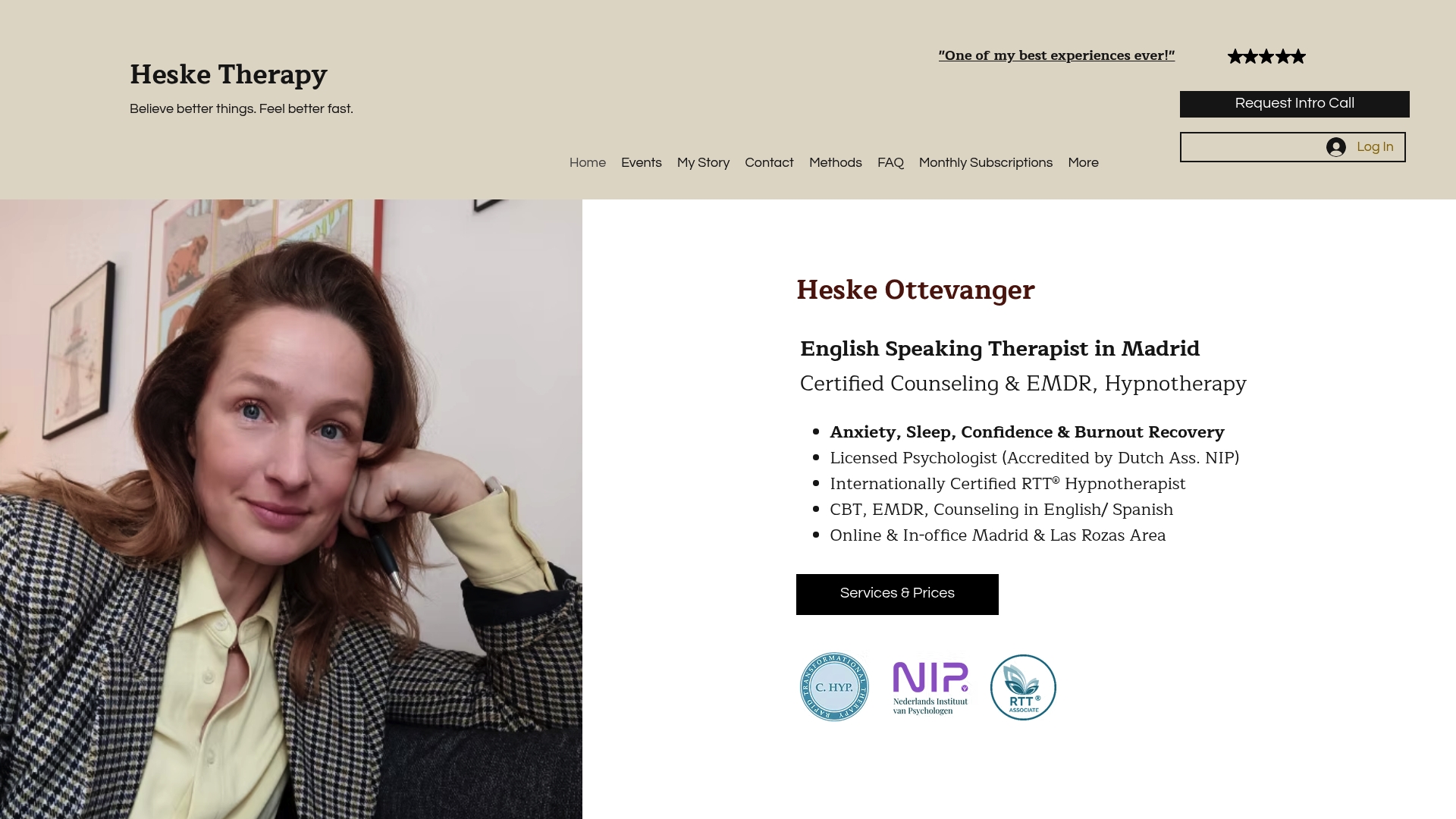
At Heske Therapy, we work specifically with English-speaking expats in Madrid who are ready to see results without spending years in weekly sessions. Our approach combines RTT, EMDR, hypnotherapy, and CBT into personalized treatment plans that move at your pace.
You can book a session online directly, with no GP referral or waiting list. If you want to understand the method first, learn about RTT therapy and how it works in practice. For those ready to commit to a structured, rapid transformation, the 21-day RTT package offers an intensive, evidence-based program designed to deliver lasting change in a fraction of the time traditional therapy requires. The first step is a free discovery call. Take it.
Frequently asked questions
What are the main therapy barriers for expats in Madrid?
Expats often face long public system waits, language challenges, and complex GP referrals, making private English-speaking therapy a far more accessible and practical option.
How fast can hypnotherapy or RTT reduce anxiety?
Research shows that a single session can measurably improve executive function and reduce the sympathetic stress response that drives anxiety, with changes often felt within days.
Are rapid therapy methods scientifically proven?
Yes. Studies show regression therapy achieves a large effect size of Hedges’ g=0.95, with psychological symptom scores dropping by 47% over four months, often beginning with a single session.
Why is 2026 a good year to start therapy?
Stigma is dropping significantly, with 38% citing mental health as a top 2026 resolution, while telehealth has made English-speaking therapy available from virtually anywhere in Madrid.
Recommended
Comments