Advantages of Online Counseling: What You Need to Know


TL;DR:
Online counseling enhances accessibility by overcoming geographic and mobility barriers, connecting clients with therapists worldwide. Clinical research demonstrates that digital therapy, especially CBT, achieves remission rates comparable to or surpassing in-person treatments for anxiety and burnout. Its privacy benefits, scheduling flexibility, and higher engagement rates make it an effective and convenient option for managing emotional challenges.
Online counseling is defined as professional psychotherapy delivered through video, phone, or messaging platforms, and its core advantages include accessibility, scheduling flexibility, clinical effectiveness, and reduced stigma. Research from 2025 and 2026 confirms that digital therapy outcomes are comparable or superior to in-person sessions for conditions like anxiety and burnout. Platforms like Talkspace and programs like DaylightRx have demonstrated that the modality is not just convenient. It is clinically potent. For English-speaking adults managing anxiety, burnout, or emotional challenges, understanding these advantages is the first step toward getting real support.
1. Broader access to mental health care

The most significant advantage of online counseling is that it removes the geographic wall between a person and a qualified therapist. Millions of adults live in what researchers call “therapy deserts,” areas where licensed mental health professionals are scarce or nonexistent. Online counseling reaches rural populations and those with mobility limitations who would otherwise go without support. This is not a minor convenience. For someone with chronic illness, a disability, or no reliable transportation, remote therapy is often the only realistic path to care.
Scheduling is the second barrier online counseling removes. Traditional therapy requires you to block out travel time, find parking, sit in a waiting room, and then travel back. Online sessions save an average of 121 minutes per appointment by eliminating all of that. That is two hours returned to your day, every single session.
Attend from your home, car, or private office without public exposure
Book evening or weekend slots that in-person clinics rarely offer
Avoid the logistical friction that causes people to cancel or delay care
Access therapists in your language and cultural background regardless of your location
Pro Tip: If you are an expat or international professional, look specifically for therapists who specialize in cross-cultural work. The combination of online access and cultural competence makes a measurable difference in how quickly you open up.
2. Clinical effectiveness for anxiety and related conditions
Online counseling is not a watered-down substitute for in-person therapy. A 2025 randomized clinical trial published in JAMA Network Open found that digital CBT produced 71.0% remission at 10 weeks compared to 34.6% for a psychoeducation control group. At 24 weeks, remission rates were 77.7% versus 52.0%. Those numbers are not marginal. They show that a well-designed digital program can outperform standard care by a wide margin.
Programs like DaylightRx achieve these results by directing clients to actively apply CBT skills in their daily lives between sessions, not just during appointments. This continuous skill-building is one reason digital CBT can outperform passive psychoeducation. The format forces engagement rather than passive listening.
Condition | Digital CBT outcome | Comparison outcome |
Generalized anxiety (10 weeks) | 71.0% remission | 34.6% remission (psychoeducation) |
Generalized anxiety (24 weeks) | 77.7% remission | 52.0% remission (psychoeducation) |
Student mental health engagement | 74% started digital program | 30% uptake for clinic referrals |
The Penn State engagement data is equally striking. A Penn State study found that 74% of students started a digital program when it was proactively assigned, compared to only 30% who followed through on a referral to a campus clinic. Access design matters as much as clinical design.
Pro Tip: When evaluating an online counseling program, ask whether the therapist or platform assigns structured exercises between sessions. Passive video calls alone produce weaker outcomes than programs that integrate daily skill practice.
3. Privacy and stigma reduction
Stigma is still one of the most powerful reasons people delay or avoid therapy entirely. Online counseling reduces that barrier by removing the most visible signals of help-seeking. There is no waiting room, no parking lot where a colleague might see your car, and no receptionist who knows your name. A 2026 survey found that 33.0% of respondents cited perceived anonymity and 34.3% cited convenience as key benefits of online therapy. Together, those two factors account for why a large share of new clients choose the format.
For clients managing anxiety specifically, the waiting room experience alone can trigger symptoms before a session even begins. Attending from a familiar, private space removes that pre-session stress entirely. Research also shows that online platforms improve comfort and self-disclosure for shy or privacy-sensitive clients, which directly supports stronger therapeutic outcomes.
No public exposure during arrival or departure from a clinic
Reduced fear of being recognized by neighbors, coworkers, or acquaintances
Greater willingness to discuss sensitive topics from a familiar environment
Lower threshold to book a first session, especially for first-time therapy clients
The practical privacy benefit depends on one condition: you need a genuinely private space. A distraction-free environment is not optional. It is the foundation that makes all other privacy advantages real.
4. Scheduling flexibility and time efficiency
Online counseling gives both clients and therapists more control over when and how sessions happen. For adults with caregiving responsibilities, irregular work schedules, or demanding travel commitments, the ability to book an evening or weekend slot without a commute is a genuine quality-of-life improvement. Traditional clinic hours rarely accommodate the realities of modern work life.
Therapists benefit too. Clinicians report reduced travel, less burnout, and better scheduling capability when working via telehealth. A therapist who is not burned out delivers better care. This is a systemic advantage that flows directly to the client, even if it is invisible to them.
Book sessions around your work schedule, not around clinic hours
Eliminate commute time and use those 121 minutes for recovery or rest
Reschedule more easily when life changes without losing your slot entirely
Access top online therapy platforms that offer same-week availability
For expats and internationally mobile professionals, time zone flexibility is an underrated advantage. Finding a therapist in your home language who can meet at 7 a.m. your time is only possible through online formats. That specificity of fit, language, culture, and timing, produces better therapeutic relationships than settling for whoever is available locally.
5. Higher engagement and follow-through rates
One of the least discussed advantages of remote therapy is that people actually show up. Engagement rates for digital mental health programs are consistently higher than for traditional clinic referrals. The Penn State research cited earlier showed a 74% start rate for proactively assigned digital programs versus 30% for clinic referrals. That gap represents real people who got help versus real people who did not.
The reason is friction. Every additional step between a person and their first session, calling a clinic, waiting for a callback, driving to an appointment, reduces the probability they complete it. Online counseling compresses that process to a few clicks. For someone managing anxiety or burnout, lower friction is not just a convenience. It is the difference between starting treatment and not starting at all.
Telehealth engagement also benefits from reminder systems, app-based check-ins, and asynchronous messaging that keep clients connected between sessions. These design elements reinforce the therapeutic relationship without requiring additional scheduled time.
6. Support for expats and internationally mobile adults
For English-speaking adults living abroad, the advantages of online counseling extend beyond convenience. Finding a therapist who speaks your language, understands your cultural context, and has experience with expat-specific challenges like relocation stress, identity disruption, and social isolation is genuinely difficult in most cities. Online access removes the geographic constraint entirely.
Hesketherapy’s work with expats in Madrid and internationally illustrates this directly. Clients who could not find a qualified English-speaking therapist locally are able to access specialized care through online sessions. The combination of language match, cultural competence, and flexible scheduling produces faster therapeutic progress than a mismatched local option.
This matters clinically. Therapeutic alliance, the quality of the relationship between client and therapist, is one of the strongest predictors of outcome. A therapist who understands your cultural frame of reference builds that alliance faster. Online access makes that match possible.
7. Challenges and trade-offs to consider
Online counseling is not without limitations, and acknowledging them honestly makes the advantages more credible. The most cited challenge is the reduction in nonverbal cues. Studies report that video sessions reduce eye contact and body language visibility, which can affect the depth of early rapport-building. This is a real trade-off, not a theoretical one.
Factor | Online counseling | In-person therapy |
Accessibility | High, no geographic limit | Limited by location and transport |
Nonverbal communication | Reduced via video | Full body language visible |
Privacy perception | High, attend from home | Lower, public clinic setting |
Scheduling flexibility | High, evenings and weekends | Limited to clinic hours |
Engagement and start rates | Higher with proactive design | Lower due to logistical friction |
Technical issues, poor internet connections, platform glitches, and audio delays, can disrupt session flow at critical moments. Telehealth success depends on both parties having reliable technology and a stable connection. For most urban and suburban clients, this is a manageable issue rather than a dealbreaker.
Clinicians increasingly recommend hybrid models, combining online and occasional in-person sessions, to capture the benefits of both formats. For clients with severe trauma or complex presentations, in-person sessions may be preferable at certain stages of treatment. The right answer depends on the individual, not on a blanket rule.
Key takeaways
Online counseling delivers measurable advantages in accessibility, clinical effectiveness, privacy, and engagement that make it a genuinely superior option for many adults managing anxiety, burnout, or emotional challenges.
Point | Details |
Clinical outcomes are strong | Digital CBT produced 71.0% remission for anxiety at 10 weeks versus 34.6% for standard psychoeducation. |
Accessibility removes real barriers | Online counseling reaches clients in therapy deserts and saves an average of 121 minutes per session. |
Privacy increases disclosure | 33.0% of users cite anonymity as a key benefit, supporting greater openness and therapeutic progress. |
Engagement rates are higher | 74% of clients start digital programs versus 30% who follow through on clinic referrals. |
Trade-offs are manageable | Reduced nonverbal cues and technical issues are real but addressable through hybrid models and good setup. |
What I have learned from working with clients online
I want to be direct about something that most articles on this topic avoid. The biggest barrier to online counseling is not technology or clinical effectiveness. It is the belief that “real” therapy only happens in a room with a couch and a box of tissues. That belief keeps people stuck.
In my experience working with English-speaking clients across time zones, the clients who engage most deeply are often the ones who would never have walked into a clinic. The privacy of their own space, their own chair, their own cup of coffee, gives them permission to say things they have been holding for years. That is not a lesser version of therapy. It is sometimes a better one.
The trade-offs are real. I notice when a client’s camera angle cuts off their hands, or when a connection drop interrupts a difficult moment. Those things matter. But they matter less than the alternative, which is no session at all. For adults managing burnout or anxiety, the most dangerous outcome is not imperfect therapy. It is no therapy.
If you are weighing whether online counseling is “good enough,” reframe the question. Ask whether the format gives you the best realistic chance of actually starting and continuing care. For most people reading this, the answer is yes.
— Heske
Start your online counseling journey with Hesketherapy
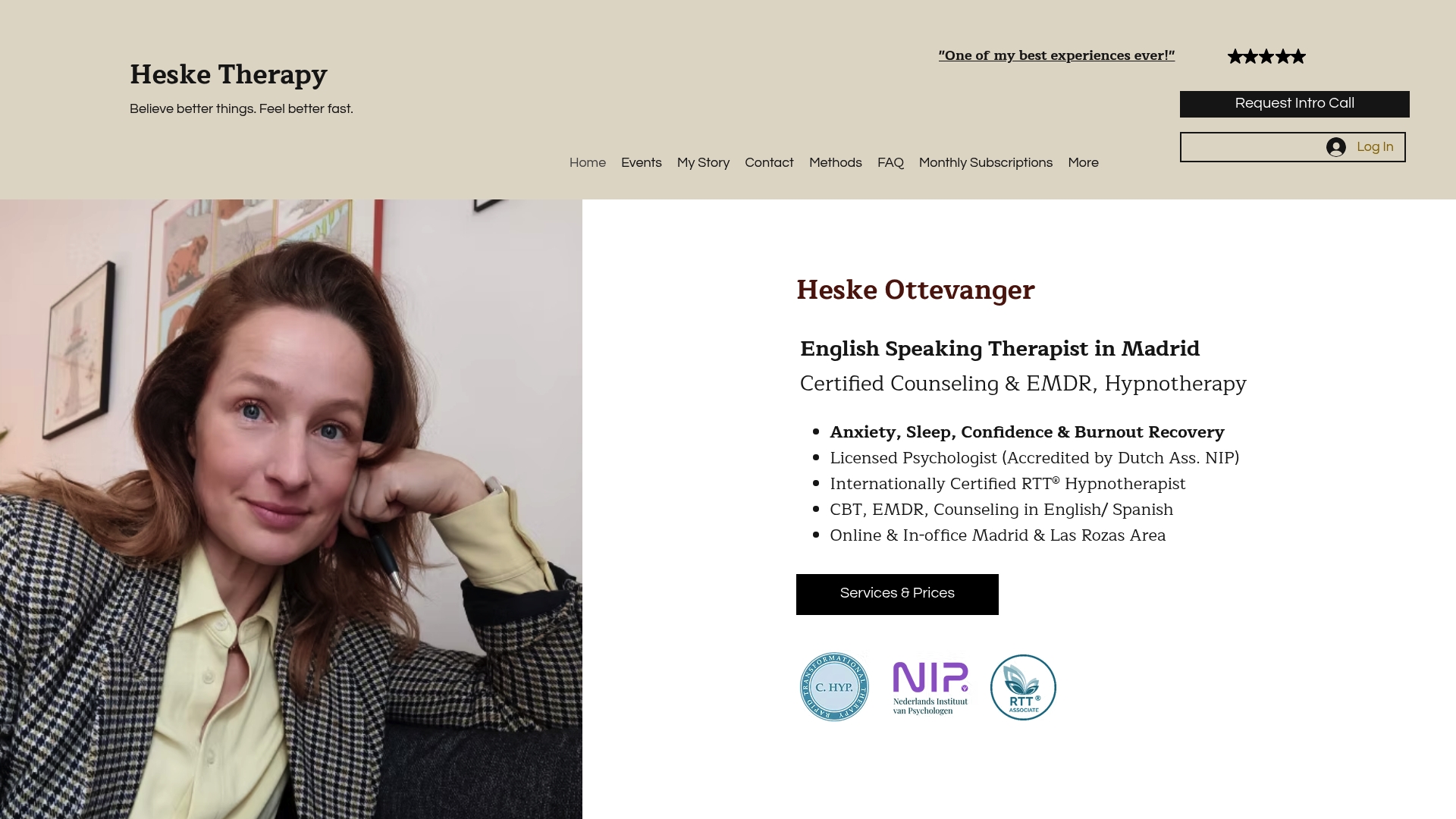
Hesketherapy offers specialized online counseling for English-speaking adults managing anxiety, burnout, trauma, and emotional challenges. Sessions are available via video from anywhere in the world, with flexible scheduling that fits around your work and life. The practice integrates CBT, EMDR, Rapid Transformational Therapy (RTT), and hypnotherapy into personalized treatment plans designed for lasting results, not just symptom management. Whether you are an expat in Madrid or living abroad, you get a therapist who speaks your language and understands your context. Book your free discovery call and find out which approach fits your situation best.
FAQ
What are the main advantages of online counseling?
Online counseling offers broader accessibility, flexible scheduling, comparable clinical outcomes to in-person therapy, and greater perceived privacy. Research shows digital CBT produces remission rates above 70% for generalized anxiety disorder.
Is online therapy as effective as in-person therapy?
Yes. A 2025 JAMA Network Open randomized clinical trial found digital CBT achieved 71.0% remission for anxiety at 10 weeks, significantly outperforming standard psychoeducation and matching or exceeding typical in-person benchmarks.
Who benefits most from online counseling?
Adults in rural or underserved areas, expats, people with mobility limitations, and those with demanding schedules benefit most. Online formats also help anxiety-prone clients who find clinic environments triggering before sessions even begin.
What are the downsides of online counseling?
The main trade-offs are reduced nonverbal communication via video and potential technical disruptions. Clinicians recommend hybrid models combining online and occasional in-person sessions for clients who need fuller relational cues at certain treatment stages.
How do I get the most out of online counseling sessions?
Create a private, distraction-free space before each session and choose a platform that assigns structured exercises between appointments. Research confirms that active skill practice between sessions, not just the video call itself, drives the strongest clinical outcomes.
Recommended
Comments