Anxiety therapy types: Evidence-based and integrative options


TL;DR:
CBT is the most researched and effective therapy for anxiety, especially for expats.
ACT offers flexibility and focuses on values and mindfulness for emotional resilience.
Rapid methods like EMDR and RTT are beneficial for trauma-related or specific phobia anxiety.
Moving to Madrid and realizing you need mental health support can feel overwhelming, especially when every online search returns a wall of unfamiliar therapy names, Spanish-language clinics, and conflicting opinions. As an expat, you face a narrower field of English-speaking practitioners, a system where clinical guidelines may differ from what you knew back home, and the added pressure of figuring it out while already stressed, burned out, or anxious. This guide breaks down the most effective therapy types for anxiety, anchored in real clinical evidence, so you can make a confident, informed choice rather than just booking whoever shows up first.
Table of Contents
Cognitive behavioral therapy (CBT): The gold standard for anxiety
Acceptance and commitment therapy (ACT): Flexibility for burnout and emotional challenges
Rapid and trauma-focused options: EMDR, relaxation, and integrative approaches
The uncomfortable truth about therapy choice for expats: What works (and what doesn’t)
Explore rapid and integrative therapy paths with Heske Therapy
Key Takeaways
Point | Details |
CBT is most effective | Cognitive behavioral therapy has the strongest evidence for anxiety relief in expats. |
ACT supports flexibility and burnout | Acceptance and commitment therapy is ideal for emotional challenges and sustained change. |
Rapid options for trauma | EMDR and some integrative methods can bring faster results for trauma-related anxiety. |
Fit and flexibility matter | Matching therapy to your needs, culture, and openness to blending approaches improves results. |
How to evaluate therapy for anxiety: Key criteria
Before picking a therapy type, it helps to know what you’re actually comparing. Not all therapies for anxiety are equal, and “popular” does not always mean “effective.” Here are the criteria that matter most, especially if you’re an English-speaking expat navigating Madrid’s mental health landscape.
Effectiveness: This is non-negotiable. CBT is strongly recommended as a first-line treatment for anxiety disorders, backed by decades of clinical trials and real-world data. When evaluating any therapy, ask what the research actually shows, not what the practitioner’s website claims.
Speed to relief: For acute burnout or panic, you may need something that moves faster than traditional weekly talk therapy. Rapid approaches like EMDR or Rapid Transformational Therapy (RTT) are designed with faster timelines in mind.
Integrative value: Some of the most persistent anxiety challenges involve emotional inflexibility, avoidance patterns, or unresolved stress from major life transitions. Approaches that integrate mindfulness, values-based work, or somatic elements can offer something purely cognitive methods miss.
Cultural and expat fit: Language access matters enormously. A therapist who is fluent in your first language, understands expat-specific stressors like identity shifts, loneliness, and professional reinvention, and offers flexible scheduling is not a luxury. It is a functional necessity.
Practicality and cost: Think about session frequency, total number of sessions, and whether your approach can flex between online and in-person. Some therapies are designed to work in 8 to 12 sessions; others are open-ended.
You can start exploring specific CBT steps and techniques to get a sense of what structured, evidence-based work actually looks like before your first appointment.
Pro Tip: Before booking, ask any therapist directly: “What outcome measures do you use?” A good practitioner will track your progress systematically, not just through your gut feeling at the end of each session.
Establishing a clear selection framework is crucial, so what are the main therapy types that meet these criteria?
Cognitive behavioral therapy (CBT): The gold standard for anxiety
CBT is the most researched and most consistently effective psychological treatment for anxiety disorders available today. It works by targeting the connection between your thoughts, emotions, and behaviors. When anxiety becomes chronic, you tend to develop habitual thinking patterns that amplify threat and shrink your sense of control. CBT helps you identify those patterns, test them against reality, and replace them with more accurate, functional ones.

For expats in Madrid, CBT is particularly practical because it is structured and goal-oriented. Sessions are not open-ended conversations. You work on specific problems, practice skills between sessions, and measure progress in real terms. This suits people who are high-functioning but struggling, which describes a large portion of the expat community dealing with performance anxiety, social anxiety, or generalized worry.
The evidence is striking. CBT shows large effect sizes of Hedges’ g = 1.09 post-treatment and 1.39 at follow-up for anxiety disorders in routine clinical care settings, meaning the gains not only hold but often improve after therapy ends. This is not lab-only data. These results come from real clinical settings with diverse clients.
Who benefits most from CBT:
Expats with generalized anxiety disorder, social anxiety, panic disorder, or specific phobias
People who want transparent, skill-based work with measurable results
Those who can commit to homework and between-session practice
Clients combining therapy with digital tools or apps for anxiety management
CBT also integrates well with other methods. A therapist trained in CBT for expats in Madrid can layer in mindfulness elements, psychoeducation about burnout, or complementary relaxation skills depending on your specific profile. If you want to start learning the techniques before your first session, reviewing CBT techniques for anxiety abroad gives you a head start.
Pro Tip: If CBT feels too rigid or intellectual, that reaction itself is useful information. Bring it up with your therapist. Many skilled practitioners blend CBT with ACT or other modalities to make it more engaging and emotionally resonant.
Acceptance and commitment therapy (ACT): Flexibility for burnout and emotional challenges
ACT is often described as a “third-wave” cognitive behavioral therapy, but calling it just a variation of CBT undersells it. Where CBT focuses on changing thought content, ACT focuses on changing your relationship with your thoughts. You stop fighting the mental noise and start asking what kind of life you actually want to build.
For expats, this distinction is especially relevant. Many people who move abroad for work or family carry invisible emotional loads: identity uncertainty, grief for left-behind relationships, constant adaptation pressure. ACT addresses the psychological inflexibility that underlies chronic stress and burnout far more directly than a purely cognitive approach.
Core ACT principles:
Acceptance: Stop treating anxiety as an enemy to defeat; instead, allow difficult feelings to exist without letting them steer your decisions
Mindfulness: Observe your inner experience without fusion or judgment
Values-based action: Identify what genuinely matters to you and commit to moving toward it, even when anxiety is present
The research confirms ACT’s effectiveness. ACT improves anxiety with a standardized mean difference of -0.43 and improves psychological flexibility with an SMD of 0.50, with effects that hold at follow-up. Notably, studies show optimal results at around 8 sessions, meaning it is not a long-haul commitment.
ACT is also culturally flexible. Its emphasis on personal values rather than symptom elimination translates well across cultural backgrounds, making it a natural fit for the expat context. You can explore how integrative ACT for expats works in practice, or see how it connects to strategies to manage burnout with ACT if exhaustion is your primary concern.
Both CBT and ACT address core anxiety processes, but some challenges, like trauma-based or phobic anxiety, may call for faster, more targeted methods.
Rapid and trauma-focused options: EMDR, relaxation, and integrative approaches
Not every anxiety presentation fits neatly into a 12-week CBT program. Sometimes the anxiety is rooted in specific traumatic memories, a phobia with a clear origin point, or a nervous system that needs direct, somatic intervention before cognitive work can even begin. This is where specialized approaches become essential.
EMDR (Eye Movement Desensitization and Reprocessing) is a structured therapy originally developed for trauma that has shown impressive results for phobia-related and trauma-linked anxiety. EMDR is recommended for specific phobias and trauma-linked anxiety, and it is often faster than traditional talk therapy for these presentations. One key caveat: it is not recommended for panic disorder without an identifiable traumatic component. You can read more about using EMDR for trauma to understand when it makes the most sense.
Clinical hypnotherapy works through the subconscious to reframe deeply ingrained patterns that maintain anxiety. When combined with evidence-based methods, it can accelerate change in ways that purely rational approaches sometimes cannot. The clinical hypnotherapy overview at Heske Therapy explains how this integrates with broader anxiety treatment.
Psychodynamic therapy and applied relaxation both appear regularly in the therapy market, but the evidence picture is genuinely unclear. Psychodynamic therapy and applied relaxation have uncertain or weak recommendations due to limited high-quality evidence for most anxiety disorders. That does not make them useless, but it does mean they should probably complement rather than replace evidence-based options. You can explore psychodynamic insights for anxiety if you’re curious about the approach.
Some clients also explore craniosacral therapy for stress as a complementary body-oriented option. The evidence base here is limited, but some people find it useful alongside their primary psychological treatment.
“The best rapid therapy is the one that matches both the anxiety type and the person. EMDR can produce results in a handful of sessions for trauma-linked phobias, while CBT is the more reliable backbone for generalized anxiety.”
Signs a rapid or integrative approach might be right for you:
Your anxiety is tied to a specific memory, event, or identifiable trigger
Traditional talk therapy has not moved the needle after several months
You have a hard deadline (e.g., returning home, a major life event) and need faster results
You prefer a more body-based or experiential approach to purely verbal work
Comparing popular anxiety therapies: Which is best for you?
Here is a direct comparison of the main options to help you match your situation to the right approach.
Therapy type | Evidence strength | Speed to results | Best for | Integrative potential |
CBT | Very strong | Moderate (8-16 sessions) | General anxiety, panic, phobias | High (mindfulness, digital tools) |
ACT | Strong | Moderate (8 sessions optimal) | Burnout, emotional inflexibility | High (values, mindfulness) |
EMDR | Strong for trauma | Fast (3-8 sessions) | Trauma-linked anxiety, phobias | Moderate |
Hypnotherapy/RTT | Emerging | Rapid (1-3 sessions) | Subconscious patterns, blocks | High |
Psychodynamic | Unclear | Slow | Insight-focused work | Moderate |
Applied relaxation | Unclear | Variable | Mild anxiety, sleep support | Low |
CBT remains gold standard with the strongest evidence base, while ACT offers a compelling integrative alternative focused on psychological flexibility. EMDR fills a critical gap for trauma-linked presentations. Hypnotherapy and RTT are worth exploring for rapid, targeted change, especially when combined with evidence-based frameworks.
Top recommendations by situation:
New to Madrid, first-time anxiety treatment: Start with CBT or ACT with an English-speaking therapist
Burnout and emotional exhaustion: ACT or integrative ACT-CBT hybrid
Trauma or specific phobia: EMDR, possibly followed by CBT consolidation
Need rapid results or prefer non-verbal methods: RTT, hypnotherapy, or EMDR
Complex, layered challenges: Integrative approach combining multiple modalities
The uncomfortable truth about therapy choice for expats: What works (and what doesn’t)
Here is something that clinical guidelines rarely say out loud: the therapy label matters less than you think, and the therapeutic relationship matters more than most people expect.
In practice, expats who make the most progress are not always the ones who chose the most evidence-backed therapy on paper. They are the ones who found a therapist they could trust, communicate openly with, and return to consistently. Language, rapport, and cultural understanding are not soft extras. They are the architecture on which all the evidence-based techniques are built.
Many expats in Madrid end up blending approaches over time, starting with CBT for the structure, moving into ACT when the emotional layers deepen, and using EMDR or RTT for specific stuck points. That is not a failure of one method. It is actually how good therapy works in real life, adapting to what you need at each stage.
The uncomfortable part is this: there is no shortcut to finding the right fit. Some people need to try two or three therapists before they find their match. Some need to pivot from CBT to a more body-based approach because their anxiety lives more in their chest than in their thoughts. Expecting instant resolution from any single therapy type will almost always lead to disappointment.
Our honest recommendation: try the evidence-based gold standard first, but stay open. Explore integrative therapies for expats and give yourself permission to combine methods. Therapy is not a one-size-fits-all prescription. For expats navigating identity, language, and life reinvention simultaneously, flexibility in treatment is often what makes the difference between stalling and genuine progress.
Explore rapid and integrative therapy paths with Heske Therapy
If you are an English-speaking expat in Madrid looking for anxiety therapy that actually fits your life, pace, and specific challenges, Heske Therapy is built precisely for that need.
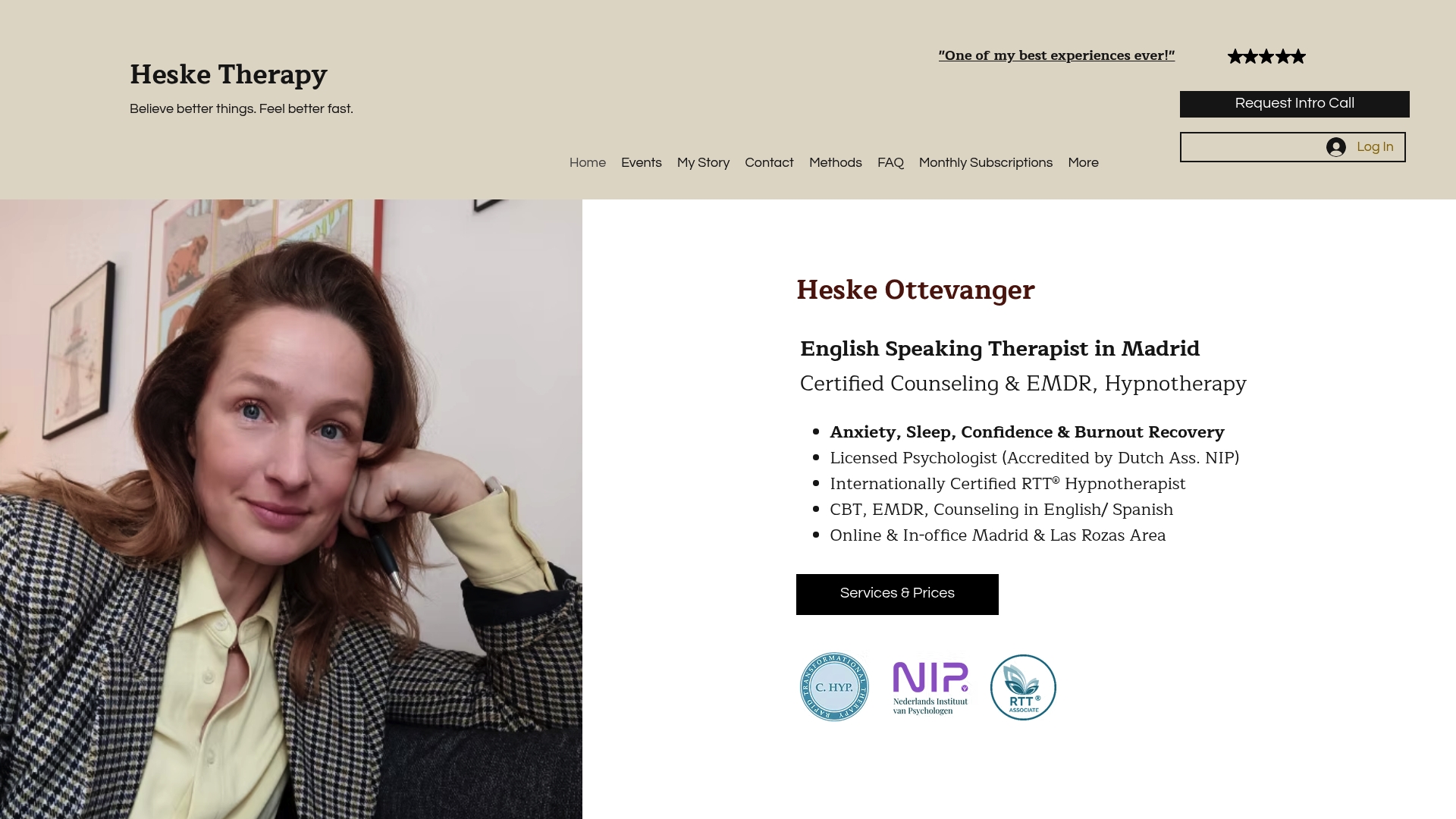
Heske Therapy specializes in rapid RTT therapy options alongside EMDR, CBT, ACT, and clinical hypnotherapy, offering personalized programs in English, Spanish, and Dutch. For clients who want structured, time-limited results, the 21-day RTT package provides an intensive, integrative route to real change. Sessions are available both in-office in Madrid and online, making access practical no matter your schedule or location. Book a free discovery call to find the right approach for your specific situation.
Frequently asked questions
Which therapy works fastest for anxiety?
EMDR is recommended for trauma-linked anxiety and specific phobias and tends to produce faster results than standard talk therapy, while CBT remains the most consistently effective option for general anxiety across all timelines.
How effective is CBT for expats with anxiety?
CBT is highly effective, with large effect sizes of Hedges’ g = 1.09 post-treatment and 1.39 at follow-up, making it the best-supported option for most expats dealing with anxiety and burnout in real clinical settings.
Are integrative or relaxation therapies effective for anxiety?
ACT improves anxiety and psychological flexibility with sustained effects at follow-up, but psychodynamic therapy and applied relaxation carry uncertain recommendations due to limited high-quality evidence for most anxiety disorders.
Can you mix therapy types for faster anxiety relief?
Combining methods is not only common but often clinically appropriate; many expats find blending CBT or ACT with EMDR or RTT addresses both the cognitive and trauma-linked dimensions of their anxiety more completely.
What if therapy hasn’t worked before?
If progress has stalled, switching to a different evidence-based method or working with a therapist who has specific expat experience often unlocks movement, particularly when integrative or rapid approaches have not yet been tried.
Recommended
Comments