Integrative psychotherapy for expats: rapid emotional healing


TL;DR:
Integrative psychotherapy combines multiple techniques tailored to expats’ unique stressors and cultural background.
It emphasizes a collaborative, adaptive approach that fosters rapid, lasting emotional healing.
Research shows strong effectiveness for trauma, anxiety, and burnout when using an integrative framework.
Many expats in Madrid carry a quiet assumption that healing from anxiety, burnout, or trauma is a long, slow process. That assumption is wrong. Integrative psychotherapy challenges that belief directly by combining the most effective therapeutic tools into one personalized approach. Rather than forcing you into a single method that may only partially fit your situation, it adapts to your specific stressors, your cultural background, and the pace your nervous system can handle. This guide breaks down what integrative psychotherapy actually is, how it works in practice, and why it is especially well-suited for expats seeking real, rapid emotional healing.
Table of Contents
Key Takeaways
Point | Details |
Flexible framework | Integrative psychotherapy uses multiple approaches to fit your unique challenges. |
Rapid emotional relief | Blending evidence-based methods accelerates healing for trauma, anxiety, and burnout. |
Therapist expertise matters | Effective integration relies on a clear framework and strong therapist-client collaboration. |
Expats need tailored support | Cultural sensitivity and language-matched therapists boost success for expatriates. |
What is integrative psychotherapy?
Integrative psychotherapy is not a single method. It is a framework that draws from multiple psychological theories and clinical practices to create a treatment plan built around you. As psychology.town explains, integrative psychotherapy combines concepts and interventions from multiple theoretical approaches rather than staying loyal to one school of thought.
Traditional therapy often works within a fixed model. A strictly cognitive behavioral therapist, for example, focuses almost entirely on thought patterns and behaviors. That can be powerful, but it may miss the body-level trauma responses, the grief of leaving a home country, or the identity confusion that many expats experience. Integrative psychotherapy fills those gaps.
The modalities most commonly woven together include:
Cognitive Behavioral Therapy (CBT): Targets unhelpful thought patterns and behaviors
Psychodynamic therapy: Explores how past experiences shape current emotional responses
Humanistic and existential approaches: Focus on meaning, identity, and personal growth
EMDR (Eye Movement Desensitization and Reprocessing): Processes traumatic memories at a neurological level
Mindfulness-based methods: Build present-moment awareness to reduce anxiety
Somatic therapy: Addresses how stress and trauma are stored in the body
Hypnotherapy and RTT: Access subconscious patterns for rapid change
For expats, this flexibility is not just convenient. It is necessary. You may be dealing with work burnout and cultural isolation and unresolved trauma all at once. A single-method therapist may address one layer while the others go untouched.
“Integrative psychotherapy holds a holistic and relational foundation at its core. The therapeutic relationship itself becomes a vehicle for healing, not just the techniques applied within it.”
This relational dimension matters enormously for expats who often feel unseen or misunderstood in a new country. When your therapist genuinely understands your cross-cultural experience and adapts their approach accordingly, the work moves faster and goes deeper.
Core methods and mechanics: How integration works
Knowing that integration blends approaches is one thing. Understanding how that blending happens is what helps you choose the right therapist and get the most from your sessions. There are four main methodologies in psychotherapy integration: common factors, technical eclecticism, theoretical integration, and assimilative integration.
Method | What it means | Best for |
Common factors | Focuses on shared elements across therapies (alliance, empathy, hope) | Building trust and motivation |
Technical eclecticism | Selects specific techniques from different models without a unifying theory | Targeting specific symptoms quickly |
Theoretical integration | Merges two or more theories into a new unified framework | Complex, overlapping issues |
Assimilative integration | Starts from one core model, then borrows from others as needed | Structured yet flexible care |
For expats, theoretical integration and assimilative integration tend to produce the most coherent results. They give your therapist a clear map while still allowing them to adapt when your needs shift.
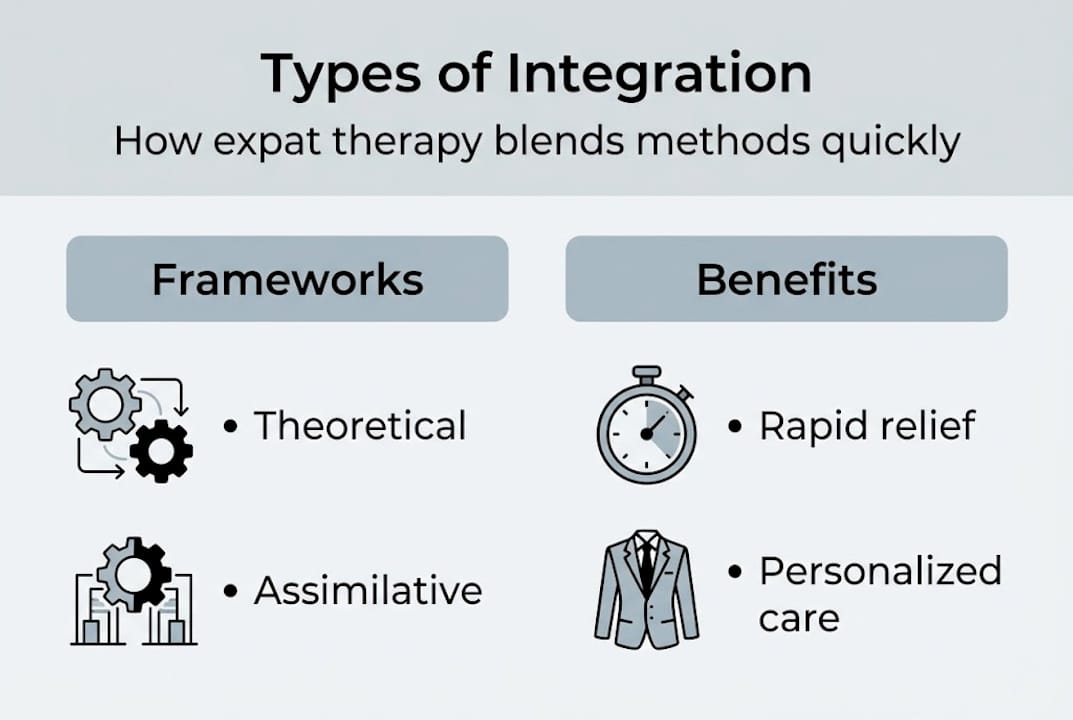
The therapist-client collaboration is not just a nice-to-have. It is the primary change mechanism. Your therapist tailors interventions based on ongoing feedback, meaning the approach evolves as you do.
Here is how a well-designed integrative process typically unfolds:
Initial assessment: Your therapist maps your stressors, history, and goals
Framework selection: They choose a primary model and identify complementary methods
Active treatment: Sessions blend techniques based on what is emerging week to week
Progress review: Regular check-ins adjust the approach if something is not working
Consolidation: Gains are reinforced and relapse prevention is built in
For expats managing personalized integrative therapy across multiple stressors, this structured flexibility is what makes rapid progress possible. And for those who cannot attend in-person sessions, online therapy solutions for expats deliver the same quality of integrative care.
Pro Tip: Before committing to a therapist, ask them directly: “What is your integrative framework?” A skilled practitioner will explain their approach clearly. Vague answers like “I use whatever works” signal a lack of theoretical grounding, which can lead to inconsistent results.
How integrative psychotherapy addresses anxiety, burnout, and trauma
Here is where the evidence gets compelling. Research consistently shows that psychotherapies with integrative elements produce strong effects for PTSD, depression, and anxiety, with trauma-focused CBT and EMDR standing out as particularly powerful tools within integrated frameworks.

Condition | Effect size (integrative approaches) | Standout methods |
PTSD / Trauma | Large (d > 1.0) | EMDR, trauma-focused CBT |
Anxiety disorders | Medium to large (d = 0.7-1.1) | CBT, mindfulness, somatic |
Burnout / Depression | Medium (d = 0.5-0.8) | Psychodynamic, humanistic, CBT |
These are not small improvements. An effect size above 0.8 is considered large in clinical research, meaning most people experience meaningful, measurable change.
For expats specifically, EMDR, somatic, and mindfulness-based methods are particularly effective for the kinds of stressors that come with international relocation and cultural adaptation. Here is why each one matters:
EMDR processes traumatic memories that may be driving anxiety without you realizing it, often producing results in fewer sessions than talk therapy alone
Somatic experiencing releases tension stored in the body, which is especially relevant when stress has become physical (think chronic headaches, IBS, or disrupted sleep)
Mindfulness-based methods build the capacity to tolerate discomfort without spiraling, a skill that is genuinely useful when navigating an unfamiliar culture
Trauma-focused CBT restructures the narratives you carry about safety, belonging, and your own capability
For expats seeking rapid mental health relief, the combination of these methods within a coherent framework is far more effective than using any one of them in isolation. And when therapy is delivered in your native language, results come even faster. Research on multilingual counseling for anxiety relief confirms that emotional processing is deeper and more accurate when conducted in the language you think and feel in.
Nuances, risks, and best practices for expats
Integrative psychotherapy is powerful, but it is not foolproof. Understanding the risks helps you make a smarter choice.
The most important distinction to grasp is the difference between integration and eclecticism. Integration means the therapist has a unified theoretical framework that guides how and why they combine methods. Eclecticism means they pick techniques based on preference or habit, without a coherent rationale. As psychology.town notes, integration differs from eclecticism in a critical way: poor blending, sometimes called syncretism, can produce incoherent treatment that confuses rather than heals.
Risks to watch for:
Lack of a clear framework: The therapist cannot explain why they are using a particular method
Technique overload: Sessions jump between too many approaches without building on each other
Cultural blindness: The therapist applies Western frameworks without accounting for your background
Language mismatch: Processing deep emotions in a second language slows progress and reduces accuracy
Best practices for expats choosing an integrative therapist:
Ask explicitly about their integration model before the first session
Prioritize therapists with experience working with multilingual therapy for expats
Look for cultural competence, not just technique variety
Read about what to expect when choosing an English-speaking therapist in Madrid
Pro Tip: The therapeutic alliance, meaning how safe and understood you feel with your therapist, predicts outcomes more reliably than any specific technique. If you do not feel genuinely heard after two or three sessions, it is reasonable to look elsewhere.
What most guides miss: Why integration is essential for expats’ rapid emotional recovery
Most articles about integrative psychotherapy spend all their time cataloging techniques. CBT here, EMDR there, mindfulness sprinkled on top. That framing misses the point entirely.
The real reason integration works so well for expats is not the technique menu. It is the responsiveness. When you move to a new country, your identity shifts. Your support systems disappear. The emotional language you grew up with does not always translate. A therapist who works with therapy for international clients understands that your anxiety is not just a cognitive distortion to be corrected. It is a rational response to genuine instability.
The fastest healing we see happens when the therapist builds a strong working alliance first, then adapts their methods to meet the client where they actually are, not where a textbook says they should be. Technique matters. But attunement matters more. Expats who find a culturally responsive, linguistically matched therapist with a coherent integrative framework do not just feel better. They change faster, more deeply, and more permanently than those who settle for whatever is most convenient.
Take the next step toward rapid emotional healing
If this article has shifted how you think about therapy, the next move is simple: find a practitioner who actually works this way.
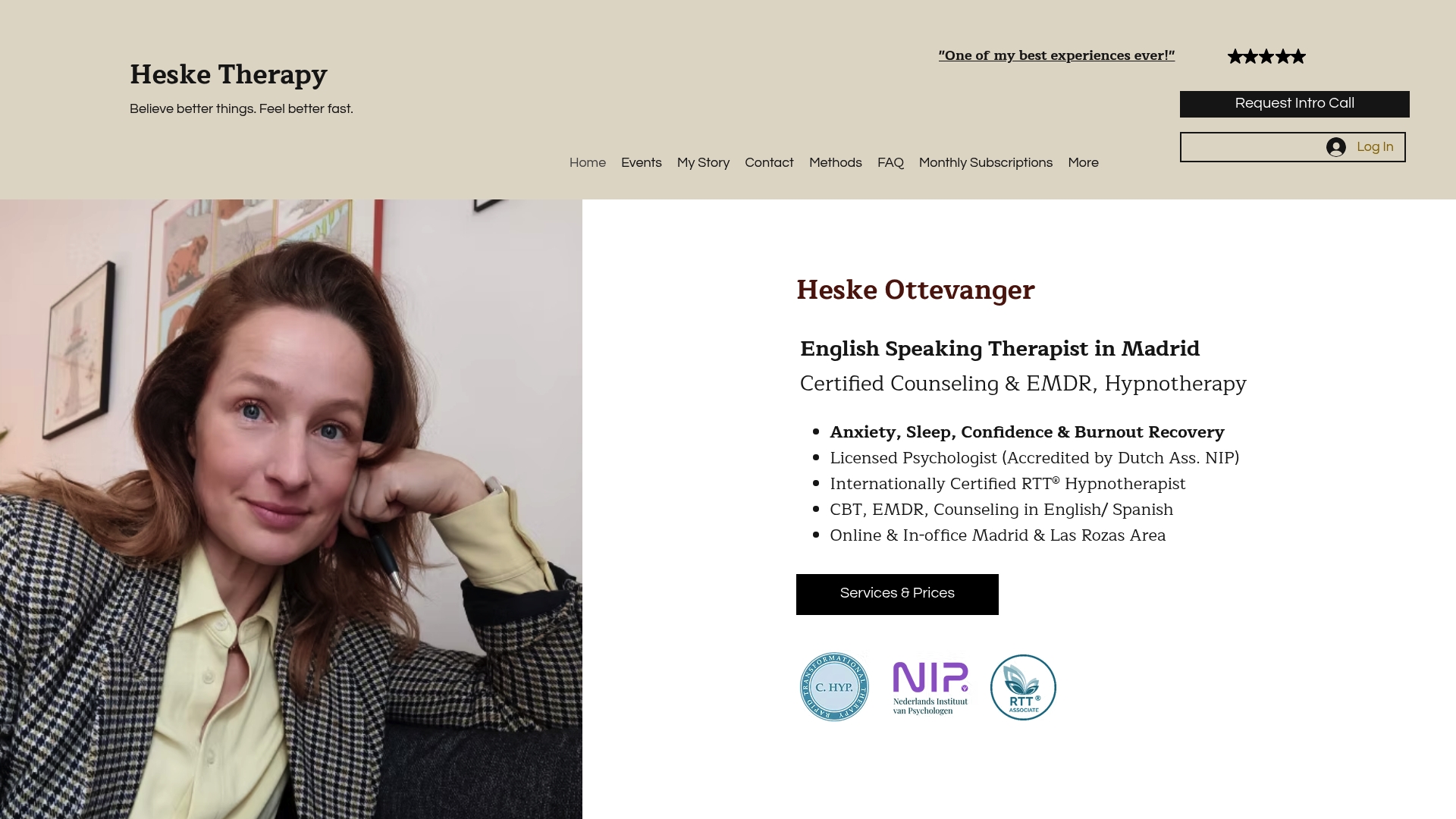
At Heske Therapy, we specialize in integrative psychotherapy for English-speaking expats in Madrid, combining EMDR, CBT, RTT, and hypnotherapy into personalized treatment plans designed for rapid, lasting results. Sessions are available in English, Spanish, and Dutch, both online and in-office. If you are not ready for a full session yet, our self-hypnosis for relaxation audio is a practical first step to calm your nervous system while you explore your options. Book a free discovery call and find out what a genuinely integrative approach can do for you.
Frequently asked questions
How does integrative psychotherapy differ from traditional therapy?
Integrative psychotherapy combines concepts from various approaches to create personalized care, while traditional therapy typically follows a single theoretical model from start to finish.
Is integrative psychotherapy effective for trauma and anxiety?
Yes. Psychotherapies with integrative elements show strong clinical outcomes for trauma, anxiety, and depression, particularly when EMDR or trauma-focused CBT is included in the framework.
What risks should expats consider when choosing integrative psychotherapy?
The main risk is choosing a therapist who mixes techniques without a coherent framework. As research on eclecticism vs. integration shows, poor blending can produce inconsistent results, so always ask about the therapist’s guiding model.
Why is therapist-client collaboration emphasized in integrative psychotherapy?
Collaboration ensures that interventions stay relevant to your evolving needs and strengthens the therapeutic alliance, which research consistently identifies as one of the strongest predictors of positive outcomes.
Can integrative psychotherapy be effective via online or multilingual therapy?
Absolutely. Integrative methods adapt well to online and multilingual formats, making them accessible and effective for expats regardless of location or preferred language.
Recommended
Why Naming Your Feelings Helps — The Caia Journal
How to process emotional trauma after infidelity – After the Affair Series
Comments