Holistic mental health: integrative solutions for expats


TL;DR:
Holistic mental health treats the whole person considering cultural, physical, and emotional factors.
Integrative therapy combines evidence-based methods with holistic tools tailored to expat needs.
Finding a culturally responsive, flexible, and personalized therapist in Madrid enhances expat well-being.
Finding an English-speaking therapist in Madrid feels like a win. But if that therapist uses a one-size-fits-all approach that ignores your cultural background, your burnout history, or the physical toll of relocation stress, you’re only getting part of the picture. Many expats discover this the hard way, cycling through sessions that feel disconnected from their real lives. Holistic mental health takes a different route. It addresses mind, body, emotions, and environment together, and when paired with integrative therapy methods, it offers something far more sustainable than symptom management alone. This article breaks down what that means for you as an English-speaking expat navigating life in Madrid.
Table of Contents
Key Takeaways
Point | Details |
Whole-person approach | Holistic mental health considers mind, body, emotions, and culture for more sustainable well-being. |
Integrative therapies work | Combining evidence-based and holistic methods like mindfulness, CBT, and yoga supports anxiety, burnout, and trauma recovery. |
Cultural fit matters | Expats in Madrid benefit from therapists who understand their language and cultural background. |
Resources exist for expats | Madrid offers specialized platforms and clinics to help English-speaking expats find holistic support. |
What is holistic mental health?
Holistic mental health is not a trend or a soft alternative to “real” therapy. It is a framework that treats you as a whole person rather than a collection of symptoms. Where traditional models often focus on diagnosing a problem and prescribing a solution, holistic care asks a broader set of questions: How is your body holding stress? What does your environment look like? Are your relationships, sleep, and daily habits working for or against you?
The contrast with conventional therapy is significant. A traditional approach might identify anxiety and apply a standard protocol. A holistic approach looks at why that anxiety exists, what feeds it, and how your unique cultural context shapes it. As holistic approaches integrate mind, body, emotions, and environment, the treatment becomes genuinely personal rather than procedural.
Traditional therapy | Holistic therapy |
Symptom-focused | Whole-person focused |
Standardized protocols | Personalized to context |
Primarily verbal/cognitive | Includes body and lifestyle |
One modality | Integrates multiple methods |
Culture often secondary | Culture and language central |
For expats, this distinction is especially important. You are not just dealing with anxiety in the abstract. You are dealing with anxiety shaped by bureaucratic hurdles, language fatigue, cultural dissonance, and the grief of leaving home. Whole-person care prioritizes cultural and linguistic fit for expats, which is why the holistic model is not just preferable but often necessary.
Common elements of holistic mental health care include:
Mindfulness and breathwork for nervous system regulation
Cognitive-behavioral therapy (CBT) adapted to your cultural frame
Yoga and somatic practices to release body-held stress
Nutritional and lifestyle guidance as part of emotional recovery
Creative therapies like art or music for non-verbal processing
Integrative therapy is the practical expression of holistic care. It is not about offering a menu of options and letting you pick. It is about a therapist who continuously assesses your needs and adapts their approach to your evolving situation. If you want to understand how this connects to counseling for expat life, the link between cultural responsiveness and lasting results becomes very clear.
Pro Tip: Do not settle for any therapist who simply speaks English. Ask specifically how they adapt their methods to your cultural background and life circumstances abroad.
Key holistic therapies and evidence for integrative care
Not all therapies are created equal, and not every method works for every challenge. Understanding the landscape helps you ask smarter questions and make better choices.
Evidence-based methods with strong research backing include CBT, dialectical behavior therapy (DBT), acceptance and commitment therapy (ACT), and eye movement desensitization and reprocessing (EMDR). On the holistic side, yoga, art therapy, music therapy, breathwork, mindfulness, and somatic therapies are increasingly used alongside these clinical tools.
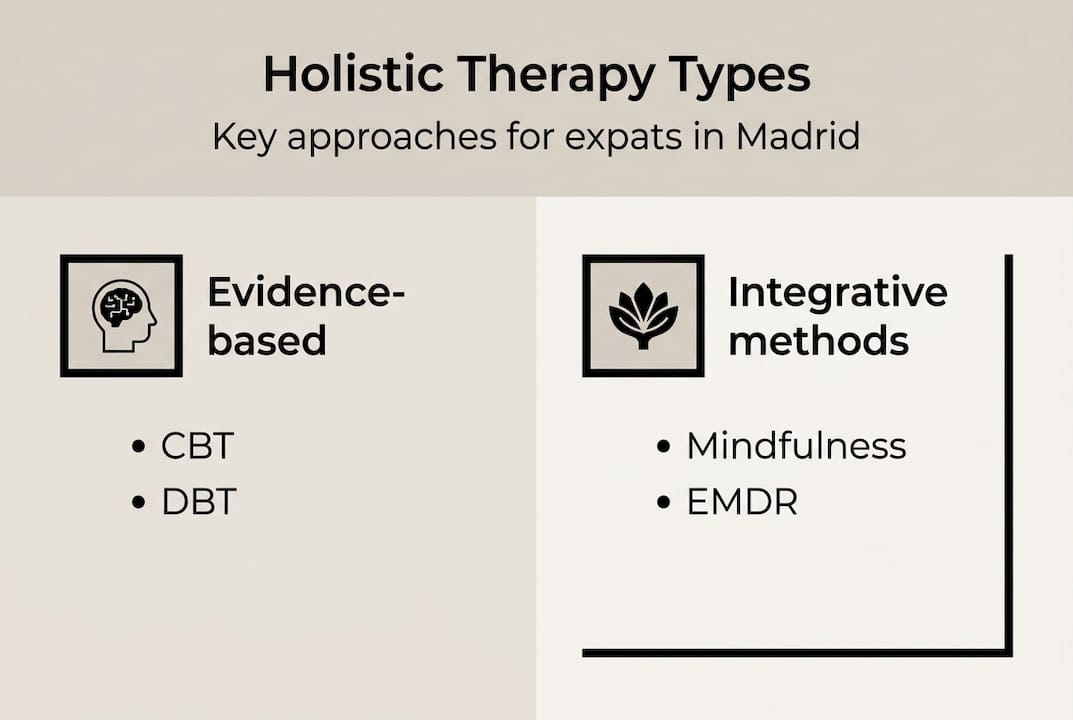
Method | Best for | Evidence level |
CBT | Anxiety, depression, burnout | High |
EMDR | Trauma, PTSD | High |
DBT | Emotional regulation, C-PTSD | High |
Mindfulness | Stress, anxiety, burnout | Moderate to high |
Yoga and breathwork | PTSD, nervous system dysregulation | Moderate |
Art and music therapy | Emotional processing, trauma | Low to moderate |
Nutritional therapy | Mood, energy, focus | Emerging |
Research confirms that mindfulness, DBT, EMDR, yoga, and breathwork are effective for PTSD, depression, and burnout. However, it is equally important to note that some methods have low certainty evidence and empirical studies are still needed for certain conditions. This does not mean they are useless. It means they work best as complements to evidence-based treatment, not replacements.
“The most effective integrative care combines the precision of evidence-based methods with the flexibility of holistic tools, always calibrated to the individual’s cultural and emotional context.”
For expats, non-verbal therapies like art or yoga can be particularly valuable when language barriers make verbal processing harder, even in your native tongue. Emotional stress does not always translate neatly into words.
Here is how to find the right integrative mix for your needs:
Identify your primary challenge: anxiety, burnout, trauma, or emotional blocks
Research which methods have the strongest evidence for that challenge
Ask potential therapists how they combine those methods with holistic tools
Evaluate whether their approach accounts for your cultural and expat context
Reassess after 4 to 6 sessions whether the combination is working
Exploring psychotherapy methods for expats and reviewing examples of therapy methods can help you go into your first session with informed expectations.
Why holistic therapy matters for English-speaking expats in Madrid
Madrid is a vibrant city, but expat life here comes with its own set of pressures. Navigating Spanish bureaucracy, managing language fatigue, building a social network from scratch, and adjusting to a completely different pace of life are all real stressors. Add professional pressure or family separation, and the emotional load becomes significant.
Holistic therapy is not just philosophically better for expats. It is practically more effective. Holistic and culturally responsive methods are especially effective for expats and refugees dealing with complex PTSD and adjustment challenges. The reason is straightforward: your stress is not generic, so your therapy should not be either.
“Prioritizing whole-person assessment and ensuring language and cultural match are not optional extras for expats. They are foundational to real progress.”
Here is what holistic expat care in Madrid can look like in practice:
Multilingual sessions in English, Spanish, or Dutch depending on your comfort
Flexible scheduling that accounts for time zone differences if you work internationally
Hybrid options combining in-person and online therapy for expats for continuity during travel
Culturally adapted CBT that does not assume a Western-only framework
Somatic and creative tools for processing emotions that resist verbal expression
Consider a common scenario: a professional expat who relocated to Madrid for work, thriving on paper but quietly burning out. Sleep is disrupted, motivation is low, and anxiety spikes before every meeting in Spanish. Standard talk therapy might address the anxiety in isolation. A holistic approach would look at sleep, physical tension, cultural identity stress, and the emotional weight of performing in a second language. The difference in outcomes is significant. Multilingual therapy and attention to culture meaningfully reduce emotional stress for expats navigating exactly these situations.

Pro Tip: When evaluating a therapist, ask them directly: “How do you adapt your approach to clients who are living abroad?” Their answer will tell you a lot about whether they truly understand expat mental health.
For more on how burnout shows up specifically for expats, counseling for burnout expats offers a detailed breakdown of what recovery can realistically look like.
How to find the right holistic support in Madrid
Knowing what you need is step one. Finding it is step two. The good news is that Madrid has a growing ecosystem of mental health resources specifically for English-speaking expats.
Expats in Madrid can access networks like Sinews Multilingual Therapy, Therapsy, Mind in Spain, and the ESHA directory. These platforms list therapists who work in English and often specialize in expat-related challenges. They are a solid starting point, but finding the right holistic fit requires a bit more digging.
Here is a step-by-step approach:
Define what you are looking for: trauma processing, burnout recovery, anxiety management, or general emotional support
Search directories filtering by language, location, and specialty
Review each therapist’s stated approach: do they mention integrative or holistic methods?
Book a discovery call and ask specific questions before committing
After your first few sessions, honestly assess whether the approach feels tailored to you
Before your first session, ask these questions:
What methods do you use, and why?
How do you adapt your approach for expat clients?
Do you offer online sessions or flexible scheduling?
What does progress look like in your practice?
How do you handle cultural differences in therapy?
Knowing when to switch therapists is equally important. If after six sessions you feel unheard, culturally misunderstood, or like you are receiving a generic protocol, trust that instinct. A second opinion is always valid. For a deeper look at what expat counseling in Spain involves, or to explore personalized expat therapy options in Madrid, those resources can help you refine your search.
Beyond labels: What holistic care really means for expats
Here is something worth saying plainly: holistic mental health has become a buzzword, and that creates a real problem. Some practitioners slap the label on their practice because they occasionally recommend meditation. That is not holistic care. That is marketing.
Genuine holistic care is an ongoing, adaptive process. It means a therapist who reassesses your needs as your life in Madrid changes, who understands that your emotional state in month three of expat life looks nothing like month eighteen, and who adjusts their methods accordingly. It is not about having a long list of tools. It is about knowing which tool fits your specific situation right now.
The most common mistake expats make is prioritizing language match over everything else. Language matters enormously, but a therapist who speaks English and applies a rigid, culturally tone-deaf protocol is not serving you holistically. The second mistake is chasing trends: signing up for every new modality without a coherent treatment plan.
What actually works is a therapist who sees you as a whole person living a specific life in a specific city, and who builds their approach around that reality. Exploring therapy for international clients shows how this kind of tailored, adaptive care differs from standard practice, and why it produces better outcomes for people navigating life across cultures.
Find your integrative expat support at Heske Therapy
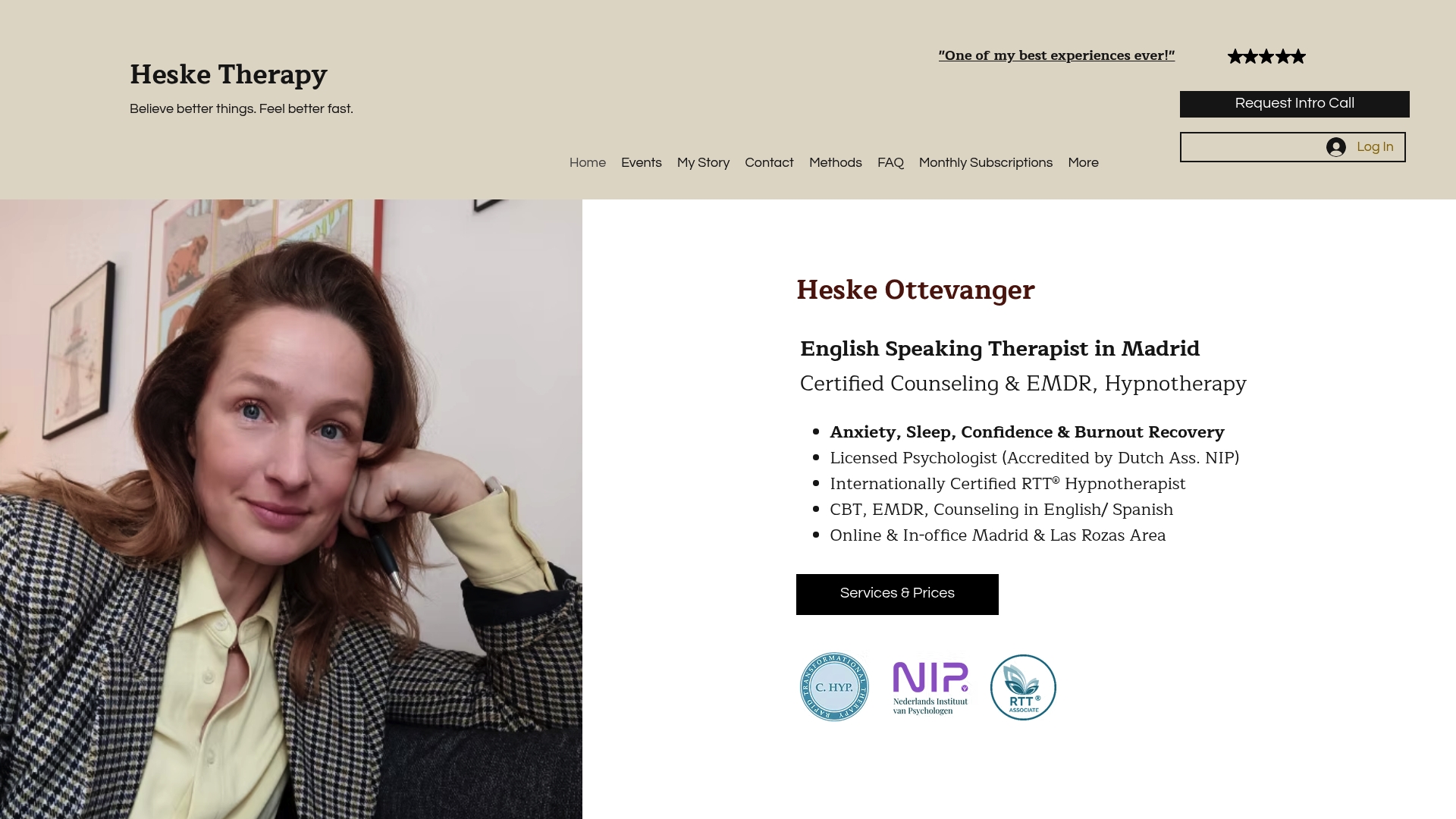
If what you have read here resonates, Heske Therapy offers exactly the kind of integrative, whole-person care described in this article. Based in Madrid and working with English-speaking expats from across the world, the practice combines RTT, EMDR, CBT, hypnotherapy, and counseling into personalized treatment plans built around your actual life circumstances.
Whether you are dealing with anxiety, burnout, trauma, or emotional blocks that have resisted standard therapy, there are accessible options designed for you. Explore RTT therapy for expats for rapid, lasting change, try the self-hypnosis for stress program for daily nervous system support, or commit to the structured 21-day RTT program for deep transformation. A free discovery call is the simplest first step.
Frequently asked questions
What makes holistic mental health different from traditional therapy?
Holistic mental health looks at the whole person, including physical, emotional, and cultural dimensions, while traditional therapy often focuses primarily on symptoms. As research confirms, holistic approaches integrate mind, body, emotions, and environment into a unified treatment approach.
Are holistic therapies evidence-based or alternative?
Many holistic therapies are integrated with evidence-based treatments like CBT and EMDR, making them clinically credible. However, some methods have low certainty evidence and work best as complements to, not replacements for, proven treatments.
How can I find holistic, English-speaking mental health support in Madrid?
Start with directories like Sinews Multilingual Therapy, Therapsy, or Mind in Spain, and always ask about language, cultural fit, and evidence-based integration. Expats in Madrid can access several dedicated networks that specialize in multilingual and culturally responsive care.
What are practical holistic strategies for managing burnout or trauma?
Mindfulness, yoga, DBT, and culturally tailored therapy are effective for both burnout and trauma, particularly when combined with structured skill training. Research shows that mindfulness, DBT, EMDR, yoga, and breathwork produce meaningful results, and holistic and culturally responsive methods are especially effective for complex PTSD in expat and refugee populations.
Recommended
Comments