How to choose the best therapy approach for faster results


TL;DR:
Clarify your specific mental health goals and needs before choosing a therapy approach.
Evidence-backed therapies like CBT, EMDR, and CPT are effective for common expat issues.
Flexibility and a strong therapist-client relationship are key to successful long-term treatment.
You’ve been managing anxiety or burnout while building a life in Madrid, and somewhere between work stress, culture shock, and the distance from your support network, things got heavier. You searched for a therapist, found dozens of options, and now you’re more confused than when you started. Choosing the right therapy approach as an expat is genuinely hard, especially when emotional exhaustion makes every decision feel bigger than it is. This guide cuts through the noise with evidence-backed, practical guidance on matching therapy methods to your actual needs, so you can take a confident first step toward real, lasting change.
Table of Contents
Key Takeaways
Point | Details |
Match needs to method | Assess your symptoms and therapy goals before picking an approach for best results. |
Rapid options work | Methods like CBT and EMDR can bring real relief within a few weeks for many expats. |
Integrative therapy excels | Blending approaches often helps with complex emotional struggles and cultural adaptation. |
Trial and adapt | Test a therapy for several sessions, then adjust based on your comfort and results. |
Results take time | Change can be quick, but lasting improvement comes from consistency and a good therapist fit. |
Clarify your goals and personal needs
Before you compare therapy methods or scroll through therapist profiles, the most important step is getting clear on what you actually need. This sounds obvious, but most people skip it. They know they feel bad, but they haven’t named the specific problem driving that feeling.
Are you dealing with persistent anxiety that disrupts sleep and concentration? Emotional exhaustion from overwork that looks like burnout signs and solutions? A past trauma that keeps surfacing in unexpected ways? Each of these calls for a different approach, and treating them the same way wastes time and money.
Here are the key factors to clarify before choosing:
Your primary concern: Anxiety, burnout, trauma, grief, low self-esteem, or relationship stress
Your timeline: Do you need relief in weeks, or are you open to longer-term work?
Your style preference: Do you prefer structured exercises and homework (CBT), or open exploration of patterns and feelings (integrative or psychodynamic)?
Language and cultural comfort: English-language therapy with a culturally aware therapist matters more than most people admit
Format: In-person in Madrid, online, or a mix of both
Research consistently shows that therapy outcomes depend on the presenting issue, client preferences for structured versus exploratory work, the therapist alliance, and evidence fit, with a trial of 4 to 6 sessions recommended before drawing conclusions. The therapist relationship is not a soft factor. It is one of the strongest predictors of whether therapy works.
Expats face a specific layer of complexity here. Language barriers, isolation, identity shifts, and cultural adjustment all shape what kind of support feels safe and effective. Integrative therapy examples show how blending methods can address these layered challenges more effectively than a single-method approach.

Pro Tip: Start with one clear, specific goal, like sleeping through the night, reducing panic attacks, or processing a past event. One concrete goal gives your therapist a clear starting point and gives you a way to measure progress.
Compare the leading therapy approaches for expats
With your needs in mind, let’s look at how the top therapy approaches actually compare, especially for the issues most common among expats in Madrid.
Cognitive Behavioral Therapy (CBT) is the most researched approach in the world. It targets the thought patterns and behaviors that maintain anxiety, depression, and burnout. CBT shows large effect sizes of g=0.84 to 0.87 across hundreds of meta-analyzed trials for anxiety and burnout, making it one of the most reliable options for structured, goal-focused change.
EMDR (Eye Movement Desensitization and Reprocessing) and trauma-focused CBT approaches like CPT (Cognitive Processing Therapy) are the gold standard for trauma. EMDR and CPT produce very large effect sizes above g=1.0 for PTSD, and EMDR typically works within 6 to 12 sessions for single-incident trauma.
Integrative therapy blends methods based on your individual profile. It is especially useful for complex cases involving multiple issues, cultural adaptation challenges, or clients who have tried one approach and plateaued.
Approach | Best for | Typical sessions | Evidence strength |
CBT | Anxiety, burnout, depression | 12 to 20 | Very strong (g=0.84 to 0.87) |
EMDR | Trauma, PTSD | 6 to 12 | Very strong (g>1.0) |
CPT | Trauma, PTSD | 12 | Strong |
Integrative | Complex, multicultural cases | Varies | Strong for complex profiles |
SFBT | Solution-focused, short-term goals | 3 to 8 | Moderate to strong |
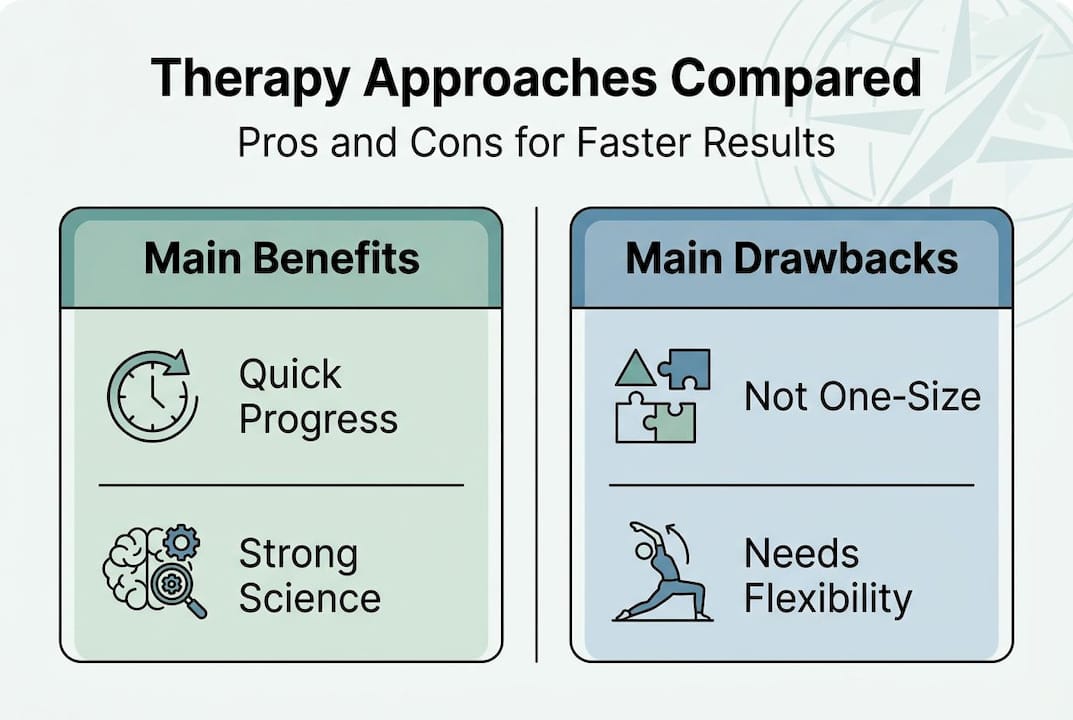
A few important limits worth knowing: CBT and EMDR are highly effective for PTSD symptoms, but they are less powerful for what researchers call DSO (disturbances in self-organization), which includes chronic emotion dysregulation and identity disruption. For those presentations, a rapid therapy guide combining stabilization with trauma processing tends to produce better overall outcomes. See also this CBT vs RTT comparison for a closer look at how newer rapid methods stack up.
Decide: step-by-step process for choosing your therapy path
Understanding which method may suit you is one thing. Actually making the choice and booking that first session is another. Here is a practical framework to move from confusion to action.
Write down your top three symptoms or struggles. Be specific. “I feel anxious” is less useful than “I wake up at 3am with racing thoughts about work.”
Decide on your format. Online therapy is flexible and equally effective. In-person in Madrid works well if you value face-to-face connection. Both are valid.
Match your main issue to the evidence. Use the table above as a starting reference.
Check for language and cultural fit. Working with an English-speaking therapist who understands expat life removes a significant barrier.
Book a trial period of 4 to 6 sessions. Research on choosing therapy modalities recommends this window to assess fit, progress, and comfort before committing long-term.
Goal | Recommended approach | Format options |
Reduce anxiety fast | CBT, RTT | Online or in-person |
Process trauma | EMDR, CPT | In-person preferred |
Recover from burnout | CBT, integrative | Online or in-person |
Build emotional resilience | Integrative, counseling | Either |
Explore rapid therapy types if you need results quickly, or look into trauma-focused therapy for expats if past experiences are driving your current struggles.
Pro Tip: Combine research with your gut instinct. Your first sessions are a test drive, not a lifetime commitment. If something feels off after three or four sessions, say so or try something different.
What to expect and how to evaluate results
Once you’ve started, knowing what realistic progress looks like keeps you from quitting too early or staying too long in something that isn’t working.
EMDR typically produces significant trauma relief within 6 to 12 sessions. Solution-focused approaches like SFBT can create meaningful shifts in as few as 3 to 8 sessions. CBT for anxiety usually shows measurable improvement within 8 to 12 weeks. These are not guarantees, but they give you a realistic benchmark.
Here is how to actively track your progress:
Weekly symptom check-ins: Rate your anxiety, sleep quality, or emotional stability on a simple 1 to 10 scale
Journaling: Note what triggered difficult feelings and how you responded, compared to how you would have responded before therapy
Therapist feedback loops: Ask your therapist directly, every few sessions, whether the approach is still the right fit
Behavioral markers: Are you avoiding fewer situations? Sleeping better? Reacting less intensely to stress?
Some approaches are rapid, but always ensure stabilization if severe trauma symptoms exist. Jumping into trauma processing without a solid foundation can temporarily intensify symptoms.
Common expat obstacles include difficulty trusting a new therapist in an unfamiliar city, uncertainty about whether sessions are “working” because progress feels subtle, and language fatigue when processing deep emotions in a second language. These are real and worth naming with your therapist.
Standard CBT and EMDR are strong for core PTSD symptoms but show weaker results for affect regulation and self-organization difficulties. If you find that your emotional responses feel chaotic even after several sessions, an integrative or phase-based approach may serve you better. Read more about RTT healing for expats and expat rapid therapy outcomes to understand what faster results can realistically look like. You can also take a trauma self-test to better understand your starting point.
Why one-size rarely fits all: The real secret to effective therapy as an expat
Here is something most therapy guides won’t tell you directly: the “best” approach on paper is not always the best approach for you. Research gives us probabilities, not certainties. And expat life adds layers that most clinical trials never account for, including identity disruption, grief for the life you left behind, and the exhausting work of belonging somewhere new.
Rapid therapy methods like RTT and EMDR are genuinely powerful. But deep, sustained change often requires blending approaches as your needs evolve. What helps you stabilize in month one may not be what helps you grow in month six. Flexibility is not a sign that therapy is failing. It is a sign that it is working.
The best trauma therapy methods are ultimately the ones your therapist can adapt to your cultural background, your language comfort, and where you are emotionally right now. The therapist-client relationship remains the single most consistent predictor of good outcomes across all modalities. If that connection is strong, even an imperfect method produces results. If it is weak, even the most evidence-based approach struggles.
Don’t get discouraged if your first choice isn’t perfect. Real progress is iterative. Self-compassion is not just a therapeutic concept here. It is a practical strategy.
Next steps: Discover a therapy approach that fits you
Ready to act? Here’s how you can find a flexible, effective starting point.
At Heske Therapy, we specialize in helping English-speaking expats in Madrid find the right approach quickly, without years of trial and error. Whether you’re drawn to RTT rapid therapy for fast, root-cause change, prefer flexible online counseling from wherever you are, or want to start with a self-hypnosis relaxation tool to calm your nervous system right now, there is an entry point that fits your life.
We offer a free discovery call so you can ask questions, describe what you’re dealing with, and get an honest recommendation before committing to anything. That is the lowest-risk first step you can take today.
Frequently asked questions
How do I know which therapy approach is best for trauma?
EMDR and CPT are first-line options for trauma and PTSD, with very large effect sizes above g=1.0, making them the most evidence-backed starting points for trauma recovery.
Can therapy really help with anxiety or burnout quickly?
Yes. CBT produces large effect sizes of g=0.84 to 0.87 for anxiety and burnout, with measurable improvement typically visible within 8 to 12 weeks of consistent sessions.
What if the first therapy I try doesn’t work?
Switching approaches or therapists is completely normal. A trial of 4 to 6 sessions is the recommended window to assess fit before deciding whether to continue or pivot.
Is online therapy effective for expats in Madrid?
Yes, online therapy offers flexible access and is equally effective for most presentations, particularly when working with an English-speaking therapist who understands expat-specific challenges.
Are integrative or blended approaches better for complex emotional struggles?
Integrative approaches outperform single-method therapy for complex cases by adapting methods to your unique needs, cultural background, and trauma history.
Recommended
Comments