Burnout syndrome: key signs, causes, and proven solutions
- Heske Ottevanger
- May 1
- 10 min read


TL;DR:
Burnout is a recognized occupational phenomenon characterized by emotional exhaustion, cynicism, and reduced efficacy.
Expatriates in Madrid face unique challenges like cultural isolation, language barriers, and support system gaps increasing burnout risk.
Early, personalized intervention using therapy, community support, and boundary setting can effectively reverse burnout.
Living and working abroad sounds exciting on paper, but for many English-speaking expats in Madrid, the reality includes double the workplace pressure, the exhaustion of navigating a new culture, and the creeping feeling that something has gone deeply wrong. Burnout syndrome is defined by the WHO as an occupational phenomenon resulting from chronic workplace stress that has not been successfully managed, making it far more serious than ordinary tiredness. This guide walks you through exactly what burnout is, how it differs from stress and depression, who carries the highest risk, and which evidence-based strategies actually work, including the innovative options increasingly available to expats in Madrid.
Table of Contents
Key Takeaways
Point | Details |
Burnout defined clearly | Burnout syndrome is a workplace-specific condition with unique symptoms, not just general stress. |
Know the difference | Burnout, stress, and depression overlap but are distinct—knowing which one you face is essential for recovery. |
Expat risks are higher | English-speaking expats in Madrid are especially vulnerable due to added stresses of relocation and isolation. |
Effective recovery is possible | Both traditional and innovative therapies, including online CBT, help reverse burnout when started early. |
Tailored support matters | Recovery is most successful when therapy is adapted to your cultural and situational realities. |
What is burnout syndrome? Definition and dimensions
Now that you understand burnout is more than just feeling tired, let’s look at what truly sets it apart and how professionals define and measure it.
Burnout is not a character flaw, a bad week, or the price you pay for ambition. It is a recognized clinical phenomenon with specific dimensions that researchers and therapists can identify and measure. The distinction matters because knowing exactly what you are dealing with is the first step toward actually getting better.
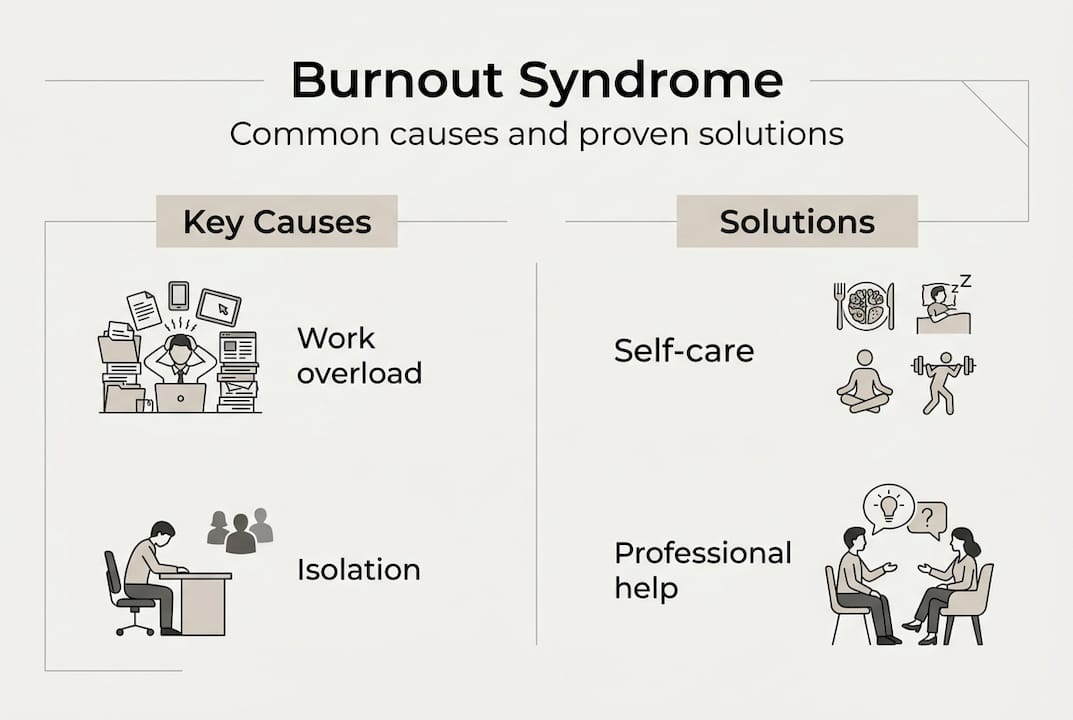
The World Health Organization classifies burnout in its ICD-11, the international diagnostic reference, as an occupational phenomenon with three main dimensions. It is described specifically as a result of chronic workplace stress and is categorized separately from diseases, meaning it is a condition that develops within a professional context rather than arising from biological causes alone.
The most widely used measurement tool in clinical practice and research is the Maslach Burnout Inventory, which captures burnout through three core components:
Emotional exhaustion: Feeling completely drained, with nothing left to give at work or at home
Cynicism or depersonalization: Becoming emotionally detached, even callous, toward your work or the people you work with
Reduced personal efficacy: Doubting your ability to achieve results and feeling like your professional contributions no longer matter
“Burnout is not simply about working too hard. It is about the sustained erosion of your identity as a capable, motivated professional.”
For expats, these three dimensions often show up in amplified form. When you are already spending enormous energy adapting to a new language, building a social network from scratch, and managing the practical logistics of living abroad, there is less reserve available to buffer workplace stress. Learning more about burnout recovery in daily life can be the practical starting point that changes your trajectory.
Burnout dimension | What it feels like | Common workplace sign |
Emotional exhaustion | Dreading Monday before Sunday ends | Calling in sick frequently |
Cynicism | Not caring if the project succeeds | Sarcasm, disengagement in meetings |
Reduced efficacy | Feeling like a fraud | Procrastination, missed deadlines |
Physically, burnout can trigger headaches, digestive issues, disrupted sleep, and even immune suppression. For expats who already lack their usual support systems, these physical symptoms can feel isolating and hard to explain to a local doctor in a second language.

Burnout vs. stress and depression: Key differences
Understanding the definitional differences sets up the next challenge: distinguishing burnout from other common expat mental health concerns.
Burnout shares symptoms with both chronic stress and depression, which is one reason it often goes unrecognized for months. People chalk it up to a heavy workload, assume they will feel better after a vacation, and then return to work only to crash harder than before.
Research on the Maslach framework and burnout makes a clear distinction: stress involves over-engagement, where everything feels urgent and overwhelming, while burnout involves disengagement, where nothing feels worth engaging with at all. Depression, by contrast, has a broader impact that extends well beyond work, touching every area of life including relationships, hobbies, and basic daily functioning.
Feature | Burnout | Chronic stress | Depression |
Primary emotion | Emptiness, detachment | Anxiety, urgency | Sadness, hopelessness |
Scope | Mostly work-related | Often work-related | Pervasive, all areas of life |
Energy | Total depletion | Overextension | Low, but varies |
Mood about future | Indifference | Worry | Despair |
Physical symptoms | Fatigue, headaches | Muscle tension, insomnia | Appetite changes, persistent low mood |
The steps for identifying your situation more clearly:
Ask yourself whether the emptiness and exhaustion are tied primarily to work or whether they follow you into every part of your life
Notice whether you feel too much (overwhelmed, racing thoughts) or too little (numb, indifferent)
Consider when symptoms started and whether they correlate with specific workplace events or patterns
Reflect on whether rest actually helps, because in burnout a two-week vacation rarely solves the problem
Consult with a professional who can distinguish burnout from co-occurring anxiety or depression
Pro Tip: Many expats experience all three conditions simultaneously. Burnout can open the door to depression, and existing anxiety can accelerate burnout. Getting an accurate picture from a therapist familiar with expat contexts is far more effective than self-diagnosing from a checklist. Techniques like CBT for burnout and anxiety are particularly useful when the conditions overlap.
Feeling misunderstood is a hallmark expat experience. When your colleagues have entirely different cultural norms around work, when your family back home does not quite grasp what your daily life looks like, and when you are navigating medical systems in a foreign language, identifying and naming burnout can feel like a relief in itself.
Who is at risk? Burnout prevalence and vulnerable groups
Now, let’s explore who faces the greatest risk and why certain groups struggle more than others.
Burnout is far more common than most people realize, and the numbers vary significantly depending on your profession and geography. Burnout rates range from 67% among US physicians to around 11% globally among nurses, with other professions falling at various points across that spectrum. These numbers reflect that burnout is not an individual weakness but a systemic problem driven by workplace culture, workload, and support systems.
For expatriates in Madrid specifically, several overlapping risk factors stack on top of the standard professional stressors:
Cultural isolation: Even in a vibrant city like Madrid, forming deep social connections takes years, and shallow social contact does not buffer stress the same way
Language demands: Operating in your second or third language all day is cognitively exhausting in ways that are hard to explain to native speakers
Administrative burden: Dealing with visa paperwork, tax systems, and bureaucratic processes that feel opaque adds invisible mental load
Distance from support networks: Being far from family, longtime friends, and familiar professional communities removes natural safety valves
Identity uncertainty: Expats often experience what psychologists call “cultural limbo,” not fully belonging anywhere, which chips away at the sense of identity that sustains resilience
Pro Tip: Prolonged stress combined with perfectionism and cultural isolation creates a particularly risky combination. If you are the type of person who holds yourself to high standards and you are also navigating the complexity of expat life, you are carrying a heavier load than your workload alone reflects.
The groups facing the highest burnout risk include:
Expatriates: Especially those in senior roles with international responsibilities
Perfectionists and high achievers: Who set demanding internal standards and struggle to accept “good enough”
Caregivers: Both professional and personal caregivers who deplete themselves attending to others’ needs
Neurodivergent individuals: Who often expend additional energy masking or adapting to neurotypical environments
Healthcare and education professionals: Who carry both the work demands and the emotional weight of their roles
Understanding that you belong to a high-risk group is not a reason to panic. It is a reason to take your mental health as seriously as you take your professional performance. Resources specifically designed for burnout recovery for expats account for these layered challenges in ways that generic advice simply does not.
Proven recovery strategies: Standard and innovative therapies
Ready to tackle burnout? Here are actionable steps, both classic and innovative, that have proven effective, especially for expats.
The encouraging truth is that burnout is reversible with early intervention. The longer it goes unaddressed, the longer recovery takes, but recovery is genuinely possible. What does not work is pushing through and hoping it resolves on its own.
Building your recovery plan step by step:
Set firm boundaries at work. Define specific times when you stop responding to emails and communicating about projects. This is not laziness; it is a clinical strategy.
Practice mindfulness or relaxation techniques. Even ten minutes of daily breathwork or body scanning reduces the chronic activation of your stress response system.
Reconnect with your body. Regular movement, whether walking along the Retiro, swimming, or a yoga class, resets the nervous system in ways that mental strategies alone cannot.
Audit your environment. Identify the specific workplace stressors driving your burnout. Addressing root causes matters more than symptom management.
Invest in professional support. Therapy is not a last resort; it is the most direct route to lasting change.
Build community deliberately. Seek out English-speaking groups in Madrid, join professional networks, and schedule social connection as intentionally as you schedule meetings.
On the innovative side, digital CBT interventions show significant reductions in burnout and associated symptoms within months of consistent use. This is particularly relevant for expats who may struggle to find English-speaking therapists locally or whose schedules make in-office appointments difficult.
Effective approaches now available include:
Cognitive-behavioral therapy (CBT): Both in-office and online formats, focusing on changing thought patterns that drive overwork and self-criticism
EMDR: Especially useful when burnout is linked to past trauma or accumulated adverse experiences
Rapid Transformational Therapy (RTT): A results-focused method that works at the subconscious level to break the deep-seated patterns behind chronic burnout
Hypnotherapy: Helps access and reprogram automatic responses to workplace stress
Mindfulness-based stress reduction: Structured programs that build sustainable stress tolerance
Pro Tip: Using self-care strategies alongside professional therapy produces faster and more durable results than either approach alone. Think of therapy as addressing the roots and self-care as tending the daily soil.
The step-by-step burnout recovery process works best when it is personalized. What helps a 35-year-old marketing director in Madrid recover will look different from what helps a freelance consultant or a teacher navigating Spanish bureaucracy. Exploring options for overcoming burnout naturally can supplement professional care, and understanding therapy’s role in recovery gives you a clearer picture of what professional support can realistically achieve. Many expats are also surprised by the specific therapy benefits for burnout that go beyond symptom relief into deeper identity restoration.
Why burnout solutions must adapt to expat realities
Here is something most burnout articles will not say directly: the advice written for people with stable community roots, fluent access to local healthcare, and a lifetime of social infrastructure does not fully translate to expat life. And pretending it does is part of why so many expats keep trying conventional recommendations and feeling like they are failing, when in reality the map does not match their territory.
In Madrid, finding an English-speaking therapist who genuinely understands what it feels like to rebuild your entire life in a foreign country is not a luxury. It is a clinical necessity. Therapy works through the relationship. If you spend half your session explaining what an expat work contract looks like or why you feel guilty for struggling when you “chose” this life, you are losing precious therapeutic ground.
The expat burnout experience carries specific layers that culturally attuned care must address: the grief of missing home without wanting to go back, the hypervigilance of always performing competence in a second language, and the exhausting performance of seeming fine because vulnerability feels riskier when your professional reputation is all you have built so far.
Digital therapy formats have genuinely changed the landscape. Accessing support for expats in Madrid online means you can work with specialists who understand your context without being limited to who happens to practice within your neighborhood. This is not a compromise. For many expats, it is the superior option because the therapeutic fit matters more than the physical proximity.
Community is the piece that no amount of individual therapy fully replaces. Burnout thrives in isolation. When you find a group of people who understand your specific version of the expat experience, whether that is through a professional network, a therapy group, or even an online forum, something fundamental shifts. You stop explaining yourself and start actually being known. That experience of being understood is, in itself, healing.
Find accessible burnout recovery tailored for expats in Madrid
If any part of this article described your experience, that recognition is worth acting on.
At Heske Therapy, we work specifically with English-speaking expats in Madrid who are navigating burnout, anxiety, and the layered pressures of international life. Our approach combines innovative therapy options including RTT, EMDR, CBT, and hypnotherapy, both online and in-office, tailored to your situation rather than a generic protocol. For those ready to move quickly, the 21-day rapid recovery program offers an intensive, structured path to relief. Recovery does not have to take years. Start with a free discovery call and take the first real step toward feeling like yourself again.
Frequently asked questions
How long does it take to recover from burnout syndrome?
Burnout is reversible with early intervention, and many people notice meaningful improvements within a few months of consistent support, though recovery timelines vary based on severity and individual circumstances.
Can digital therapy really help with burnout?
Yes. Digital CBT interventions show significant reductions in burnout and stress in clinical studies, making online therapy a practical and evidence-backed option for expats who need flexible, accessible support.
Is burnout syndrome recognized as a medical condition?
Burnout is classified in ICD-11 by the WHO as an occupational phenomenon rather than a disease, but it has real, measurable effects on both mental and physical health that warrant professional attention.
Who is most at risk for burnout syndrome?
Individuals in high-pressure professions, perfectionists, caregivers, and expatriates facing cultural isolation carry the highest risk, particularly when multiple stress factors stack together over a sustained period.
How can I tell if I have burnout or just stress?
Burnout involves disengagement and helplessness tied specifically to work, while stress feels like overwhelming engagement with too many demands, and depression has a broader impact that extends well beyond the professional sphere.
Recommended
Comments