CBT for Anxiety: Why It Works for Expats

Long workdays, unfamiliar routines, and the constant challenge of adapting to life in Madrid can leave English-speaking expats feeling anxious and exhausted. When the pressure peaks, finding relief quickly becomes your top priority. For many, cognitive-behavioral therapy (CBT) stands out as an effective, structured, and evidence-based approach that helps you break free from the cycle of negative thoughts and unhelpful habits, offering practical tools to manage anxiety and reconnect with your daily life in Spain.
Table of Contents
Key Takeaways
Point | Details |
CBT Overview | Cognitive-behavioral therapy (CBT) is a structured, short-term approach that focuses on changing negative thought patterns and behaviors to alleviate anxiety. |
Techniques for Success | Key techniques include cognitive restructuring, behavioral experiments, and exposure, tailored to address specific anxiety triggers for expats in Madrid. |
Engagement in Therapy | Active participation and consistent practice of skills between sessions are crucial for achieving meaningful improvements in anxiety management. |
Therapy Fit | Ensure your therapist understands your unique expat challenges and tailors the approach accordingly to foster better outcomes. |
Defining CBT and Its Role in Anxiety
Cognitive-behavioral therapy (CBT) is a structured, evidence-based treatment that works by addressing the interconnected relationship between your thoughts, feelings, and behaviors. If you’re an expat in Madrid struggling with anxiety, CBT offers a practical framework for understanding why you feel the way you do and how to change it. The therapy typically runs for 12-16 weeks with weekly sessions, making it both time-efficient and goal-oriented.
At its core, CBT operates on a simple but powerful principle: negative thinking patterns fuel anxiety, and by changing these patterns alongside your behaviors, you can reduce distress. Think of it like this. Your anxious brain tells you that a work presentation will be a disaster. You believe it. Your body tenses up. You avoid preparing thoroughly. The presentation goes poorly. Your brain was “right,” reinforcing the cycle. CBT breaks this chain by helping you identify when your thoughts are distorted and teaching you to respond differently.
The therapy targets three interconnected areas simultaneously. First, it challenges dysfunctional thinking patterns, helping you recognize catastrophic interpretations that aren’t based in reality. Second, it addresses the emotional and physical responses tied to anxiety like racing heartbeat or tension. Third, it changes the behaviors that maintain anxiety, such as avoidance or excessive checking.
For expats, this approach resonates deeply. You’re likely managing stress from visa uncertainties, language barriers, cultural adjustment, and distance from home. These real external pressures combine with thinking patterns that amplify anxiety. When CBT addresses both your cognitions and behaviors, it gives you tools to manage what you can control while accepting what you cannot.
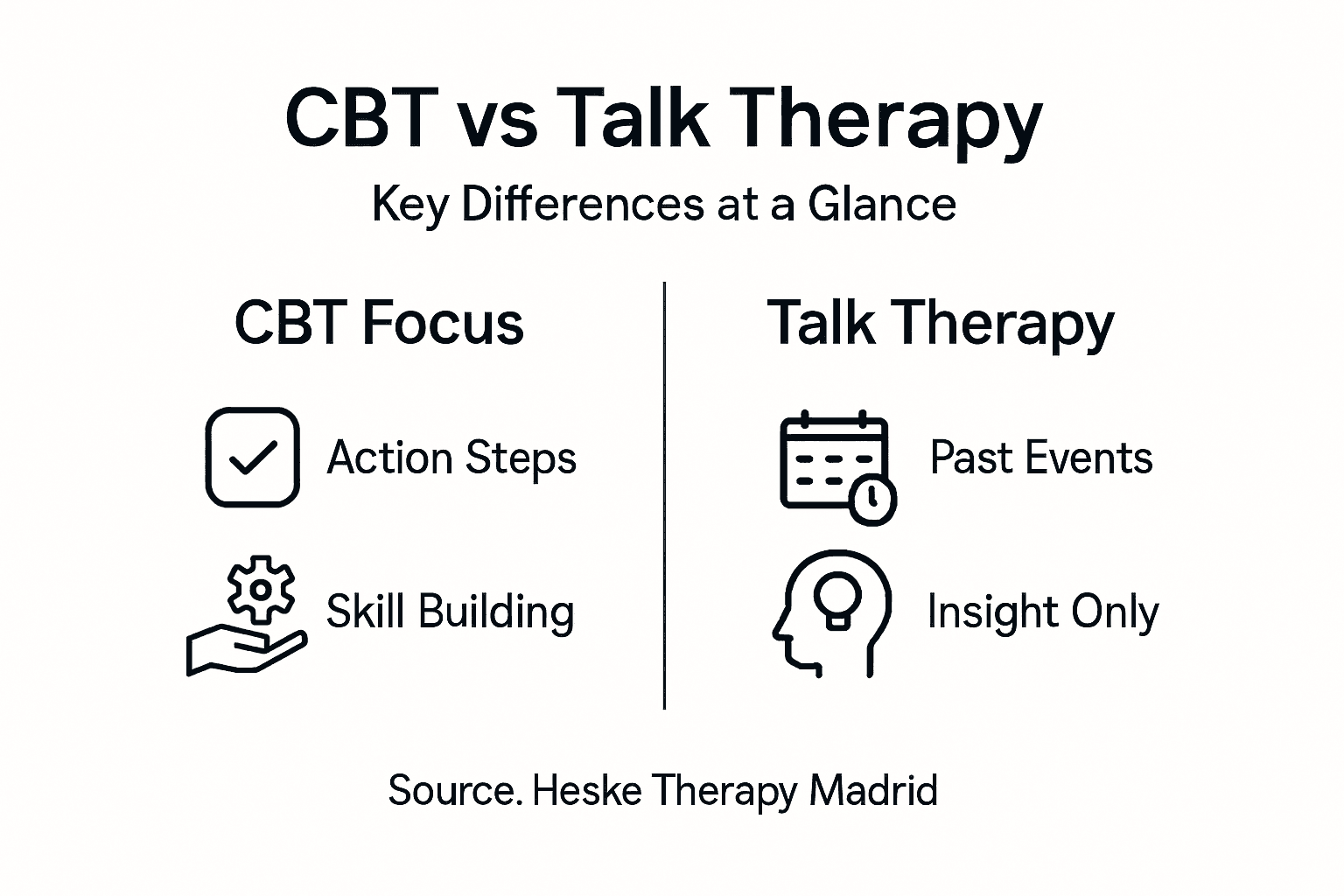
Unlike talk therapy that explores your past endlessly, CBT is action-oriented. You don’t just understand your anxiety. You practice new ways of thinking and behaving during sessions and between them. This hands-on approach produces measurable results faster, which matters when anxiety is interfering with your work performance or quality of life in Madrid.
Pro tip: When starting CBT, come prepared to identify specific situations that trigger your anxiety rather than speaking in generalities, as concrete examples help your therapist tailor techniques to your actual life as an expat.
Key CBT Techniques Used for Anxiety
CBT doesn’t offer a one-size-fits-all solution. Instead, your therapist selects from a toolkit of proven techniques tailored to your specific anxiety triggers. As an expat in Madrid, you might face unique stressors like visa stress or cultural isolation, so your therapist will customize these approaches to address what actually matters in your life.
One of the most powerful techniques is cognitive restructuring, which teaches you to identify and challenge distorted thinking patterns. When anxiety tells you “I’ll never make friends here” or “This job interview will be a disaster,” cognitive restructuring helps you examine the evidence. Is it actually true? What would you tell a friend in the same situation? By questioning these automatic negative thoughts, you develop more balanced, realistic perspectives that reduce emotional intensity.
Behavioral experiments form another core pillar. Rather than just talking about your fears, you test them in real situations. If you believe that speaking up in meetings will cause people to judge you harshly, you might conduct a small experiment by asking one question. You’ll likely discover that your prediction wasn’t accurate, weakening the anxiety’s grip. Behavioral experiments help challenge beliefs through direct experience, making changes stick faster than intellectual understanding alone.
Exposure techniques target avoidance behaviors that maintain anxiety. Many expats with anxiety avoid networking events, phone calls, or uncomfortable social situations. The more you avoid, the more anxiety grows. Exposure involves gradually facing these situations in a controlled way, proving to your nervous system that you can handle them. This doesn’t mean jumping into your worst fear immediately. Instead, you build a hierarchy and progress step by step.
Other valuable skills include mood tracking, where you log situations, thoughts, and emotional responses to spot patterns, and behavioral activation, which combats anxiety-related withdrawal by scheduling meaningful activities. Relaxation training and practical tools like deep breathing exercises also equip you with calming techniques for moments when anxiety spikes.
Below is a summary of common CBT techniques and their unique strengths for anxiety relief:
Technique | Core Advantage | Best For |
Cognitive Restructuring | Reduces distorted thinking | Persistent negative thoughts |
Behavioral Experiment | Tests anxious predictions | Social or performance fears |
Exposure | Breaks avoidance cycles | Situational anxiety |
Mood Tracking | Identifies anxiety patterns | Monitoring progress |
Behavioral Activation | Increases positive activities | Withdrawal or low motivation |
Pro tip: Keep a small notebook during your first CBT sessions to record which techniques feel most natural to you, then prioritize practicing those between appointments for faster progress.
How CBT Differs From Other Therapies
If you’ve considered therapy before, you might have heard of psychoanalysis, talk therapy, or counseling. CBT operates differently from these approaches in ways that matter for busy expats seeking fast results. The core difference comes down to structure, timeframe, and focus.
Traditional psychoanalysis digs into your past, exploring childhood experiences and unconscious motivations to understand why you developed anxiety. Sessions can stretch on for years. CBT takes a different route. Instead of analyzing your past endlessly, CBT is highly structured and short-term, typically lasting 12-16 weeks. You’re not lying on a couch discussing your dreams. You’re actively working with your therapist on concrete, measurable goals.
The collaborative nature sets CBT apart too. You and your therapist aren’t in a traditional expert-patient relationship where the therapist interprets your unconscious. Instead, you work together as a team. Your therapist teaches you skills, you practice them between sessions, and you measure progress. This homework component means real change happens outside the therapy room, not just during it.
Another key distinction is the focus. CBT is problem-focused and action-oriented rather than exploring unconscious processes. You identify your specific anxiety triggers in Madrid, whether that’s work presentations or social situations, then learn practical techniques to manage them. Generic insights about your past won’t reduce your anxiety at next week’s team meeting. But a practiced technique will.
CBT also relies on empirically validated methods, meaning researchers have tested these techniques in studies and proven they work. You’re not trying experimental approaches or vague therapeutic philosophies. You’re using evidence-based tools that have demonstrable results for anxiety. This scientific grounding appeals to many expats who want efficiency and clarity.
The speed matters too. While other therapies might take months just to build understanding, CBT produces measurable improvements within weeks because you’re practicing specific skills daily.
Here’s a concise overview comparing how CBT differs from other common therapy types:
Therapy Approach | Typical Duration | Main Focus | Patient Role |
CBT | 12–16 weeks | Present issues | Active skill practice |
Psychoanalysis | Years | Past experiences | Passive exploration |
Traditional Counseling | Varies | Emotional support | Discussion-based |
Support Groups | Ongoing | Shared experiences | Peer participation |
Pro tip: When interviewing therapists, ask directly about their CBT approach and expected timeline for improvement, as this clarity helps you assess whether their style matches your need for structured, rapid results.
Real-Life Results for Expat Clients
Theory is one thing. Actual results matter more. Many expats in Madrid have experienced significant anxiety relief through CBT, moving from constant worry to a functional, manageable baseline within weeks rather than months.
Consider the common pattern. An expat arrives in Spain with excitement but gradually develops social anxiety around networking events, professional meetings, or casual Spanish interactions. They start avoiding situations. Work performance dips. Isolation increases. Within 8-10 weeks of CBT, they’re attending events, speaking up in meetings, and building genuine friendships. The shift isn’t magical. It’s methodical. They practiced the techniques consistently.
What makes results stick for expats is personalization. CBT is highly adaptable to different client needs, particularly for people navigating unique stressors like cultural adjustment, visa uncertainty, or isolation. A therapist tailors CBT to your specific context. Rather than generic anxiety management, you’re addressing the actual situations triggering your anxiety in Madrid.
Cultural adaptation strengthens outcomes too. Research shows that culturally adapted CBT improves accessibility and effectiveness for diverse populations. When your therapist understands the expat experience and uses language or examples that resonate with your situation, you connect with the work faster. You’re not learning techniques designed for people in your home country. You’re learning approaches crafted for your actual life abroad.
Many expats report three consistent changes. First, their sleep improves noticeably within 2-3 weeks as racing thoughts slow down. Second, they experience genuine social confidence around week 6 as they complete behavioral experiments successfully. Third, they stop dreading future situations by week 10-12 because they trust their new skills.
The key: CBT’s adaptability means your results reflect your reality, not a textbook case.
Pro tip: Track one specific anxiety symptom like sleep quality or avoidance frequency before starting CBT, then measure it weekly so you can see tangible progress that motivates continued effort.
Common Pitfalls and How to Avoid Them
CBT works remarkably well for anxiety, but it’s not automatic. Some expats start therapy with high expectations, then struggle when results don’t arrive instantly or when the work feels harder than anticipated. Understanding common pitfalls helps you navigate them successfully.
The biggest mistake is skipping homework. CBT isn’t passive. Your therapist teaches techniques in sessions, but your real progress happens when you practice between appointments. If you attend weekly sessions but never apply the skills to real situations, you’ll plateau quickly. Think of it like learning Spanish. One class per week won’t make you fluent. Daily practice does. The same applies to CBT techniques.
Another frequent issue is giving up too early. Some expats expect to feel dramatically better after two or three sessions. Anxiety relief typically takes 4-6 weeks of consistent effort. If you quit at week two because you’re not “fixed” yet, you miss the breakthrough period. CBT requires patience alongside action.
Premature therapy termination often stems from lack of patient engagement or insufficient tailoring. This is why therapist fit matters enormously. If your therapist isn’t customizing CBT to your expat experience or isn’t explaining techniques clearly, speak up immediately. A good therapeutic relationship makes all the difference.
Poor session structure creates another stumbling block. Sessions should have clear goals and structure, not rambling discussions. If your therapist isn’t using structured protocols with specific goals each session, you’re spinning your wheels. Each meeting should build on the last and move you closer to measurable improvements.
Finally, many expats struggle because they haven’t addressed underlying beliefs. Your therapist must validate your real challenges before challenging your thoughts. You’re not imagining visa stress or cultural isolation. Once your therapist acknowledges those genuine stressors, reframing becomes possible. Validation first, then challenge.
Pro tip: Write down three specific homework tasks after each session and complete them before the next appointment, then discuss what you learned, as this consistency accelerates progress significantly.
Take Control of Anxiety with Expert CBT Therapy in Madrid
If you are an expat in Madrid struggling with anxiety triggered by cultural adjustment, work stress, or social challenges, understanding how CBT targets negative thought patterns and avoidance behaviors brings hope and practical relief. Heske Therapy offers specialized, evidence-based CBT tailored to the unique stressors faced by English-speaking expatriates. With personalized treatment plans and a blend of integrative techniques including Rapid Transformational Therapy, EMDR, and hypnotherapy, you gain a customized approach designed to produce rapid and lasting results.
Working with experienced therapists who appreciate the expat experience ensures that you receive compassionate care that validates your real challenges and guides you in mastering skills like cognitive restructuring and behavioral experiments tailored to your life in Madrid. Discover how to break anxiety cycles and rebuild your confidence with therapies offered both online and in-office for your convenience.
Ready to start your journey toward managing anxiety effectively and living more fully in Spain? Visit Heske Therapy today to schedule your free discovery call. Learn more about how our integrative psychotherapy services can help you overcome anxiety with proven CBT techniques adapted to the expat lifestyle. Take the first step now toward reclaiming your peace of mind and achieving measurable progress in just weeks.
Frequently Asked Questions
What is Cognitive Behavioral Therapy (CBT) and how does it help with anxiety?
Cognitive Behavioral Therapy (CBT) is a structured, evidence-based treatment that addresses the relationship between thoughts, feelings, and behaviors. It helps individuals recognize negative thinking patterns that fuel anxiety and teaches them how to change those patterns to reduce distress.
How long does CBT typically take to see results for anxiety?
CBT usually runs for 12-16 weeks, with weekly sessions. Many individuals start to see measurable improvements within 4-6 weeks of consistent effort and practice of the techniques taught in therapy.
What techniques are commonly used in CBT for anxiety?
CBT employs various techniques, including cognitive restructuring, behavioral experiments, exposure techniques, mood tracking, and behavioral activation. These methods help individuals challenge negative thoughts, face anxiety-provoking situations, and increase positive activities in their lives.
How does CBT differ from traditional talk therapy?
CBT is action-oriented and structured, focusing on present issues and providing practical skills to manage anxiety. Unlike traditional talk therapy, which often delves into past experiences, CBT is time-limited and aims for swift, measurable results through collaborative work between the therapist and patient.
Recommended
Comments