Staged Care Three Month Plan for Stress Related Dissociation in Madrid


Dissociation from stress is a disruption in how consciousness, memory, and identity normally work together, triggered when the nervous system is overwhelmed. It shows up as depersonalization, derealization, memory gaps, or “zoning out”, and it becomes clinically significant when episodes are frequent, involuntary, or interfere with driving, work, or parenting. If that describes your experience, the next step is a professional assessment, not guesswork.
TL;DR:
Dissociation episodes often involve frequent, involuntary symptoms that interfere with daily activities like driving, parenting, or work, warranting professional assessment.
Stress triggers dissociation through conditioned survival responses involving the HPA axis and neural patterns, especially in those with traumatic childhood backgrounds.
Treatment should start with stabilization techniques such as grounding and distress tolerance before trauma processing to prevent therapy setbacks.
Psychotherapy methods like EMDR and trauma-focused CBT are most supported, with medication playing a limited role mainly for comorbid anxiety or depression.
Early intervention, a stable environment, and consistent stabilization contribute to better recovery outcomes, while setbacks are normal and part of the healing process.
Table of Contents
What Does Stress-Related Dissociation Actually Feel Like?
Depersonalization feels like watching yourself from outside your body, as though you’re an actor in your own life instead of the one living it. Derealization is different: the world itself feels unreal, muffled, or like it’s behind glass. Both are among the two most common symptoms in the dissociative subtype of PTSD, and they frequently show up together rather than in isolation.
Other presentations are less cinematic but just as disruptive. Dissociative amnesia leaves gaps in memory around a stressful event, sometimes just minutes, sometimes hours. Automatisms are actions performed on autopilot, like driving a familiar route and arriving with no memory of the trip. “Zoning out” during a stressful meeting or a difficult conversation is the mildest end of this spectrum, and almost everyone experiences it occasionally.
The distinction that matters clinically is frequency and interference, not the presence of the symptom itself:
Occasional and situational: happens during acute stress, resolves on its own, doesn’t affect safety.
Frequent and involuntary: recurs across unrelated situations, starts to feel unpredictable.
Impairing: interferes with driving, caring for children, holding a job, or maintaining relationships.
People with trauma-related dissociative symptoms often go years before receiving an accurate diagnosis, partly because the symptoms are easy to dismiss as stress or fatigue. If you’ve ever “come back” from a dissociative episode behind the wheel or mid-conversation with your child, that’s not a quirk to shrug off. That’s a safety signal worth naming to a clinician.
Why Do Stress and Trauma Trigger Dissociation?
Dissociation starts as a defense, not a malfunction. When a threat feels inescapable, the mind can detach from the full weight of the experience, which is adaptive in the moment but can become a conditioned response that fires even when the danger has passed.
The biology behind this involves the HPA axis and autonomic nervous system, and people differ in how these systems respond to stress. Some people develop a blunted cortisol response paired with high dissociation scores, while others show the more familiar hyperarousal pattern of racing heart and flooding adrenaline. Functional imaging backs this split at the brain level: dissociative and hyperarousal presentations of PTSD show different activation patterns, with the dissociative subtype linked to oversuppression of emotional processing rather than its opposite.
Baseline dissociation tendencies predict how strongly someone dissociates under new stress. Research in PTSD and borderline personality disorder samples found that trait dissociation levels reliably forecast stress-induced state dissociation, meaning your history with dissociation shapes your vulnerability to it now.
Certain factors raise the risk further:
Repeated childhood trauma, especially when it began early and continued over years.
Disrupted attachment relationships in childhood.
A preexisting trait tendency toward dissociation, even before a new stressor hits.
For survivors of repeated early trauma, dissociation often becomes an automatic survival strategy learned so young it feels like personality rather than a response. Reframing it as once-adaptive, rather than broken, is usually where real change begins.
When Should You Seek an Assessment for Dissociation?
A handful of signs justify a formal evaluation rather than waiting to see if things improve on their own. Seek assessment if episodes happen weekly or more, if they interrupt work or caregiving, if you’ve had memory gaps you can’t account for, or if you feel unsafe during or after an episode.
Clinicians typically use structured interviews focused on three domains: depersonalization and derealization experiences, memory continuity, and identity coherence over time. When dissociative symptoms accompany full PTSD, clinicians look specifically for the dissociative subtype of PTSD, because that diagnosis changes how treatment gets sequenced. Processing trauma memories too soon, before someone can stay grounded, tends to backfire.
Practical steps if you recognize yourself in this:
Write down when episodes happen and what preceded them, even a rough pattern helps a clinician.
Contact a licensed therapist experienced in trauma and dissociation, not general counseling alone.
If you feel unsafe (driving, alone with children, at height), build a same-day safety plan with someone you trust.
Pro Tip: Bring your episode log to the first session. A week of notes on triggers and duration often tells a clinician more than a single conversation can.
What Treatments Actually Help With Stress-Induced Dissociation?
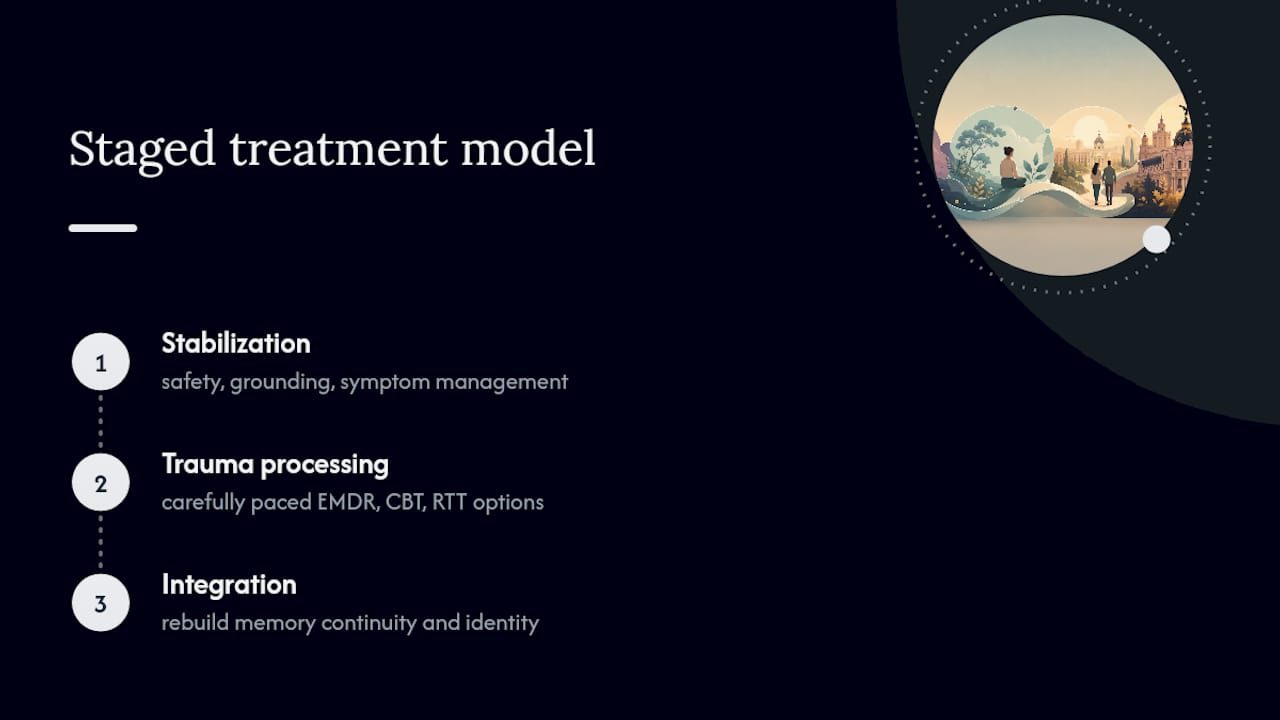
Treatment for dissociation almost always follows a staged structure, and skipping the first stage is the most common reason trauma therapy backfires. Stabilization comes first: grounding skills, distress tolerance, and enough nervous-system regulation to stay present. Only after that foundation holds does trauma processing begin.

Psychotherapy carries the strongest evidence. EMDR and trauma-focused CBT are the most commonly recommended approaches, often within a phased framework that paces exposure to avoid overwhelming an already sensitized system. EMDR in particular is used specifically because it lets processing happen without requiring a detailed verbal account of the trauma, which matters when memory itself is fragmented. Rapid Transformational Therapy and clinical hypnotherapy can serve as adjuncts within this staged model, often useful for accessing and reframing subconscious material once stabilization is solid.
Medication has a real but limited role. There’s no specific drug that treats dissociation itself; instead, medications target comorbid anxiety or depression that often ride alongside it.
Between sessions, self-management matters:
Grounding techniques (naming five things you see, pressing feet into the floor) interrupt an episode in progress.
Sensory anchors, a strong scent, cold water, textured fabric, pull attention back into the body.
A written safety plan for high-risk moments like driving or childcare.
Pro Tip: Practice your grounding technique when you’re calm, not just during an episode. It works faster under stress if your body already knows the motion. For structured exercises, grounding techniques for trauma and science-backed grounding methods both offer practical starting points.
What Recovery Actually Looks Like Over Time
Recovery timelines depend heavily on whether you’re dealing with a transient stress response or a pattern that’s been entrenched for years. A single stressful period that triggers occasional depersonalization often resolves within weeks of targeted therapy. Chronic dissociation tied to early or repeated trauma takes longer, often months of staged work rather than a quick fix.
Several factors predict better outcomes:
Starting treatment early, before dissociation becomes the default coping response.
A stable current environment without ongoing threat or chaos.
Trauma that was time-limited versus trauma that was chronic or relational.
Setbacks are normal and expected, not signs that therapy has failed. A skilled therapist treats a relapse into dissociation as data, adjusting pacing rather than abandoning the approach. Watch for these markers of real progress: shorter episodes, faster recovery after one occurs, and longer stretches of feeling present without effort.
Heske Therapy: Clinical Approach to Treating Dissociation
I’m Heske, a practicing therapist in Madrid working with English-speaking expatriates and international clients across Spanish, English, and Dutch. My approach to dissociation follows the staged model the evidence supports: stabilization first, then carefully paced trauma processing, then integration work to rebuild memory continuity and a coherent sense of identity.
Sessions draw on EMDR, CBT, Rapid Transformational Therapy, and clinical hypnotherapy, chosen based on where a client sits in that staging. If you’re weighing which approach fits your situation, how CBT and RTT compare for trauma is a useful starting point. Both online and in-person sessions are available for clients based in Madrid or abroad.
A Clinician’s Note on Dissociation
Dissociation gets misread as weakness or drama, when it’s neither. It’s a survival response, one your nervous system learned because it worked at some point. My first priority with every client isn’t to eliminate it overnight. It’s safety and stabilization, because pushing toward trauma processing before someone can stay grounded almost always backfires. The reassuring part: dissociation responds well to staged, paced treatment. You don’t have to live disconnected from your own life.
— Heske
Ready to Address Dissociation? Here’s Where to Start
If dissociative episodes are interfering with your work, relationships, or sense of safety, Hesketherapy offers a direct path to staged, evidence-based treatment instead of a long wait for a diagnosis. Sessions combine EMDR, Rapid Transformational Therapy, CBT, and clinical hypnotherapy, sequenced around stabilization first, available both online and in-person in Madrid.

This approach tends to suit people who’ve noticed a pattern, memory gaps, zoning out during stress, a sense of watching themselves from outside, and want an assessment rather than more self-diagnosis. Sessions run on a three-month engagement, which gives enough time to move through stabilization and into real processing rather than stalling at the first stage. If Rapid Transformational Therapy’s faster format interests you, the RTT program details walk through how that works, and a self-hypnosis relaxation resource is available as an adjunct for grounding between sessions. For your first appointment, come with a rough log of when episodes happen, what precedes them, and any safety concerns. Book a free discovery call through the Heske Therapy booking page to talk through what staged treatment would look like for you.
This article is general information, not a substitute for advice from a qualified doctor. Consult a qualified healthcare professional about your own circumstances before acting on anything here.
Sources
Recommended
Comments