Emotional blocks in expats: Causes and effective solutions
- Heske Ottevanger
- May 6
- 9 min read


TL;DR:
Feeling emotionally numb is a protective response from unresolved trauma, stress, or cultural adaptation challenges. For expats in Madrid, relocation-related triggers like language barriers, social isolation, and identity shifts often intensify these blocks. Seeking culturally sensitive therapy, such as CBT, EMDR, or rapid approaches, can help reconnect with genuine emotions and facilitate adaptation.
Feeling cut off from your own emotions is not a character flaw, and it is definitely not “all in your head” in the dismissive sense people sometimes mean. For English-speaking expats living in Madrid, emotional numbness or feeling emotionally frozen can feel deeply confusing, especially when life on paper looks like an adventure. The truth is that emotional blocks stem from very real causes: unprocessed trauma, chronic stress, childhood emotional suppression, repeated negative patterns, grief, and avoidance as a survival mechanism. Understanding these roots is the first step toward breaking free.
Table of Contents
Key Takeaways
Point | Details |
Not your fault | Emotional blocks stem from real causes like trauma and chronic stress, not personal failure. |
Expat challenges | Living abroad can trigger or worsen emotional blocks due to unique stressors. |
Recognize the signs | Emotional blocks can look like numbness, avoidance, or perfectionism affecting daily life. |
Innovative therapies work | CBT, EMDR, and schema therapy help break emotional blocks—especially with a culturally sensitive approach. |
Seek tailored support | English-speaking, expat-focused therapy in Madrid offers fast relief and deeper understanding. |
Understanding emotional blocks: Causes and mechanisms
Emotional blocks are not dramatic, obvious breakdowns. More often, they are quiet. You go through the motions at work, smile at social gatherings, and tell yourself everything is fine, yet something feels missing. You cannot connect to joy, grief, excitement, or even ordinary frustration in a way that feels real. That disconnect is an emotional block at work.
At the core, emotional blocks function as the mind’s protective response. When an experience feels too overwhelming to process in the moment, the brain essentially files it away. The emotion gets stored but not resolved. Over time, that unresolved material accumulates, and what began as protection becomes a wall that keeps you from feeling anything clearly. As research consistently shows, the primary causes include:
Unprocessed trauma: Single events or prolonged exposure to threatening situations the nervous system never fully recovered from.
Chronic stress: Sustained pressure, especially common in high-pressure expat careers, wears down emotional regulation capacity over time.
Childhood emotional suppression: Growing up in environments where feelings were dismissed, punished, or simply not acknowledged.
Repeated negative patterns: Cycles of disappointment, rejection, or failure that train the mind to stop expecting emotional reward.
Grief and loss: Unacknowledged losses, including leaving your home country, losing community, or losing a sense of identity.
Emotional avoidance: Habitual steering away from uncomfortable feelings, which eventually broadens into a general emotional flatness.
For expats in Madrid specifically, the emotional load is compounded. Breaking emotional blocks requires acknowledging that your nervous system has been working overtime just to help you adapt to a new culture, language, and professional environment simultaneously.
“Emotional blocks are not weakness. They are the brain’s way of saying: I was carrying too much and needed to put something down. The problem is when we forget where we set it.”
Core cause | How it shows up for expats |
Unprocessed trauma | Triggered by unfamiliar social cues or isolation |
Chronic stress | Career pressure, bureaucratic frustration in Spain |
Emotional suppression | Cultural norms that discourage vulnerability |
Negative patterns | Repeated failed attempts to build community |
Grief and loss | Homesickness, loss of identity outside home country |
Avoidance | Staying busy to avoid confronting difficult feelings |
Hidden triggers for expats: Why relocation amplifies emotional blocks
Living abroad introduces a specific and often underestimated category of stressors. Understanding the expat challenges in Madrid is essential for recognizing why emotional blocks can intensify after relocation, even when the move was entirely your choice.
Language barriers do more than make grocery shopping difficult. They cut you off from the emotional nuance of communication. When you cannot express frustration, humor, or sadness in the language surrounding you, your emotional world shrinks. That restriction is cumulative. Over months, it trains you to suppress rather than express.
Loss of community hits expats on multiple levels. Back home, you had people who knew your history. In Madrid, you are starting from scratch socially, often in professional environments where making friends requires extra effort and cultural navigation. That isolation does not stay neatly in the “social” box. It bleeds into how emotionally available and responsive you feel across all areas of life.
Pressure to succeed is another powerful trigger. Many expats carry an invisible expectation, either self-imposed or from family and peers, to make the move “worth it.” That pressure creates a perfectionism loop that is directly connected to emotional shutdown. When you demand too much of yourself emotionally, the system eventually stops responding. Exploring expat therapy benefits is worthwhile precisely because professional support addresses these layered pressures directly.
Hidden triggers that are less commonly discussed include:
Parentification patterns: Adults who took on emotional caretaking roles in childhood often find those patterns resurface under the stress of relocation. They focus on managing everyone else’s adjustment while their own emotional needs go unmet.
Perfectionism rooted in old trauma: The drive to appear “fine” while living abroad can be a direct replay of childhood survival strategies.
Medication and health factors: Certain medications, neurological conditions, and substance use can directly cause emotional numbness, adding a physiological layer to what may otherwise seem purely psychological.
Pro Tip: If you have recently relocated and notice emotional flatness creeping in, do not wait for a crisis. Emotional blocks often surface during major life transitions. Catching them early makes resolution significantly faster.
How emotional blocks show up: Recognizing the signs
Recognizing the signs of emotional blocks matters because they often masquerade as other things. You might assume you are just tired, introverted, or “not a feelings person.” But there is a meaningful difference between personality and a block that has taken hold.
Emotional symptoms include numbness, feeling detached from experiences you expected to enjoy, difficulty crying even when you want to, and a general sense that your emotional range has narrowed. You may feel irritable for no clear reason, which is often suppressed emotion looking for an exit.
Behavioral symptoms include avoiding situations that might stir feelings, pulling back from relationships, filling every moment with tasks, overworking, or scrolling compulsively to stay distracted. These behaviors serve the avoidance function your nervous system has adopted.
Physical symptoms are where many expats first notice something is wrong. Fatigue that sleep does not fix, tension headaches, digestive issues, and muscle tightness are all ways unprocessed emotional stress manifests in the body. This is not coincidental. The mind and body are not separate systems.

The following table helps distinguish emotional blocks from clinical depression or anxiety, since the treatments differ significantly:
Feature | Emotional blocks | Depression | Anxiety |
Primary feeling | Numbness, flatness | Persistent sadness, hopelessness | Excessive worry, dread |
Relationship to past | Linked to specific events or patterns | May have no clear trigger | Often future-focused |
Physical signs | Fatigue, tension | Appetite/sleep changes | Muscle tension, rapid heart rate |
Response to positive events | Muted but can improve | Little or no improvement | May still feel moments of relief |
Duration | Variable, often situational | Persistent (two weeks or more) | Ongoing, often chronic |
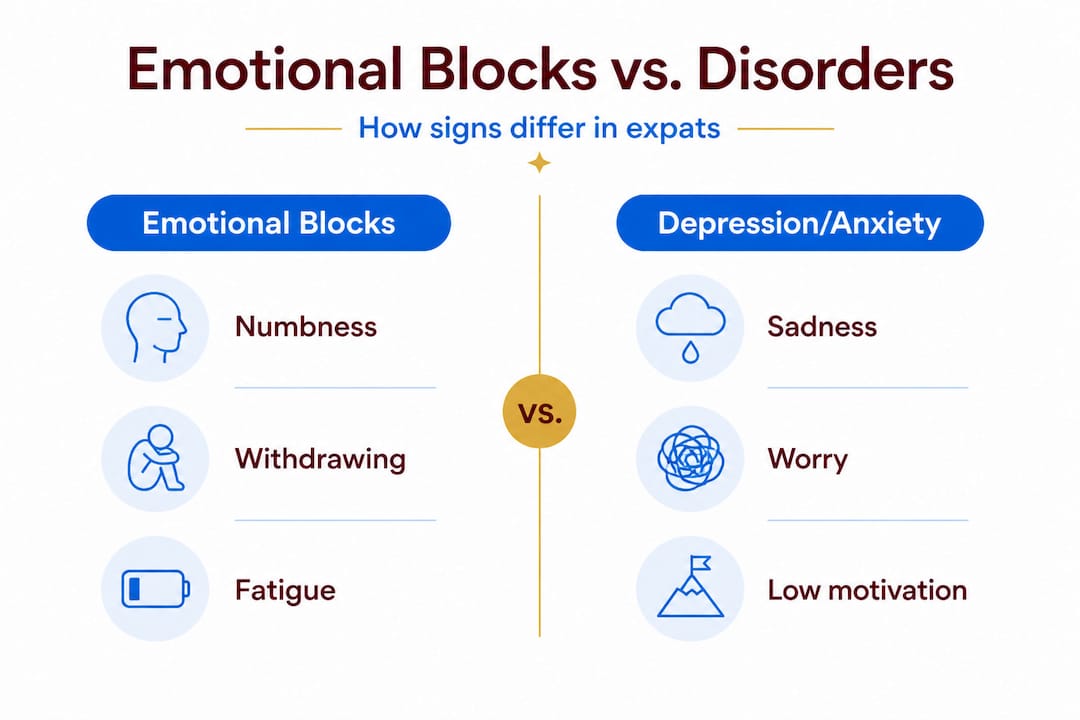
If you are not sure which applies to you, working through mental health relief strategies with a professional is the clearest path to an accurate picture. Self-diagnosis has real limitations, especially when you are navigating a foreign healthcare system.
For expats specifically, unrecognized emotional blocks affect adaptation directly. When you cannot access your emotions clearly, your ability to read social situations, connect with Spanish colleagues, or build friendships is compromised. The emotional block creates a feedback loop: isolation deepens the block, and the block reinforces isolation.
Evidence-based therapies: Innovative ways to break emotional blocks
Recognizing emotional blocks sets the stage for effective treatment. The good news is that several well-researched therapies directly target the mechanisms behind them, and many are accessible to English-speaking expats in Madrid both in person and online.
Cognitive Behavioral Therapy (CBT) is one of the most evidence-supported approaches for emotional and adjustment difficulties. It works by identifying the thought patterns and behaviors that maintain emotional avoidance, then systematically changing them. CBT is structured, practical, and often produces noticeable shifts within eight to sixteen sessions. It is particularly effective for expats dealing with perfectionism, performance anxiety, and acculturation stress.
EMDR (Eye Movement Desensitization and Reprocessing) is particularly powerful when the emotional block has a traumatic root. Rather than talking through the trauma repeatedly, EMDR helps the brain reprocess stored memories so they no longer carry the same emotional charge. For expats who carry unresolved experiences from their home country or childhood, EMDR can unlock blocks that CBT alone may not fully reach.
Schema therapy addresses deeper, long-standing patterns. It is the right choice when the emotional block is tied to early childhood experiences, such as emotional neglect or a parentification dynamic, that created fundamental beliefs about whether emotions are safe to feel or express.
Mindfulness-based approaches train attention and body awareness, which helps clients recognize emotional signals before they get suppressed. Mindfulness is not a standalone solution for deep blocks, but it is a valuable complement to other therapies.
Exploring therapy methods for expats shows the range of approaches now available specifically within the expat context. An important consideration is language. Processing emotions in a second language is genuinely harder and can produce shallower therapeutic results. Working with a therapist in your first language, or with one fluent in your primary emotional vocabulary, matters more than most people expect.
Online therapy for expats has made access significantly easier, particularly for expats whose schedules, locations, or work commitments make in-person sessions difficult to arrange consistently. The therapeutic relationship remains equally strong in an online format when the therapist is experienced with remote work.
Multilingual mental health support is another dimension worth considering. Being able to switch between languages during a session, or simply knowing your therapist understands the cultural references you carry, reduces the friction that slows emotional processing.
Pro Tip: If your schedule is packed and your support network in Madrid is still thin, prioritize therapies specifically designed to produce faster results. Methods like RTT (Rapid Transformational Therapy) compress deep work into fewer sessions, which suits the reality of expat life.
What most guides miss about emotional blocks in expat life
Most articles on emotional blocks read like they were written for someone sitting quietly in a familiar city, surrounded by their usual support systems. They recommend journaling, deep breathing, and talking to friends. Those things have their place. But they sidestep something important for expats: the context of your emotional life is fundamentally different when you are living abroad.
Here is what we see consistently in expat-focused therapy. The emotional block is almost never just about the presenting issue. It is about the accumulated weight of adapting. Every day of navigating a foreign bureaucracy, every conversation where you could not quite express what you meant, every social event where you felt like an outsider, all of that registers in the nervous system. Over time, the system does not crash dramatically. It quietly dims.
Standard therapeutic advice also tends to treat identity as stable. For expats, identity is in active negotiation. Who you are in your home country, defined by language, social role, professional reputation, and cultural fluency, is not who you are in Madrid yet. That gap is disorienting in ways that are rarely named directly. The disorientation itself becomes a source of emotional blocking, because if you cannot clearly feel who you are, the emotional signals that depend on identity become unreliable.
The most effective expat-focused therapy, as we practice it, does not treat you as a generic patient with a standard protocol. It acknowledges where you are coming from, where you are now, and the very real psychological labor of living between those two worlds. Expat counseling insights consistently show that this acknowledgment alone produces faster therapeutic progress than any number of generic coping techniques.
Seeking therapy is not admitting failure. It is recognizing that what you are navigating is objectively demanding, and that support is a strategic resource, not a last resort.
Break through: Culturally sensitive therapy options for expats in Madrid
You now have a clear picture of what emotional blocks are, why expats in Madrid are particularly vulnerable, how to recognize the signs, and which therapies produce real results. The natural next step is finding support that is specifically designed for your experience, not adapted from a general model.
At Heske Therapy, we work exclusively with English-speaking expats and international clients in Madrid. Every method we use, including RTT therapy, EMDR, CBT, and counseling, is applied with full awareness of the expat context. Our 21-day RTT package is specifically designed for clients who want deep, lasting change without spending years in therapy. For immediate relief between sessions or as a starting point, our self-hypnosis audio for perfect relaxation gives you a practical daily tool. Sessions are available both in-person in Madrid and online. Book a free discovery call and let’s find the right approach for where you are right now.
Frequently asked questions
Are emotional blocks a mental health disorder?
No, emotional blocks are not a defined clinical disorder but rather common responses to life stress, trauma, or sustained emotional difficulty. As research on emotional numbness shows, they stem from identifiable causes and respond well to targeted therapy.
What’s the fastest way to start resolving emotional blocks?
Working with an English-speaking, culturally sensitive therapist using evidence-based methods such as CBT or EMDR gives you both speed and accuracy, since the therapist can pinpoint which cause is driving your specific block rather than using a one-size approach.
Can medication or health conditions cause emotional blocks?
Yes. Certain medication side effects, neurological conditions, and substance use can directly produce emotional numbness, which is why a thorough assessment with a qualified therapist is important before assuming the cause is purely psychological.
How do I know if I need professional help?
If emotional numbness is affecting your relationships, work performance, or ability to settle into life in Madrid, those are clear signals. A therapist can quickly identify specific causes and design a treatment plan that fits your situation rather than a generic framework.
Recommended
Comments