How sleep therapy transforms mental health for expats


TL;DR:
Sleep therapy, especially CBT-I, targets root causes of chronic insomnia and outperforms medication long-term.
For expats, combining sleep therapy with mental health support addresses underlying stressors like anxiety, grief, and adjustment.
Therapist-led programs are more effective than digital apps, which often have lower adherence and personalization.
Moving to Madrid should feel exciting. But for many English-speaking expatriates, the reality includes restless nights, racing thoughts, and a growing reliance on sleeping pills that don’t address the root cause. CBT-I is an evidence-based first-line treatment for chronic insomnia that outperforms medication in long-term safety and effectiveness. This guide breaks down how sleep therapy works, why it’s especially relevant for expats navigating life transitions in Spain, and how integrating it with broader mental health support can change not just your nights, but your entire wellbeing.
Table of Contents
Key Takeaways
Point | Details |
CBT-I is first-line | Cognitive Behavioral Therapy for Insomnia offers proven, lasting results for sleep disturbances with minimal side effects. |
Integration drives results | Pairing sleep therapy with mental health care improves outcomes for anxiety, stress, and adjustment challenges. |
Digital tools need support | Apps and automated CBT-I work best when paired with therapist guidance and good adherence. |
Non-drug strategies matter | Optimizing your environment and routines can enhance the effectiveness of any sleep therapy approach. |
Personalization is key | Tailoring therapy to your unique circumstances as an expat yields the greatest improvement in sleep and mental health. |
Why sleep therapy is crucial for expats
Life as an expat carries a unique emotional load. You’re rebuilding social networks, navigating a new language, adjusting to different workplace norms, and often managing the quiet grief of leaving everything familiar behind. Each of these stressors chips away at sleep quality in ways that are easy to underestimate until you’re lying awake at 3 a.m. for the fifth night in a row.
Sleep disturbances among expats aren’t simply about jet lag or unfamiliar surroundings. They often reflect deeper psychological shifts: identity changes, loneliness, financial uncertainty, and the pressure to appear fine when things feel anything but. When sleep breaks down, it rarely stays isolated. Poor sleep fuels anxiety, which disrupts sleep further, creating a feedback loop that’s genuinely hard to break without targeted support.
This is exactly where sleep therapy steps in. Unlike medication, which manages symptoms without building new coping patterns, sleep therapy targets the thoughts, behaviors, and environmental factors that keep you stuck in poor sleep. As the evidence shows, CBT-I causes minimal adverse effects compared to pharmacological treatments, making it a far safer long-term choice, especially for people whose lives are already in flux.
What makes sleep therapy particularly well-suited for expats is its flexibility. Integrative therapy examples for expats show that combining sleep-focused work with anxiety management, lifestyle adjustment, and cultural transition support delivers results that a single-method approach simply cannot.
Key reasons sleep therapy matters for expats:
Sleep disruption is often a symptom of broader adjustment challenges, not just poor habits
Medication provides temporary relief without building resilience or new skills
Therapy can be tailored to individual schedules, language preferences, and cultural contexts
Sustainable sleep improvement requires addressing both mind and environment
Pro Tip: If you’ve been using sleep medication for more than a few weeks and still don’t feel rested, that’s a strong signal that a behavioral or psychological approach may serve you far better.
The essentials of evidence-based sleep therapy
CBT-I is not a single technique. It’s a structured program that combines several approaches working together to break the cycle of chronic insomnia. Understanding what it includes helps you appreciate why it’s so much more durable than reaching for a pill.
The core components of CBT-I include:
Sleep restriction therapy: Temporarily limiting time in bed to build sleep pressure and consolidate sleep into a more efficient window, then gradually extending it.
Stimulus control: Reconnecting the bed with sleepiness rather than wakefulness or anxiety, which means getting out of bed when you can’t sleep instead of lying there frustrated.
Cognitive restructuring: Identifying and challenging unhelpful beliefs about sleep, such as “I need eight hours or I’ll fall apart,” which paradoxically create the anxiety that prevents sleep.
Relaxation training: Progressive muscle relaxation, diaphragmatic breathing, and guided imagery to lower physiological arousal before bed.
Sleep hygiene education: Practical adjustments to light, noise, caffeine, alcohol, and exercise timing.
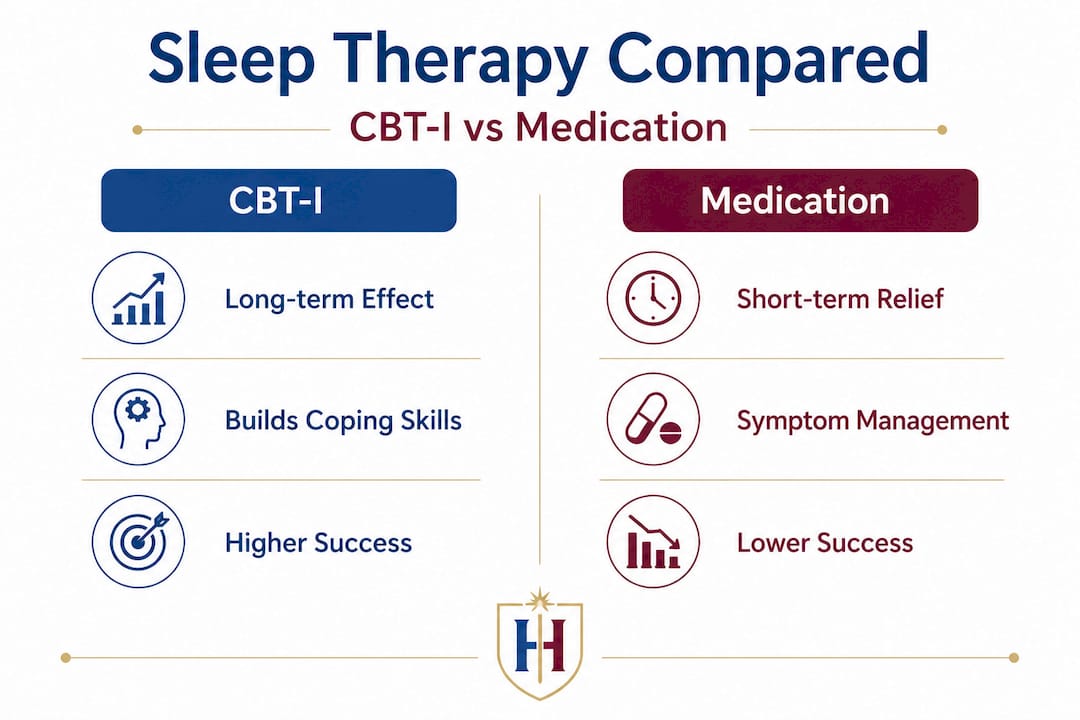
Comparison: CBT-I versus sleep medication
Factor | CBT-I | Sleep medication |
Long-term effectiveness | High | Moderate, decreases over time |
Risk of dependence | None | Moderate to high |
Side effects | Minimal | Grogginess, memory effects |
Relapse risk | Low | High after stopping |
Addresses root cause | Yes | No |
Requires professional input | Ideally yes | Prescription needed |
Research confirms that CBT-I is a first-line, multimodal therapy for chronic insomnia, and that it consistently outperforms sleep medication when measured over months rather than nights. For people with complex needs, evidence also shows that combining CBT-I and medication can benefit certain chronic insomnia cases, though CBT-I alone is frequently sufficient.
Understanding how CBT transforms mental health reveals why this approach resonates so deeply. It changes the way you relate to thoughts and experiences, not just the symptom itself. And combining therapy methods often accelerates progress, especially for clients dealing with layered challenges like anxiety, burnout, and disrupted sleep simultaneously.

Pro Tip: Therapist-assisted CBT-I consistently outperforms self-guided digital programs. If you’ve tried an app and found it didn’t stick, that’s not a character flaw. It’s a delivery gap.
Integrating sleep therapy with mental health care
Here’s something most sleep guides overlook: insomnia almost never travels alone. For expats, it frequently shows up alongside anxiety, low mood, adjustment disorder, or burnout. Treating sleep in isolation often yields partial results because the underlying drivers remain unaddressed.
Research confirms that CBT-I delivered in parallel with other therapies can produce better psychiatric outcomes than addressing either sleep or mental health in isolation. In practical terms, this means that when a therapist works with you on both sleep and the anxiety keeping you awake, progress on both fronts tends to accelerate.
Areas where integrated sleep and mental health therapy helps most:
Anxiety and hyperarousal that prevent the nervous system from downregulating at night
Depressive episodes that shift sleep architecture and increase early morning waking
Post-traumatic stress that fragments sleep through nightmares and hypervigilance
Adjustment difficulties tied to relocation, new roles, or cultural isolation
Physical symptoms like IBS or tension headaches that are worsened by poor sleep
How integrated care is typically structured:
Phase | Focus | Methods |
Assessment | Identifying sleep patterns and mental health picture | Sleep diary, clinical interview |
Stabilization | Reducing acute symptoms | CBT-I basics, medication review if needed |
Core therapy | Addressing root psychological drivers | CBT, EMDR, RTT, counseling |
Consolidation | Building sustainable habits | Lifestyle integration, relapse prevention |
“Addressing sleep as part of broader psychiatric care, rather than as a standalone issue, significantly improves outcomes for people with co-occurring mental health conditions.”
The sleep and health connection extends further than most people realize, including the role of diet, gut health, and inflammation in disrupting rest. This is why integrative psychotherapy techniques that honor the whole person, not just the symptom, tend to generate more lasting change. And for expats managing therapies for expat anxiety, weaving sleep support into the broader therapeutic plan is simply good clinical practice.
Digital sleep therapy versus therapist-assisted care
Sleep apps are everywhere. Many promise CBT-I in your pocket, guided meditations, sleep scores, and AI-powered insights. They’re convenient, often affordable, and there’s no waiting room. So what’s the catch?
The evidence is clear: digital CBT-I reduces insomnia symptoms but is consistently less effective than therapist-assisted CBT-I, primarily because adherence drops off. People start strong, complete a few modules, and then disengage when the content feels repetitive or doesn’t account for their specific situation.
Comparison: Digital versus therapist-assisted CBT-I
Feature | Digital/app-based | Therapist-assisted |
Accessibility | High (24/7) | Appointment-based |
Personalization | Low to moderate | High |
Adherence rates | Variable, often low | Generally higher |
Effectiveness | Moderate | High |
Ability to adapt to setbacks | Limited | Strong |
Cost | Lower | Higher |
Common reasons digital sleep programs fail:
No real-time support when the program becomes difficult or confusing
Generic content that doesn’t reflect cultural or personal nuances
No accountability structure to maintain consistency
Inability to address co-occurring anxiety or trauma that complicates sleep
Tracking tools can become sources of anxiety rather than reassurance
For expats in Madrid, the language factor also matters. A therapist who understands your cultural context, speaks your language, and can adapt step-by-step CBT techniques to your specific situation brings something no app can replicate.
One valid use of technology is tracking trends in your sleep data over time, as long as it’s reviewed and interpreted with a clinician. Obsessing over a poor sleep score displayed by a wearable device can actually worsen sleep anxiety, the opposite of what you need. Meanwhile, managing screen time before bed is a simple but powerful behavioral change that both apps and therapists consistently recommend.
Pro Tip: Use apps as a supplement, not a substitute. Track your sleep data and bring it to your therapist for interpretation rather than acting on it alone.
Targeting physiology: Non-drug strategies for restful sleep
Psychology is central to sleep therapy, but the body has its own role to play. Two key physiological systems govern sleep quality: thermoregulation and melatonin rhythm. Disrupting either makes falling or staying asleep significantly harder.
Research into thermoregulatory processes and sleep confirms that body temperature naturally drops as part of sleep initiation. When the bedroom is too warm, or when internal temperature regulation is disrupted by stress hormones, this cooling process is delayed, increasing the time it takes to fall asleep. Madrid summers make this particularly relevant, as temperatures often remain high well into the night.
Melatonin and sleep are closely linked. Melatonin is not a sedative. It’s a timing signal, produced by the pineal gland in response to darkness. Exposure to artificial light in the evening, particularly blue light from screens, suppresses melatonin production and delays the biological clock, pushing your natural sleep window later and later.
Effective physical strategies to support sleep therapy:
Keep the bedroom between 16 and 19 degrees Celsius for optimal sleep temperature
Take a warm foot bath or shower 30 to 60 minutes before bed to promote peripheral heat loss and trigger the internal cooling response
Dim indoor lighting and use blue-light filtering settings from two hours before bed
Get morning sunlight exposure within 30 to 60 minutes of waking to anchor your circadian rhythm
Avoid caffeine after 2 p.m., as its half-life in the body runs six to eight hours for most people
Limit alcohol, which fragments sleep in the second half of the night despite feeling sedating initially
Summary of physiological sleep supports:
Strategy | Mechanism | Practical note |
Cool bedroom | Supports body temperature drop | Aim for 17-18°C in summer |
Warm foot bath | Promotes heat redistribution | 20 minutes, 30 min before bed |
Morning light | Anchors circadian clock | 10-30 min outdoor exposure |
Evening light reduction | Preserves melatonin timing | Dim screens and overhead lights |
These strategies work best when embedded inside a structured sleep therapy program rather than applied piecemeal. Knowing the why behind each one, which a therapist can explain in the context of your own pattern, dramatically improves motivation and consistency.
Our perspective: What most sleep therapy guides miss for expats
Most guides on sleep therapy treat insomnia as a standalone problem with a neat, linear solution. Take CBT-I, do the modules, get better. But in our experience working with English-speaking expats in Madrid, that framing misses something important.
Sleep for expats is often a signal, not just a symptom. When someone moves abroad and starts sleeping poorly six months in, it usually means the nervous system is telling them something that the conscious mind has been too busy to hear. There may be unprocessed grief about leaving home. There may be identity questions about who you are outside your familiar culture. There may be a mismatch between the life you imagined and the one you’re actually living.
The conventional response, whether pills or even isolated CBT-I, addresses the volume on the alarm without asking what the alarm is actually about. This is why we believe personalized therapy is not a luxury but a necessity for genuine recovery.
The most meaningful progress we see happens when clients combine behavioral strategies with deeper work on the underlying drivers, whether that’s anxiety, trauma, or the invisible stress of constant cultural adaptation. Sleep therapy is the foundation, but integrative methods build the structure above it. Getting both right, simultaneously, changes everything.
Expert, integrative sleep therapy: Your next step in Madrid
If you’ve recognized your own experience in this article, you’re not alone, and you don’t have to keep patching things together.
At Heske Therapy, we work specifically with English-speaking expatriates in Madrid who are ready to address sleep disturbances at their root. Our integrative approach brings together CBT, EMDR, counseling, and RTT therapy for sleep and mental health, creating a personalized plan that addresses both your nights and your days. Whether you prefer face-to-face sessions or online appointments, expert support is accessible. The 21-day RTT sleep package is a structured starting point that combines Rapid Transformational Therapy with targeted behavioral strategies for lasting change. Book a free discovery call today and take the first step toward real, sustainable rest.
Frequently asked questions
What is the most effective sleep therapy for chronic insomnia?
CBT-I (Cognitive Behavioral Therapy for Insomnia) is the most effective first-line treatment for chronic insomnia, consistently outperforming medication in long-term safety and sustained results.
Can sleep therapy help with anxiety or stress?
Yes. Treating sleep as part of broader mental health care improves outcomes for both, because treating sleep alongside psychiatric issues produces better results than addressing each in isolation.
Are sleep therapy apps as effective as therapist-led programs?
Sleep apps can reduce insomnia symptoms, but digital CBT-I is less effective than therapist-led programs, largely because adherence and personalization are harder to sustain.
Can adjusting my sleep environment improve results from therapy?
Absolutely. Physical and environmental interventions like temperature regulation and light management work best when combined with structured sleep therapy rather than practiced alone.
Is medication required for sleep therapy to work?
No. Most people improve significantly with CBT-I alone, and evidence shows that medication is only needed in certain cases where CBT-I alone does not fully resolve symptoms.
Recommended
Comments