Hypnotherapy Habit Change Explained: Your 2026 Guide
- Heske Ottevanger
- 53 minutes ago
- 8 min read

TL;DR:
Hypnotherapy uses focused hypnosis to access subconscious habits and reprogram neural pathways. It effectively doubles weight loss outcomes when combined with behavioral programs and produces lasting change by reinforcing new responses through neuroplasticity. Success depends on specific cue identification, daily practice, and integrating hypnotherapy with behavioral techniques.
Hypnotherapy habit change is the process of using focused hypnosis to access and reprogram subconscious cue-response loops, enabling lasting behavioral shifts that willpower alone cannot produce. The standard clinical term for this work is hypnotherapy for behavior change, and it draws on neuroplasticity, the brain’s ability to form new neural pathways through repeated rehearsal. Research shows that hypnotherapy doubles weight loss outcomes when added to behavioral programs, which signals how powerfully it can shift deeply rooted habits. Hesketherapy applies this evidence-based approach with individualized scripts and integrated therapy plans to help clients build habits that actually stick.
How does hypnotherapy work to change habits?
Hypnotherapy works by bypassing the conscious mind and speaking directly to the subconscious, where habits are stored as automatic responses. During a session, a trained therapist guides you into a state of focused relaxation. That state lowers mental resistance and makes the subconscious far more receptive to new suggestions.

Willpower operates consciously, while habits run on subconscious triggers and associations. This is why you can decide to stop a habit and still find yourself repeating it hours later. Hypnotherapy targets the layer where the habit actually lives.
The mechanism involves neuroplasticity. Every time you rehearse a new response in a relaxed, focused state, you weaken the old neural pathway and strengthen a new one. Short, consistent rehearsal of a replacement behavior in this state builds more durable habit pathways than long, infrequent sessions. Think of it like carving a new trail through a forest: the more you walk it, the clearer it becomes.
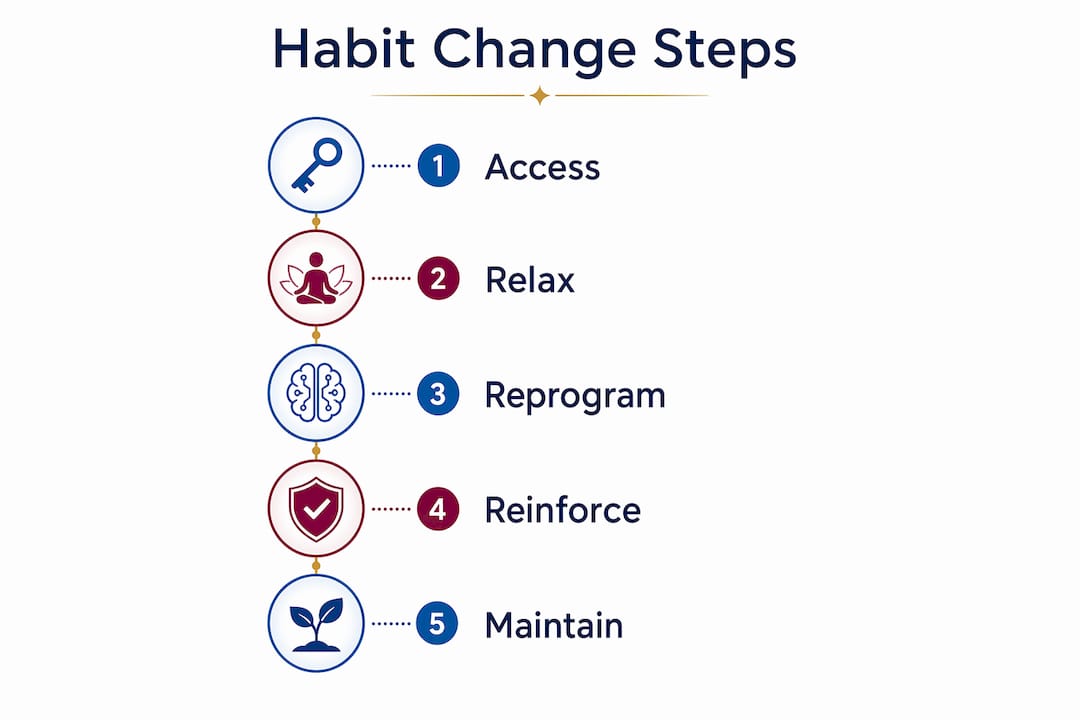
Suggestion during hypnosis works by helping you view a situation differently and adopt a new response. Over time, that new response integrates with your conscious values and goals. The old behavior fades not because you forced it out, but because the new one feels more natural.
The four-part habit loop that hypnotherapy targets works like this:
Notice the cue. Identify the specific trigger, whether it is stress, boredom, a time of day, or a physical sensation.
Interrupt the automatic motion. Pause before the old behavior fires.
Apply a calming signal. Use a breath, a word, or a physical anchor installed during hypnosis.
Perform the replacement behavior. Execute the new response you rehearsed in session.
Pro Tip: Write your cue and replacement behavior on paper before your first session. The more specific you are, the more precisely your therapist can tailor the suggestion script to your actual trigger.
What does clinical research say about hypnotherapy’s effectiveness?
The clinical evidence for hypnotherapy in habit change is strongest in weight management and behavioral modification programs. Incorporating hypnotherapy into behavioral weight management can approximately double average weight loss compared to behavioral treatment alone. Participants using hypnosis also show sustained results at long-term follow-up, while control groups tend to plateau.
That finding matters beyond weight loss. It tells us that hypnotherapy does not just produce short-term compliance. It changes the underlying pattern, which is why the results hold.
“Hypnotherapy reduces emotional resistance, enabling sustainable behavioral shifts by addressing subconscious emotional triggers. This makes change feel more natural and less forced, improving habit maintenance.”
For sleep, hypnotic suggestion increases slow-wave sleep and eases onset. A simple bedtime routine that pairs environmental cues with self-hypnosis techniques can reinforce these gains between sessions. Hypnotherapy for sleep improvement works through the same subconscious pathway as other habit changes: it replaces the anxious mental loop at bedtime with a calmer, rehearsed response.
For smoking cessation, the evidence is more variable. Hypnotherapy works best for smoking when it addresses the emotional trigger behind the urge, not just the physical act. Clients who identify their specific cue, such as stress after a meeting or a habitual post-meal smoke, and rehearse a concrete replacement, report stronger outcomes than those who use hypnosis as a general relaxation tool.
Credible hypnotherapy approaches always pair hypnosis with cognitive-behavioral techniques and lifestyle adjustments. Hypnotherapy is an adjunct, not a standalone cure. Treating it as a magic fix sets up unrealistic expectations and undermines the real work it can do.
What practical steps maximize hypnotherapy’s impact?
Applying hypnotherapy for behavior change requires structure. Vague intentions produce vague results. The following steps give the process the specificity it needs to work.
Define your cue precisely. “I feel stressed” is too broad. “I reach for my phone when I sit down at my desk after lunch” is a workable cue. The more specific the trigger, the more targeted the hypnotic suggestion can be.
Choose a concrete replacement behavior. The replacement must be realistic and available in the moment the cue fires. “Go for a two-minute walk” works. “Think positive thoughts” does not.
Keep sessions short and daily. Short rehearsal sessions followed by immediate application outperform long, infrequent meditations. An 8–12 minute daily session is more effective than a single 60-minute weekly session.
Apply the rehearsal in real life immediately. Hypnotherapy sessions function as mental rehearsals. Real change happens when the trigger fires in actual life and you execute the replacement behavior you practiced.
Adjust your environment. Environmental changes that remove cues for the old behavior compound the effect of hypnosis. If stress-eating is the habit, removing snacks from your desk is not willpower. It is cue elimination.
Balance guided and self-hypnosis. Guided sessions with a trained therapist establish the script and anchor. Self-hypnosis between sessions maintains the rehearsal. Both are necessary for durable change.
Pro Tip: Avoid using your hypnotherapy session as a reason to delay the real-world behavior. Sessions should prepare you for action, not replace it. If you finish a session and feel “done for the day,” that is a sign the session has become an avoidance ritual.
Combining hypnotherapy with CBT techniques gives you both the subconscious rehearsal and the conscious behavioral framework. The two approaches reinforce each other at different levels of the mind.
Common misconceptions about hypnotherapy for habit change
Several myths about hypnotherapy prevent people from using it effectively or cause them to abandon it too soon.
Hypnotherapy is not mind control. You remain aware and in control throughout a session. A therapist cannot make you do anything against your values or intentions.
It is not an instant cure. Neuroplasticity requires repetition. One session can shift perspective, but durable habit change takes consistent rehearsal over weeks.
It does not replace medical care. For habits tied to addiction, eating disorders, or chronic illness, hypnotherapy supports but does not substitute for medical or psychiatric treatment.
It does not work through relaxation alone. The relaxation is a vehicle for suggestion, not the mechanism of change. Falling asleep during a session means you missed the active ingredient.
Not all providers are equal. Practitioners who promise guaranteed results in one session or claim hypnotherapy cures specific diseases are making claims the evidence does not support.
Hypnotherapy accesses subconscious patterns that conscious willpower cannot reach, but it works by reducing emotional resistance, not by forcing new behavior. That distinction matters. Change feels less like fighting yourself and more like the old behavior simply losing its grip.
When habits involve complex emotional roots, such as trauma-linked eating, anxiety-driven insomnia, or compulsive behaviors tied to unresolved stress, exploring root causes through a structured clinical approach is necessary before or alongside hypnotherapy. Skipping that step limits results.
Key Takeaways
Hypnotherapy changes habits by targeting subconscious cue-response loops through focused suggestion and neuroplastic rehearsal, producing results that outlast conscious willpower efforts.
Point | Details |
Subconscious access | Hypnotherapy reaches the layer where habits are stored, bypassing conscious resistance. |
Neuroplasticity drives change | Short daily rehearsal of replacement behaviors rewires neural pathways more durably than long sessions. |
Evidence supports adjunct use | Adding hypnotherapy to behavioral programs can approximately double weight loss outcomes at long-term follow-up. |
Specificity is required | Naming your exact cue and replacement behavior makes hypnotic suggestion significantly more effective. |
Combine with behavioral tools | Pairing hypnotherapy with CBT and environmental changes produces the strongest and most lasting habit shifts. |
What I’ve learned from working with habits at the subconscious level
The clients who get the most from hypnotherapy are not the ones who believe in it most strongly. They are the ones who come in with a specific problem and a willingness to do the daily work between sessions. Belief helps, but structure is what actually produces change.
What surprises most people is how quickly the emotional charge around a habit can shift. A person who has tried to stop stress-eating for years can, after a few targeted sessions, find that the urge simply feels smaller. That is not magic. That is the subconscious receiving a clearer instruction than it ever got from a New Year’s resolution.
The limitation I see most often is people treating hypnotherapy as a passive experience. They come in, they relax, they feel better, and then they wait for the habit to disappear. It does not work that way. The session is the rehearsal. Real life is the performance. You have to show up for both.
At Hesketherapy, I integrate hypnotherapy with RTT, EMDR, and CBT because no single method addresses every layer of a habit. The subconscious script, the emotional memory, and the behavioral plan each need attention. When all three align, the change tends to be fast and durable in a way that single-method approaches rarely achieve.
— Heske
Hesketherapy’s approach to habit change through hypnotherapy
Persistent habits rarely respond to information alone. Knowing why a habit is harmful does not stop it from firing when the trigger hits.
Hesketherapy offers professional hypnotherapy sessions in Madrid and online, integrated with RTT, EMDR, and CBT to address the subconscious, emotional, and behavioral layers of habit change simultaneously. Each plan is built around your specific triggers and replacement behaviors, not a generic script. Whether you are working on weight management through hypnotherapy, sleep, smoking cessation, or another deeply rooted pattern, the approach is the same: precise, evidence-informed, and tailored to what is actually driving the behavior. You can explore professional hypnotherapy services in English, Spanish, or Dutch, in person or remotely.
FAQ
What is hypnotherapy habit change?
Hypnotherapy habit change is the clinical use of focused hypnosis to access subconscious cue-response loops and rehearse new behavioral responses, producing lasting shifts that willpower-based methods cannot reliably achieve.
How many sessions does it take to change a habit with hypnotherapy?
The number of sessions varies by habit complexity, but short daily self-hypnosis combined with regular guided sessions over several weeks produces the most durable results. One session can shift perspective; consistent repetition builds the new neural pathway.
Can hypnotherapy help with sleep improvement?
Yes. Hypnotic suggestion increases slow-wave sleep and eases sleep onset by replacing the anxious mental loop at bedtime with a calmer, rehearsed response. It works best when paired with consistent environmental sleep cues.
Is hypnotherapy safe for smoking cessation?
Hypnotherapy is safe and works best for smoking cessation when it targets the specific emotional trigger behind the urge rather than the physical act alone. It should be combined with a behavioral plan for the strongest outcomes.
Does hypnotherapy work if I am skeptical?
Skepticism does not block hypnotherapy from working, but active resistance does. Clients who engage with the process and complete daily rehearsal between sessions achieve results regardless of their initial level of belief.
Recommended