RTT Sleep Disorders Approach: What You Need to Know
- Heske Ottevanger
- Jul 11
- 8 min read


TL;DR:
Rapid Transformational Therapy targets the subconscious beliefs behind sleep disorders, addressing emotional causes CBT-I may overlook. It uses guided relaxation and personalized exploration to reframe deep-seated beliefs that block restful sleep. Combining RTT with good sleep hygiene and behavioral therapy enhances the chance of lasting sleep improvements.
Rapid Transformational Therapy (RTT) is a therapeutic method that targets the subconscious emotional patterns driving sleep disorders, including insomnia, fragmented sleep, and racing thoughts at night. The RTT sleep disorders approach works differently from conventional treatments because it goes beneath the surface behaviors to find the beliefs keeping you awake. While Cognitive Behavioral Therapy for Insomnia (CBT-I) remains the gold-standard first-line treatment, many people find their sleep problems persist because the emotional root cause stays untouched. RTT addresses exactly that gap, making it a meaningful complement to established sleep disorder treatment protocols.
What is the RTT sleep disorders approach?
RTT, formally known as Rapid Transformational Therapy, is a method developed by Marisa Peer that combines elements of hypnotherapy, cognitive behavioral techniques, and neuro-linguistic programming to access the subconscious mind. The goal is to identify and reframe the deep beliefs that interfere with natural sleep. For people researching RTT therapy for sleep, the core idea is straightforward: your subconscious mind runs patterns it learned earlier in life, and some of those patterns actively block rest.
RTT sessions use guided relaxation to bring the conscious mind into a quieter state. In that state, a trained therapist helps you locate the specific beliefs or memories that created your sleep problem. The process is not passive. You remain aware and engaged throughout, which is one reason clients often describe RTT as different from what they expected hypnotherapy to feel like.
The approach is particularly relevant for people whose sleep issues are tied to anxiety, stress, or unresolved emotional experiences. Hesketherapy applies RTT within an integrative framework that also draws on EMDR and CBT, giving clients multiple tools depending on what their sleep pattern requires.

What sleep challenges does RTT address?
RTT targets sleep problems that have a clear emotional or psychological component. The most common presentations include:
Difficulty falling asleep driven by an overactive mind that cannot switch off
Frequent nighttime awakenings linked to a subconscious sense of threat or hypervigilance
Shallow or unrefreshing sleep connected to chronic stress or unprocessed trauma
Racing thoughts at bedtime rooted in beliefs like “I must stay alert” or “I am not safe”
Performance anxiety around sleep where the fear of not sleeping becomes its own barrier
RTT identifies subconscious beliefs such as “I am not safe” or “I must stay alert” that underlie insomnia, then works to reprogram them toward restful sleep. That reprogramming is what separates RTT from approaches that only manage symptoms.
Sleep disorders also appear at high rates in people with neurodevelopmental conditions. Over 80% of individuals with Rett syndrome experience sleep disturbances that affect the whole family. That figure underscores how widespread and disruptive sleep problems are, and why personalized approaches matter.
Pro Tip: If you wake at the same time each night, note the time and any thoughts or feelings present. This pattern often points directly to the subconscious belief an RTT therapist will work to identify.
The emotional roots of sleep disorders are rarely obvious to the person experiencing them. Someone who lies awake worrying about work may not connect that habit to a childhood belief that they are only safe when they are in control. RTT creates space to make those connections visible and changeable.
How does RTT differ from CBT-I?
CBT-I and RTT target sleep problems from different angles. Understanding the distinction helps you decide which approach fits your situation, or whether both together make sense.
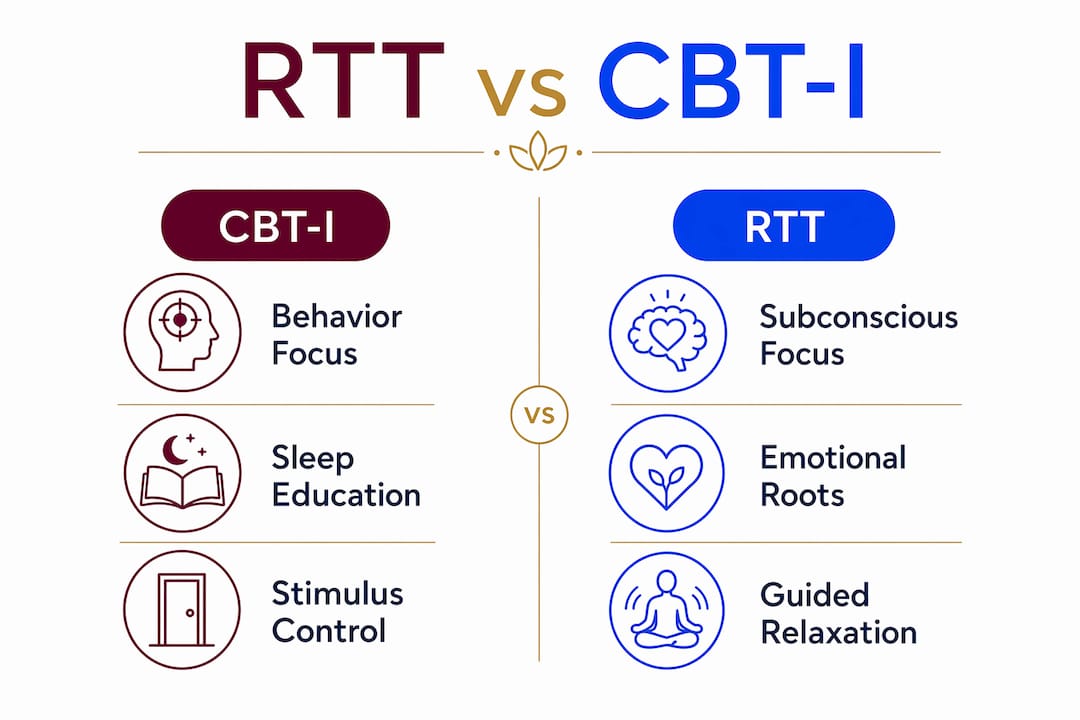
CBT-I includes stimulus control, sleep restriction, sleep education, and cognitive therapy targeting sleep-related thoughts and behaviors. It is structured, goal-oriented, and typically runs across 4–8 sessions. CBT-I achieves significant improvements in 70–80% of people with chronic insomnia. That success rate is why the American Academy of Sleep Medicine lists it as the preferred first-line treatment.
RTT works on a different level. Where CBT-I teaches you to change what you do and think around sleep, RTT asks why those unhelpful patterns exist in the first place. The subconscious exploration in RTT can surface memories, beliefs, or emotional experiences that CBT-I does not directly address.
Feature | CBT-I | RTT |
Primary focus | Behavior and thought patterns | Subconscious emotional beliefs |
Session structure | Structured, protocol-driven | Guided, individualized exploration |
Typical length | 4–8 sessions | 1–3 sessions, often with recordings |
Evidence base | Extensive clinical trials | Emerging, practitioner-reported |
Best suited for | Behavioral sleep habits | Emotionally rooted sleep blocks |
Combines well with | Medication, sleep hygiene | CBT-I, EMDR, sleep hygiene |
RTT does not replace CBT-I but may complement it by targeting emotional stress, trauma, and subconscious fear patterns that contribute to insomnia. The American Academy of Sleep Medicine recommends personalized treatment for insomnia, including behavioral therapies and, where appropriate, pharmacological support. RTT fits naturally into that personalized, multimodal picture.
What does an RTT session for sleep actually involve?
An RTT session for sleep follows a clear structure, though the content is always personal to you. Here is what the process typically looks like:
Initial conversation. The therapist gathers your sleep history, emotional patterns, and any significant life events. This shapes the session’s direction.
Guided relaxation. You are led into a deeply relaxed state. Your body rests while your mind stays engaged. This is not unconsciousness; it is focused attention turned inward.
Subconscious exploration. The therapist guides you to locate memories or beliefs connected to your sleep problem. RTT therapy sessions typically last 30–60 minutes and involve guided subconscious exploration tailored to individual emotional patterns. Root causes often include trauma, grief, stress, or performance pressure.
Belief reframing. Once a belief is identified, the therapist helps you understand it in a new way. A belief formed in childhood for protection may no longer serve you as an adult. RTT makes that shift explicit and felt, not just intellectually understood.
Transformation recording. Most RTT practitioners provide a personalized audio recording. Listening to it daily for 21 days reinforces the new belief pattern while you sleep or rest.
Pro Tip: Commit to the 21-day recording practice. The subconscious mind responds to repetition, and skipping days slows the reprogramming process significantly.
The session experience is often described as deeply relaxing and surprisingly clear. Clients frequently report that they understand their sleep problem differently after a single session. That clarity alone can reduce the anxiety around sleep, which is itself a significant barrier to rest. Hesketherapy integrates RTT with anxiety-focused techniques because anxiety and sleep disruption almost always overlap.
What does the evidence say about RTT for sleep?
The evidence base for RTT is still developing compared to CBT-I, but the clinical logic behind it is grounded in well-established neuroscience. The subconscious mind does govern automatic behaviors, including sleep onset and maintenance. Therapies that access and retrain those automatic patterns have a sound theoretical basis.
Combination treatment of behavioral therapy plus medication improves some insomnia outcomes over medication alone, but is not necessarily superior to behavioral therapy alone. That finding matters because it positions behavioral and subconscious approaches as the core of effective sleep treatment, with medication as a support rather than a solution.
“Managing chronic sleep issues depends heavily on consistency in sleep hygiene combined with personalized therapeutic approaches. Multimodal management, including sleep hygiene and tailored programs, shows the strongest clinical utility.” — Frontiers in Sleep, 2026
Consistent sleep hygiene, including regular routines, environment control, and fixed schedules, is foundational for improvement across all therapies. RTT practitioners at Hesketherapy treat sleep hygiene as a non-negotiable baseline, not an optional add-on. The subconscious work RTT does is most effective when the body’s physical sleep environment supports it.
Behavioral and educational sleep therapies are considered safe and useful when personalized, even in complex populations. That finding supports RTT’s individualized model, where no two sessions follow the same script. For people who have tried standard approaches and still struggle, RTT offers a different entry point into the same goal: restful, consistent sleep. You can read more about how sleep therapy works as a broader category before deciding which method fits your situation.
Key Takeaways
RTT addresses sleep disorders by targeting the subconscious emotional beliefs that behavioral therapies alone do not reach, making it most effective when combined with strong sleep hygiene and, where appropriate, CBT-I.
Point | Details |
RTT targets root causes | RTT identifies beliefs like “I am not safe” that drive insomnia, not just surface behaviors. |
CBT-I remains first-line | CBT-I achieves 70–80% improvement rates and is the gold-standard starting point for chronic insomnia. |
Sessions are personalized | RTT sessions run 30–60 minutes and are tailored to your specific emotional patterns and history. |
Sleep hygiene is foundational | Consistent routines and environment control improve outcomes across every therapeutic approach. |
Multimodal treatment wins | Combining RTT with behavioral therapy and sleep hygiene produces the most durable results. |
What I’ve learned from working with RTT clients on sleep
The clients who come to me with sleep problems have almost always tried the obvious fixes first. They’ve cut caffeine, bought blackout curtains, and downloaded sleep apps. Some have completed CBT-I. And yet they still lie awake at 2:00 AM with a mind that refuses to stop.
What RTT reveals, consistently, is that the problem is not the bedroom or the habits. The problem is a belief the nervous system formed years ago that says rest is not safe. That belief runs silently in the background, overriding every behavioral strategy the person tries. Once you surface it and reframe it, the behavioral tools they already have start working.
The commitment piece is real. RTT is not a passive experience. Clients who listen to their transformation recording daily and pair it with honest sleep hygiene see the clearest results. Clients who treat it as a one-time fix tend to plateau. The subconscious responds to repetition, and that requires patience.
My honest view is that RTT works best as part of a broader plan, not as a standalone cure. For expats in Madrid dealing with sleep issues tied to relocation stress, RTT combined with counseling and sleep hygiene coaching produces results that neither approach achieves alone. Sleep is not just a behavior. It is a state of felt safety. RTT helps people get there.
— Heske
RTT and sleep therapy at Hesketherapy
Hesketherapy offers RTT sessions specifically designed for people whose sleep problems have an emotional or subconscious component. Sessions are available online and in-office in Madrid, in English, Spanish, and Dutch, making them accessible for international clients and expatriates who need culturally sensitive care.
If you have tried behavioral approaches and still struggle to sleep, RTT may address what those methods could not reach. Hesketherapy’s RTT therapy services combine subconscious exploration with practical sleep strategies for lasting results. A free discovery call is the first step. You can also explore self-hypnosis for relaxation as a daily support tool between sessions.
FAQ
What is RTT therapy for sleep disorders?
RTT therapy for sleep disorders is a subconscious-focused approach that identifies and reframes the emotional beliefs driving insomnia and related sleep problems. It uses guided relaxation and inner exploration to access patterns that behavioral therapies do not directly address.
How many RTT sessions does it take to improve sleep?
Most clients see meaningful shifts within 1–3 sessions, supported by a personalized transformation recording used daily for 21 days. The recording reinforces new subconscious patterns during the critical post-session period.
Can RTT replace CBT-I for insomnia?
RTT does not replace CBT-I, which achieves significant improvement in 70–80% of chronic insomnia cases and is the recommended first-line treatment. RTT works best as a complement, targeting emotional roots that CBT-I does not directly address.
Is RTT effective for anxiety-related sleep problems?
RTT is particularly effective when sleep problems are driven by anxiety, hypervigilance, or unresolved stress, because it targets the subconscious beliefs behind those states. Hesketherapy combines RTT with EMDR and CBT for clients where anxiety and sleep disruption overlap.
What should I do alongside RTT to improve my sleep?
Consistent sleep hygiene, including fixed wake times, a dark and cool sleep environment, and a wind-down routine, is foundational for all sleep therapies including RTT. Strong adherence to these habits significantly improves outcomes from any therapeutic approach.
Recommended
Comments