Therapy Session Structure Explained: What to Expect


TL;DR:
A therapy session is a structured, time-limited meeting designed to promote emotional processing and skill development. Its three-part framework—check-in, main work, and reflection—provides a safe container that enhances engagement and progress. The initial session focuses on assessment and rapport, while subsequent sessions adapt flexibly to individual needs and intensity.
A therapy session is defined as a structured, time-limited meeting between a client and a licensed therapist, designed to create a safe space for emotional processing and skill-building. Understanding the therapy session structure explained in this article removes the guesswork before your first appointment. Most people feel anxious walking in not because therapy is hard, but because they don’t know what happens inside the room. The three-part framework used across most evidence-based approaches, including CBT, EMDR, and Rapid Transformational Therapy (RTT), gives every session a clear beginning, middle, and end.
What are the main components of a therapy session?
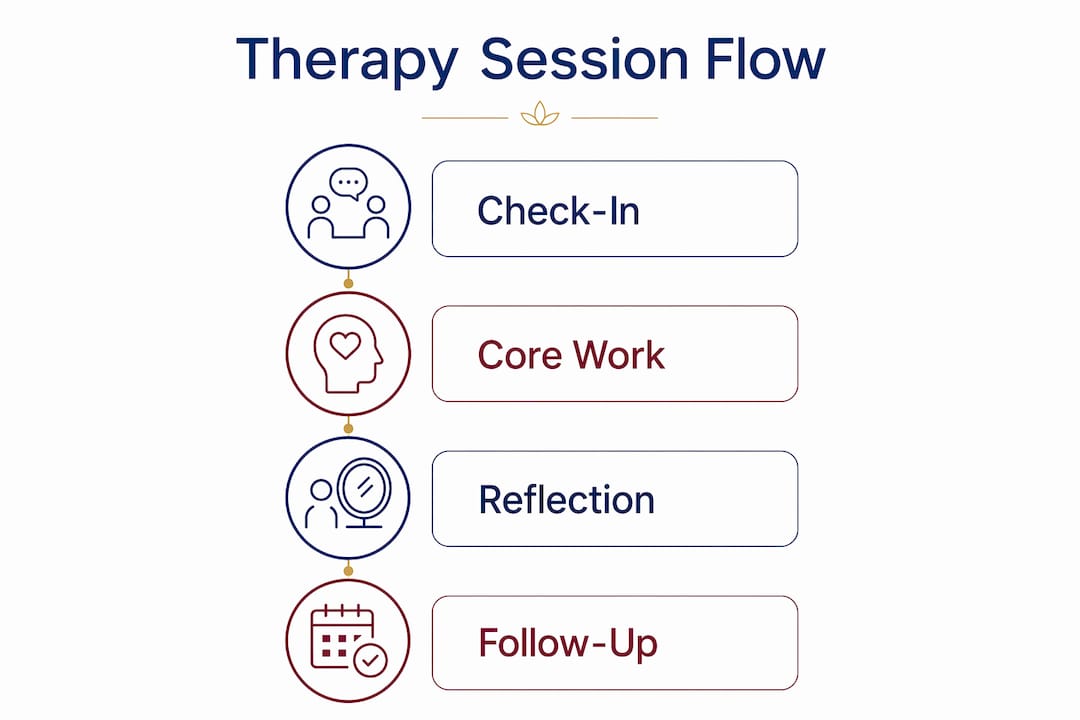
A standard therapy session lasts approximately 45–50 minutes and follows a three-part outline: introduction, main therapeutic work, and closing reflection. Each phase has a distinct purpose, and knowing them in advance makes the experience far less intimidating.
The opening check-in (5–10 minutes)
The session opens with a brief check-in. Your therapist asks how you’ve been since the last appointment, what’s on your mind today, and whether anything urgent has come up. This phase sets the agenda for the session. It’s not small talk. It’s a clinical tool that helps the therapist calibrate where you are emotionally and what the session needs to focus on.
The main therapeutic work (30–40 minutes)
The core of the session is where the real work happens. Depending on the approach, this might involve talking through a specific event, practicing a CBT technique like cognitive restructuring, processing a memory with EMDR, or working through a limiting belief using RTT. The therapist guides the conversation with intention. They are not just listening passively. They are tracking patterns, noticing what you avoid, and choosing when to push gently and when to hold back.
Cognitive Behavioral Therapy (CBT): Identifies and challenges unhelpful thought patterns.
EMDR: Uses bilateral stimulation to process traumatic memories.
RTT (Rapid Transformational Therapy): Combines hypnotherapy and CBT to access and reframe root beliefs.
Counseling: Focuses on talk-based exploration of emotions and experiences.
Skill-building exercises: Breathing techniques, grounding practices, or journaling prompts.
The closing reflection (5–10 minutes)
Sessions end with a structured closing that identifies what stood out and what remains open for the next appointment. This phase is not an afterthought. It consolidates the session’s insights and gives you something concrete to carry forward. Your therapist may assign a small reflection task or simply ask what felt most significant.
Pro Tip: Write down one sentence after each session that captures your biggest takeaway. Over time, these notes reveal patterns you won’t notice in the moment.
How does the first therapy session differ from ongoing sessions?
The first therapy session focuses on intake and familiarization rather than deep therapeutic work. Think of it as a mutual interview. You are assessing whether this therapist is a good fit. They are gathering the information they need to help you effectively.
Here is what typically happens in an initial session:
Personal history: Your therapist asks about your background, current challenges, and what brought you to therapy now.
Goal setting: You discuss what you hope to get out of therapy, even if your answer is “I’m not sure yet.” That’s a valid starting point.
Confidentiality: Your therapist explains what stays private and the narrow legal exceptions. This is foundational to building trust.
Session flow: They walk you through how sessions typically work so you know what to expect going forward.
No pressure to perform: You are not expected to have clarity, the right words, or a tidy narrative.
Clients often leave the first session feeling surprised by how much ground they covered without it feeling heavy. That’s intentional. The therapist’s job in session one is to make you want to come back. You are also fully within your rights to set boundaries by telling your therapist there are topics you’re not ready to discuss. That boundary will be respected without question.
What flexibility exists within the therapy session structure?
Therapy structure is flexible, not rigid. It creates emotional safety without locking the session into a script. Some sessions are deeply reflective. Others are practical and skill-focused. A few will feel emotionally intense. All of these are normal.
Here is how session pacing typically adapts:
Client-led priorities: If something significant happened during the week, the therapist shifts focus to address it rather than sticking to a pre-planned topic.
Emotional intensity: When a client reaches a breakthrough or becomes distressed, the therapist slows down and holds space rather than pushing forward.
Silence as a tool: Silence in sessions is intentional. It creates space for internal noticing and lets insights surface without being rushed.
Skill-building vs. processing: Some sessions lean toward teaching a technique. Others focus entirely on processing an experience. The balance shifts based on where you are in your progress.
Therapist adaptation: An experienced therapist reads the room continuously and adjusts pacing, tone, and depth in real time.
The structure is the container. What goes inside it changes every week.
Pro Tip: If a session feels off-track or you’re not getting what you need, say so. Telling your therapist “I’d like to focus on something specific today” is not rude. It’s exactly the kind of self-advocacy that makes therapy work.
Feeling emotionally drained after a session is not a sign that something went wrong. Post-session exhaustion often signals deep engagement and active therapeutic processing. It means the work is happening.
How long are therapy sessions and how often do they occur?
A standard session runs 45–50 minutes, sometimes called a “therapy hour” even though it’s slightly shorter. That length is not arbitrary. It balances enough depth to do meaningful work with enough containment to keep the session manageable. Sessions that run longer can leave clients feeling ungrounded.

Session frequency typically starts at once per week and shifts to biweekly as the client builds stability and internal resources. The right frequency depends on the presenting issue, the therapy method, and your own schedule and capacity.
Session type | Typical length | Common frequency |
Initial intake session | 60–75 minutes | Once (first appointment) |
Standard ongoing session | 45–50 minutes | Weekly |
Maintenance or check-in session | 45–50 minutes | Biweekly or monthly |
Intensive session (e.g., EMDR, RTT) | 90–120 minutes | As clinically indicated |
Session length and frequency are always decided collaboratively. Your therapist will not lock you into a rigid schedule without discussing what works for your life. If you want to understand how personalized therapy adapts these variables to individual goals, that framework is worth exploring before you book.
What should clients do to prepare for a therapy session?
Therapy is collaborative and nonjudgmental. You do not need perfect explanations, a clear agenda, or the “right” feelings. Showing up authentically is the only requirement.
That said, a little preparation makes sessions more productive:
Reflect on the past week: Notice what felt hard, what shifted, or what kept coming up in your thoughts. You don’t need to analyze it. Just notice.
Identify one focus area: If you have something specific you want to address, name it at the start of the session. Your therapist will work with it.
Write down questions: If you’re curious about the therapy process itself, ask. Good questions to bring include: “What approach are you using with me and why?” or “How will I know I’m making progress?”
Give yourself transition time: Arrive a few minutes early or log in before an online session. Rushing in stressed makes it harder to settle into the work.
Know your limits: You are always allowed to say “I’m not ready to go there today.” Declining a topic is a healthy use of your agency, not avoidance.
A useful resource for thinking through what to ask your therapist is this checklist for therapy questions, which is especially practical for clients new to structured therapy. For a deeper look at how healing practices build on session-by-session reflection, that framework complements what most therapists teach in the closing phase.
Pro Tip: Don’t wait until you feel “ready enough” to start therapy. Most people who benefit most from it started when they felt the least prepared.
Key Takeaways
A therapy session’s three-part structure, consisting of check-in, core work, and closing reflection, creates the safety and focus that make real change possible.
Point | Details |
Three-part session structure | Every session includes a check-in, main therapeutic work, and a closing reflection. |
Standard session length | Most sessions run 45–50 minutes, with intensive formats running up to 120 minutes. |
First session is intake-focused | The initial appointment builds rapport and gathers history rather than diving into deep work. |
Structure is flexible | Therapists adapt pacing, focus, and depth to meet your needs each week. |
Authenticity beats preparation | Showing up honestly matters more than having the right words or a clear agenda. |
Why session structure matters more than most clients realize
Clients often come to me focused on the method: “Is this CBT? Is it EMDR? What exactly will you do?” That’s a fair question. But in my experience, the structure of the session matters just as much as the technique inside it.
Structure is what makes the room feel safe. When you know a session has a beginning, a focused middle, and a clear end, your nervous system can relax into the work. Without that container, even the best technique lands on anxious ground.
What I’ve found is that clients who understand the session flow from the start engage more deeply and progress faster. They stop spending mental energy wondering what comes next and start actually being present. That shift is significant.
The flexibility within the structure is equally important. A session that follows a rigid script regardless of what you bring in that day is not good therapy. Real clinical work means reading the room, following the client’s lead, and knowing when to hold back. The structure is the frame. The client fills the canvas.
One thing I tell clients at Hesketherapy: feeling uncertain before your first session is completely normal. The structure exists precisely to hold that uncertainty. You don’t need to arrive with answers. You just need to arrive.
— Heske
Structured therapy sessions at Hesketherapy
Hesketherapy offers individual therapy sessions in Madrid and online, using structured approaches that combine EMDR, RTT, CBT, counseling, and hypnotherapy. Each session follows the three-part framework described in this article, adapted to your specific goals and pace. Whether you’re dealing with anxiety, burnout, trauma, or sleep issues, the session structure is designed to give you clarity and progress from the first appointment. Hesketherapy works with English-speaking clients in Madrid and internationally, with sessions available in English, Spanish, and Dutch. You can start with a free discovery call to understand how sessions are organized before you commit. Book your first counseling session and see what structured therapy actually feels like.
FAQ
How long is a typical therapy session?
A standard therapy session runs 45–50 minutes. Intensive formats like EMDR or RTT may run 90–120 minutes depending on the clinical need.
What happens in the first therapy session?
The first session focuses on intake: your therapist collects personal history, discusses your goals, explains confidentiality, and outlines how sessions work. Deep therapeutic work typically begins in subsequent sessions.
Do I need to prepare before a therapy session?
No specific preparation is required. Reflecting briefly on the past week and identifying one area to focus on can help, but showing up authentically is enough.
Is silence in therapy sessions normal?
Silence is a deliberate therapeutic tool. It creates space for reflection and lets insights surface without being rushed. Your therapist uses it intentionally, not as a sign that something has gone wrong.
How often should I attend therapy sessions?
Most clients start with weekly sessions and shift to biweekly as they build stability. Frequency is always decided collaboratively based on your goals, progress, and schedule.
Recommended
Comments