Multilingual Therapy Process: A Step-by-Step Guide
- Heske Ottevanger
- Jun 10
- 9 min read


TL;DR:
Multilingual therapy enhances emotional depth and promotes genuine healing by using a client’s preferred language. It requires culturally competent therapists trained in evidence-based methods, language proficiency, and cultural humility to be effective. This structured approach involves deliberate language choice, switching techniques, and ongoing adaptation to optimize therapeutic outcomes across cultures.
The multilingual therapy process is the structured practice of delivering mental health care across two or more languages, chosen by the client, to maximize emotional precision and therapeutic outcomes. For expatriates, immigrants, and international professionals, this is not a convenience. It is the difference between surface-level coping and genuine healing. Language and culture are inseparable in shaping how mental health care lands, which means the language you speak in therapy directly affects how deeply you can access and process your emotions. Hesketherapy works with clients in English, Spanish, and Dutch, and what follows is the clearest guide available to understanding how this process works and why it matters.
What the multilingual therapy process actually involves
Multilingual therapy, also referred to as language-concordant care in clinical literature, goes far beyond a therapist who happens to speak two languages. The industry term “language-concordant care,” used by organizations like Oak Health Center, describes a model where the client’s preferred language drives every stage of treatment, from intake to discharge. Bilingual therapy is a matter of equity, not a niche add-on, because language barriers actively exclude people from care that is fully accessible and respectful of their identity.

The core benefit is emotional precision. When you speak your mother tongue, you access memories, family dynamics, and emotional vocabulary that simply do not translate word-for-word into a second language. Clients working with Hesketherapy in Madrid frequently describe the relief of switching from formal English to their native Dutch or Spanish mid-session, not because they lack vocabulary, but because the feeling they need to express only exists in one language. That precision accelerates progress in ways that monolingual therapy cannot replicate.
What qualifications should multilingual therapists have?
The role of multilingual therapists requires more than fluency. A therapist who speaks Spanish but was trained exclusively in a Northern European clinical framework may miss the cultural weight behind phrases like “me da vergüenza” (I feel shame) or the family loyalty dynamics embedded in many Latin American clients’ presenting problems. Linguistic fluency alone is insufficient. Cultural competency and humility are equally required.
In 2026, industry standards for multilingual mental health care emphasize three combined competencies:
Clinical training in evidence-based modalities such as CBT, EMDR, or RTT, delivered with awareness of how those models were developed and for whom
Language proficiency at a level sufficient for emotional nuance, not just conversational exchange. This means understanding idioms, metaphors, and culturally specific expressions of distress
Cultural humility, which means the therapist actively recognizes the limits of their own cultural lens and invites the client to define their own experience rather than fitting it into a preset framework
Care in a client’s preferred language improves comfort discussing stigma-laden topics and increases diagnostic accuracy. This matters enormously for expats navigating anxiety, burnout, or trauma in a country where the dominant language is not their own.
Pro Tip: When evaluating a multilingual therapist, ask directly: “In which languages have you received clinical supervision?” Supervision in the working language is a stronger indicator of competency than conversational fluency.
The distinction between language fluency and cultural competence is not academic. A therapist may speak perfect Mandarin but have no framework for understanding the role of filial piety in a client’s depression. Dual attention to language and emotional process is what separates effective multilingual therapy from a bilingual conversation.
How does the multilingual therapy process work step by step?
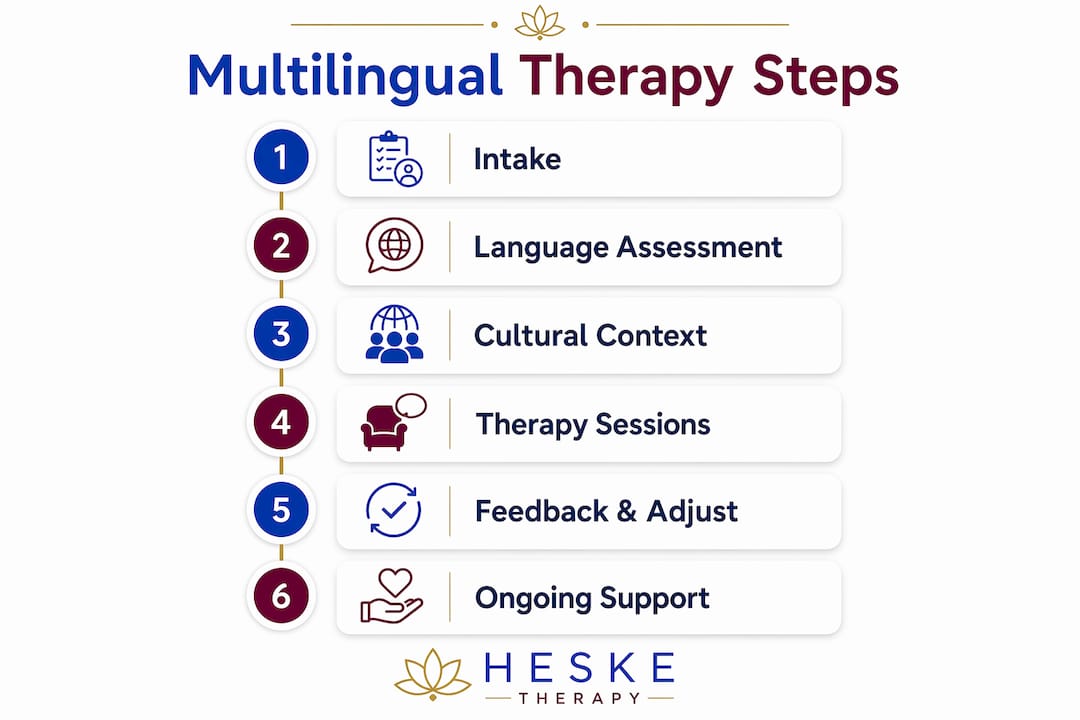
The process follows a clear structure, though it adapts to each client’s cultural background and emotional needs.
Language preference and cultural intake. The first session includes an explicit conversation about which language or languages the client wants to use, and why. A client from the Netherlands living in Madrid may want sessions in English for professional distance, Dutch for emotional depth, or Spanish to practice integration. Each choice carries therapeutic meaning.
Goal-setting with cultural context. The therapist and client define therapeutic goals while accounting for cultural values. Collectivist backgrounds may frame goals around family harmony rather than individual achievement. Individualist frameworks may prioritize autonomy. Neither is wrong. Both must be recognized.
Session conduct with language flexibility. During sessions, the therapist tracks which language the client reaches for when emotions intensify. Clients feel more precise emotional expression when they can switch languages to access cultural identity and regulate emotions effectively. This is not disorganized. It is a deliberate therapeutic tool.
Language switching as a clinical technique. The therapist may gently invite a language shift when a client appears stuck. Moving from a second language to the mother tongue often unlocks emotional material that was blocked. The reverse is also true. Therapy in a second language can create useful psychological distance for processing difficult topics, which is why some clients prefer to discuss trauma in their non-native language first.
Review and adaptation. Progress is reviewed regularly, including whether the language choices are still serving the client’s goals. This is not a fixed contract. It evolves.
Pro Tip: Before your first session, write down three emotions you struggle to express in your second language. Bring that list to your intake. It gives your therapist immediate insight into where language and emotion intersect for you.
Approach | Best suited for | Key advantage |
Mother tongue focus | Trauma, early childhood work, grief | Deepest emotional access and release |
Second language focus | Processing recent events, building distance | Reduces emotional overwhelm, increases reflection |
Bilingual switching | Complex identity work, expat adjustment | Mirrors real-life experience, maximizes flexibility |
What language therapy techniques enhance cross-cultural sessions?
Specific language therapy techniques define what separates a skilled multilingual therapist from one who simply speaks multiple languages. These methods are grounded in cross-cultural therapy methods and applied moment to moment during sessions.
Code-switching as a therapeutic tool. Code-switching, the practice of alternating between languages within a conversation, is not a sign of confusion. In multilingual therapy, it is a signal. When a client switches languages mid-sentence, a trained therapist reads that as an emotional shift and responds accordingly. Clients bound emotionally to their mother tongue experience faster therapeutic progress when therapy includes that language, particularly when exploring early family dynamics.
Culturally responsive validation. This technique requires the therapist to explicitly acknowledge the cultural context of a client’s experience before applying any clinical framework. For an expat in Madrid dealing with burnout, that might mean recognizing the cultural pressure to perform professionally in a foreign language before addressing the cognitive distortions underneath.
Linguistic idiom interpretation. Idioms and cultural references must be contextually interpreted to maintain emotional authenticity. A Dutch client saying “ik voel me leeg” (I feel empty) carries different clinical weight than the same phrase translated into English, because the cultural context of emotional expression differs between the two languages.
Collaborative language negotiation. Clients benefit from explicit discussions with their therapist about language-switching preferences. This is not a one-time intake question. It is an ongoing conversation that helps both parties navigate emotional thresholds together.
Technique | Clinical purpose | When to use it |
Code-switching | Emotional access and regulation | When client shifts language spontaneously |
Culturally responsive validation | Build trust and reduce stigma | At the start of culturally loaded topics |
Idiom interpretation | Preserve emotional authenticity | When direct translation loses meaning |
Language negotiation | Client agency and safety | At intake and at regular review points |
What are common challenges in multilingual therapy?
The multilingual therapy process carries specific challenges that both clients and therapists need to anticipate.
Translation technology has real limits. Translation tools lack the linguistic adaptability and cultural sensitivity required for trauma and emotional discussions. Apps like Google Translate can handle logistics. They cannot hold space for grief. When technology is used as a supplement, hybrid models combining human interpreters with translation tools perform better than technology alone, because human interpreters provide the empathy and trust that software cannot replicate.
Emotional blockages tied to language. Some clients find that certain emotions are simply inaccessible in one language. This is not a personal failure. It is a neurological reality. The brain encodes emotional memories in the language context in which they were formed. A therapist who understands this will not push through the block but will work around it by inviting the client to try expressing the feeling in a different language.
Confidentiality with interpreters. When a professional interpreter joins a session, confidentiality agreements must be explicit and documented. Clients have the right to know who is in the room, in what capacity, and under what ethical obligations.
Finding qualified multilingual therapists. Ask prospective therapists about their clinical training in each language, not just their conversational ability. Platforms that specialize in therapy for international clients are a more reliable starting point than general directories.
“Language is not just a vehicle for therapy. It is the therapy itself. When a client finds the word that finally names what they feel, something shifts. That moment only happens in the right language.”
Key takeaways
Effective multilingual therapy requires language-concordant care, cultural humility, and deliberate language-switching techniques to unlock emotional depth that monolingual therapy cannot reach.
Point | Details |
Language choice drives outcomes | Clients express and process emotions more precisely in their preferred language, accelerating progress. |
Cultural competence is non-negotiable | Therapists must combine clinical training with cultural humility, not just fluency. |
Language switching is a clinical tool | Shifting languages mid-session is a deliberate technique for accessing or regulating emotion. |
Technology supplements, not replaces | Translation tools support logistics but cannot provide the empathy required for trauma work. |
Client agency matters | Explicit, ongoing conversations about language preferences strengthen the therapeutic alliance. |
Why language in therapy is more than a preference
Working with expats in Madrid across English, Spanish, and Dutch has shown me something that clinical literature confirms but rarely states plainly: the language a client chooses is not about comfort. It is about truth. I have sat with clients who could describe their anxiety fluently in English but could only feel it in Dutch. The English version was accurate. The Dutch version was real.
What concerns me about the current state of multilingual mental health care is the gap between availability and quality. Many therapists list multiple languages on their profiles without the cultural training to work in those languages at depth. A client who books a session in their mother tongue and receives culturally tone-deaf care is not just underserved. They are actively harmed, because they came in trusting that the language would create safety.
The equity argument for bilingual counseling is not abstract. For an expat managing burnout, trauma, or anxiety in a foreign country, access to care in their own language is the difference between engaging with treatment and abandoning it. I believe the field needs to hold therapists to a higher standard: clinical supervision in every language they offer, not just conversational competency. Until that becomes the norm, clients need to ask harder questions before they commit to a therapist.
The future of multilingual therapy is not just about adding languages. It is about deepening the cultural intelligence behind each one. That is the work worth doing.
— Heske
Multilingual therapy at Hesketherapy
Hesketherapy offers counseling sessions in English, Spanish, and Dutch, both online and in-office in Madrid, specifically designed for expatriates and international clients navigating anxiety, burnout, trauma, and emotional challenges across cultural contexts. Every session is built around your language preference and cultural background, not a one-size-fits-all protocol. Whether you are looking to book a single session or a structured package, the process starts with a free discovery call to discuss your language needs and therapy goals. For clients who want consistent, committed support, online session packages offer flexibility without sacrificing depth. Your language is not a barrier here. It is the starting point.
FAQ
What is the multilingual therapy process?
The multilingual therapy process is a structured approach to mental health care where sessions are conducted in the client’s preferred language or across multiple languages to improve emotional access, cultural connection, and therapeutic outcomes. It includes language preference assessment, culturally responsive goal-setting, and deliberate language-switching techniques.
How does language switching work in therapy sessions?
Language switching in therapy is a clinical technique where the therapist and client shift between languages to access deeper emotional material or create helpful psychological distance. Clients often reach for their mother tongue when emotions intensify, and a trained therapist uses that shift as a therapeutic signal.
Can translation technology replace a multilingual therapist?
Translation technology cannot replace a multilingual therapist. Studies show these tools lack the cultural sensitivity required for trauma and emotional processing, and hybrid models that combine human interpreters with technology still depend on human empathy for therapeutic alliance.
What should I look for in a multilingual therapist?
Look for a therapist with clinical training and supervision in each language they offer, not just conversational fluency. Ask specifically about their experience with cross-cultural therapy methods and whether they have worked with clients from your cultural background.
Is multilingual therapy only for people who are not fluent in one language?
Multilingual therapy is not limited to people with language barriers. Many fluent bilingual clients choose it because certain emotions are encoded in specific languages, and accessing those emotions requires working in the language where they were originally formed.
Recommended
Comments