Psychotherapy and Self-Esteem: Transforming Expat Life

Moving to Madrid brings excitement but also unexpected challenges for many English-speaking expatriates. Facing new languages, cultural shifts, and professional doubts can make even the most confident person question their worth. When your self-esteem takes a hit, it does more than cause discomfort—it may lead to anxiety and impact your adjustment in both work and relationships. This article breaks down the basics of self-esteem and psychotherapy solutions tailored for expats, offering clear strategies that encourage real emotional growth and renewed confidence.
Table of Contents
Key Takeaways
Point | Details |
Understanding Self-Esteem | Self-esteem influences how expatriates perceive their worth and can affect social and professional integration in a new environment. |
Impact of Low Self-Esteem | Low self-esteem can lead to professional withdrawal, reduced resilience, and increased mental health issues like anxiety and depression for expatriates. |
Psychotherapy Approaches | Various therapies such as Cognitive Behavioral Therapy and Rapid Transformational Therapy can help in developing a more stable sense of self-worth. |
Addressing Expat Barriers | Language, cultural barriers, and professional identity challenges necessitate seeking therapists who understand the expatriate experience for effective treatment. |
Defining Self-Esteem and Psychotherapy Basics
Self-esteem is fundamentally about how you perceive your own worth. It’s the sum total of all those beliefs you hold about yourself—whether you’re capable, deserving of good things, and valuable as a person. More precisely, self-esteem is the degree to which the qualities and characteristics contained in one’s self-concept are perceived to be positive. This includes your physical self-image, your view of your accomplishments and capabilities, and how well you believe you’re living up to your own values. It also encompasses how you think others perceive and respond to you. For expatriates in Madrid navigating a new culture, language barriers, and professional environments, self-esteem often becomes the foundation for either thriving or merely surviving.
Here’s what’s crucial: self-esteem exists on a spectrum. On one end, you have low self-esteem involving feelings of worthlessness and actively disliking yourself. On the other end, high self-esteem means liking yourself and believing in your intrinsic worth regardless of external circumstances. For many expats, the transition abroad disrupts their self-esteem dramatically. You’re stripped of familiar social networks, professional recognition, and cultural context. Suddenly, you’re questioning whether you’re good enough in a new language, whether your qualifications mean anything here, whether you belong. This is precisely why self-esteem therapy specifically designed for expats addresses these particular pressures. A reasonably high degree of self-esteem is considered important for mental health, whereas low self-esteem and feelings of worthlessness are common symptoms of depression and anxiety—conditions that frequently affect expatriates adjusting to life abroad.
Psychotherapy, at its core, is a structured process designed to help you identify and transform the beliefs and patterns that undermine your sense of worth. It’s not about positive thinking or forcing yourself to feel better. Instead, psychotherapy involves addressing the underlying negative beliefs that keep you stuck. The goal specifically related to self-esteem is to work toward a more positive and stable sense of self-worth that isn’t dependent on external validation or whether you’re performing perfectly in your new environment. Various approaches exist, from cognitive behavioral therapy that examines thought patterns to rapid transformational therapy that works with your subconscious to create lasting shifts in how you perceive yourself. These approaches work because they don’t just manage symptoms; they get to the root of why you internalized negative beliefs about yourself in the first place.
Pro tip: Before starting therapy, write down three specific situations where your self-esteem took a hit since moving to Madrid—this gives your therapist concrete material to work with and helps you track genuine progress over weeks, not just feelings.
How Low Self-Esteem Affects Expat Life
When you move to Madrid, you’re not just changing your address. You’re stepping into an environment where your credentials might not translate directly, where your accent marks you as an outsider, where professional hierarchies work differently than back home. Low self-esteem in this context becomes far more than just feeling bad about yourself. It actively undermines your ability to integrate into your new life. Research shows that low self-esteem impedes professional adjustment and increases psychological withdrawal during expatriate assignments. You might find yourself avoiding networking events, staying silent in meetings, or assuming you’re not qualified for opportunities that actually match your experience. Instead of building momentum and confidence in your new role, you spiral inward, withdrawing from exactly the professional and social connections that would help you settle in.
The ripple effects go deeper than your work life. Low self-esteem tends to create a pattern of underestimating your own performance and capabilities across both social and professional domains. As an expat, this means you might dismiss genuine compliments from colleagues, blame yourself excessively when things go wrong, or assume that friendships aren’t genuine because you can’t believe people actually want to spend time with you. This undermines your resilience precisely when you need it most. Facing unfamiliar challenges—navigating Spanish bureaucracy, learning workplace norms, building social circles from scratch—requires confidence that things will work out. When low self-esteem erodes that confidence, even manageable problems feel insurmountable. You struggle to bounce back from setbacks. Your motivation dips. The integration that could happen naturally instead becomes a painful, exhausting effort where you’re constantly questioning whether you belong.
Perhaps most concerning is how low self-esteem affects your mental health during the expat experience. You’re already dealing with the psychological strain of adaptation, cultural adjustment, and distance from your support systems. Layer in low self-esteem, and anxiety and depression become far more likely. You might isolate yourself, convincing yourself you’re too awkward or insufficient to maintain friendships. You might work excessively to prove your worth. You might develop physical stress responses like sleep problems or tension. Building emotional resilience as an expat requires a foundation of self-worth that says “I’m capable of handling this challenge” and “I deserve good relationships and experiences.” Without that foundation, every difficulty feels personal, every setback confirms your worst beliefs about yourself, and your overall wellbeing suffers.
The good news is that this pattern is entirely reversible. Your low self-esteem isn’t a permanent character flaw. It’s a learned belief system, which means it can be unlearned. When you address the root causes through targeted therapy, you simultaneously improve your work adjustment, strengthen your relationships, and protect your mental health. You move from surviving Madrid to actually thriving here.
Pro tip: Track one specific area where low self-esteem impacts you most—whether it’s work situations, social interactions, or decision-making—and bring concrete examples to your first therapy session rather than vague feelings.
Psychotherapy Approaches for Self-Esteem Issues
When it comes to treating low self-esteem, there’s no one-size-fits-all solution. Different approaches work for different people, depending on how your low self-esteem developed, what maintains it, and what resonates with you personally. Cognitive Behavioral Therapy (CBT) stands as one of the most researched and effective approaches. The core idea is straightforward: your beliefs about yourself shape your feelings and behaviors. If you believe you’re not good enough, you’ll interpret situations through that lens, avoid challenges, and dismiss your accomplishments. CBT works by identifying these negative core beliefs about personal adequacy and systematically challenging them with evidence from your actual life. For expats in Madrid, this might mean examining the belief “I’m not good enough to succeed here” by looking at concrete evidence: projects you’ve completed, positive feedback you’ve received, problems you’ve solved. Over time, this practice rewires how you perceive yourself.

Rapid Transformational Therapy (RTT) takes a different approach by working directly with your subconscious mind, where many of these beliefs were formed in the first place. Instead of spending months gradually shifting thoughts, RTT aims for rapid change by identifying the root cause of your low self-esteem, often tracing it back to a specific event or repeated messaging you internalized. Once identified, the therapy uses hypnotic techniques to reprogram these core beliefs at the subconscious level. This is particularly valuable for expats because it bypasses the logical mind that might be telling you “I should feel confident” while your subconscious is broadcasting “You don’t belong here.” The goal isn’t to ignore reality but to align your subconscious beliefs with your actual capabilities and worth. Many clients report significant shifts in how they perceive themselves within just a few sessions.
Other complementary approaches include mindfulness-based interventions and compassion-focused therapy, both of which address how you relate to yourself moment-to-moment. Rather than trying to fight negative thoughts, these approaches teach you to observe them without judgment and develop genuine compassion for yourself. This matters because many people with low self-esteem are harshly self-critical, treating themselves with contempt they’d never direct at a friend. Mindfulness helps you notice when you’re being that inner critic and choose a kinder response. Compassion-focused therapy goes further by deliberately cultivating warmth and understanding toward yourself, especially during difficult moments. Hypnotherapy can work particularly well for shifting your mindset around these ingrained patterns, making it easier to sustain self-compassion rather than relying on willpower alone. Research shows these approaches lead to increased self-acceptance and better management of negative thoughts, which directly translates to improved resilience and social connection.
The reality is that effective treatment often combines multiple approaches. You might use CBT to identify and challenge specific distorted thoughts, RTT to address root causes in your subconscious, and mindfulness to build an ongoing practice of self-compassion. During your initial consultation, a skilled therapist will assess which approach or combination makes sense for your situation. They’re not choosing based on what’s popular or what they specialize in exclusively, but what will actually work for you based on how your low self-esteem operates.
Pro tip: Before your first session, notice one situation this week where low self-esteem held you back and write down what you believed about yourself in that moment—this gives your therapist concrete material to address rather than working with abstract feelings.
Here’s a comparison of leading psychotherapy approaches for self-esteem issues:
Approach | Core Technique | Typical Timeframe | Notable Strength |
Cognitive Behavioral Therapy (CBT) | Identifying and challenging negative beliefs | 8-16 sessions | Strong research evidence |
Rapid Transformational Therapy (RTT) | Hypnotic and subconscious reprogramming | 1-3 sessions | Rapid lasting changes |
Mindfulness-Based Therapy | Observing thoughts non-judgmentally | Ongoing | Improved self-compassion |
Compassion-Focused Therapy | Cultivating self-kindness | Ongoing | Reduces harsh self-criticism |
Evidence: Therapy Methods and Lasting Impact
You might be wondering whether therapy actually works, and whether the results stick around or fade once you stop going to sessions. The evidence is compelling. A systematic review and meta-analysis of 19 randomized controlled trials examined psychotherapy specifically for depression and its impact on self-esteem. The findings showed that psychotherapy yields sustained improvements in self-esteem at post-treatment and continuing through 6 to 12 months of follow-up. This matters tremendously because it means the gains aren’t temporary feel-good moments. They persist. You’re not just getting short-term relief; you’re building lasting changes in how you perceive yourself. Cognitive Behavioral Therapy demonstrated the strongest evidence in these studies, though improvements across multiple approaches were linked to overall reductions in depressive symptoms. This tells you something important: self-esteem doesn’t exist in isolation. When you address the underlying depression and anxiety that often accompany low self-esteem, your sense of self-worth naturally improves as part of a broader mental health transformation.
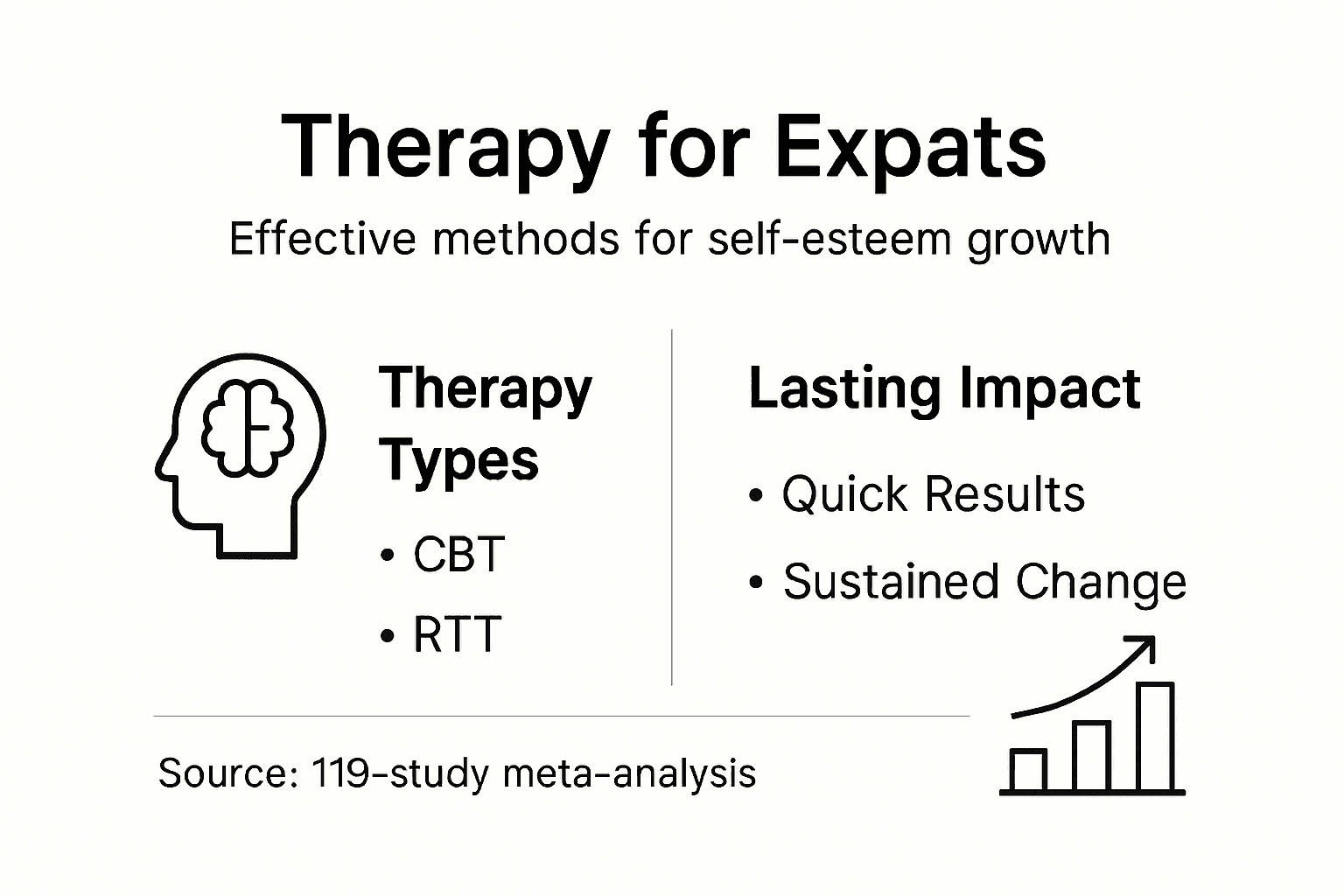
But the evidence goes even deeper when you look at self-esteem interventions more broadly. A meta-analysis covering 119 studies on self-esteem interventions found significant positive effects on global self-esteem in adults. More importantly, the research identifies which specific techniques generate the longest-lasting results. Interventions incorporating cognitive restructuring, behavioral activation, and self-compassion techniques produced the most sustained benefits for long-term self-esteem enhancement. Notice what these have in common: they’re not about artificially boosting your confidence or pretending problems don’t exist. Cognitive restructuring means examining and changing distorted thought patterns. Behavioral activation means actually doing things that build competence and connection. Self-compassion means treating yourself with the kindness you deserve. These are active, substantive changes in how you operate, not superficial affirmations.
For expats specifically, this evidence base matters because you’re dealing with compounded challenges. You’re not just addressing low self-esteem; you’re addressing it while managing cultural adjustment, professional uncertainty, and social isolation. The various therapy methods available for expatriates have been adapted to account for these specific pressures. Rapid Transformational Therapy, EMDR, CBT, and hypnotherapy all show efficacy, but what matters is selecting the approach that addresses your particular situation. Someone struggling with identity loss after relocating might benefit from one approach, while someone wrestling with perfectionism in a new job might benefit from another. The research supports combining methods when needed. Your therapist isn’t locked into one technique; they’re using evidence-based approaches flexibly to match your needs.
Perhaps most reassuring is that these improvements don’t require months or years of therapy. Studies show meaningful shifts in self-esteem and symptom reduction within 8 to 16 sessions on average, with some approaches like RTT targeting rapid changes even more quickly. You’re not signing up for a never-ending process. You’re investing in a focused intervention that produces measurable results. After therapy ends, the research demonstrates that gains remain stable. You’ve essentially learned a new way of perceiving and relating to yourself, and that skill set persists. This is why many people find therapy to be genuinely transformative rather than just temporarily helpful.
Pro tip: Ask your therapist at your initial consultation how they’ll measure progress and what timeframe they anticipate for noticeable improvements, then track specific situations weekly where your self-esteem impacts decisions so you have concrete data rather than just subjective feelings.
Overcoming Barriers: Myths, Risks, and Expat Needs
If you’re hesitating about therapy, you’re not alone. Many expatriates carry misconceptions that prevent them from seeking help despite needing it. The most persistent myth is that therapy means you’re broken or weak. The reality is the opposite. Therapy requires courage. It means looking honestly at yourself, being willing to change, and investing in your own wellbeing. Another common myth is that talking about your problems makes them worse. In fact, stigma and misconceptions about psychotherapy effectiveness remain significant obstacles especially for expatriates from cultures where mental health is discussed quietly or avoided entirely. When you actually talk about what’s troubling you with a trained professional, you gain clarity. You’re no longer carrying it alone in your head. A third myth is that therapy is indefinite and expensive. As we discussed earlier, meaningful changes happen within 8 to 16 sessions on average. You’re not committing to years of weekly appointments.
Beyond myths, real barriers exist that specifically affect expats considering therapy. Language and cultural barriers top the list. If English isn’t your first language, explaining nuanced emotional experiences to a therapist who doesn’t understand your cultural background feels risky. This is precisely why seeking a therapist who specializes in working with expatriates matters so much. They understand that your low self-esteem isn’t just about personal inadequacy; it’s shaped by cultural displacement, professional uncertainty in a new system, and the specific pressures of building a life from scratch. They also understand that online therapy for expats can provide culturally sensitive solutions when in-person options feel uncomfortable. Cost and access represent another barrier. Some expats worry therapy is prohibitively expensive or that their health insurance won’t cover it. Many practices, including those specializing in expat clients, offer flexible payment options and work with various insurance providers. Fear of change is subtle but powerful. You’ve adapted to low self-esteem as a survival mechanism. It’s familiar, even though it’s painful. Part of you might worry that changing how you perceive yourself will alienate you from who you’ve been or damage relationships. This fear is real, and addressing client-related factors like motivation and fear of change through tailored strategies enhances both therapy retention and outcomes.
Expats face unique risks that domestic populations don’t encounter. Isolation compounds mental health challenges. You lack the extended family, long-term friendships, and community networks that typically cushion emotional struggles. When low self-esteem hits in this context, there’s no automatic safety net. Professional identity disruption creates additional pressure. Your credentials might not transfer directly, your expertise might be undervalued, or you’re starting from scratch in your career. This attacks your sense of competence precisely when you’re trying to build confidence in a new environment. Cultural identity confusion emerges as you adapt to Spanish norms while maintaining your heritage. You’re caught between two worlds, and low self-esteem whispers that you don’t fully belong in either. These aren’t standard therapy situations; they require therapists who understand the expatriate experience specifically. When you find someone who gets this context, therapy becomes far more effective because you’re not spending sessions explaining your background.
The path forward requires acknowledging these barriers and addressing them directly. Choose a therapist who speaks your language fluently and understands expatriate psychology. Be honest about what scares you about therapy. Ask specific questions about how they’ll measure progress and what changes you can expect. Clear communication between you and your therapist transforms potential barriers into opportunities for targeted work. You’re not just treating low self-esteem in isolation; you’re addressing it within the specific context of your expatriate life. That tailored approach is what creates lasting transformation.
To summarize key factors that influence expat progress in therapy:
Barrier or Risk | Common Impact on Expats | Solution or Strategy |
Language/Cultural Barriers | Hinders open communication | Seek expat-specialist therapists |
Cost and Insurance Limits | Restricts therapist access | Use flexible payment, check coverage |
Isolation Abroad | Heightens emotional struggles | Build new support networks |
Professional Identity Disruption | Reduces confidence | Address career transfer concerns |
Cultural Identity Confusion | Undermines sense of belonging | Explore integration in therapy |
Pro tip: During your free discovery call, ask the therapist directly about their experience working with expats from your country of origin and what they see as your specific cultural and psychological landscape—this tells you whether they truly understand your context.
Transform Your Self-Esteem and Thrive as an Expat in Madrid
Low self-esteem can deeply affect your ability to adapt and succeed in a new country like Spain. Feeling undervalued or uncertain often leads to professional setbacks, social isolation, and emotional distress. If you find yourself doubting your worth or struggling to navigate the complex challenges of expat life, specialized psychotherapy focused on rebuilding your self-esteem can be the solution you need. At Heske Therapy, we understand how critical a positive and stable sense of self-worth is for expatriates facing cultural adjustment, career changes, and identity concerns.
Start your journey toward lasting change with a tailored treatment plan combining proven methods such as Rapid Transformational Therapy, Cognitive Behavioral Therapy, and hypnotherapy. Our experienced therapists offer culturally sensitive support in English and other languages designed specifically for expatriates. Don’t let low self-esteem hold you back from enjoying the full potential of your life in Madrid. Visit Heske Therapy today to schedule your free discovery call and take the first step to thriving with confidence.
Frequently Asked Questions
What is self-esteem and how does it affect expats?
Self-esteem is the perception of your own worth and capabilities. For expats, low self-esteem can hinder professional integration, lead to feelings of isolation, and worsen mental health during the adjustment period.
How can psychotherapy help improve self-esteem for expatriates?
Psychotherapy can help identify and address the negative beliefs contributing to low self-esteem. Approaches like Cognitive Behavioral Therapy (CBT) and Rapid Transformational Therapy (RTT) target the subconscious beliefs, leading to improved self-worth and resilience in new environments.
What types of therapy are effective for addressing self-esteem issues?
Effective therapies include Cognitive Behavioral Therapy (CBT), which challenges negative beliefs, and Rapid Transformational Therapy (RTT), which reprograms subconscious thoughts. Mindfulness-based and compassion-focused therapies also promote self-kindness and resilience.
How long does it typically take to see improvements in self-esteem through therapy?
Most individuals experience noticeable changes in self-esteem within 8 to 16 therapy sessions, especially with focused interventions like CBT and RTT. Long-lasting improvements can continue beyond the therapy period.
Recommended
Comments