Role of CBT in Anxiety: Lasting Relief for Expats

Stress from navigating a new life in Madrid can leave even the most resilient expatriates feeling overwhelmed by anxiety and burnout. Adjusting to unfamiliar routines, cultural differences, and professional pressures often compounds emotional distress. For English-speaking expats looking for fast, practical support, Cognitive Behavioral Therapy (CBT) is a structured, evidence-based approach that teaches you how to change anxious thought patterns and build lasting coping skills, providing a proven path to emotional relief without endless talking.
Table of Contents
Key Takeaways
Point | Details |
CBT Effectiveness | CBT is a time-efficient, evidence-based treatment for various anxiety disorders, yielding measurable results within weeks. |
Personalization is Key | Customizing CBT for individual backgrounds and expat challenges enhances engagement and outcomes. |
Technique Variety | Techniques like cognitive restructuring and exposure therapy address negative thought patterns and avoidance behaviors effectively. |
Comparison with Other Therapies | CBT outperforms many other therapies due to its structured approach and ability to instill long-term skills for anxiety management. |
CBT Fundamentals in Anxiety Treatment
Cognitive Behavioral Therapy, or CBT, is a structured, goal-oriented approach developed in the 1960s by Aaron Beck. It works by identifying how your negative thought patterns drive emotional distress and anxiety. You’re not stuck with these patterns—CBT teaches you to challenge and change them.
The core principle is simple: your thoughts, feelings, and behaviors are connected. When you shift one, the others follow.
How CBT Addresses Anxiety
CBT is evidence-based for anxiety treatment, helping with panic disorder, social anxiety, generalized anxiety, and specific phobias. Unlike open-ended therapy, CBT follows a structured timeline with clear goals. Sessions are focused, practical, and measurable.
Here’s what makes CBT effective for expats:
Specific targets — You identify exact anxiety triggers and behaviors to address
Homework between sessions — Real-world practice reinforces learning
Quick measurable results — Many see improvement within 8-12 weeks
Portable skills — You take techniques with you long after therapy ends
Core Components
CBT involves three interconnected areas:
Identifying negative thought patterns — The thoughts fueling your anxiety often feel automatic. CBT makes them visible so you can examine them.
Examining the evidence — You learn to test whether your anxious thoughts match reality. This isn’t positive thinking; it’s honest thinking.
Behavioral experiments — Exposure therapy gradually confronts feared situations, reducing avoidance behaviors that maintain anxiety. You face what you fear in safe, controlled ways.
For expats in Madrid, CBT’s structured approach works well alongside your busy life. Sessions are finite, measurable, and designed for people who want results without endless talking.
CBT is a time-efficient, evidence-based intervention supported by decades of research across anxiety disorders worldwide.
Pro tip: Start tracking one specific anxiety trigger this week—when it happens, write down what you thought, felt, and did. This self-awareness is where CBT begins.
Types of Anxiety Disorders Addressed by CBT
CBT isn’t a one-size-fits-all treatment, but it works remarkably well across multiple anxiety conditions. Whether you’re dealing with panic attacks, social situations, or intrusive thoughts, CBT has proven techniques to address each.
The beauty of CBT is that it targets the same underlying patterns—negative thinking and avoidance behaviors—regardless of which anxiety disorder you’re facing. This universality is why therapists worldwide rely on it.

Specific Disorders CBT Treats
CBT’s efficacy across anxiety disorders is well-established. Here are the main conditions where CBT delivers results:
Here’s a summary of common anxiety disorders and how CBT adapts approaches for each:
Anxiety Disorder | Typical Symptoms | Unique CBT Focus |
Generalized Anxiety Disorder | Persistent worry, muscle tension | Challenge overestimation of threat |
Panic Disorder | Sudden fear, heart palpitations | Break panic-fear response cycle |
Social Anxiety Disorder | Fear of judgment, avoidance | Boost confidence via exposure |
Specific Phobias | Intense object/situation fears | Gradual, safe desensitization |
PTSD | Flashbacks, avoidance, hypervigilance | Safely process traumatic memories |
Generalized Anxiety Disorder (GAD) — Constant worry about multiple areas of life. CBT teaches you to challenge catastrophic thinking and reduce physical tension.
Panic Disorder — Sudden, intense panic attacks with physical symptoms. CBT breaks the cycle of fear feeding more panic.
Social Anxiety Disorder — Fear of judgment or embarrassment in social settings. Exposure exercises gradually rebuild confidence around people.
Specific Phobias — Intense fear of particular objects or situations (heights, flying, animals). Gradual exposure desensitizes you safely.
PTSD — Trauma-related anxiety and flashbacks. CBT helps process traumatic memories and reduce triggers.
Why CBT Works Across These Disorders
Despite different triggers, anxiety disorders share common patterns. You avoid situations that trigger anxiety, which actually strengthens the fear. You interpret normal physical sensations as danger. You catastrophize about unlikely outcomes.
CBT addresses all three patterns, which is why it works across the spectrum. You’re not just managing symptoms—you’re changing how your brain processes threat.
For Expats in Madrid
Many expats experience anxiety from relocation stress, cultural adjustment, and social isolation. These create a mixed presentation of GAD, social anxiety, and situational panic.
CBT works particularly well because it’s practical and time-bound. You don’t need years of therapy to see results.
CBT remains the gold-standard psychological treatment for a broad spectrum of anxiety disorders globally.
Pro tip: Identify which specific anxiety disorder resonates most with your experience—this clarity helps your therapist tailor CBT techniques to your exact challenges.
How CBT Techniques Reduce Anxiety Symptoms
CBT works by interrupting the cycle that keeps anxiety alive. Your anxious thoughts trigger avoidance, which confirms the danger feels real, which strengthens the anxiety. Breaking this cycle is how you get lasting relief.
The process involves three interconnected shifts: changing how you think, changing what you do, and rewiring how your brain processes fear.
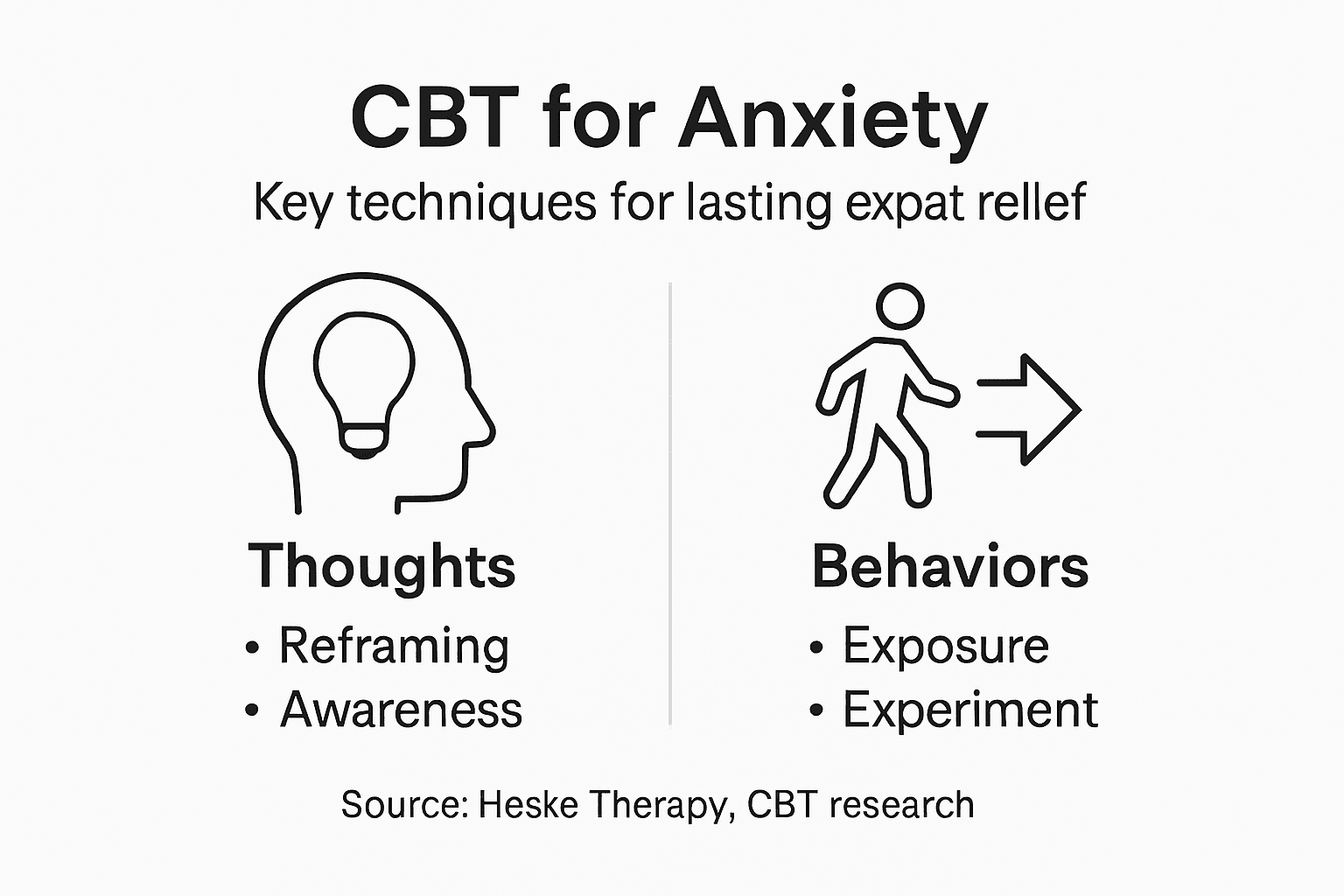
The Mechanism Behind Symptom Reduction
CBT enhances brain regions responsible for emotion regulation while reducing activity in fear-processing areas. This isn’t just psychology—your brain actually changes during treatment. When you confront feared situations safely, your brain learns the threat isn’t real.
This dual-route approach combines cognitive and behavioral work:
Cognitive interventions — Challenge the thoughts fueling your anxiety
Behavioral exposure — Face situations you’ve been avoiding
Combined effect — Your brain normalizes its fear response
Key Techniques That Work
Cognitive restructuring helps you identify thought distortions. You catch yourself thinking “This will be a disaster” and ask: What evidence supports this? What’s a more realistic thought? Over time, catastrophic thinking loses its grip.
Exposure therapy is the most powerful behavioral tool. You gradually confront feared situations in safe, controlled ways. Each time you face what you feared without the predicted disaster happening, anxiety decreases. The fear response literally extinguishes.
Behavioral experiments test whether your anxiety predictions are accurate. You might worry that speaking up in meetings will humiliate you. The experiment: speak up and observe what actually happens. Reality usually contradicts your fear.
Why These Techniques Work for Expats
CBT reduces anxiety by identifying and modifying negative patterns of thought and behavior. For expats, this is particularly effective because your anxiety often stems from specific, identifiable situations—social interactions, work stress, cultural adjustment.
You’re not treating vague unease. You’re targeting concrete patterns you can see and change.
CBT breaks the cycle of avoidance and erroneous threat perception through targeted cognitive and behavioral interventions.
Pro tip: Start with one small feared situation this week—something manageable but anxiety-provoking. Do the exposure, observe what actually happens, and notice how the anxiety decreases.
Personalizing CBT for Diverse Expat Needs
Standardized CBT protocols work well as a foundation, but they don’t account for your unique situation as an expat. Your therapist needs to adapt the approach to match your background, values, and specific challenges in Madrid.
One-size-fits-all therapy is why some people don’t see results. Personalized CBT is why they do.
Why Customization Matters
Culturally adapted CBT has demonstrated significant effectiveness across diverse populations, including expatriates and immigrants worldwide. When therapy respects your cultural values and language preferences, you engage more fully. The work feels relevant to your actual life, not a generic template.
Personalization goes beyond language translation. It means adjusting therapy content, delivery style, and how your therapist interacts with you.
What Makes CBT Personalized for Expats
Your therapist should tailor CBT by addressing:
Cultural values — How your background shapes what you fear, what shame means, and how you handle emotions
Language preferences — Whether you think most clearly in English or your native language
Expat-specific stressors — Visa uncertainty, family distance, workplace dynamics, social isolation
Your goals — Anxiety relief that lets you build the life you came to Madrid to create
Practical constraints — Your schedule, budget, whether you need online or in-person sessions
Key Personalization Strategies
Individualized attention makes a measurable difference. Rather than rushing through protocol steps, your therapist explores what matters to you. They adjust exercises to fit your real circumstances.
Flexible homework acknowledges your expat reality. Instead of generic anxiety worksheets, assignments reflect situations you actually face—networking events, video calls home, navigating Spanish bureaucracy.
Therapeutic partnership means you and your therapist agree on what to work on and how. Patients value agreement on therapeutic tasks tailored to their life context, which improves engagement and results.
The Practical Impact
When CBT is personalized, you move faster. Your brain isn’t working to translate generic examples into your situation. The therapy fits immediately.
You’re also more likely to stick with it. Treatment feels designed for you, not delivered to you.
Personalized CBT improves treatment engagement and outcomes for clients from various backgrounds facing unique expat experiences.
Pro tip: In your first therapy session, explicitly discuss your background, what brought you to Madrid, and what success looks like for you—this information lets your therapist customize CBT from day one.
Comparing CBT With Other Anxiety Therapies
You’ve probably heard about multiple therapy options for anxiety—medication, mindfulness, psychodynamic therapy, and others. How does CBT stack up against these alternatives?
The evidence is clear: CBT performs exceptionally well. But understanding the differences helps you choose what’s right for your situation.
CBT vs. Medication
CBT is comparable in efficacy to pharmacotherapy for generalized anxiety disorder. Both reduce symptoms effectively. The key difference: medication works while you take it; CBT teaches skills you keep.
Many people combine both. Starting with medication can stabilize you enough to engage in therapy. Then therapy becomes the long-term solution.
For expats, this matters practically. You won’t always have consistent access to your prescriber in Madrid. CBT skills travel with you.
CBT vs. Other Psychological Therapies
CBT compares favorably with psychodynamic therapy and mindfulness-based interventions for anxiety. All three help, but they work differently:
Psychodynamic therapy — Explores childhood patterns and unconscious conflicts. Takes longer, less structured.
Mindfulness-based therapy — Teaches acceptance of anxious thoughts. Works well as a supplement.
CBT — Directly targets anxious thoughts and avoidance behaviors. Fastest results, highly structured.
Delivery Matters: Individual vs. Group vs. Remote
Research shows that individual and group CBT outperform treatment as usual. Remote CBT increases accessibility but may be slightly less effective than in-person work.
For expats, this is practical. You might start with online CBT, then transition to in-person sessions in Madrid as you settle in.
See how leading anxiety therapies compare on key features:
Aspect | CBT | Medication | Psychodynamic | Mindfulness-Based |
Duration | 8–20 sessions | Ongoing use | Several months–years | Varies, often weekly |
Long-Term Skills | Teaches self-management | Skills not learned | Insight over time | Acceptance, awareness |
Evidence Strength | High for anxiety | High for some cases | Moderate | Moderate |
Accessibility | In-person/remote options | Prescription needed | Specialist required | Group/individual formats |
CBT Stands Out for Time-Strapped People
CBT is goal-oriented and time-limited. You’re not committing to years of open-ended therapy. You get measurable progress within weeks or months.
Other therapies often require longer commitment. If you’re busy managing expat life, CBT’s efficiency matters.
Combination Therapy Works Best
Combination therapy shows superior quality of life benefits compared to single modalities. CBT paired with medication or mindfulness creates stronger outcomes.
You don’t have to choose one. Strategic combinations maximize results.
CBT maintains a robust evidence base as a leading evidence-based psychological therapy for anxiety disorders globally.
Pro tip: Ask your therapist whether combining CBT with other approaches makes sense for your specific anxiety—the evidence supports mixing modalities when appropriate.
Find Lasting Anxiety Relief With Personalized CBT at Heske Therapy
If you are an expat in Madrid struggling with anxiety triggered by cultural adjustment, social isolation, or relocation stress, you are not alone. This article highlights how Cognitive Behavioral Therapy (CBT) targets patterns like avoidance and negative thinking to break the cycle of anxiety. At Heske Therapy, we specialize in delivering personalized CBT tailored to your unique background and challenges. We understand the importance of culturally sensitive, efficient, and measurable therapy that fits your busy expat lifestyle.
Our clinical team combines CBT with integrative methods such as Rapid Transformational Therapy and EMDR to accelerate your progress toward lasting emotional balance and confidence. Whether you prefer online or in-office sessions, all treatment plans are customized to your goals and designed to give you practical tools you can carry forward. Explore how our approach can help you overcome anxiety and embrace the life you came to Madrid to build.
Start your journey toward relief today at Heske Therapy for expert care crafted specifically for English-speaking expatriates. Learn more about CBT and anxiety treatment and how personalized therapy makes a difference in true recovery.
Looking for effective, compassionate support in managing anxiety? Take the first step now.
Visit Heske Therapy and schedule a free discovery call to unlock personalized CBT strategies that work for you.
Frequently Asked Questions
What is Cognitive Behavioral Therapy (CBT)?
CBT is a structured, goal-oriented psychological treatment that focuses on identifying and changing negative thought patterns that contribute to emotional distress and anxiety.
How effective is CBT for treating anxiety disorders?
CBT has been proven to be effective for several anxiety disorders, including generalized anxiety disorder, panic disorder, social anxiety disorder, and specific phobias. Many individuals notice improvement within 8-12 weeks.
What are the core components of CBT?
The core components of CBT include identifying negative thought patterns, examining the evidence for these thoughts, and engaging in behavioral experiments to confront feared situations safely.
How can expats benefit from CBT in managing anxiety?
Expats can benefit from CBT as it offers a structured and time-efficient approach to address specific anxiety triggers and equips individuals with portable skills that can be utilized long after therapy ends.
Recommended
Comments