RTT Inner Child Healing: Rewire Your Subconscious Mind


TL;DR:
RTT inner child healing uses hypnosis to access and reprogram subconscious childhood patterns. It offers rapid results, typically within 3 to 4 sessions, by targeting root causes of emotional issues. The process involves regression, belief reframing, and reinforcement through personalized audio, leading to lasting change.
RTT inner child healing is a therapeutic method that uses Rapid Transformational Therapy to access and reprogram the subconscious patterns formed during childhood. These patterns drive adult anxiety, low self-worth, emotional blocks, and self-sabotage. RTT combines hypnotherapy, CBT, NLP, and psychotherapy into a single, focused process that targets root causes rather than surface symptoms. Most clients see significant results within 3–4 sessions. That speed is not a marketing claim. It reflects RTT’s core design: go directly to the source.
What is RTT inner child healing and why does it matter?
Inner child healing is a clinically grounded approach, not a self-help trend. The “inner child” refers to the emotional and behavioral patterns encoded in your nervous system during early life. When childhood needs go unmet, or when attachment is disrupted by neglect, criticism, or instability, the brain stores those experiences as rules for survival. Those rules run silently in adulthood, shaping how you respond to rejection, conflict, and self-worth.

Inner child work addresses real emotional patterns encoded in the nervous system, and it requires somatic integration for full trauma resolution. That means the body must be part of the healing process, not just the thinking mind. Talking about a painful memory is different from actually releasing it at a physiological level.
Research-based models like schema therapy and Internal Family Systems (IFS) both incorporate inner child work. Schema therapy and IFS show reductions in core schema activation and improved emotion regulation. These are not fringe approaches. They are used in clinical settings worldwide to treat complex trauma, personality disorders, and chronic emotional dysregulation.
What makes inner child therapy distinct from general counseling is its focus on origin. Most people know their triggers. Fewer people know why those triggers exist or where they came from. Inner child work answers that question directly. It locates the specific childhood experience that created the belief, and it updates that belief with new information.
The key reasons inner child healing produces lasting change:
Root cause focus: It addresses the original wound, not just the current symptom.
Belief reprogramming: It replaces maladaptive childhood schemas with accurate, adult-informed perspectives.
Nervous system regulation: Healing happens at the somatic level, not just the cognitive level.
Emotional integration: Buried feelings get acknowledged and processed, reducing their grip on present behavior.
Self-compassion building: Clients learn to relate to their younger selves with care rather than shame.
How does RTT specifically facilitate inner child healing?
RTT works by using hypnosis to bypass the critical, analytical mind and access the subconscious directly. This is where childhood memories, decisions, and emotional imprints are stored. Standard talk therapy operates at the conscious level. RTT goes deeper, faster.
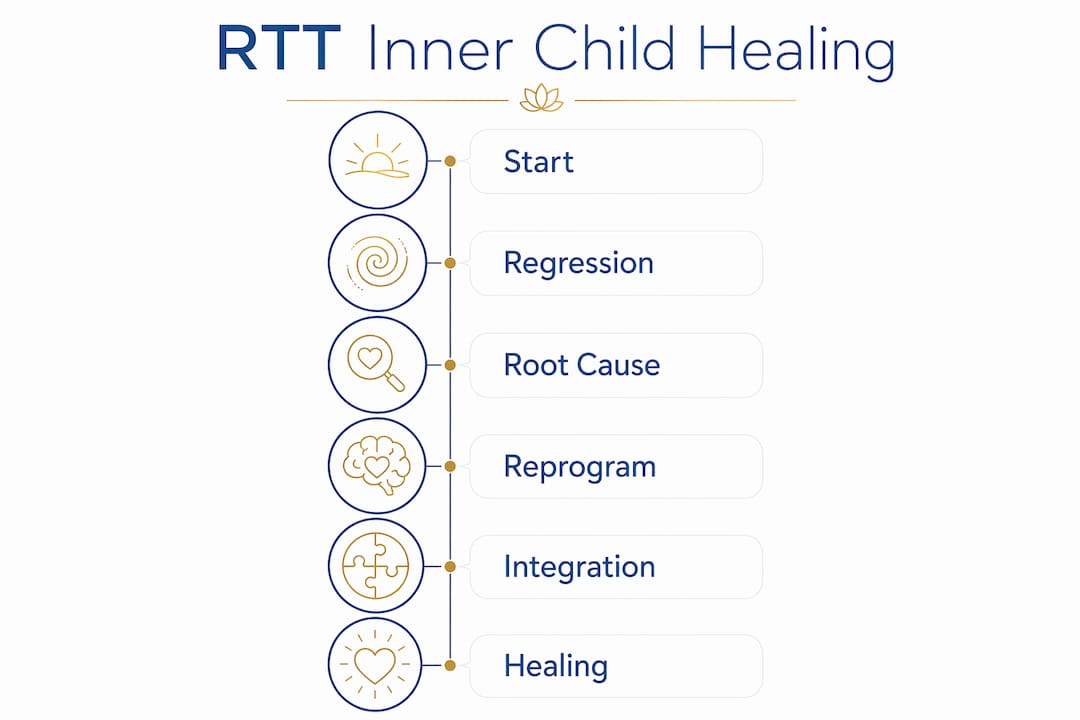
The process follows a clear structure. Here is what a typical RTT treatment plan looks like:
Intake and intention setting. The therapist works with you to identify the presenting issue, whether that is anxiety, low self-esteem, relationship patterns, or a specific phobia. You clarify what you want to feel differently about.
Hypnotic induction. The therapist guides you into a relaxed, focused state. You remain aware and in control throughout. Hypnosis in RTT is not sleep. It is a state of heightened receptivity.
Scene regression. The subconscious surfaces memories connected to the root cause. These are often childhood scenes you have not thought about in years. The therapist helps you examine them from an adult perspective.
Reframing and belief transformation. Once the origin of a limiting belief is identified, the therapist helps you update the meaning you assigned to that experience. A child who was told they were “too sensitive” can now understand that sensitivity is a strength, not a flaw.
Belief installation. New, empowering beliefs are embedded through direct suggestion while you are in the hypnotic state. The subconscious accepts these more readily than the conscious mind would.
Custom audio reinforcement. Clients receive personalized audio to listen to daily for 21 days after each session. This consolidates the new belief patterns and supports ongoing neural rewiring.
RTT sessions build progressively, with each session addressing a specific issue and leading to cumulative healing. Clients frequently report automatic improvements in unrelated areas once a core root cause is resolved. That ripple effect is one of RTT’s most consistent outcomes.
Pro Tip: Listen to your post-session audio every day without skipping, even on days when you feel fine. The 21-day window is when the subconscious is most receptive to consolidating new patterns.
What can you expect during an RTT inner child healing session?
Knowing what to expect reduces anxiety and helps you show up ready to do the work. RTT sessions are typically 90–120 minutes long. They feel different from standard therapy appointments.
The session begins with a conversation. Your therapist asks about your goals, your history, and what you want to change. This is not small talk. It shapes the entire direction of the hypnosis. You then move into the hypnotic state, which most people describe as deeply relaxed but mentally alert, similar to the feeling just before sleep.
During regression, your subconscious surfaces memories. These are not always dramatic. Sometimes the most impactful scenes are quiet ones: a parent who dismissed your feelings, a teacher who humiliated you in front of the class, a moment when you decided you were not enough. The therapist guides you through these scenes without re-traumatizing you. The goal is understanding, not reliving.
After the session, some people feel lighter immediately. Others feel emotionally raw for a day or two. This is normal and expected.
A ‘vulnerability hangover’ after an RTT session is not a sign that something went wrong. It is a sign that something real was accessed. The emotional system is recalibrating, and that process takes a little time. Proper guidance through this phase is what separates a completed treatment plan from a dropped one.
This awakening phase is a normal stage of RTT inner child work, and experienced practitioners prepare clients for it in advance. Knowing it is coming makes it manageable. Clients who understand the vulnerability hangover are far more likely to complete their full treatment plan and reach lasting results.
What clients commonly experience across a full RTT course:
Reduced emotional reactivity to old triggers
Clearer sense of personal identity and self-worth
Improved relationships as attachment patterns shift
Less anxiety in situations that previously felt threatening
A new, compassionate relationship with their younger self
How does RTT compare with other therapeutic approaches?
RTT is not the only path to inner child healing, but it is one of the most direct. Understanding how it differs from other methods helps you make an informed choice.
Approach | Primary focus | Typical timeline | Subconscious access |
RTT | Root cause resolution via hypnosis | 3–4 sessions | Direct, via hypnotic regression |
CBT | Cognitive restructuring of current thought patterns | 12–20 sessions | Indirect, through conscious analysis |
Traditional psychotherapy | Insight and relational processing | Months to years | Minimal |
Somatic therapy | Body-based trauma release | Variable | Partial, via physical sensation |
IFS / schema therapy | Parts work and schema updating | 20+ sessions | Moderate, through structured dialogue |
RTT’s primary advantage is speed without sacrificing depth. CBT vs. RTT for trauma shows that while CBT addresses thought patterns effectively, it rarely reaches the subconscious origin of those patterns. RTT goes there directly.
Somatic therapies are valuable, particularly for complex trauma stored in the body. The subconscious mind responds not to force or willpower but to consistent safety and regulated emotional states. RTT addresses this by creating a calm, hypnotic state before any emotional material is accessed. The nervous system is settled before the work begins.
RTT is not a replacement for all therapeutic support. People with severe dissociative disorders, active psychosis, or highly complex trauma histories may need additional clinical care alongside RTT. A qualified RTT practitioner will assess this during the intake process and refer out when appropriate. The role of RTT in healing trauma is well established, but it works best as part of a thoughtful, personalized treatment plan.
How to begin inner child work with RTT and get the most from it
Starting RTT inner child therapy is straightforward. The most important step is choosing a certified RTT practitioner with specific experience in trauma and childhood healing. Certification through the RTT training program ensures the therapist has completed rigorous training in hypnosis, regression, and belief reprogramming.
Practical steps to prepare and maximize your results:
Clarify your intention. Before your first session, write down the specific pattern you want to change. Vague goals produce vague results. “I want to stop feeling like I am not enough” is more useful than “I want to feel better.”
Be honest in your intake. The more your therapist knows about your history, the more precisely they can direct the session. Nothing you share will surprise an experienced practitioner.
Commit to the audio. The 21-day post-session audio is not optional. It is where the majority of the neural rewiring happens. Skipping it reduces results significantly.
Support the process with mindfulness. Short daily mindfulness practices calm the nervous system between sessions. A regulated nervous system absorbs new beliefs more effectively.
Practice self-compassion actively. Self-praise during healing strengthens self-worth and calms the nervous system. This is not positive thinking. It is a physiological intervention.
Healing buried fears and memories requires therapies that engage both mind and body. RTT addresses the mind directly through hypnosis. Pairing it with body-based practices like breathwork, gentle movement, or somatic awareness exercises accelerates the full integration of new beliefs.
Pro Tip: After each RTT session, keep a brief journal for 3–5 days. Note any shifts in how you react to situations, what memories surface, and how you feel about yourself. These entries reveal the healing in real time and help your therapist calibrate the next session.
For those exploring RTT hypnotherapy for trauma recovery, the research and clinical experience both point to the same conclusion: the subconscious is where lasting change lives, and RTT is one of the most direct routes to get there.
Key Takeaways
RTT inner child healing works because it targets the subconscious origin of limiting beliefs, not just their surface expression, producing lasting change in 3–4 focused sessions.
Point | Details |
RTT reaches the root cause | Hypnotic regression accesses childhood memories that standard talk therapy rarely touches. |
Sessions build cumulatively | Each RTT session resolves a specific issue and often triggers automatic healing in related areas. |
The vulnerability hangover is normal | Emotional rawness after a session signals real progress, not failure. Expect it and continue. |
Post-session audio is non-negotiable | Listening daily for 21 days is where subconscious rewiring is consolidated. |
Preparation improves outcomes | A clear intention, honest intake, and daily mindfulness between sessions all increase results. |
What I have learned from working with RTT and the inner child
The clients who get the most from RTT inner child work are not the ones who arrive with the least emotional baggage. They are the ones who arrive willing to be honest. That distinction matters more than most people expect.
What I see consistently is this: people come in knowing their patterns. They know they people-please, or shut down under criticism, or choose unavailable partners. What they do not know is the specific moment those patterns were born. RTT surfaces that moment. And when a client sees, in a hypnotic state, the five-year-old version of themselves making a decision that still runs their adult life, something shifts that no amount of conscious analysis can replicate.
The vulnerability hangover is real, and I always prepare clients for it. The day or two after a deep session can feel disorienting. Emotions that have been locked away for decades suddenly have space. That is not a problem. That is the work doing exactly what it is supposed to do.
The piece most people underestimate is the audio. I have had clients report dramatic shifts in self-perception within the first week of consistent listening. The subconscious does not need to be convinced. It needs to be shown the same thing, repeatedly, in a calm state. That is what the audio does.
My honest advice: trust the process enough to complete it. One session gives you insight. A full plan gives you change.
— Heske
RTT inner child healing at Hesketherapy
Hesketherapy offers RTT sessions online and in-office in Madrid, designed specifically for English-speaking clients navigating anxiety, trauma, burnout, and emotional blocks rooted in childhood. Every treatment plan is built around your specific history and goals, not a generic protocol.
If you are ready to address the patterns that have followed you from childhood into adulthood, book your session online and start with a free discovery call. For clients who want structured, progressive support, the pack of 4 counseling sessions provides the full RTT treatment arc at a consistent pace. Hesketherapy also offers a self-hypnosis audio for clients who want to support their healing between sessions.
FAQ
What is RTT inner child healing?
RTT inner child healing uses Rapid Transformational Therapy to access subconscious childhood memories through hypnosis and reprogram the limiting beliefs formed there. It combines NLP, CBT, psychotherapy, and hypnotherapy into a focused process that targets root causes directly.
How many RTT sessions does inner child healing take?
Most clients complete meaningful inner child healing within 3–4 RTT sessions, because the method targets root causes rather than managing symptoms session by session.
What is a vulnerability hangover after RTT?
A vulnerability hangover is a period of emotional rawness that follows a deep RTT session. It is a normal part of the healing process, not a sign that something went wrong, and it typically resolves within 1–2 days.
How does RTT differ from CBT for inner child work?
CBT restructures conscious thought patterns and typically requires 12–20 sessions. RTT accesses the subconscious origin of those patterns directly through hypnotic regression, producing root-cause resolution in fewer sessions.
Can I do RTT inner child healing online?
RTT sessions are fully effective online. Hesketherapy offers remote sessions for English-speaking clients worldwide, with the same structured process and post-session audio support as in-office appointments.
Recommended
Comments