How self-esteem shapes mental health for expats in Madrid


Living as an English-speaking expat in Madrid can be exhilarating, but it comes with a hidden emotional cost. Expats in Spain face heightened anxiety and depression from isolation, culture shock, and language barriers at rates two to three times higher than the general population. Most people assume the fix is simple: just feel better about yourself. But self-esteem is far more complex than a confidence boost, and misunderstanding it can actually make things worse. This guide breaks down what self-esteem really means for your mental health, separates fact from myth, and gives you practical tools designed specifically for the expat experience in Madrid.
Table of Contents
Key Takeaways
Point | Details |
Self-esteem shapes mental health | Low or unstable self-esteem greatly increases risk for anxiety and depression. |
Stability matters more than level | Stable self-esteem is more protective than simply boosting confidence. |
CBT and self-compassion work | Evidence supports CBT and self-compassion techniques for expat self-esteem. |
Self-acceptance is essential | Lasting mental health relies on self-acceptance, not constant self-esteem boosts. |
Professional help accelerates change | Expat-focused therapy can break negative self-esteem cycles and build resilience. |
Why self-esteem matters for mental health abroad
When you move to a new country, your entire support system shifts. The friendships, routines, and social roles that quietly reinforced your sense of self are suddenly gone. For expats in Madrid, this disruption hits harder than most people expect.
86% of expats feel isolated, and that isolation does not just feel uncomfortable. It actively erodes the emotional foundation that self-esteem depends on. Without a stable sense of self-worth, managing everyday stress becomes exhausting, and social situations that once felt easy can trigger real anxiety.
Self-esteem is not just about feeling confident at a party. It underpins your emotional resilience, your ability to set boundaries, and your capacity to recover after setbacks. When it is low or unstable, the effects ripple outward into every area of life.
Research confirms that low self-esteem predicts both depression and anxiety over time, not just in the moment. This is why mental health professionals who work with expats treat self-esteem as a clinical priority, not a soft skill.
Here is what low self-esteem typically looks like for expats in Madrid:
Avoiding social events because you fear judgment from locals or other expats
Constantly comparing yourself to people who seem to have “figured out” expat life
Feeling like an imposter at work or in social settings
Dismissing your own achievements as luck rather than skill
Struggling to ask for help, even when you genuinely need it
If any of these feel familiar, exploring self-esteem therapy for expats or online therapy for expats can be a meaningful first step.
“Self-esteem is not a luxury for expats. It is the psychological infrastructure that holds everything else together when your external world is uncertain.”
The real science: Self-esteem, stability, and mental health
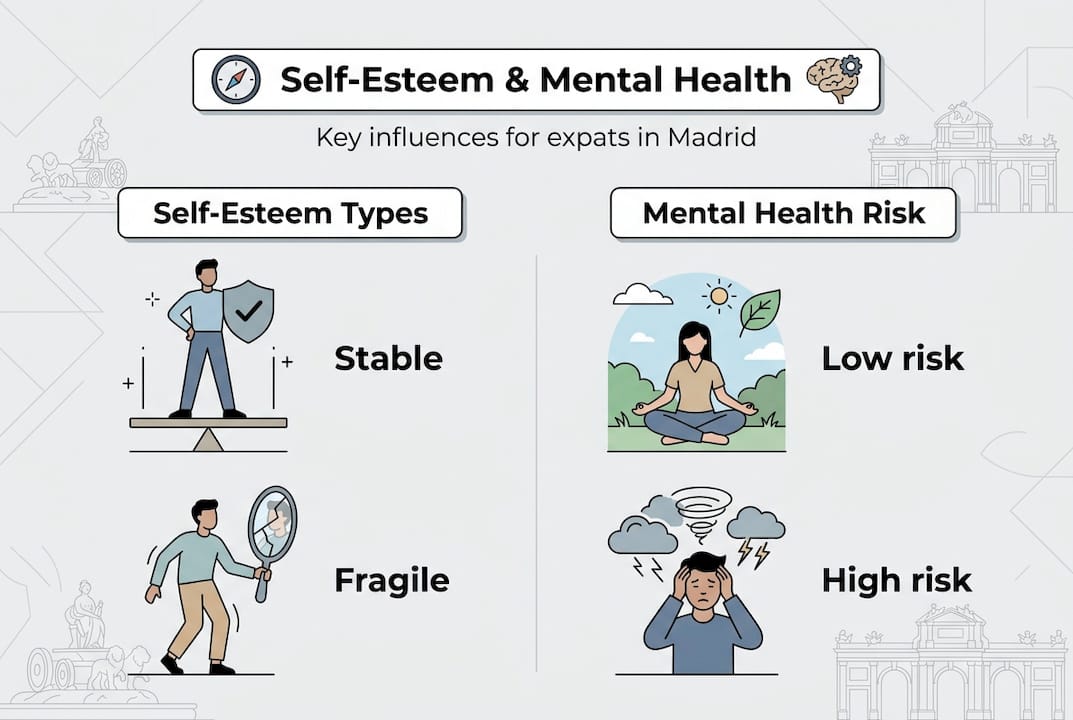
Not all self-esteem is created equal. This is where most popular advice goes wrong. There is a critical difference between stable self-esteem and fragile self-esteem, and understanding it changes everything.
Self-esteem instability predicts poorer mental health outcomes beyond simply having low self-esteem. In other words, someone whose self-worth swings wildly depending on daily events can suffer just as much as someone with chronically low self-esteem, even if they feel great on good days.

Type of self-esteem | How it feels | How it responds to setbacks | Mental health impact |
Stable, earned | Consistent and grounded | Recovers steadily | Protective against anxiety and depression |
Fragile, contingent | High but conditional | Crashes sharply | Increases vulnerability to mood disorders |
Chronically low | Persistently negative | Rarely recovers | Strong predictor of depression |
High self-esteem can be fragile when it depends on external validation, achievements, or other people’s approval. For expats, this is especially dangerous because those external anchors, your job title, your social circle, your sense of belonging, are all in flux.
The goal is not to feel great about yourself every day. The goal is to build a self-worth that does not collapse when Madrid throws something hard at you.
Pro Tip: Stop chasing quick confidence boosts like positive affirmations that feel hollow. Instead, focus on small, consistent actions that align with your values. That is how stable self-esteem is actually built. Working with a therapist through psychotherapy for expat self-esteem or exploring therapy methods for expats can help you identify which approach fits your situation.
“Fragile high self-esteem is not a strength. It is a vulnerability wearing a confident mask.”
How self-esteem issues fuel anxiety and depression
Low or unstable self-esteem does not just make you feel bad. It actively shapes how your brain processes threats, relationships, and failure. Understanding this cycle is the first step to breaking it.
Here is how the cycle typically unfolds for expats:
Negative self-perception forms. You interpret a social misunderstanding or work setback as proof that you do not belong or are not good enough.
Avoidance kicks in. To protect yourself from further pain, you pull back from social events, new opportunities, or honest conversations.
Isolation deepens. Pulling back reduces the positive experiences that could challenge your negative beliefs, reinforcing them instead.
Anxiety and depression follow. The brain, now primed to expect failure or rejection, becomes hypervigilant. Anxiety spikes. Mood drops.
Self-esteem drops further. The emotional fallout confirms the original negative belief, and the cycle tightens.
Expats in Spain are 2 to 3 times more likely to experience mental health issues, and this cycle is a major reason why. The combination of cultural displacement and unstable self-esteem creates a feedback loop that is hard to exit without support.
Research also confirms that low self-esteem prospectively predicts both anxiety and depression, meaning it is not just a symptom but a cause. Traditional esteem-building tactics like repeating “I am enough” rarely interrupt this cycle because they do not address the underlying thought patterns.
Approaches like CBT for expat anxiety and psychotherapy types for expat anxiety are specifically designed to target these thought patterns at their root, not just paper over them.
Proven strategies: Building stable self-esteem as an expat
The good news is that stable self-esteem can be built deliberately. It takes practice, but the tools are clear and the research behind them is solid.
Step-by-step CBT-informed approach:
Identify your core beliefs. Write down the recurring thoughts you have about yourself when things go wrong. These are your core beliefs, and they drive your self-esteem more than any single event.
Challenge the evidence. For each negative belief, ask: what actual evidence supports this? What contradicts it? Most negative core beliefs do not hold up under honest scrutiny.
Behavioral activation. Take small, meaningful actions that align with your values, even when motivation is low. Action builds evidence that challenges negative beliefs far more effectively than thinking alone.
Track your wins. Keep a simple daily log of things you handled well, no matter how small. Over time, this rewires your brain’s default narrative about yourself.
CBT effectively enhances self-esteem through exactly these mechanisms: cognitive restructuring and behavioral activation working together.
Self-compassion is equally important. Self-compassion buffers stress and helps regulate self-esteem, especially during the kind of difficult transitions expats face. Treating yourself with the same kindness you would offer a friend is not weakness. It is a clinically supported skill.
Pro Tip: Once a week, write down three things that are uniquely hard about your expat experience and three ways you have grown because of it. This practice builds honest self-awareness, which is the foundation of stable self-esteem.
Daily habits that support self-acceptance:
Limit social media comparisons, especially expat highlight reels
Spend time with people who know and value the real you
Practice saying no without over-explaining yourself
Acknowledge difficult emotions instead of pushing them away
Celebrate cultural adaptation as a genuine skill, not a given
For structured support, the mental health blog at Heske Therapy offers resources tailored to expat life. You can also explore counseling for expats or find an English-speaking therapist for expats who understands the specific pressures you face.
Beyond self-esteem: Rethinking self-acceptance for lasting mental health
Here is something the self-help industry rarely admits: endlessly chasing high self-esteem can actually make you more fragile, not less. When your mental health depends on always feeling good about yourself, any criticism or failure becomes a threat.
Self-acceptance is a more reliable predictor of well-being than high self-esteem. Self-acceptance means acknowledging your strengths and your struggles without judgment. It does not require you to feel great. It requires you to be honest.
For expats, this shift is particularly powerful. You do not need to love every part of your Madrid experience. You do not need to be thriving every day. You need to be able to hold the full picture of who you are, including the hard parts, without it destroying your sense of worth.
Practices that build genuine self-acceptance:
Journaling without editing. Write honestly about your experience without trying to make it sound positive or negative. Just accurate.
Balanced thinking. When you catch yourself in all-or-nothing thinking (“I am failing at this” or “Everything is fine”), practice finding the middle ground.
Honest self-reflection. Regularly ask yourself what you actually value, not what you think you should value. Living in alignment with your real values is one of the strongest foundations for self-acceptance.
Reducing self-monitoring. Stop constantly evaluating how you are coming across. The mental energy spent on self-monitoring is energy taken away from genuine connection.
“Self-acceptance is not giving up on growth. It is the stable ground from which real growth becomes possible.”
Exploring psychotherapy methods for expats can help you find the right framework for building this kind of grounded, lasting mental health.
Find real support for your self-esteem journey
Understanding the difference between fragile self-esteem and genuine self-acceptance is one thing. Doing the work to shift it is another. That is where professional support makes a real difference, especially when you are navigating expat life in a city like Madrid.
At Heske Therapy, we work specifically with English-speaking expats and internationals in Madrid using approaches that go beyond surface-level confidence building. RTT therapy for rapid transformation targets the deep-rooted beliefs that keep self-esteem unstable, often producing meaningful shifts in just a few sessions. For those ready to commit to lasting change, the 21-day RTT package offers a structured, intensive path forward. You can also start gently with the self-hypnosis for relaxation audio, a practical tool for calming the nervous system and creating space for real self-acceptance. If you are ready to stop cycling through the same patterns, we are here to help.
Frequently asked questions
How can I tell if my self-esteem is fragile or stable?
Stable self-esteem feels consistent even after setbacks, while fragile self-esteem drops sharply when things go wrong or your achievements are criticized. If your sense of worth swings with daily events, that instability itself is a risk factor worth addressing.
Is low self-esteem a sign of mental illness?
Low self-esteem by itself is not a mental illness, but it is a strong predictor for anxiety and depression when left unaddressed. Research shows low self-esteem predicts both conditions over time, making early intervention genuinely worthwhile.
What’s the best therapy for building healthy self-esteem as an expat?
Cognitive Behavioral Therapy (CBT) with a focus on stable self-acceptance is the most evidence-based approach for expats. CBT enhances self-esteem through cognitive restructuring and behavioral activation, targeting the thought patterns that keep self-worth unstable.
Can self-compassion really help with expat stress?
Yes. Self-compassion buffers stress and helps regulate self-esteem, especially for expats navigating difficult transitions. It is not just a feel-good concept but a clinically supported skill that reduces isolation and anxiety.
Recommended
Comments