What Is Anxiety Disorder: Symptoms, Causes, and Treatment
- Heske Ottevanger
- May 23
- 8 min read


TL;DR:
Anxiety disorder is a persistent, overwhelming condition that causes excessive fear beyond normal stress, impairing daily life. It involves biological, psychological, and environmental factors, with effective treatments like CBT, EMDR, and medication. Early professional help improves outcomes, making recognition and intervention crucial for long-term well-being.
Most people feel anxious before a job interview or a difficult conversation. That’s normal. But what is anxiety disorder? It’s something fundamentally different: a persistent, often overwhelming experience of fear or worry that doesn’t match the actual threat and doesn’t go away when the stressor does. Anxiety disorders affect approximately 359 million people worldwide, making them the most common class of psychiatric conditions on the planet. If you’ve been wondering whether what you’re experiencing goes beyond everyday stress, this article will give you the clarity you need.
Table of Contents
Key takeaways
Point | Details |
Not just normal worry | Anxiety disorder involves persistent, excessive fear lasting six or more months with real functional impairment. |
Physical symptoms are real | Racing heart, muscle tension, and digestive issues are genuine physiological responses, not imagination. |
Multiple causes exist | Genetics, trauma, life stress, and even certain medical conditions can all trigger or worsen anxiety disorders. |
Treatment works | CBT, EMDR, RTT, and medication are all evidence-based options with strong track records. |
Early help matters | Catching and treating anxiety disorder early dramatically improves quality of life and long-term prognosis. |
What is anxiety disorder: definition and diagnosis
Anxiety is a natural human response to perceived danger. An anxiety disorder is what happens when that response fires too often, too intensely, and without a proportionate cause. The clinical threshold is specific: DSM-5-TR criteria require excessive fear or worry occurring more days than not for at least six months, causing significant distress or functional impairment in daily life.
That last part matters. Feeling nervous about a presentation at work is not a disorder. Avoiding work entirely because the anxiety feels unmanageable, and suffering daily as a result, is something else entirely.
The most common types of anxiety disorders include:
Generalized Anxiety Disorder (GAD): Persistent, excessive worry about multiple areas of life such as work, health, or relationships, with little ability to control the worry.
Panic Disorder: Recurrent, unexpected panic attacks followed by persistent fear of future attacks or significant behavioral changes related to them.
Social Anxiety Disorder: Intense fear of social situations due to concerns about embarrassment, judgment, or humiliation.
Specific Phobias: Disproportionate fear of a specific object or situation, such as heights, flying, or needles.
Agoraphobia: Fear of situations where escape might be difficult, often leading to avoidance of public spaces or crowded areas.
Pro Tip: If you’re unsure whether your anxiety crosses the clinical threshold, ask yourself one question: Is it stopping you from doing things you want or need to do? If yes, that’s your signal to talk to a professional.
What separates anxiety disorder from normal stress is not just intensity. It’s duration, persistence, and the degree to which it shapes your decisions and limits your life.
Symptoms of anxiety disorders
Understanding what anxiety symptoms look like, both in the mind and in the body, is one of the most useful things you can do for yourself or someone you care about. Many people experiencing an anxiety disorder don’t recognize it as such because the physical symptoms can feel more like a medical problem than a mental one.
Psychological symptoms
The psychological side includes excessive worry that feels impossible to shut off, a constant sense of dread or impending doom, difficulty concentrating, irritability, and an intense need to avoid situations that trigger fear. You might find yourself replaying scenarios obsessively, always bracing for the worst outcome.
Physical symptoms
This is where anxiety disorders often surprise people. Physical symptoms stem from nervous system and hormonal responses, particularly the release of adrenaline and cortisol. When your brain perceives a threat, real or not, it triggers your body’s fight-or-flight response. Common physical signs of anxiety disorder include:
Rapid or pounding heartbeat
Shortness of breath or chest tightness
Muscle tension or trembling
Sweating or chills
Nausea, stomach pain, or diarrhea
Dizziness or feeling lightheaded
Fatigue and sleep disturbances
Headaches
Chronic anxiety keeps cortisol elevated, which explains why long-term anxiety leads to fatigue, headaches, and digestive instability that many people attribute to unrelated physical health problems. In the United States alone, over 19% of adults experience anxiety disorders, yet a significant portion go undiagnosed for years because they are treating symptoms rather than the source.
Symptom patterns vary significantly by disorder type. Panic disorder involves sudden, intense surges of physical symptoms. GAD tends to produce lower-level but constant physical tension. Social anxiety often triggers symptoms specifically in interpersonal contexts. Recognizing these patterns is a key step in understanding what you’re dealing with.

Anxiety disorder causes and risk factors
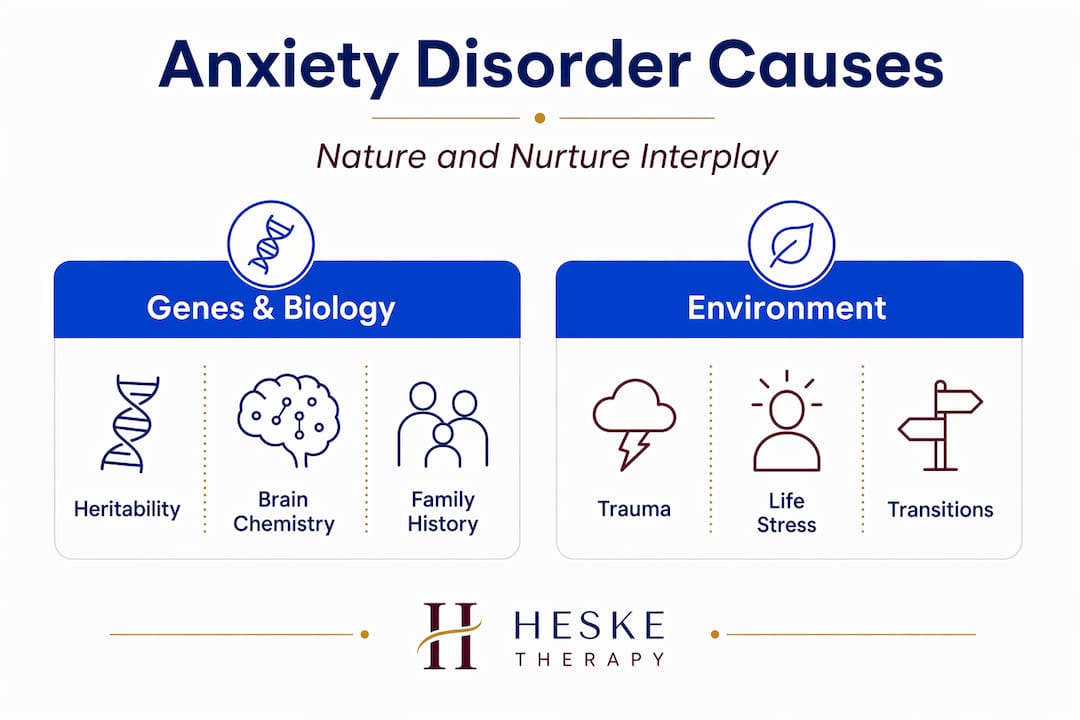
There’s no single cause of anxiety disorders. What the research consistently shows is a combination of factors that interact in complex ways.
Genetics and biology
Anxiety disorders have a moderate heritability of 30 to 50%, meaning genes do play a meaningful role. But genetics are not destiny. Gene-environment interaction is the more accurate picture. You might carry a genetic predisposition, yet never develop a disorder if your environment and experiences don’t activate it.
Life experiences and environment
Traumatic life events, childhood adversity, chronic stress, and major life transitions all increase the risk of developing an anxiety disorder. Expatriates, for example, often face a unique combination of these triggers: cultural displacement, language barriers, social isolation, and professional pressure stacked together at once.
Medical causes that mimic anxiety
This is a point that’s often overlooked and deserves real attention. Certain medical conditions like hypoglycemia and pheochromocytoma can produce anxiety symptoms that are virtually indistinguishable from a psychiatric anxiety disorder. Some medications and substances, including stimulants and even some asthma treatments, have similar effects.
Anxiety disorder | Medical condition mimicking it |
GAD or panic disorder | Hyperthyroidism |
Panic attacks | Pheochromocytoma (adrenal tumor) |
General anxiety symptoms | Hypoglycemia (low blood sugar) |
Sudden anxiety/physical symptoms | Medication side effects (stimulants, corticosteroids) |
This is why a professional evaluation, including medical screening, is not optional. It’s the only reliable way to know what you’re actually dealing with.
Pro Tip: Before concluding that what you’re experiencing is purely psychological, ask your doctor to rule out thyroid dysfunction and blood sugar irregularities. These are commonly missed and straightforward to test for.
How to treat anxiety disorders
The good news about anxiety disorder treatment is that it works. Multiple evidence-based treatments exist and are effective across a range of severity levels and disorder types. The key is matching the approach to the individual.
Behavioral and psychological treatments
Cognitive Behavioral Therapy (CBT): CBT is the most studied and most consistently effective psychological treatment for anxiety disorders. It works by identifying distorted thought patterns and changing the behaviors that reinforce anxiety. You can learn more about CBT techniques for anxiety and how they apply in practice.
Exposure therapy: A specific application often used within CBT, this involves gradual, controlled exposure to feared situations to reduce avoidance and desensitize the fear response over time.
EMDR (Eye Movement Desensitization and Reprocessing): Particularly effective for anxiety rooted in trauma, EMDR helps reprocess distressing memories so they lose their emotional charge.
Rapid Transformational Therapy (RTT): An integrative approach combining hypnotherapy and CBT principles, RTT targets the subconscious beliefs driving anxiety patterns.
Mindfulness-based therapies: Approaches like Mindfulness-Based Stress Reduction (MBSR) reduce the reactivity of the threat-detection system over time with consistent practice.
Medications
SSRIs (Selective Serotonin Reuptake Inhibitors): First-line pharmacological treatment, with options like sertraline and escitalopram commonly prescribed.
SNRIs (Serotonin-Norepinephrine Reuptake Inhibitors): Effective for both anxiety and co-occurring depression.
Benzodiazepines: Sometimes used short-term for acute symptoms, but generally not recommended for long-term use due to dependency risk.
Shared decision-making between patient and clinician significantly improves outcomes. When you’re involved in choosing your treatment based on your preferences, history, and concerns, you’re more likely to stay engaged and follow through.
Lifestyle factors also matter: regular physical activity, consistent sleep, reduced caffeine intake, and social connection all support recovery. These aren’t replacements for treatment. They’re accelerators.
When to seek help for anxiety
Knowing the difference between regular anxiety and an anxiety disorder isn’t always obvious in the moment. Here’s what to look for as signals that it’s time to talk to a professional:
Your worry or fear feels disproportionate to the actual situation
Symptoms have persisted for six weeks or longer
You’ve started avoiding places, people, or activities because of anxiety
Anxiety is affecting your work, relationships, or daily functioning in noticeable ways
Physical symptoms have no clear medical explanation
You’ve tried self-help strategies and the anxiety hasn’t improved
Many people wait years before seeking help, often because they normalize the symptoms or feel embarrassed. But anxiety disorders respond well to treatment, especially when addressed early. The prognosis with proper care is genuinely positive. You can learn practical rapid relief methods for anxiety as a starting point, but professional evaluation is the most important step you can take.
When talking to a healthcare provider, be specific. Describe how long symptoms have been present, what triggers them, and how they affect your daily life. That information helps clinicians make an accurate diagnosis rather than treating surface-level symptoms.
My perspective on recognizing and treating anxiety
I’ve worked with enough clients to say this with confidence: the people who struggle the most with anxiety aren’t always the ones with the most severe symptoms. They’re often the ones who’ve spent years convincing themselves that what they feel is just who they are.
That’s the part no one tells you. Anxiety disorders are extraordinarily good at disguising themselves as personality traits. “I’m just a worrier.” “I’ve always been sensitive.” “I don’t like crowds.” Those statements can be true, and they can also be symptoms. The line matters.
What I’ve seen consistently is that the moment someone names what they’re experiencing as a disorder rather than a character flaw, something shifts. Not magically. But meaningfully. There’s suddenly something to address rather than something to endure.
Treatment surprises people, too. They expect it to be slow, uncomfortable, and uncertain. And sometimes it is. But many clients, especially those using integrative approaches that work at the level of the subconscious, experience real change faster than they thought possible. The brain is more flexible than anxiety wants you to believe.
If you’re reading this and recognizing yourself in these descriptions, that recognition is worth something. Don’t wait until it gets worse. Help is available, and it’s more effective than the stigma around mental health would have you think.
— Heske
Ready to address your anxiety with real support?
If you’ve recognized signs of an anxiety disorder in yourself while reading this, the next step is getting support that’s actually tailored to you.
At Hesketherapy, we specialize in treating anxiety through integrative, evidence-based approaches including EMDR, clinical hypnotherapy, RTT, and CBT. We work with English-speaking clients in Madrid and online, offering personalized treatment plans designed to produce lasting results. Whether you’re dealing with generalized anxiety, panic attacks, or anxiety rooted in past trauma, there’s a path forward. Explore our EMDR and hypnotherapy services or discover how Rapid Transformational Therapy can help you shift the patterns driving your anxiety. Book a free discovery call and find out what’s possible for you.
FAQ
What is an anxiety disorder, exactly?
An anxiety disorder is a clinical condition involving persistent, excessive fear or worry lasting at least six months, causing significant distress or impairment in daily functioning. It goes well beyond normal situational anxiety.
What are common symptoms of anxiety disorders?
Symptoms include excessive worry, restlessness, irritability, difficulty concentrating, rapid heartbeat, muscle tension, sleep problems, and digestive issues. Physical and psychological symptoms often appear together.
What causes anxiety disorders?
Anxiety disorders result from a mix of genetic predisposition (heritability of 30 to 50%), traumatic or stressful life experiences, and sometimes underlying medical conditions or medications that trigger anxiety-like symptoms.
How are anxiety disorders treated?
CBT is the primary evidence-based behavioral treatment, while SSRIs and SNRIs are first-line medications. Integrative approaches including EMDR, RTT, and hypnotherapy are also effective, particularly for anxiety linked to trauma or deep-rooted beliefs.
When should you see a doctor about anxiety?
If anxiety symptoms have lasted more than six weeks, are affecting your work or relationships, or feel disproportionate to actual circumstances, it’s time to seek a professional evaluation. Early intervention consistently leads to better outcomes.
Recommended
Comments